Virology
Ebola's 100-Day Test: The Bundibugyo Vaccine Sprint
The Bundibugyo Ebola outbreak is now the largest in DRC history. With no licensed vaccine, three candidates have reached human trials in weeks — a real-world stress test of the 100 Days Mission, AI-assisted drug discovery and outbreak modelling.

Twelve weeks ago, most virologists could have gone an entire career without thinking about Bundibugyo virus: two small outbreaks on record, no licensed vaccine, no approved treatment, not even a field diagnostic that reliably detects it. Today it is driving the largest Ebola outbreak the Democratic Republic of the Congo has ever recorded, and the second-largest the world has seen.[1][2]
As of 4 August, the DRC had reported 3,973 confirmed cases and 1,801 deaths, with 51 of 140 health zones affected across five provinces.[2] Uganda, which caught imported cases early, declared its own outbreak over on 28 July, proof that containment is possible even against this virus.[1][2] But on the Congolese side of the border, transmission is still accelerating, and WHO's Emergency Committee reconvenes on 18 August.[1]
What makes this moment remarkable (and the reason it leads today's briefing) is the countermeasure sprint running in parallel. Nineteen years after Bundibugyo virus was first named, vaccines against it are already in human trials, a treatment trial is enrolling patients inside the outbreak zone, and machine-learning tools are nominating antiviral candidates. The pandemic-preparedness machinery rebuilt since COVID-19 around an ambition called the 100 Days Mission is getting its first real stress test against a filovirus.
Executive summary#
The 2026 Bundibugyo Ebola outbreak, declared a Public Health Emergency of International Concern on 17 May, is now the largest in the DRC's history, with nearly 4,000 confirmed cases and a crude case-fatality ratio around 44 per cent.[1][2] No licensed vaccine or specific treatment exists for this viral species. In response, an unusually fast research mobilisation is under way: Oxford's ChAdOx1 BDBV vaccine dosed its first volunteer in late July, roughly 620,000 doses are stockpiled, and mRNA and rVSV candidates are advancing behind it.[3][4][5] The WHO-sponsored PARTNERS platform trial is simultaneously testing two antiviral therapies in outbreak treatment centres.[6] Computational modelling, rapid genomic surveillance and AI-driven drug screening are shaping decisions in near real time. Whether this machinery can outrun a filovirus in a conflict zone is the defining preparedness question of 2026.
What happened?#
The immediate news is a convergence of grim epidemiology and genuine scientific firsts.
On 1 August, WHO's Disease Outbreak News confirmed the outbreak had overtaken every previous Ebola event in the DRC: 3,605 confirmed cases and 1,587 deaths as of 30 July, with epidemiological week 30 setting records of 567 cases and 296 deaths in seven days.[1] Four days later, ECDC's update pushed the tally to 3,973 confirmed cases and 1,801 deaths, with 674 patients in isolation.[2]
Against that backdrop, three vaccine candidates have reached or are approaching first-in-human studies at a pace without precedent for this virus:
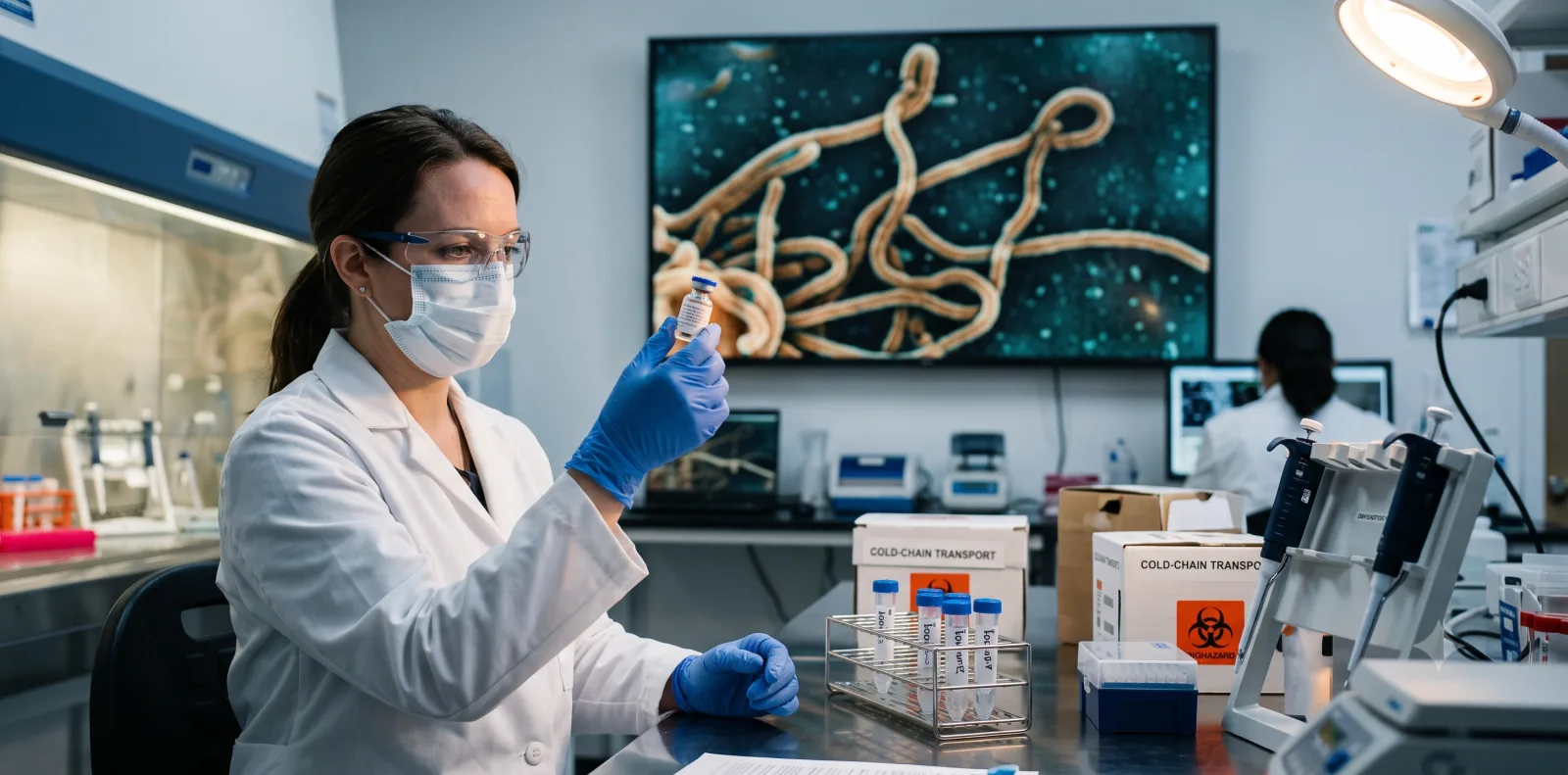
- ChAdOx1 BDBV (Oxford). The first volunteer was vaccinated in late July in a Phase 1 trial of 50 healthy adults aged 18–55, run by the Oxford Vaccine Group with CEPI funding.[3][4] The Serum Institute of India has already stockpiled roughly 620,000 doses for larger studies and possible rapid deployment.[4]
- Moderna's mRNA candidate. CEPI lists Moderna's Bundibugyo vaccine as having entered a first-in-human trial with its backing: the second platform in the clinic.[5]
- rVSV candidate. CEPI announced on 30 July that Singapore's Hilleman Laboratories will produce clinical-trial doses of a recombinant vesicular stomatitis virus vaccine (the same platform family as the licensed Ervebo shot), with MSD providing manufacturing expertise.[7]
On the treatment side, the WHO-sponsored PARTNERS trial (Platform Adaptive Randomised Trial for New and Repurposed Filovirus TreatmentS) began enrolling patients in Bunia on 2 July, the first treatment trial ever conducted for this disease.[6] Coordinated by the DRC's Institut National de Recherche Biomédicale (INRB), the Institute of Tropical Medicine in Antwerp and the University of Oxford, it randomises patients to standard care alone or with the antibody cocktail MBP134, remdesivir, or both, with 28-day mortality as the endpoint and a target of 700–1,000 participants.[6][8] A companion trial of the oral antiviral obeldesivir as post-exposure prophylaxis opened in Ituri in mid-July.[8]
Background: why Bundibugyo was a blind spot#
Ebola disease is caused by several distinct species of orthoebolavirus. Almost everything the world owns to fight it (the Ervebo and Zabdeno/Mvabea vaccines, the antibody therapies Inmazeb and Ebanga) targets the Zaire species responsible for the 2014–16 West African epidemic.[9] Bundibugyo virus, first identified in a 2007 outbreak in western Uganda and seen once more in the DRC in 2012, caused too few cases to build a commercial case for countermeasures; both historical outbreaks ended with fewer than 150 confirmed infections.[9][10]
That neglect had concrete consequences this spring. Because confirming Bundibugyo requires specialist laboratory testing (existing rapid diagnostics are built for Zaire), the virus circulated undetected for weeks, possibly months, before the INRB confirmed it in May.[10][11] CDC modelling later inferred that the spillover most likely occurred in February 2026: the response began against an outbreak with a long head start.[12]
The machinery activated since then reflects lessons bought painfully in 2014 and 2020. CEPI invested more than US$60 million across three vaccine platforms within two weeks of the PHEIC declaration.[13][5] Congolese researchers at INRB, supported by the ARTIC 2.0 sequencing network, shared complete viral genomes openly within days of confirmation, giving vaccine designers worldwide their target almost immediately.[11] WHO's immunization advisory group met in late May, favouring a single-dose strategy for contacts of cases and two doses for high-risk unexposed groups such as frontline health workers.[8]
Why this matters#
For pandemic preparedness, this is the first live examination of the 100 Days Mission: CEPI's goal of having vaccines ready within 100 days of a new threat being identified.[13] Bundibugyo was no true Disease X: the virus was known, and designs could draw on filovirus vaccine libraries built in peacetime. Even so, moving from declaration to first-in-human dosing in about ten weeks, with hundreds of thousands of doses pre-manufactured at risk, genuinely compresses a timeline that took years in 2014–16.[4][13]
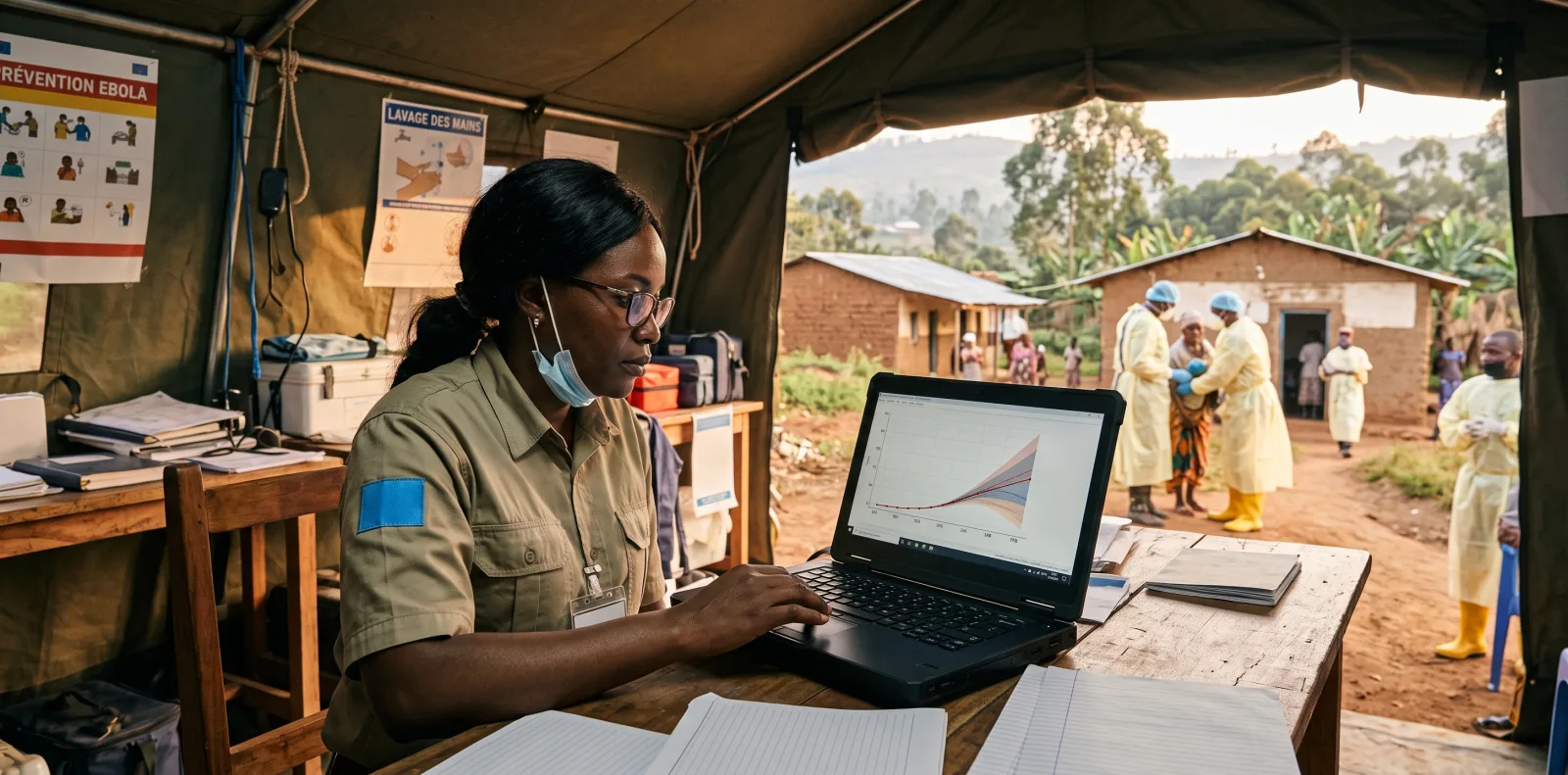
For AI and computational biology, the outbreak is a working demonstration rather than a demo. Southwest Research Institute used its Rhodium machine-learning docking software to nominate nearly two dozen candidate antivirals against Bundibugyo, with partners at Texas Biomedical Research Institute positioned to test the most promising against live virus in a BSL-4 facility.[14] Separately, the CDC's modelled scenario projections quantified how sharply outcomes depend on isolation rates: with only 20 per cent of infectious people isolated, 65 per cent of simulations projected at least 20,000 cases; at 70 per cent isolation, most simulations kept the outbreak below 10,000.[12] Numbers like these convert an abstract operations target into a measurable one.
For virology and medicine, the trials matter beyond this outbreak. MBP134 is a pan-ebolavirus antibody cocktail that protected non-human primates against lethal Zaire, Sudan and Bundibugyo challenge; success would move the field towards species-agnostic Ebola therapy.[8] A successful vaccine would also close the last major gap in the Ebola portfolio, validating the strategy of preparing countermeasures across whole viral families rather than one species at a time.[15]
Critical analysis#
The speed is real, but so are the caveats, and they deserve equal weight.
First, none of these tools will help most patients in the current wave. Phase 1 trials answer safety questions in 50 healthy volunteers in Oxford, not efficacy questions in Ituri. Efficacy trials and any ring-vaccination deployment are months away, so Africa CDC's target of a vaccine "by the end of 2026" should be read as aspirational, and WHO insists experimental products belong inside trials.[3][16]
Second, the operational environment is degrading faster than the science is advancing. Only about 75 per cent of identified contacts are under follow-up, below the threshold models associate with control.[2][12] At least 119 health workers have been infected, treatment centres have been attacked, and staff at one Ituri facility walked out this month over unpaid bonuses.[1][3] A vaccine stockpile in Pune cannot compensate for an empty isolation ward in Mongbwalu.
Third, the AI contributions are real but upstream. Rhodium's nominated compounds are computational hits, not validated drugs; the base rate from virtual screen to approved antiviral is brutal. AI has shortened the shortlisting step from months to days, but the wet-lab bottleneck that follows is untouched.[14]
Finally, the models carry wide error bars. The CDC projections rest on assumptions about under-reporting and intervention timing in a conflict zone where even confirmed counts lag reality.[1][12] Imperial College London's early estimate that true infections were triple the reported figure proved directionally right, but precision was never on offer.[17]
Expert perspective#
Set against previous milestones, the 2026 response occupies new territory. In 2014, the world took roughly ten months to move the rVSV-ZEBOV vaccine from shelf to the Guinean ring-vaccination trial that proved its worth. In the 2018–20 Kivu outbreak, vaccination began within months, but against a virus with a far more mature pipeline. Here, three platform technologies are racing in parallel against a species that had no pipeline at all in April.[4][5][7] CEPI's deputy CEO, Aurélia Nguyen, frames it soberly: not a vindication of the 100 Days Mission, but "a real-world stress test of it": proof that speed in an emergency depends on preparation before the emergency.[13]
The competing approaches tell a strategic story. Oxford's ChAdOx1 platform prioritises manufacturability at scale and cost, hence the Serum Institute stockpile.[4] Moderna's mRNA candidate trades manufacturing head start for design agility; the rVSV route leans on the deepest field precedent in Ebola vaccinology.[7] Running all three is not redundancy but portfolio logic under uncertainty: the same logic the field now applies to Disease X.
Key takeaways#
- The 2026 Bundibugyo outbreak is the largest Ebola event in DRC history: 3,973 confirmed cases and 1,801 deaths as of 4 August, and it is still accelerating, with a WHO Emergency Committee review set for 18 August.[1][2]
- Three vaccine platforms reached human trials within ~10 weeks of the PHEIC declaration, and roughly 620,000 doses of the Oxford candidate are already manufactured: a historic compression of vaccine timelines.[3][4][5]
- The PARTNERS adaptive platform trial is testing MBP134 and remdesivir inside the outbreak, the first treatment trial ever run for this virus, designed to deliver answers in months rather than years.[6]
- Computation is now response infrastructure: CDC models are steering operational targets, rapid sequencing gave designers their target within days, and AI screening has nominated antiviral candidates, all still upstream of wet-lab and clinical validation.[12][11][14]
- The binding constraint is operational, not scientific: contact tracing, health-worker safety, security and financing will decide whether the new tools matter in this outbreak or only the next.[1][8]
Frequently asked questions#
Is there a vaccine for Bundibugyo Ebola? Not yet licensed. Three candidates (Oxford's ChAdOx1 BDBV, Moderna's mRNA vaccine and an rVSV-based vaccine) are in or entering early human trials as of August 2026.[3][5][7]
Why doesn't the existing Ebola vaccine (Ervebo) work? Licensed vaccines target the Zaire species; Bundibugyo is genetically distinct, and evidence suggests Zaire-specific shots may not adequately cross-protect.[9][10] A study is nonetheless being prepared to test whether Ervebo offers partial interim protection.[4]
Should people outside Africa be worried? WHO and ECDC assess the global risk as low. Ebola spreads through direct contact with the bodily fluids of symptomatic people, not through the air; imported cases in France and Germany were contained without secondary transmission.[1][18]
What is the PARTNERS trial testing? Whether the antibody cocktail MBP134, the antiviral remdesivir, or both improve 28-day survival versus optimised standard care. Everyone enrolled receives supportive care.[6][8]
What role is AI actually playing? Narrow but useful ones: machine-learning virtual screening to shortlist antiviral compounds, and modelling to project trajectories under different intervention scenarios. Neither replaces laboratory or clinical validation.[12][14]
What is the 100 Days Mission? CEPI's goal of developing safe, effective, accessible vaccines within 100 days of identifying a new pandemic threat. The Bundibugyo response is its first major real-world stress test: fast, but not yet 100 days, because the mission is not yet operational for every threat.[13]
When could a vaccine reach affected communities? No date is certain. Efficacy trials and deployment depend on Phase 1 results, regulators and security conditions. Africa CDC aims for availability by end-2026; WHO counsels that experimental products be used only within trials for now.[16]
References#
[1]: World Health Organization. "Ebola disease caused by Bundibugyo virus — Democratic Republic of the Congo." Disease Outbreak News, 1 August 2026. https://www.who.int/emergencies/disease-outbreak-news/item/2026-DON614
[2]: European Centre for Disease Prevention and Control. "Ebola disease outbreak in the Democratic Republic of the Congo and Uganda." Updated 5 August 2026. https://www.ecdc.europa.eu/en/ebola-outbreak-democratic-republic-congo-and-uganda
[3]: CIDRAP. "First volunteer vaccinated in Ebola vaccine trial." 27 July 2026. https://www.cidrap.umn.edu/ebola/first-volunteer-vaccinated-ebola-vaccine-trial
[4]: Gavi, the Vaccine Alliance. "The world's first Bundibugyo Ebola vaccine has entered human trials: here's why it matters." 23 July 2026. https://www.gavi.org/vaccineswork/worlds-first-bundibugyo-ebola-vaccine-has-entered-human-trials-heres-why-it-matters
[5]: Coalition for Epidemic Preparedness Innovations. "Ebola Bundibugyo." Accessed 6 August 2026. https://cepi.net/ebola-bundibugyo
[6]: World Health Organization. "Patient enrolment begins in a scientific trial to identify the first effective treatments for Bundibugyo virus disease." 2 July 2026. https://www.who.int/news/item/02-07-2026-patient-enrolment-begins-in-a-scientific-trial-to-identify-the-first-effective-treatments-for-bundibugyo-virus-disease
[7]: CEPI. "Hilleman Laboratories to develop and produce CEPI-backed Bundibugyo ebolavirus vaccine doses for clinical trials." 30 July 2026. https://cepi.net/hilleman-laboratories-develop-and-produce-cepi-backed-bundibugyo-ebolavirus-vaccine-doses-clinical
[8]: Infection Control Today. "Bundibugyo Ebola Explained: Why Existing Vaccines Don't Work and What Comes Next." 28 July 2026. https://www.infectioncontroltoday.com/view/bundibugyo-ebola-explained-why-existing-vaccines-don-t-work-what-comes-next
[9]: Bhadelia, N. "Bundibugyo virus outbreak: when a concerning pathogen meets a humanitarian emergency." Nature Reviews Microbiology, 19 June 2026. https://www.nature.com/articles/s41579-026-01332-9
[10]: Wellcome. "The 2026 Bundibugyo Ebola outbreak: why R&D investment matters." 19 June 2026. https://wellcome.org/insights/articles/2026-bundibugyo-ebola-outbreak-why-rd-investment-matters
[11]: Wellcome. "How Wellcome and partners are supporting the Ebola response" (ibid.); INRB/ARTIC 2.0 sequencing effort. https://wellcome.org/insights/articles/2026-bundibugyo-ebola-outbreak-why-rd-investment-matters
[12]: Mooring, E.Q. et al. "Modeled Scenario Projections for the Ebola Disease Outbreak Caused by Bundibugyo Virus, 2026." MMWR 75(22): 285–289, 11 June 2026. https://www.cdc.gov/mmwr/volumes/75/wr/mm7522e1.htm
[13]: CEPI. "Bundibugyo and the 100 Days Mission: Preparedness, Readiness and Response." 8 July 2026. https://cepi.net/bundibugyo-and-100-days-mission-preparedness-readiness-and-response
[14]: News-Medical. "New AI tools identify potential drugs for rare Ebola virus." 26 May 2026. https://www.news-medical.net/news/20260526/New-AI-tools-identify-potential-drugs-for-rare-Ebola-virus.aspx
[15]: CEPI. "Filoviruses." https://cepi.net/priority-pathogens/filoviruses
[16]: TRT Afrika. "Africa CDC aims for Ebola vaccine by end of 2026 as deadly Bundibugyo outbreak spreads." 28 May 2026. https://www.trtafrika.com/english/article/066374734e7d
[17]: Callaway, E., Lenharo, M. & Wolf, L. "Ebola outbreak: the data that show why researchers are so alarmed." Nature news explainer, 21 May 2026. https://www.nature.com/articles/d41586-026-01646-x
[18]: European Commission. "Ebola virus outbreak 2026." Updated 31 July 2026. https://health.ec.europa.eu/health-security-and-infectious-diseases/crisis-management/ebola-virus-outbreak-2026_en