AI
Pharma's Locked Structures Just Trained an AI
Five pharmaceutical companies fine-tuned OpenFold3 on 20,167 private protein–ligand structures without pooling the data. Protein–ligand accuracy jumped from 35.6% to 52.1%. Here is what that means for drug discovery, antiviral design and pandemic preparedness.
For a decade, everyone working on computational drug discovery has told a version of the same story over a beer at a conference. The public structural record is thin in exactly the places that matter. The Protein Data Bank holds more than 260,000 experimental and integrative structures (RCSB PDB, 2026), yet by Nature's reckoning only around 10,000 capture a protein bound to something that looks like a drug (Callaway, 2026). The dense medicinal-chemistry series, forty analogues walked around a single binding pocket, each one crystallised, each one measured, sit inside pharmaceutical companies, behind legal walls that have never come down.
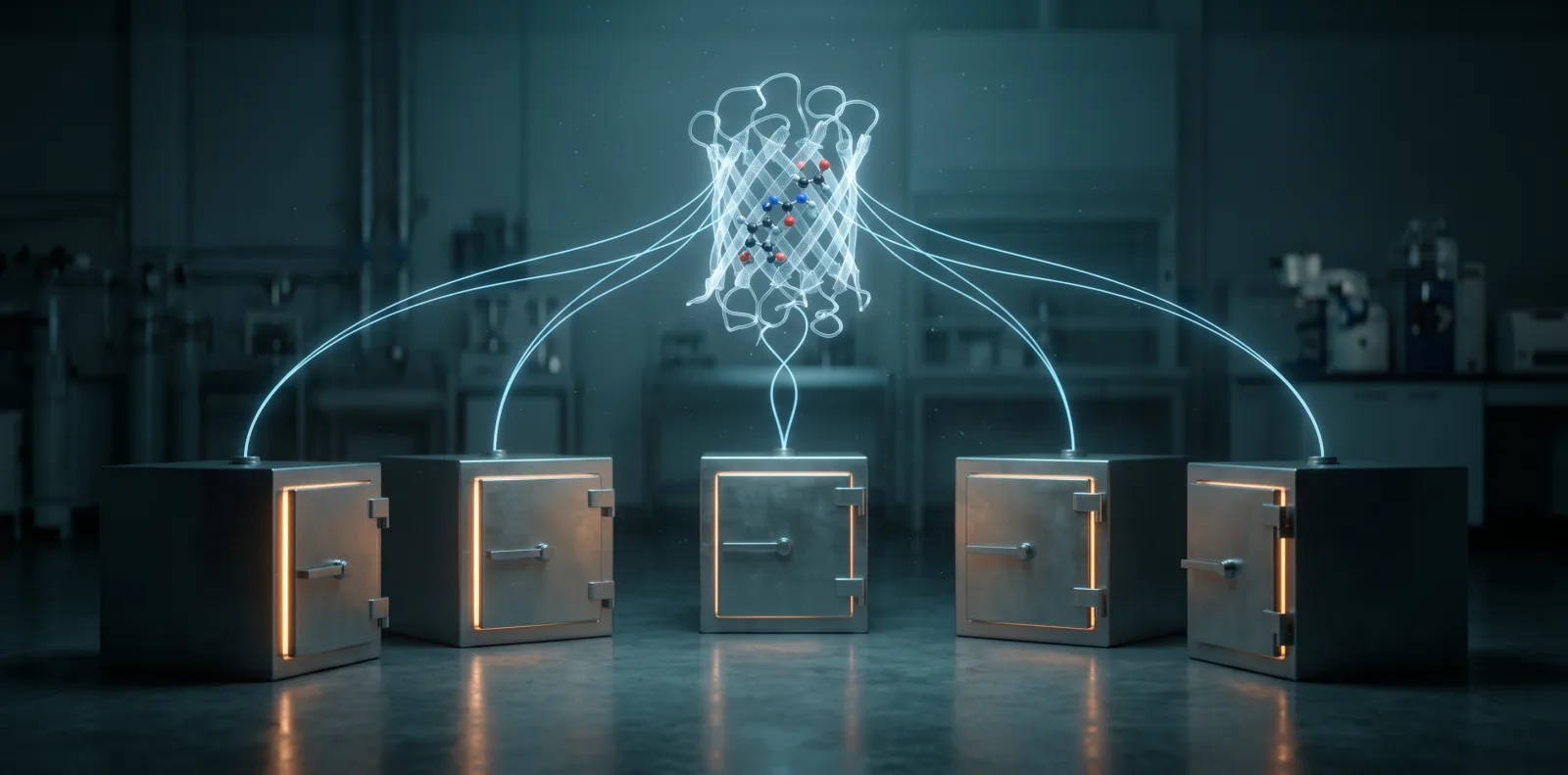
On 14 September 2026, a consortium calling itself the AI Structural Biology (AISB) Network reported that it had trained a model on that hidden data without anyone handing it over (Javer et al., Apheris, 2026). Five companies, AbbVie, Astex Pharmaceuticals, Bristol Myers Squibb, Johnson & Johnson and Takeda, fine-tuned the open-source OpenFold3 model across 20,167 proprietary protein–ligand structures. The structures stayed put. Only model weights moved.
The accuracy numbers are the part worth sitting with. On 1,056 held-out structures, the proportion predicted to a high-confidence protein–ligand interface threshold rose from 35.6% to 52.1%. That is not a tuning gain. That is a different model.
The AISB Network's flagship project is a federated fine-tune of OpenFold3 Preview 2, the open replication of AlphaFold 3 maintained by the OpenFold Consortium (OpenFold, 2026). Federation here means what it means in machine learning generally: each partner trains locally on data it never transmits, sends parameter updates to a central aggregator, and receives an updated global model back. Apheris ran the orchestration layer, with compute and federated-learning infrastructure from NVIDIA and AWS. Public PDB data up to a 19 November 2025 cutoff was mixed into training to keep the model from over-fitting to any single company's chemistry.
The resulting model, AISB-1-Fed, was evaluated on 1,056 structures held out at the target and project level inside each partner, a 95/5 split, made before training started. Twenty-five predictions were generated per structure (five diffusion samples across five seeds), with the best selected by the model's own confidence score. Two metrics carried the result:
- Protein–ligand interface lDDT ≥ 0.8: 35.6% for the OpenFold3 Preview 2 baseline, 52.1% for AISB-1-Fed. A 16.5-point absolute gain, 46% relative.
- Ligand bisymmetry-corrected RMSD ≤ 2 Å: 28.9% baseline, 46.8% for AISB-1-Fed. A 17.9-point gain, 62% relative.
Against Boltz-2, the strongest public reference model tested (Passaro et al., bioRxiv, 2025 preprint, not peer reviewed), AISB-1-Fed held roughly an 11-point advantage on interface lDDT and 10.3 points on ligand RMSD. Bootstrapped 95% confidence intervals over 500 replicates did not overlap with any reference model on either metric.
An unplanned result turned up too. On a 443-structure subset scored for protein–protein interface accuracy, AISB-1-Fed hit 62.6% against 38.8–40.9% for the public baselines, despite the team not optimising for protein–protein interfaces at all.
The control that matters most is the quietest one. The team also trained a public-only model, AISB-1-OF3p2-all-PDB, on an expanded PDB with no private structures. It underperformed. That isolates the contribution of the proprietary data rather than the extra training compute.
Background: Why Co-Folding Has Been Stuck#
AlphaFold 2 solved the protein-folding problem in the narrow sense, given a sequence, predict the fold. AlphaFold 3 (Abramson et al., Nature, 2024) extended that to biomolecular complexes, including proteins bound to small molecules, a task the field calls co-folding. Predicting where a drug candidate sits in a pocket, and in what conformation, is the single most useful thing a structural model can do for a discovery programme.
Co-folding is data-starved in a way that plain folding never was. Sequence databases are enormous; crystal structures of a protein with a drug-like ligand bound are not, and those that exist are skewed towards what academics found interesting and what companies chose to publish. As AbbVie's John Karanicolas put it to Nature, "the data that's missing from the PDB is exactly the data that's present in our internal data" (Callaway, 2026).
That is why the AISB result is more than a leaderboard bump. It tests where the ceiling on co-folding accuracy actually sits. If the ceiling were architectural, more data would not move it much. It moved a lot.
The open-model context matters too. AlphaFold 3 was published without accompanying code, prompting a community race to build accessible replications (Nature, 2024). OpenFold3 is the result, descended from the OpenFold retraining of AlphaFold 2 (Ahdritz et al., Nature Methods, 2024) and released in March 2026 with weights, code and datasets under permissive licences. That the experiment ran on an open base model is not incidental it is what made a five-company collaboration tractable at all.
Why This Matters for Virology and Pandemic Preparedness#
The direct beneficiaries are whichever therapeutic areas the five partners work in; no target-class breakdown has been published, so any guess about that is inference, not fact. The interesting question for this readership is whether antiviral discovery benefits too and the argument for it is structural rather than commercial.
Structure-based design produced the clearest antiviral wins of the past decade. Nirmatrelvir, the active component of Paxlovid, was designed against the SARS-CoV-2 main protease through exactly this crystallography-plus-chemistry loop (Owen et al., Science, 2021). The loop is slow each turn needs a new complex crystallised and it is the rate-limiting step between a newly sequenced pathogen and a candidate molecule.
CEPI's 100 Days Mission sets a three-month target from threat identification to a deployable countermeasure (CEPI, 2026). Vaccines have a platform answer to that clock; small-molecule antivirals largely do not. A co-folding model reliable on novel pockets would replace some fraction of those crystallography turns with predictions.
Here is the catch, and it is a real one: viral proteases, polymerases and entry proteins are almost certainly under-represented in a training set assembled from five large pharmaceutical companies' internal discovery programmes. The AISB team has not published a target-class breakdown, noting only that finer analyses "by target class such as GPCRs or kinases" exist but are available to participants alone. Whether the gains generalise to a coronavirus 3CL protease or a paramyxovirus polymerase is, at present, unknown.
Which makes a parallel effort worth flagging. OpenBind, a UK consortium hosted at Diamond Light Source and supported by up to £8 million in UK government funding (Callaway, 2026) and, since August 2026, by the Gates Foundation, is generating open protein–ligand structures at scale through automated chemistry and high-throughput crystallography (OpenBind, 2026). Its first public release, in May 2026, was a structure–affinity dataset for the enterovirus A71 2A protease a viral target, released openly, with affinity and kinetics data attached. Two approaches to the same bottleneck are running simultaneously: unlock what already exists behind firewalls, or generate new data in the open. They are complementary, and for pandemic preparedness the second is likelier to cover the pathogens nobody has a commercial programme against.
Critical Analysis#
The strengths are methodological, not just numerical. The public-only control is the right experiment, and it was run. The target-and-project-level split was fixed before training, not chosen afterwards. Confidence intervals were bootstrapped. Twenty-five predictions per structure selected by native confidence reflects how these models are actually used rather than a best-of-N inflation. The privacy assessment went beyond assertion: reconstruction and membership-inference attacks were run under attacker-favourable conditions, returning true-positive rates of 0.05–0.32 at zero false-positive rate and a successful membership inference confirms only that an attacker already held a compound's exact structure, leaking no binding data, assay results or structure–activity context.
The limitations are serious, and the team states most of them. The evaluation set comes from the same five partners that supplied the training data. Target-level splitting reduces leakage but cannot eliminate chemotype similarity across partners, and federation makes cross-partner similarity hard to measure because the structures stay private. This is partner-held-out validation, not external validation. The authors say so: the result "should be read as evidence that federated fine-tuning improved performance on the participating partners' own held-out private structures. It is not a universal claim about all protein–ligand co-folding tasks."
Three further constraints matter. This is a company technical report, not a refereed paper, though Nature confirms a submission is planned (Callaway, 2026). The weights and structures remain private, so nothing here is reproducible by an outside group or usable by an academic lab or public-health agency, the community gets the finding, not the artefact. And the model predicts structure, not affinity: it says where a molecule binds, not how tightly.
The competing interpretation deserves airtime. A sceptic would say a model fine-tuned on five companies' chemistry and tested on the same five companies' chemistry has learned those series, not general protein–ligand physics. The public-only control weakens that reading without killing it, since both models were scored on the same partner-derived set. The comparison establishes that private data helps on private-style targets commercially the useful claim, scientifically the narrower one. Independent evaluation on PoseBusters or CASP-style blind targets would settle it, and has not been published.
Timeline for impact. Inside the five companies, now; that was the point. For everyone else it depends on peer review, a broader federation, or a policy shift on releasing derived weights. The more consequential near-term effect may be demonstrative: if federated training works at this scale on this data, the case for staying out of such consortia just got weaker.
Expert Perspective: How This Compares#
Federated learning across pharmaceutical companies is not new. MELLODDY, an Innovative Medicines Initiative project, ran federated training across ten EFPIA companies on more than a billion drug-development data points covering over 10 million molecules (IHI, 2026). MELLODDY proved the governance model was possible. What it federated, though, was bioactivity data for quantitative structure–activity models, tabular assay readouts.
AISB-1-Fed federates three-dimensional structures into a diffusion-based generative model, harder in both directions. Structures are richer and more identifying than assay tables, raising the privacy stakes; the downstream artefact is a foundation model rather than a per-target classifier, raising the technical ones. Columbia's Mohammed AlQuraishi, whose lab co-led the work and originated OpenFold, put the finding plainly to Nature: "You add all this data, and you get a pretty big bump in performance."
Each rival approach embeds a different theory of the bottleneck. Closed commercial efforts assume proprietary scale under one roof is the answer. Boltz-2 assumes architecture and joint affinity modelling can substitute for data volume and it remains the strongest public model here. OpenBind assumes the missing data should be manufactured in the open. AISB assumes the data already exists and the problem is access.
On this evidence, AISB's assumption looks the most immediately productive and the least publicly useful, since the product stays private. That tension is the honest summary of the day.
Key Takeaways#
- Federated fine-tuning on 20,167 private pharmaceutical structures lifted OpenFold3's protein–ligand interface accuracy from 35.6% to 52.1%, a 46% relative gain, beating every public model tested, including Boltz-2.
- A public-data-only control model underperformed, isolating the proprietary structures not extra compute as the source of the improvement.
- No structures were pooled. Only model parameters moved, and empirical reconstruction and membership-inference attacks found no meaningful leakage under attacker-favourable conditions.
- The result is unrefereed and the model is private. This is partner-held-out validation, not external validation, and neither weights nor data are available outside the consortium.
- Antiviral relevance is plausible but unproven. Viral targets are likely thin in pharmaceutical discovery archives; open efforts such as OpenBind, whose first release covered the enterovirus A71 2A protease, address a gap federation alone probably will not close.
Frequently Asked Questions#
What is "co-folding" and why is it harder than protein folding? Co-folding predicts the structure of a protein together with a bound partner usually a small drug-like molecule rather than the protein alone. It is harder because the training signal is scarcer: the PDB holds more than 260,000 experimental and integrative structures but, by Nature's estimate, only around 10,000 protein–drug-like-ligand complexes and those are a biased sample of the chemistry that has actually been made.
Does federated learning mean the companies saw each other's data? No. Each partner trained locally on structures that never left its infrastructure; only model parameter updates were sent to a central aggregator, which averaged them and returned an updated global model. The consortium additionally ran reconstruction and membership-inference attacks and reported no meaningful privacy risk, alongside contractual restrictions and role separation between data custodians, model provider and infrastructure operator.
Can I download and use AISB-1-Fed? No. The trained weights and the underlying structures remain private to AbbVie, Astex, Bristol Myers Squibb, Johnson & Johnson and Takeda. The base model, OpenFold3, is openly available under permissive licences, but the federated fine-tune is not.
Is this peer reviewed? Not yet. The results were released as a technical blog post on 14 September 2026. Nature reports the team plans to submit to a peer-reviewed journal. Until then the figures should be read as credible but unverified by independent referees.
Does the model predict binding affinity? No. AISB-1-Fed predicts structure where and how a ligand sits in a pocket not binding strength. Affinity prediction and binder classification are named as the network's next objective. Boltz-2, by contrast, does model affinity jointly, which is one reason it remains a relevant comparator despite lower structural accuracy here.
Will this help with the next pandemic? Indirectly, and not yet. Better co-folding would shorten the structure-based design cycle that produced antivirals such as nirmatrelvir, which matters for targets like CEPI's 100 Days Mission. But viral proteins are probably under-represented in these companies' internal archives, and no target-class breakdown has been published. Open data efforts focused on viral targets are the more direct route.
How does this compare with MELLODDY? MELLODDY federated bioactivity tables across ten companies to build quantitative structure–activity models. AISB federates three-dimensional structures into a generative foundation model. Same governance idea, substantially harder data and a more capable downstream artefact.
What would make this result more convincing? Independent evaluation on an external public benchmark PoseBusters or a CASP-style blind assessment rather than partner-held-out structures alone; peer review; and a published breakdown by target class so the field can see where the gains concentrate.
References#
- Javer, A., Gautier, N., Irwin, B. W. J., et al. (2026). Federated training dramatically improves the accuracy of protein–ligand co-folding on private pharma structures. Apheris, 14 September 2026. Technical report not peer reviewed. https://www.apheris.com/resources/federated-training-dramatically-improves-the-accuracy-of-protein-ligand-co-folding-on-private-pharma-structures
- Callaway, E. (2026). Drug firms' secret data supercharge AI protein models. Nature News, 14 September 2026. https://www.nature.com/articles/d41586-026-02882-x
- Abramson, J., Adler, J., Dunger, J., et al. (2024). Accurate structure prediction of biomolecular interactions with AlphaFold 3. Nature 630, 493–500. https://doi.org/10.1038/s41586-024-07487-w
- Ahdritz, G., Bouatta, N., Floristean, C., et al. (2024). OpenFold: retraining AlphaFold2 yields new insights into its learning mechanisms and capacity for generalization. Nature Methods 21, 1514–1524. https://doi.org/10.1038/s41592-024-02272-z
- Passaro, S., Corso, G., Wohlwend, J., et al. (2025). Boltz-2: Towards Accurate and Efficient Binding Affinity Prediction. bioRxiv. Preprint (not peer reviewed). https://doi.org/10.1101/2025.06.14.659707
- OpenFold Consortium (2026). OpenFold Announces Major OpenFold3 Update and Public Release of Training Data. 13 March 2026. https://www.businesswire.com/news/home/20260313170622/en/
- Apheris (2025). AISB Network Expands Federated OpenFold3 Initiative with Three New Pharma Contributors. 1 October 2025. https://www.apheris.com/resources/aisb-network-expands-federated-openfold3-initiative-with-three-new-pharma-contributors
- Owen, D. R., Allerton, C. M. N., Anderson, A. S., et al. (2021). An oral SARS-CoV-2 Mpro inhibitor clinical candidate for the treatment of COVID-19. Science 374, 1586–1593. https://doi.org/10.1126/science.abl4784
- RCSB Protein Data Bank (2026). PDB Statistics. https://www.rcsb.org/statistics
- Innovative Health Initiative (2026). MELLODDY project factsheet. https://www.ihi.europa.eu/projects-results/project-factsheets/melloddy
- OpenBind Consortium (2026). OpenBind: open-access dataset of drug–protein interactions. https://openbind.uk/
- Nature (2024). Who will make AlphaFold3 open source? Scientists race to crack AI model. https://www.nature.com/articles/d41586-024-01555-x
- CEPI (2026). The 100 Days Mission. https://cepi.net/100-days-mission
This article reports on scientific and technical developments. It does not offer medical, clinical or investment advice. Findings described from technical reports and preprints have not been peer reviewed and should not be treated as established scientific consensus.