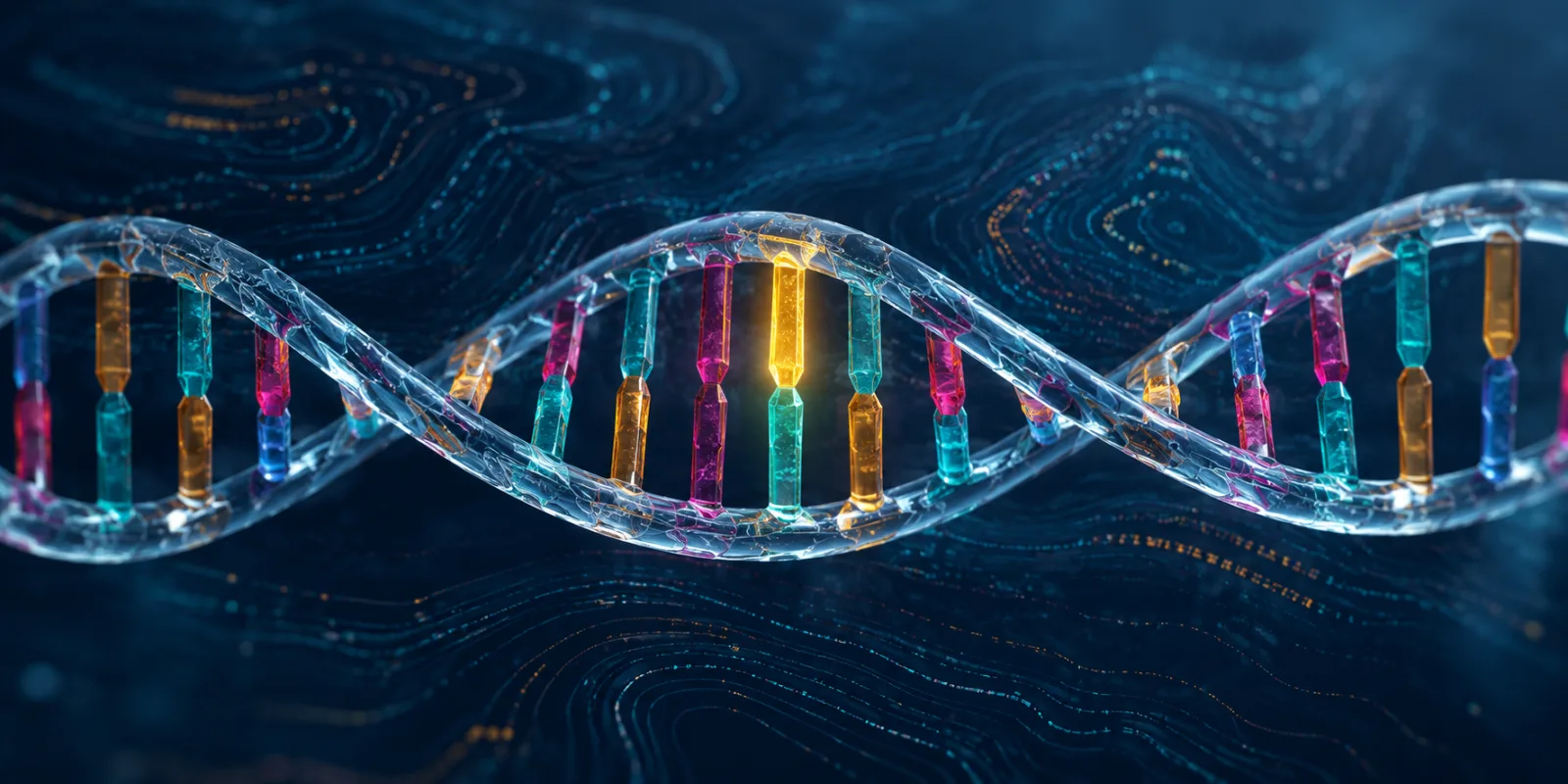
For more than two decades, biologists have owned a near-complete copy of the human instruction manual and still cannot read most of it. Only about 1 to 2% of our DNA spells out proteins. The rest either governs when, where and how strongly genes switch on, or appears to do nothing at all, an evolutionary attic often dismissed as "junk" (UC Berkeley). Buried in that murky majority are the genetic changes that tip people towards cancer, heart disease and autism. Working out which ones matter is one of the hardest problems in modern genetics.
This week, a team at UC Berkeley published an artificial intelligence system that reads that difficult part of the genome more accurately than rivals many times its size, and it can be trained in hours rather than months. The model, called GPN-Star, appeared in Nature on 9 September 2026. It is a small, efficient tool with an outsized claim: that biology, not brute-force computing, is the ingredient most genomic AI has been missing.
Researchers led by Yun Song, a professor of computer science and statistics at Berkeley and an investigator at the Innovative Genomics Institute, introduced GPN-Star as a "genomic language model" built to judge whether a given change in DNA is likely to be harmful. In benchmark after benchmark, the model set a new standard for predicting the effects of genetic variants in both the protein-coding and the non-coding parts of the human genome.
Two results stand out. First, GPN-Star is unusually good at flagging variants that cause disease and at pinpointing the specific changes behind signals from genome-wide association studies, the large scans that link DNA to traits. Second, it does this while being far cheaper to build. A rival model released earlier in 2026, Evo 2, was trained on the genomes of more than 100,000 species and needed roughly 2,000 high-end NVIDIA processors running for months (UC Berkeley). GPN-Star can be trained in days, sometimes hours, on a handful of chips.
The team also released genome-wide predictions and open-source code, so other laboratories can point the model at the parts of the genome they care about. The work was funded partly by the US National Institutes of Health, with computing support from the Chan Zuckerberg Initiative.
The genome's dark matter, and the "grammar" of DNA#
To see why this is clever, start with the raw material. A genome is a string of four chemical letters, A, C, G and T. A variant is simply a spot where one person's letter differs from the reference. Some variants are harmless; a few break a gene or scramble the switches that control it. Pathogenicity is the term for how likely a variant is to cause disease.
The trouble is scale. The human genome runs to three billion letters, and researchers cannot test every possible change in the laboratory. So they turn to prediction. One family of tools borrows an idea from chatbots. A genomic language model is trained on vast amounts of DNA and learns to guess a hidden letter from the sequence around it, much as a text model predicts the next word (UC Berkeley). By doing this billions of times, the model absorbs the "grammar" of the genome and can spot letters that look out of place, a decent proxy for damage.
GPN-Star's twist is evolutionary. Rather than reading one genome at a time, it learns from whole-genome alignments: computational stacks that line up the same stretch of DNA across many species, so you can see where the code has stayed constant over millions of years and where it has drifted. Regions preserved across mice, chickens and humans alike are usually doing something important, because natural selection tends to weed out harmful mutations in useful DNA while tolerating them in the rest. This principle underpins long-standing conservation tools such as PhastCons and PhyloP (Nature).
Feeding the model these alignments does two things. It hands the AI a ready-made map of what evolution considers important, so the system wastes less effort puzzling over junk DNA, and it slashes the computing bill. The architecture is also phylogeny-aware, meaning it explicitly encodes the family tree relating the species in each alignment rather than treating them as an undifferentiated pile. As Song put it, the aim is to "use these biological insights to improve the model, rather than hoping that the model will figure out what's important by itself" (UC Berkeley).
Why this matters#
The most immediate payoff is for human genetics. Clinicians increasingly sequence patients' genomes and then face a list of variants of "uncertain significance", changes nobody can yet interpret. A sharper predictor helps rank which of those are worth a closer look, and which genes and regulatory switches deserve laboratory follow-up. Song frames the model as a way to "prioritise the experiments that could have the greatest impact on human health" (UC Berkeley).
A subtler finding concerns time. The team trained separate versions on alignments reaching back over different evolutionary distances, from close primate relatives out to distant vertebrates, and found that each was tuned to a different job. Models steeped in deep, ancient conservation were best at judging rare changes inside proteins, which evolve slowly. Models trained only on recent primate evolution were better at complex traits such as schizophrenia risk, which involve thousands of small effects scattered largely across non-coding DNA (UC Berkeley). In other words, the right evolutionary lens depends on the biological question, a genuinely useful insight for anyone designing these tools.
There is a democratic angle too. Because GPN-Star is light enough to run on modest hardware, groups without supercomputers can retrain and adapt it. The authors extended it to five laboratory workhorses, the mouse, chicken, fruit fly, roundworm and the plant Arabidopsis thaliana, with little extra tuning. That matters for crop science, conservation and basic biology, not only medicine, and it lowers the barrier for the global research community to build on the work.
Critical analysis#
The clearest limitation is baked into the method: GPN-Star depends on high-quality whole-genome alignments across many species. Where those alignments are thin, patchy or missing, its evolutionary advantage fades. It is telling that the biggest gains show up in regions with rich comparative data.
There is also a conceptual boundary. Conservation tells you that a stretch of DNA matters; it does not tell you what it does or how a variant changes it. GPN-Star predicts functional constraint, essentially a measure of evolutionary importance, rather than a specific molecular consequence such as a shift in gene activity. Purely evolutionary approaches can also miss recent, human-specific changes that have not had time to leave a comparative footprint, which is partly why the primate-scale model did better on some complex traits.
Then there is the gap between a benchmark win and a clinical tool. Strong scores on curated variant sets are encouraging, but genetic tests carry real consequences, and moving from a research prediction to something a clinician can act on requires careful validation, regulatory scrutiny and calibration on diverse populations. Many genomic datasets remain skewed towards people of European ancestry, a well-documented risk of inequity that any predictor inherits from its data. GPN-Star is a research model, not medical advice, and it is best read as a way to steer experiments rather than diagnose patients.
Finally, "state of the art" is a moving target. The field is crowded and fast, and today's leader may be overtaken within months. The honest framing is that GPN-Star is a strong new entrant that reframes the design problem, not a final word.
Expert perspective: biology versus brute force#
GPN-Star's real significance lies in the argument it makes. Much of genomic AI has followed the playbook that made chatbots powerful: build a bigger model, feed it more raw sequence, and hope capability emerges. Yet the Berkeley group notes that these general-purpose models have often struggled to beat far simpler, decades-old evolutionary methods on the specific task of interpreting variants, even at enormous size.
The model builds directly on the group's earlier GPN-MSA, which first showed that multi-species alignments could power a DNA language model, and it reports beating that predecessor on the same data. The contrast with Evo 2 is starker still. Evo 2 is a remarkable generalist that can even generate whole genomes from scratch (Evo 2, Nature); GPN-Star is a specialist that trades that breadth for accuracy and efficiency on one job. Google DeepMind's AlphaGenome, released in 2025, takes yet another path, predicting thousands of molecular readouts from a million-letter window of DNA (Nature). These are complementary lenses on the same genome rather than direct substitutes.
The comparison many biologists will reach for is AlphaFold, which cracked protein structure prediction partly by leaning on evolutionary alignments rather than sequence alone. GPN-Star extends that alignment-first philosophy from the neat world of proteins to the messy, sprawling non-coding genome. If it holds up, the lesson is one the machine-learning world keeps relearning: when you have hard-won domain knowledge, building it into the model can beat throwing computation at the problem.
Key takeaways#
- The headline result is that a smaller model won. GPN-Star matched or beat far larger systems such as Evo 2 at flagging harmful DNA variants, using a fraction of the computing power.
- Its edge comes from evolution. By learning from whole-genome alignments across species, it concentrates on DNA that natural selection has preserved and ignores much of the "junk".
- There is no single best version. Models trained on deep evolutionary history do better on rare protein variants, while those trained on recent primate history do better on complex traits such as schizophrenia risk.
- It is open and easy to reuse. The code and genome-wide predictions are public, and the team has already adapted the model to five other species.
- It points rather than diagnoses. The tool helps decide which variants and experiments to pursue, but it does not replace clinical testing or explain a variant's exact molecular effect.
Frequently asked questions#
What is a genomic language model? An AI trained on DNA the way chatbots are trained on text. It learns to predict hidden letters from their surroundings and, in doing so, picks up patterns that reveal which parts of a genome are functionally important.
What does GPN-Star actually predict? It estimates "functional constraint", how strongly evolution has protected a position in the genome, and uses that to score whether a variant is likely to be damaging, in both coding and non-coding DNA.
Why is training efficiency such a big deal? Cost is a gatekeeper. Models needing thousands of processors are out of reach for most labs. A model that trains in hours on a few chips can be adapted and improved by researchers worldwide, which tends to accelerate a field.
Can I use it for medical diagnosis? No. GPN-Star is a research tool that helps prioritise which variants and experiments to pursue. Clinical interpretation needs separate validation and professional oversight.
How is this different from AlphaFold? AlphaFold predicts protein shapes; GPN-Star predicts the importance of DNA changes. Both, notably, gain much of their power from evolutionary alignments across species rather than from single sequences.
How does it compare with Evo 2 and AlphaGenome? Evo 2 is a broad generalist that can generate genomes; AlphaGenome predicts many molecular readouts across long DNA windows; GPN-Star is a focused, efficient specialist for variant interpretation. They are complementary.
Where can I find the model? The code and predictions are on GitHub, with an archived release on Zenodo.
Glossary#
Variant: A position where an individual's DNA differs from a reference sequence.
Non-coding DNA: The roughly 98% of the genome that does not directly encode proteins; much of it regulates gene activity.
Pathogenicity: How likely a variant is to cause or contribute to disease.
Genomic language model (gLM): A machine-learning model trained on DNA sequence to learn its statistical patterns, analogous to a text language model.
Whole-genome alignment (WGA): A computational stacking of the same genomic region across many species to reveal conservation and change.
Functional constraint: A measure of how strongly natural selection has preserved a stretch of DNA, used as a proxy for importance.
Phylogeny: The evolutionary family tree describing how species are related.
Genome-wide association study (GWAS): A scan across many genomes that links genetic variants to traits or diseases.
Heritability: The share of variation in a trait across a population that is attributable to genetic differences.
References#
- Ye, C., Benegas, G., Albors, C., et al. "Predicting genome-wide functional constraints with GPN-Star." Nature (9 September 2026). https://www.nature.com/articles/s41586-026-11005-5
- UC Berkeley News. "New AI model for DNA learns from evolution to unlock secrets of the human genome." (9 September 2026). https://news.berkeley.edu/2026/09/09/new-ai-model-for-dna-learns-from-evolution-to-unlock-secrets-of-the-human-genome/
- GPN-Star source code, songlab-cal/gpn, GitHub. https://github.com/songlab-cal/gpn
- GPN-Star archived release, Zenodo. https://doi.org/10.5281/zenodo.21501177
- News-Medical. "New genomic language AI model excels in predicting the pathogenicity of genetic variants." (9 September 2026). https://www.news-medical.net/news/20260909/New-genomic-language-AI-model-excels-in-predicting-the-pathogenicity-of-genetic-variants.aspx
- Benegas, G., Albors, C., Aw, A. J., Ye, C. & Song, Y. S. "A DNA language model based on multispecies alignment predicts the effects of genome-wide variants" (GPN-MSA). Nature Biotechnology 43, 1960-1965 (2025). https://www.nature.com/articles/s41587-024-02511-w
- Brixi, G., et al. "Genome modelling and design across all domains of life with Evo 2." Nature 652, 1349-1361 (2026). https://www.nature.com/articles/s41586-026-10176-5
- AlphaGenome team. "Advancing regulatory variant effect prediction with AlphaGenome." Nature (2026). https://www.nature.com/articles/s41586-025-10014-0
- Google DeepMind. "AlphaGenome: AI for better understanding the genome." (2025). https://deepmind.google/blog/alphagenome-ai-for-better-understanding-the-genome/
- Jumper, J., et al. "Highly accurate protein structure prediction with AlphaFold." Nature 596, 583-589 (2021). https://www.nature.com/articles/s41586-021-03819-2