Ask a trained virologist to "incubate until confluent, then split", and they will get on with it. Ask a robot, and it needs to know what confluent looks like, how often to check, what to do when the cells are not ready, and which of the two dozen small movements in between nobody bothered to write down. That gap between a protocol as written and a protocol as performed is the reason robots are not running experiments inside the world's most dangerous virus laboratories. A preprint posted on 3 August 2026 is a direct attempt to close it.
What happened#
A team led by Zhe Liu published ProtoAct, a framework that converts free-form biological protocols into what the authors call state-aware, embodiment-ready action sequences. Plain translation: it turns prose written for another scientist into a structured list of instructions a robot arm can run, including the checks a human performs without thinking.
The system has three parts. ProtoRAG looks up hand-annotated examples of similar procedures to read ambiguous wording, RefineChecker hunts for steps that are missing or contradictory, and ActSchema converts the cleaned-up procedure into constrained JSON function calls that a robot controller can execute. To test it, the team built a dataset called BioP2E by manually annotating 22 cell-culture protocols into 258 monitoring conditions, 910 executable subtasks and 962 grounded action calls, then ran the pipeline across seven large language models.
Six weeks earlier, the same group released Pipette, a simulator and benchmark for wet-lab robots with more than 100 open, editable laboratory assets and a 12-task test covering sample handling, culture-ware manipulation, device operation and precision placement. Its numbers set the realistic ceiling today.
Why a containment laboratory is such a hard place to put a robot#
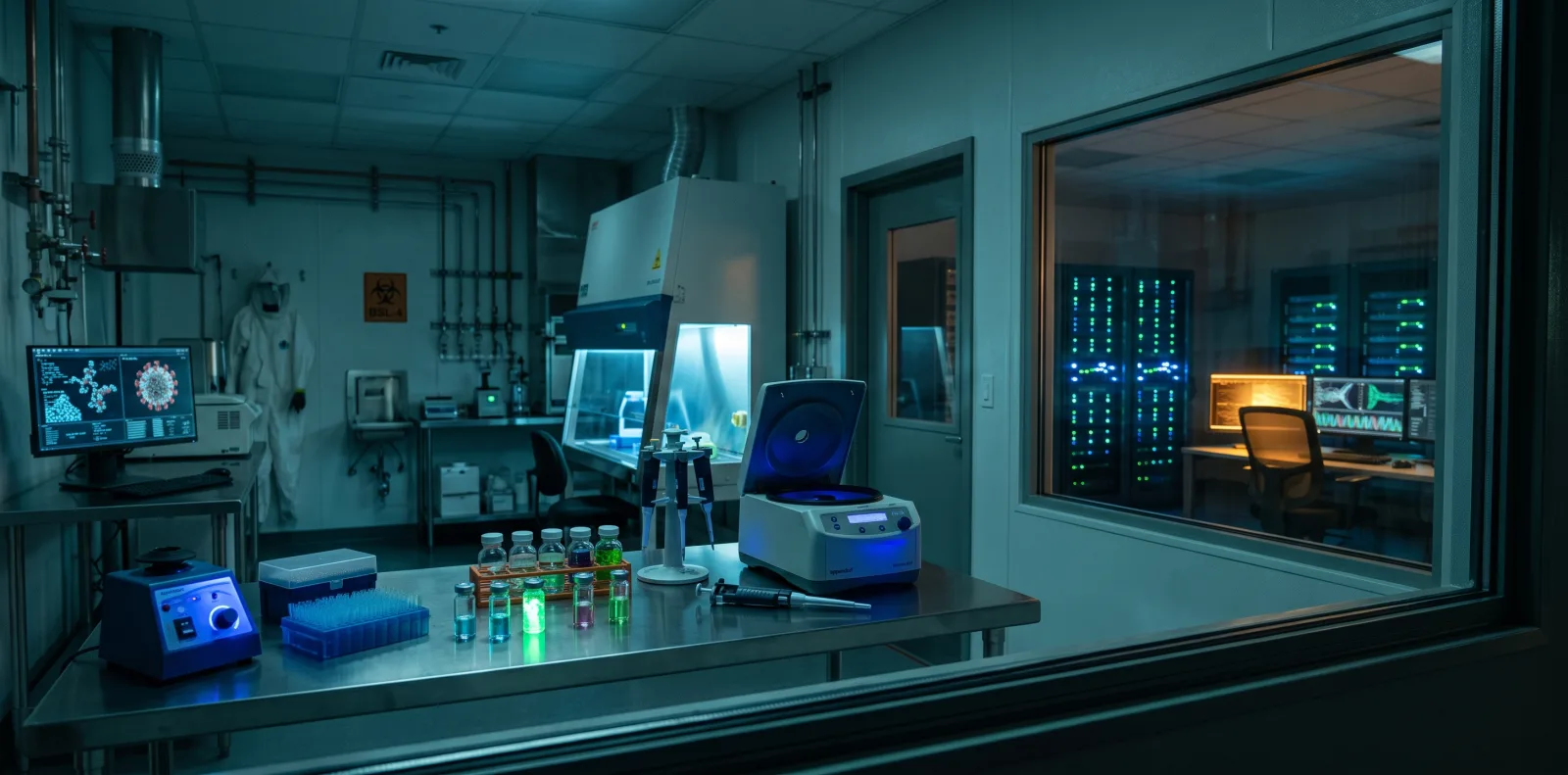
Biosafety levels run from 1 to 4 and describe how much containment a pathogen requires. A biosafety level 4 laboratory is the top tier, reserved for agents such as Ebola and Marburg virus for which there is often no vaccine or treatment. Staff work in positive-pressure suits fed by air hoses, pass through chemical showers on the way out, and work under engineering controls designed on the assumption that a person inside will eventually make a mistake.
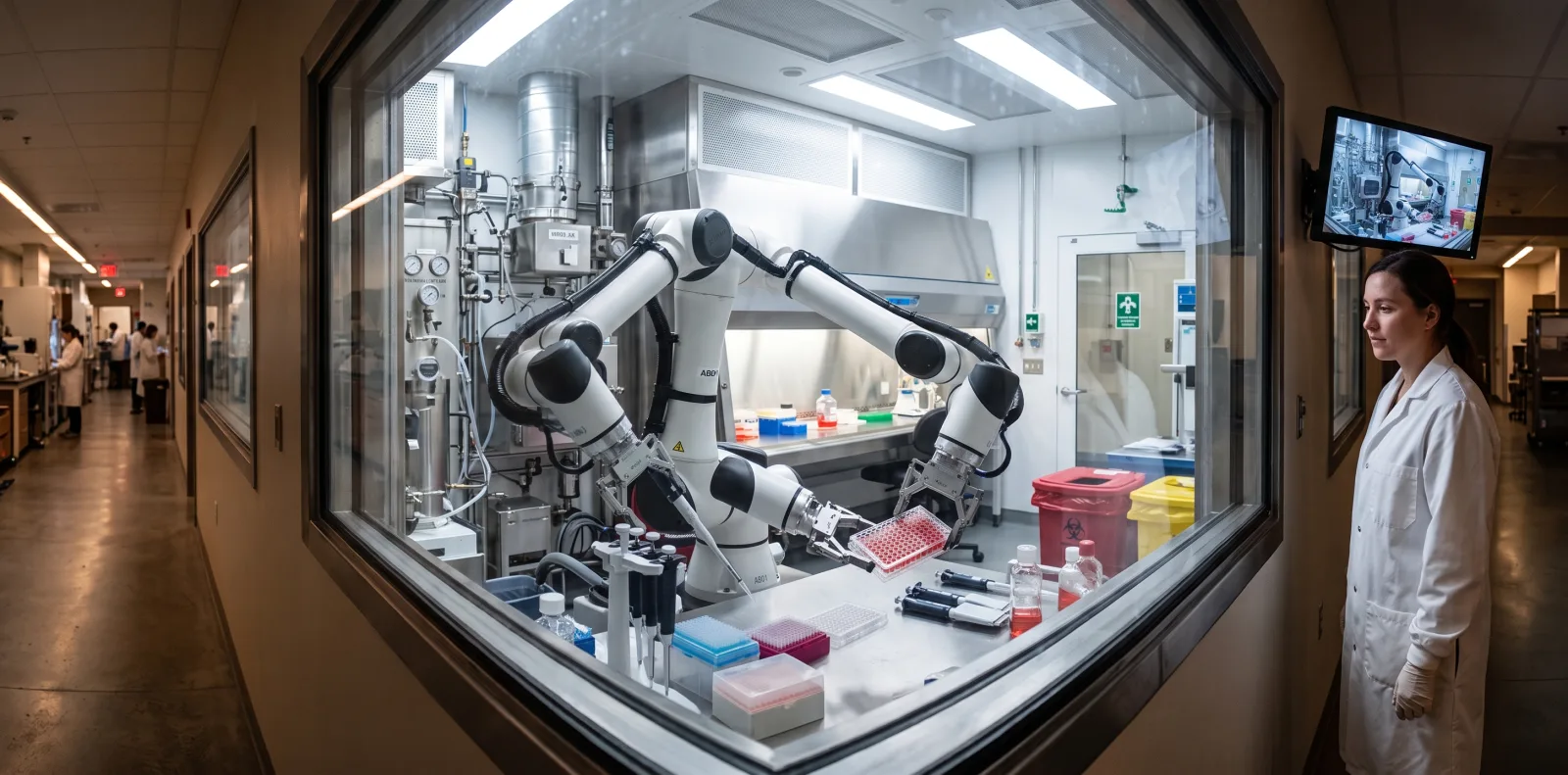
Everything about that environment argues for robots, and the case for using machines against dangerous pathogens was laid out in Science Robotics in 2021. The same environment also makes robots unusually hard to deploy. Suits and gloves rule out fine human intervention when something jams, decontamination cycles are chemically brutal on electronics and seals, and a dropped flask is not a cleaning job but an incident.
One term matters for what follows. A vision-language-action model, or VLA, is a neural network that takes camera images plus a written instruction and outputs robot movements directly; SmolVLA and pi0 below are examples. The autonomous laboratory field, sometimes called self-driving labs, has been building toward this for years, mostly in chemistry and materials science where the failure modes are better understood.
Why this matters#
There are three reasons, beyond keeping people away from lethal viruses. First, reproducibility. Protocols are notoriously under-specified, which is part of why experiments fail to replicate. A framework that forces every implicit step into an explicit, checkable list produces a by-product arguably more valuable than the robot: a machine-readable record of what was actually done.
Second, capacity. High-containment work is throttled by how many trained people can safely be in a suite at once, and that bottleneck bites hardest during an outbreak.
Third, and less comfortably, the biosecurity picture shifted this month. On 6 August 2026, researchers at Stanford and the Arc Institute reported in Science that genome language models had designed working bacteriophage genomes from scratch. Of roughly 300 candidates synthesised, 16 assembled into functional viruses, and a cocktail of those 16 killed E. coli strains resistant to a natural phage. Viruses that infect humans, animals or plants were deliberately excluded from the training data. Even so, the combination is now clear: AI that can design novel viral genomes, and robots that can execute the wet-lab steps to build and test them. A framework in Frontiers in Microbiology argued in July 2026 that existing oversight ignores the latent capabilities of highly automated laboratories, where remote operation and thin human presence create openings for malicious orders, insider misuse and cyberattack.s
Critical analysis: what the evidence does and does not show#
Start with the strengths. ProtoAct works across seven different language models, suggesting the gains come from the framework rather than from a single clever backbone. Pipette's data augmentation is a genuinely useful trick: replay a few human demonstrations in simulation, perturb the lighting, camera angle, speed and actions, then filter the results with automatic success checks. That took SmolVLA from 40.4% to 71.8% on the 12-task benchmark. Squeezing more out of 30 demonstrations matters when collecting real data inside containment is slow and expensive.
The limitations.#
The absolute numbers are not close to laboratory grade. On Pipette's benchmark with 30 demonstrations per task, the ACT policy reached 60.3% average success, and pi0 improved only from 37.3% to 44.1% with augmentation. A four-in-ten failure rate is unremarkable in robotics research and unacceptable when the flask contains a risk group 4 pathogen.
Worse, succeeding at a task is not the same as doing the experiment correctly. Labimus, a June 2026 preprint benchmarking humanoid robots on organic chemistry workflows, reported what its authors call a precision gap: policies that completed tasks still failed to meet the quantitative tolerances the protocol required. Their conclusion is blunt: a disconnect between task completion and experimental validity. A robot that weighs out slightly the wrong mass has not failed in any way the success metric notices. It has just generated bad data.
Then there is safety reasoning. LABSHIELD, a March 2026 preprint, tested 20 proprietary models, 9 open-source models and 3 embodied models on 164 laboratory tasks grounded in OSHA and GHS hazard standards. Performance fell by an average of 32.0% when questions moved from multiple choice to semi-open answers, with the weakest results in hazard interpretation and safety-aware planning. Models that can name a hazard on a quiz are considerably worse at recognising one in front of them.
A note on terminology. The word android implies a human-shaped machine, and the field is genuinely split. Labimus argues for humanoids with dexterous hands because operations such as solid-to-solid transfer resist standardisation and need real-time adaptation. Most working systems use fixed arms instead. GAMORA, a 2025 preprint aimed specifically at virology laboratories, used a VR-guided 3D-printed arm and reported 2.2 mm mean positional discrepancy, pipetting accuracy within 0.2 mL and 1.2 mm repeatability across 50 trials. Human form is a hypothesis about dexterity, not an established requirement.
None of these systems has been tested inside an operating high-containment facility in the literature reviewed here. Every result above comes from simulation or open-bench work.
How this compares with earlier attempts#
Laboratory robotics is not new. Liquid handlers have run in microbiology laboratories for decades, and teleoperated manipulators have handled hazardous material in nuclear facilities for far longer. What those systems share is rigidity: they execute a fixed script, and anything unexpected halts the run.
The change since roughly 2024 is the attempt to replace the script with a model that interprets instructions. GAMORA kept a human in the loop through VR, moving the operator out of harm's way without asking the machine to make decisions. BioProVLA-Agent added protocol-driven vision-language-action control for biological laboratory manipulation. ProtoAct pushes furthest by targeting the interpretation problem itself, treating the ambiguity in written protocols as the thing to be solved rather than something to be engineered around.
Whether that is the right bet is contested. Nature reported in 2026 on a debate over whether self-driving laboratories will displace biologists, with researchers insisting human judgement remains essential. The benchmarks support the sceptics for now, since the precision gap and the safety reasoning gap are both failures of judgement rather than of mechanics.
For the global research community, the immediate question is distribution. High-containment capacity is unevenly distributed, and automation could widen or narrow that gap.
A realistic timeline, offered as interpretation rather than fact: routine automation of well-defined tasks such as sample preparation in biosafety level 3 facilities looks tractable within a few years. Autonomous operation inside biosafety level 4 needs regulatory frameworks that do not yet exist and reliability roughly two orders of magnitude better than what these benchmarks report.
Key takeaways#
- ProtoAct, a preprint posted on 3 August 2026, converts written biological protocols into structured robot actions, validated across seven language models on a 22-protocol dataset.
- Success rates on the closest published benchmark run between 44.1% and 71.8%, well short of what containment work demands.
- Labimus identified a precision gap: robots can complete a task while missing the tolerance the experiment requires, producing invalid data without registering a failure.
- LABSHIELD found model performance on laboratory safety questions dropped by an average of 32.0% when the format moved from multiple choice to open answers.
- The August 2026 demonstration of AI-designed bacteriophages makes governance urgent, and existing oversight was not written with highly automated laboratories in mind.
Frequently asked questions#
Are humanoid robots working in BSL-4 laboratories today? Not according to the literature covered here. This work is simulation and open-bench research; deployment inside operating high-containment facilities has not been reported.
What is the difference between laboratory automation and an autonomous laboratory? Automation runs a fixed script written by a person. An autonomous laboratory, or self-driving lab, uses AI to choose experiments and interpret results as well as perform them.
Does automation make high-containment research safer? It reduces human exposure, the main argument for it. It also adds risks such as cyberattack and reduced oversight, which the Frontiers in Microbiology framework treats as the central governance problem.
Why do robots struggle with protocols that humans find easy? Protocols are written for trained readers and leave routine operations and conditional judgements implicit. ProtoAct's contribution is making those implicit steps explicit before a robot moves.
Is a human-shaped robot actually necessary? Open question. Labimus argues some manipulations resist standardisation and benefit from dexterous hands. Most deployed systems use fixed arms, and GAMORA achieved millimetre-scale precision with a simple 3D-printed arm.
Do AI-designed viruses mean automated laboratories are dangerous? The Stanford and Arc Institute work targeted bacteriophages, which infect bacteria, and excluded viruses that infect humans, animals or plants from training. Biosecurity researchers are concerned about the combination of generative design and automated execution, not that study in isolation.
References#
Peer-reviewed
- Yang, G.-Z. et al. (2021). Progress in robotics for combating infectious diseases. Science Robotics, 6(52).
- Automated Laboratory Security Tiers: a framework for evaluating and mitigating biosecurity risks from latent capabilities (2026). Frontiers in Microbiology. doi:10.3389/fmicb.2026.1832401
- King, S., Hie, B. et al. (6 August 2026). AI-generated bacteriophage genomes. Science. Reported by Stanford Report and the Arc Institute.
Preprints (not peer-reviewed)
- Liu, Z. et al. (3 August 2026). ProtoAct: Turning Wet-Lab Protocols into Embodied Robotic Actions. arXiv:2608.01690.
- Liu, Z. et al. (11 June 2026). Pipette: An Embodied Simulation Platform, Benchmark, and Data-Efficient Augmentation Framework for Wet-Lab Robotics. arXiv:2606.12936.
- Wu, Y. et al. (30 June 2026). Labimus: A Simulation and Benchmark for Humanoid Dexterous Manipulation in Chemical Laboratory. arXiv:2606.31037.
- Sun, Q. et al. (12 March 2026). LABSHIELD: A Multimodal Benchmark for Safety-Critical Reasoning and Planning in Scientific Laboratories. arXiv:2603.11987.
- BioProVLA-Agent: An Affordable, Protocol-Driven, Vision-Enhanced VLA-Enabled Embodied Multi-Agent System with Closed-Loop-Capable Reasoning for Biological Laboratory Manipulation. arXiv:2605.07306.
- Wasay, F. A., Rahman, M. A. & Ghouse, H. (17 June 2025). GAMORA: A Gesture Articulated Meta Operative Robotic Arm for Hazardous Material Handling in Containment-Level Environments. arXiv:2506.14513.
Science journalism and organisational sources
- Inside the 'self-driving' lab revolution. Nature (2026).
- Will self-driving 'robot labs' replace biologists? Paper sparks debate. Nature (2026).
- What Is a Biosafety Level 4 (BSL-4) Laboratory? Texas Biomedical Research Institute.