Virology
AI Designs Working Virus Genomes for the First Time
Stanford and Arc Institute researchers used genome language models to write complete bacteriophage genomes from scratch. Sixteen worked in the lab — and the result reopens a hard debate about AI biosecurity.
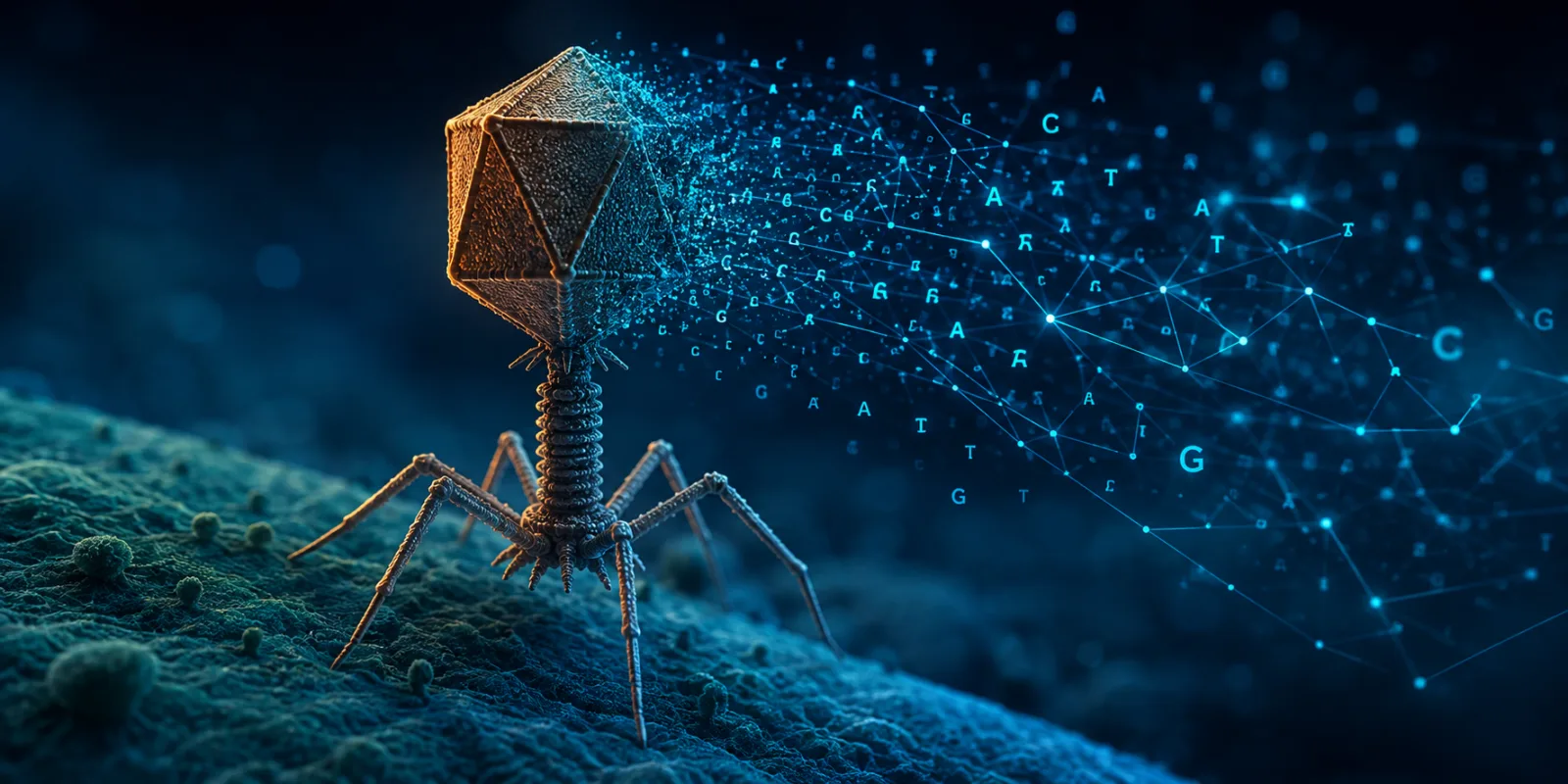
For seventy years, biology has been able to read genomes, and for the past two decades it has been able to edit them. What it could not do was write a whole one from scratch and have it come alive. That line was crossed this week.
On 6 August 2026, a team from Stanford University and the Arc Institute reported in Science that they had used artificial intelligence to design complete bacteriophage genomes (the full genetic blueprints of viruses that infect bacteria) and that sixteen of those AI-authored designs assembled into functioning viruses in the laboratory. Several killed E. coli more effectively than the natural virus the model was asked to imitate.
This is not a chatbot suggesting a gene edit. It is a generative model producing thousands of base pairs end to end, in a single pass, that fold into a living, self-replicating organism. The achievement is narrow in scope and carefully fenced off from anything that could infect a human. It is also, by common agreement among the researchers and their critics alike, a threshold moment for medicine, for synthetic biology, and for the unresolved argument about how freely such tools should circulate.
Executive summary#
Researchers led by Stanford's Brian Hie, with graduate student Samuel King as first author, applied two genome language models (Evo 1 and its successor Evo 2, both developed at the Arc Institute) to the small bacteriophage ΦX174, whose genome is under 6,000 base pairs. The models generated thousands of candidate genomes; the team synthesised the DNA for roughly 300 and recovered 16 viable phages carrying substantial genetic novelty, some with higher fitness than the natural template (King et al., Science, 2026). A cocktail of the generated phages rapidly overcame E. coli that had grown resistant to the original ΦX174, hinting at a route to "resistance-resistant" antibacterials. The work is a landmark for AI-driven genome design, but its efficiency is low, its scope is deliberately limited to a phage, harmless to people, and its publication has intensified calls for enforceable screening of synthetic DNA orders.
What happened?#
The study, "Generative design of bacteriophages with genome language models," was published in Science at 19:00 UK time on Thursday 6 August 2026 (DOI: 10.1126/science.aec2657). An earlier version appeared as a preprint on bioRxiv in September 2025, Preprint (not peer reviewed), before the peer-reviewed paper (bioRxiv, 2025).
The team gave the models little more than a fragment of ΦX174 DNA and asked them to compose whole new genomes. "In this case, we wanted the model to generate the entire genome end-to-end in a single left-to-right pass. We didn't add anything," Hie explained (Stanford Report, 2026). Because synthesising DNA remains expensive, King built a computational framework to score the thousands of candidate genomes against the traits of ΦX174 and related phages, and to narrow the field to the most promising few hundred for physical synthesis and testing.
Of the roughly 300 phages actually built and plated against E. coli, 16 proved viable: a success rate near 5%. Notably, several outperformed their natural counterpart in growth competitions and in how quickly they burst bacterial cells. When the researchers evolved E. coli strains that resisted the original ΦX174, a mixture of the AI-designed phages broke through that resistance in three separate strains. Cryo-electron microscopy confirmed that at least one generated phage used an evolutionarily distant version of a capsid protein, evidence that the model was not merely copying known sequences but recombining deep evolutionary patterns into something new.
Background: what is a genome language model?#
Large language models learn the statistics of human text and generate plausible new sentences. A genome language model does the same thing with DNA, treating the four nucleotide bases (A, C, G and T) as an alphabet. Evo 2, the more capable of the two models used here, was trained on an enormous corpus of genetic sequence spanning the domains of life. From that training it learns which arrangements of bases tend to encode functional genes, regulatory signals and protein-coding regions, and it can then propose novel sequences that obey the same grammar.
Bacteriophages are the natural target for a first attempt. They are the most abundant biological entities on Earth, they infect bacteria rather than people, and some have tiny genomes. ΦX174 is a classic of molecular biology: its roughly 5,400-base genome was the first DNA genome ever sequenced, in 1977, and the first to be chemically synthesised, in 2003. That long pedigree makes it an ideal, well-characterised proving ground: small enough to design in one pass, familiar enough to judge whether the output is genuinely new.
The therapeutic motivation is antimicrobial resistance. As bacteria evolve immunity to antibiotics, phages offer an alternative that kills bacteria directly, but bacteria evolve resistance to individual phages too. The standard workaround is a "cocktail" of several phages, which is harder for a microbe to defeat all at once. "If the bacteria gain resistance to a single phage, it's game over for the medication," Hie noted. "But if you have multiple genetically distinct phages in a mixture, it would be harder for the bacteria to develop resistance to the entire cocktail" (Stanford Report, 2026).
Why this matters#
For synthetic biology, the paper marks a shift from reading and rewriting to composing. "For the first time, we are seeing AI move beyond predicting biological sequences to generating entire functional genomes that work in the laboratory," said Patrick Cai, Chair of Synthetic Genomics at the University of Manchester. "It suggests that genome language models are beginning to learn the design principles encoded by evolution, opening the door to AI-assisted genome writing" (Science Media Centre, 2026).
For medicine, the near-term prize is faster, better phage therapy. Finding a phage in nature that matches a given pathogen can be slow and sometimes fruitless. Generating candidates computationally could shortcut that search and produce useful properties that are rare or absent in the wild. Marc Güell of Pompeu Fabra University, whose group uses Hie's tools, framed the jump plainly: the field could already design synthetic proteins such as binders and enzymes, but "here, they go a step further by designing an entire synthetic phage comprising more than ten proteins and a genome of thousands of bases" (Science Media Centre, 2026).
For public health, the logic points beyond E. coli to the bacteria that fill hospital worst-case lists: tuberculosis, MRSA and Pseudomonas aeruginosa among them. None of that is demonstrated in this paper; it is the direction of travel the authors themselves sketch, and it depends on a great deal of work still to come.
Critical analysis#
The strengths are real: an end-to-end design, rigorous experimental validation, cryo-EM structural confirmation and a functional demonstration against resistant bacteria. The limitations are equally real, and the researchers do not hide them.
Efficiency is the first. Thousands of genomes were generated to yield 16 that worked. Jordi García Ojalvo of Pompeu Fabra University cautioned that most outputs are effectively "hallucinations" of the model, and drew a sobering analogy to induced stem-cell reprogramming, a Nobel-winning technique whose efficiency remained stubbornly low for well over a decade (Science Media Centre, 2026). Whether genome models can improve markedly is uncertain, because the training data for genomes is finite in a way that internet text is not.
Second, evolution helped. Roughly half of the functional phages had picked up mutations after synthesis, which suggests natural selection in the culture dish polished the AI's drafts rather than the model getting everything right unaided, as Simon Jackson of Waikato University observed (Science Media Centre, 2026). Third, scale is unproven: ΦX174 is minute, and larger, more complex genomes may not yield to the same one-pass approach. Fourth, generative design does not confer understanding. As García Ojalvo put it, these methods do not explain why some genomes live and others fail; that interpretive work still falls to humans.
Then there is biosecurity, which the paper's publication has thrust back into the open. The authors built in safeguards: Evo 2's training deliberately excluded viruses that infect humans and other eukaryotes, and the researchers report that the model's output for pathogenic viral proteins is effectively random as a result. García Ojalvo argued the risk here is arguably lower than with general-purpose chatbots, because every candidate genome must be synthesised and tested one by one, and the low hit rate makes "out-of-the-box" viable pathogens hard to imagine. But Evo 2 is fully open (weights, code and training data), and a companion analysis in Science by biosecurity specialists at the Johns Hopkins Center for Health Security warned that the work raises urgent questions. There is still no US legal requirement that DNA-synthesis providers verify both the sequence they print and the identity of the customer ordering it, and reliable tools to flag never-before-seen AI designs are not yet deployed at scale (Science, 2026).
Hie's own position is that openness accelerates beneficial research and that natural pathogens remain the greater and more accessible danger, precisely because evolution builds in no safety checks whereas AI tools can (Stanford Report, 2026). It is a genuine disagreement about tradeoffs, not a settled question, and reasonable experts fall on both sides.
Expert perspective: how this compares#
The obvious benchmark is the protein-design revolution recognised by the 2024 Nobel Prize in Chemistry: AlphaFold's structure prediction and de novo protein design. Those systems operate on single molecules. This work operates on a whole genome that must specify more than ten proteins and their regulation, and then boot into a self-replicating organism. That is a categorical step up in the size and interdependence of what is being designed.
It also builds directly on Evo 2, launched by the Arc Institute in early 2025 as a genome model spanning all domains of life. Until now Evo 2 mostly predicted and analysed. The novelty of this study is the move from prediction to validated creation: from a model that scores biology to one that writes biology that works. Competing approaches to phage engineering (bioprospecting from nature, directed laboratory evolution, targeted genetic modification) remain slower and more dependent on what already exists. What makes this different, as Massey University's Jasna Rakonjac noted, is that generative design can source biological solutions that are "geographically or historically too distant" for natural recombination ever to combine (Science Media Centre, 2026).
Key takeaways#
- AI has, for the first time, designed complete viral genomes that function in the lab: a milestone in generative biology, not just protein design.
- Sixteen of roughly 300 synthesised bacteriophage designs were viable, and several outcompeted the natural ΦX174.
- A cocktail of the AI-written phages overcame bacterial resistance, pointing towards new tools against antimicrobial resistance.
- The result is early and inefficient: a ~5% hit rate, help from natural mutation, a tiny genome, and no understanding of why designs succeed or fail.
- Publication has reignited the biosecurity debate, centred on DNA-synthesis screening and the wisdom of releasing open-weight genome models.
Frequently asked questions#
Can these AI-designed viruses infect humans? No. The study used bacteriophages, which infect bacteria and are considered harmless to people. The Evo 2 model was also deliberately trained without viruses that infect humans or other animals.
Is this the first synthetic virus? No. Scientists chemically synthesised the ΦX174 genome from a known sequence back in 2003. What is new is that AI designed novel, functional genomes rather than copying an existing one.
How well did it actually work? Modestly, as a proof of concept. Around 5% of the synthesised designs were viable, and roughly half of those acquired mutations in culture, suggesting natural selection helped refine the AI's output.
Could this lead to real treatments? Potentially, for bacterial infections via phage therapy, but not soon. Designing larger phages, controlling exactly which bacteria they target, and proving safety and efficacy in patients all remain to be done. This is not medical advice.
Why bacteriophages and not something bigger? ΦX174 has a tiny, exhaustively studied genome, small enough to generate in one pass and familiar enough to judge novelty. Larger, more complex genomes are a much harder target.
What are the biosecurity concerns? That open, powerful genome models plus unscreened DNA synthesis could lower barriers to misuse. Specialists are urging enforceable checks on both DNA sequences and customer identity, and better tools to detect novel AI-generated designs.
Is the model publicly available? Yes. Evo 2 is released openly (including weights, code and training data) via the Arc Institute. That openness is central to both its scientific value and the safety debate around it.
References#
- King, S. H., et al. "Generative design of bacteriophages with genome language models." Science, 6 August 2026. https://www.science.org/doi/10.1126/science.aec2657
- "AI-designed viral genomes." Science (accompanying analysis on biosecurity implications), 6 August 2026. https://www.science.org/doi/10.1126/science.aej8512
- King, S. H., et al. "Generative design of novel bacteriophages with genome language models." bioRxiv, September 2025. Preprint (not peer reviewed). https://www.biorxiv.org/content/10.1101/2025.09.12.675911v1
- Myers, A. "AI designs a novel E. coli killer." Stanford Report, 6 August 2026. https://news.stanford.edu/stories/2026/08/evo-2-ai-tool-e-coli-killer-bacteriophages
- Science Media Centre. "Expert reaction to generative design of bacteriophages with genome language models." 6 August 2026. https://www.sciencemediacentre.org/expert-reaction-to-generative-design-of-bacteriophages-with-genome-language-models/
- Arc Institute. "Evo 2" (model and documentation). https://github.com/arcinstitute/evo2
This article is for information only and does not constitute medical, legal or investment advice. Preprint findings are labelled as such and should not be treated as established scientific consensus.