Biotechnology
The AI Biotech With 37,000 Virtual Employees Just Published in Science
Stanford's 37,000-agent Virtual Biotech mined 55,984 clinical trials and independently designed a lung cancer drug strategy Merck was already pursuing.

A single research team just analysed the results of 55,984 clinical trials, flagged a hidden pattern behind which drugs actually reach the market, and proposed a cancer treatment strategy that turns out to resemble one a major pharmaceutical company was already building. That team has no office and no human staff. It is the Virtual Biotech, a system of up to 37,000 coordinated AI agents built by a Stanford-led group and described in a paper published in Science on 17 September 2026, as reported by Nature. For anyone still unsure whether "AI agents" are more than a buzzword, this is one of the more concrete tests yet of what a large, coordinated group of them can do with real biomedical data.
The Virtual Biotech is the work of James Zou, a computer scientist at Stanford University, together with Hanchen Zhang, Peter Eckmann, Jiaying Miao and Adam Mahon. Instead of building one enormous model, the team arranged many smaller AI agents into something closer to an org chart. A "chief scientific officer" agent sits at the top, taking in research questions and handing them to specialised divisions covering target discovery, molecule design, safety and clinical-trial analysis, echoing the structure of a real drug company (Stanford Medicine).
To test the system, the researchers set it loose on the published results of 55,984 clinical trials. The chief scientific officer agent split that job among 37,075 "clinical-trialist" agents, each one responsible for reading and structuring the outcome of a single, later-stage trial. Cross-referencing those results against genomic and single-cell data, the system found that drugs aimed at genes active in specific cell types succeeded far more often than other drugs. According to the team's own preprint of the underlying study, posted in February 2026, such drugs were 40% more likely to progress from Phase I to Phase II trials and 48% more likely to reach the market, with 32% fewer serious side effects (bioRxiv preprint). Nature's report on the now peer-reviewed Science paper describes the same finding in rounder terms: drugs with this property were "nearly 50% likelier to reach market".
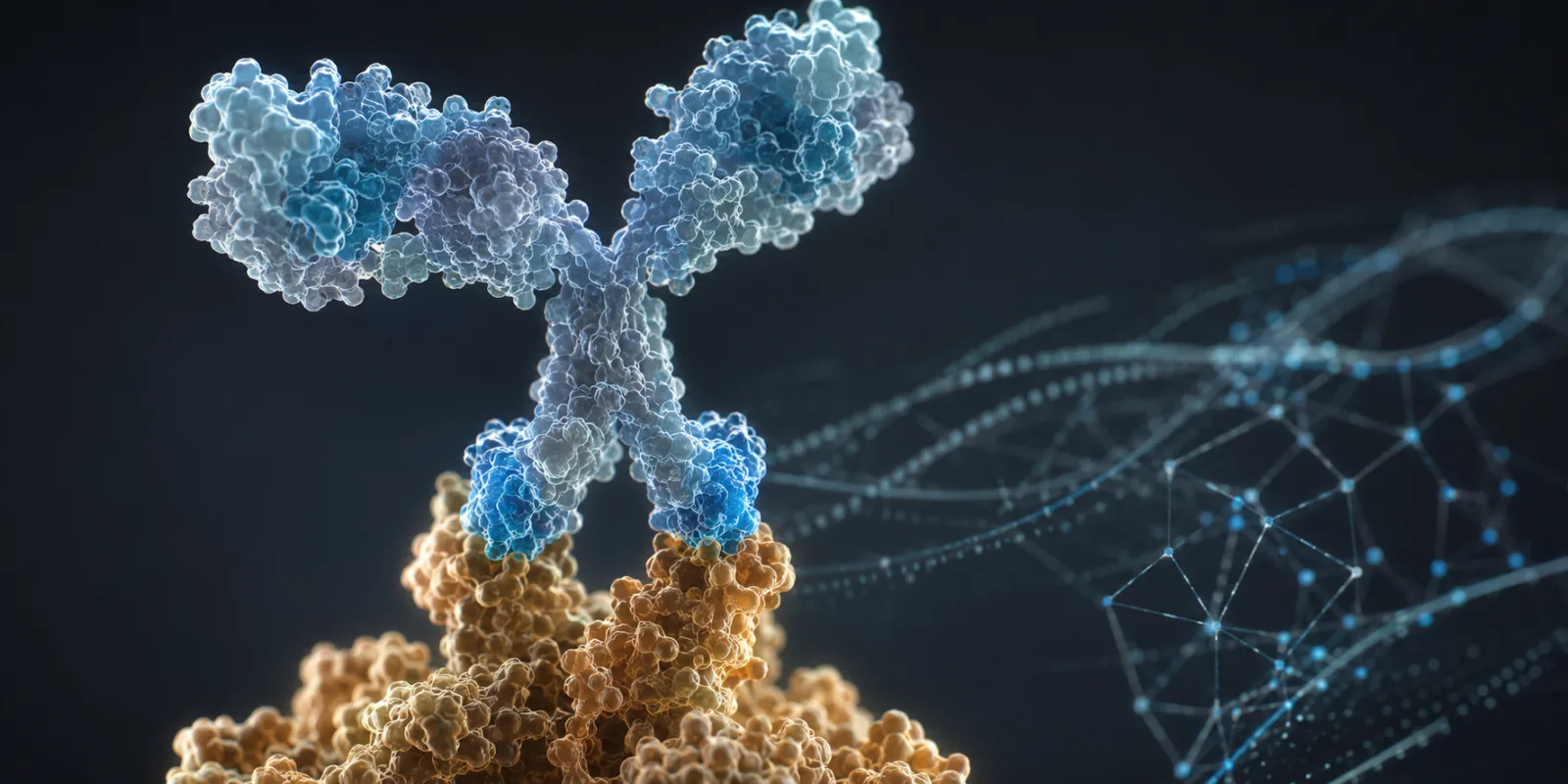
In a second test, the team asked the system to judge whether a protein called CD276 (also known as B7-H3) would make a good drug target for lung cancer. Working only from data published before January 2025, the Virtual Biotech confirmed CD276 as a plausible target and proposed a specific design: an antibody that latches onto CD276, chemically linked to a cell-killing drug, a format called an antibody-drug conjugate. External reviewers judged the proposal credible (Nature).
How do you turn a language model into 37,000 scientists?#
Large language models, the technology behind chatbots such as ChatGPT, Gemini and Claude, are trained to predict text. An "AI agent" wraps one of these models in a loop that lets it take actions, searching a database, running code, or messaging another agent, and then decide what to do next based on the result. A "multi-agent system" simply connects many such agents so they can split up a task and check each other's work.
Most earlier multi-agent science projects worked in small teams. Zou's own previous system, the Virtual Lab, used around five to eight agents modelled on a university research group. It designed new nanobodies (small antibody fragments) against COVID-19 variants, and some of the AI-designed versions bound better than ones designed by human researchers, according to a paper published in Nature in July 2025 (Stanford Report; PubMed). The Virtual Biotech scales that idea up by roughly four orders of magnitude, treating an entire company's headcount, not a single lab team, as the unit of computation.
That scale creates a practical headache: getting thousands of agents to read scientific papers, spreadsheets and trial databases without misreading or inventing details. Zou's team built a tool called Paperclip to handle this, converting messy, human-formatted data into a structured file system that agents can search directly, rather than dumping raw PDFs into a model's context window (VentureBeat; Paperclip on GitHub). The published study ran on versions of Anthropic's Claude models, though Zou has said the design should work with other capable large language models, including open-source ones.
Why this matters#
For biotechnology, the immediate appeal is speed. Reading and cross-referencing tens of thousands of trial reports by hand would occupy a large team of analysts for months; the Virtual Biotech's trial-reading agents got through the job in a matter of hours to days (Stanford Medicine; VentureBeat). If the cell-type-specificity pattern holds up under further scrutiny, it gives drug developers a concrete, checkable filter to apply early, potentially before committing hundreds of millions of pounds to a clinical programme.
For AI research, this is a data point in a live argument about whether "agentic" AI, systems that plan and act rather than just answer questions, can do useful scientific work rather than produce impressive demos. The Virtual Biotech joins a short but growing list of multi-agent systems whose outputs outside experts have judged credible, alongside Google DeepMind's Co-Scientist and FutureHouse's Robin (more on both below).
For public health, cheaper and faster early-stage discovery could eventually mean more attempts at hard-to-treat diseases, including rare cancers and conditions that rarely attract enough commercial interest to justify a traditional discovery budget. That outcome is plausible, not yet demonstrated. The system has not taken a single drug through to approval, and nothing here should be read as medical advice or a signal to expect near-term new treatments.
Critical analysis#
The most important caveat is timing. The Virtual Biotech's CD276 proposal was generated from data published before January 2025, but Merck and Daiichi Sankyo's related antibody-drug conjugate, ifinatamab deruxtecan, had already received FDA Breakthrough Therapy Designation for small-cell lung cancer in August 2025, before the Science paper appeared (Merck). So this was a retrospective test, a blinded backtest against a known outcome, rather than a genuine prediction made and verified afterwards. It shows the system can independently arrive at a strategy that real drug developers judged worth pursuing. That is meaningful. It is not the same as beating human researchers to a genuinely new discovery.
Nature's own coverage is careful on this point: the scientists it quotes note that the Virtual Biotech "has not been vetted in the crucible of real-world drug discovery," and none of its outputs have been tested in a wet lab or a clinical trial (Nature). The cell-type-specificity finding is a statistical association drawn from historical trial records, not a mechanistic proof, and those records carry known gaps and biases, including towards larger companies and better-studied diseases.
There are also open questions about cost and reproducibility. Running tens of thousands of language-model agents is computationally expensive, and the published coverage does not disclose the full cost of the analysis. Academic labs without comparable infrastructure, or without access to a tool like Paperclip, may struggle to replicate or extend the work. And because language models can produce fluent summaries that are still wrong, the reliability of 37,075 largely unsupervised readings of trial data depends on quality-control steps that are difficult for outside reviewers to audit from a published paper alone. Even if the CD276 strategy holds up under further testing, antibody-drug conjugates typically take many years to move from a proposed target to an approved medicine, so any patient benefit that traces back to this kind of AI-assisted target selection is realistically a long way off. None of this erases what the system did. It does mean the result is an early demonstration, not a validated discovery pipeline.
Expert perspective#
The Virtual Biotech did not appear out of nowhere. Google's Co-Scientist, built on its Gemini models, uses a smaller multi-agent debate process to help researchers generate and refine hypotheses, and has since been folded into a broader "Gemini for Science" toolset and validated in its own Nature paper (Google Research; Google DeepMind). FutureHouse's Robin system combined literature-search and data-analysis agents to independently propose an existing glaucoma drug, ripasudil, as a candidate for a form of age-related eye disease, with human scientists then confirming the finding at the bench (FutureHouse).
What sets the Virtual Biotech apart is scale and organisational design more than any new underlying algorithm. Where Co-Scientist and Robin lean on a handful to a few dozen agents working mostly with text, Zou's team modelled an entire corporate hierarchy, thousands of narrowly specialised agents reporting up through divisions to one coordinating "executive," and pointed it at structured trial and genomic data rather than literature alone. It is also a direct scale-up of Zou's own 2025 Virtual Lab, which used a handful of agents and produced nanobodies that were later confirmed to work in the lab (Stanford Report). Whether more agents and more hierarchy produce better science, or just a more expensive route to similar conclusions, is still an open question. Zou's team reports that debate among many agents produced more robust answers than a single large model working alone, though that comparison comes from the researchers themselves rather than an independent benchmark (VentureBeat).
Key takeaways#
- A Stanford-led team built the Virtual Biotech, an AI system of up to 37,000 coordinated agents organised like a drug company, and published the work in Science on 17 September 2026.
- The system read 55,984 clinical trials and found that drugs targeting cell-type-specific genes were substantially more likely to reach the market, with fewer serious side effects.
- Using only data from before January 2025, it proposed an antibody-drug conjugate against CD276 for lung cancer, a strategy that resembles one Merck and Daiichi Sankyo were already developing.
- None of the system's proposals have been tested in a laboratory or a clinical trial. This is an early demonstration, not a validated drug discovery pipeline.
- It is the largest entry yet in a growing lineage of multi-agent AI science systems that includes Google's Co-Scientist, FutureHouse's Robin, and Zou's own smaller 2025 Virtual Lab.
Frequently asked questions#
What is the Virtual Biotech, in one sentence? It is an AI system made of up to 37,000 coordinated software agents, organised like the departments of a drug company, built by a Stanford-led team and described in Science (Nature).
Did the AI actually discover a new drug? No. It proposed a therapeutic strategy, targeting CD276 with an antibody-drug conjugate, that matches an approach already in development elsewhere. Nothing it produced has been tested in patients (Nature).
What AI models power the system? The published study used versions of Anthropic's Claude, though the researchers say the approach should also work with other capable large language models, including open-source ones (Nature).
Is the "Merck confirmed it" claim solid? It is a retrospective match, not a live prediction. The AI used only data from before January 2025, and Merck and Daiichi Sankyo's related drug had already reached Breakthrough Therapy status by August 2025 (Merck; VentureBeat).
How is this different from Google's AI co-scientist? Co-Scientist uses a much smaller group of agents, mainly to generate and debate research hypotheses from text. The Virtual Biotech uses tens of thousands of agents to process structured trial and genomic data at a much larger scale (Google Research).
Can other researchers use this system? The Science paper and an earlier preprint are public, and the team has described its data infrastructure tool, Paperclip, on GitHub. Whether the full multi-agent system is openly available for other labs to run was not stated in the coverage reviewed for this article (bioRxiv; Paperclip).
Why does the January 2025 data cut-off matter? It lets the researchers test the system against a real-world outcome it could not have seen during its analysis, a reasonable stand-in for a genuine prediction, though not identical to one made and published before the outcome was known (Nature).
Does this mean AI will replace drug discovery scientists? Nothing in the study suggests that. The researchers describe the system as working with human oversight and external review at each major step, not as a replacement for them (Nature).
Glossary#
AI agent: Software built around a language model that can take actions, such as searching data or writing code, and adjust what it does next based on the result.
Multi-agent system: A group of AI agents working together, usually by dividing up a task and coordinating through messages or a shared workspace.
Large language model (LLM): An AI system trained on large amounts of text to predict and generate language, the technology underlying tools such as Claude, Gemini and GPT.
Antibody-drug conjugate (ADC): A cancer treatment that pairs a targeting antibody with a toxic drug payload, aiming to deliver the drug specifically to cells carrying the target protein.
Clinical trial phases (I to IV): The stages a drug moves through in human testing, from initial safety testing (Phase I) through effectiveness testing (Phase II and III) to monitoring after approval (Phase IV).
FDA Breakthrough Therapy Designation: A US regulatory status that speeds up the review of a drug showing early evidence of a substantial improvement over existing treatments.
Preprint: A scientific manuscript shared publicly before formal peer review. Findings should be treated as provisional until they pass review and appear in a journal.
Single-cell RNA sequencing: A laboratory technique that measures gene activity in individual cells, revealing which genes are switched on in specific cell types.
References#
- Callaway, E. "How a team of AIs discovered a promising lung-cancer drug." Nature News, 17 September 2026.
- Zhang, H. G., Eckmann, P., Miao, J., Mahon, A. B. & Zou, J. "The Virtual Biotech: A multi-agent AI framework for therapeutic discovery and development." Science, 2026.
- Zhang, H. G. et al. "The Virtual Biotech: A Multi-Agent AI Framework for Therapeutic Discovery and Development." Preprint (not peer reviewed), bioRxiv, posted 23 February 2026.
- Armitage, H. "Virtual biotech company puts thousands of AI scientist agents to work on drug discovery." Stanford Medicine News, 17 September 2026.
- Dickson, B. "Stanford's AI agents designed a drug Merck later built, too." VentureBeat, 7 August 2026.
- Merck & Co. "Ifinatamab Deruxtecan Granted Breakthrough Therapy Designation by U.S. FDA for Patients with Pretreated Extensive-Stage Small Cell Lung Cancer." Merck.com, August 2025.
- Swanson, K. et al. "The Virtual Lab of AI agents designs new SARS-CoV-2 nanobodies." Nature, 29 July 2025.
- Stanford Report. "Researchers create 'virtual scientists' to solve complex biological problems." 29 July 2025.
- Google Research. "Accelerating scientific breakthroughs with an AI co-scientist."
- Google DeepMind. "Co-Scientist: A multi-agent AI partner to accelerate research."
- FutureHouse. "Demonstrating end-to-end scientific discovery with Robin: A multi-agent system."