The hard part of genetic medicine was never writing the instructions. Scientists have known for years how to spell out a therapeutic message in RNA. The stubborn problem is getting that message inside the right cell, intact, without the body destroying it or the carrier piling up where it does harm. On 2 September 2026, a team in Munich reported something that shifts the problem in an unexpected direction. Instead of tweaking the fatty bubbles the industry currently relies on, they let an artificial intelligence design the courier from scratch, and it beat the fatty bubbles they tested it against.
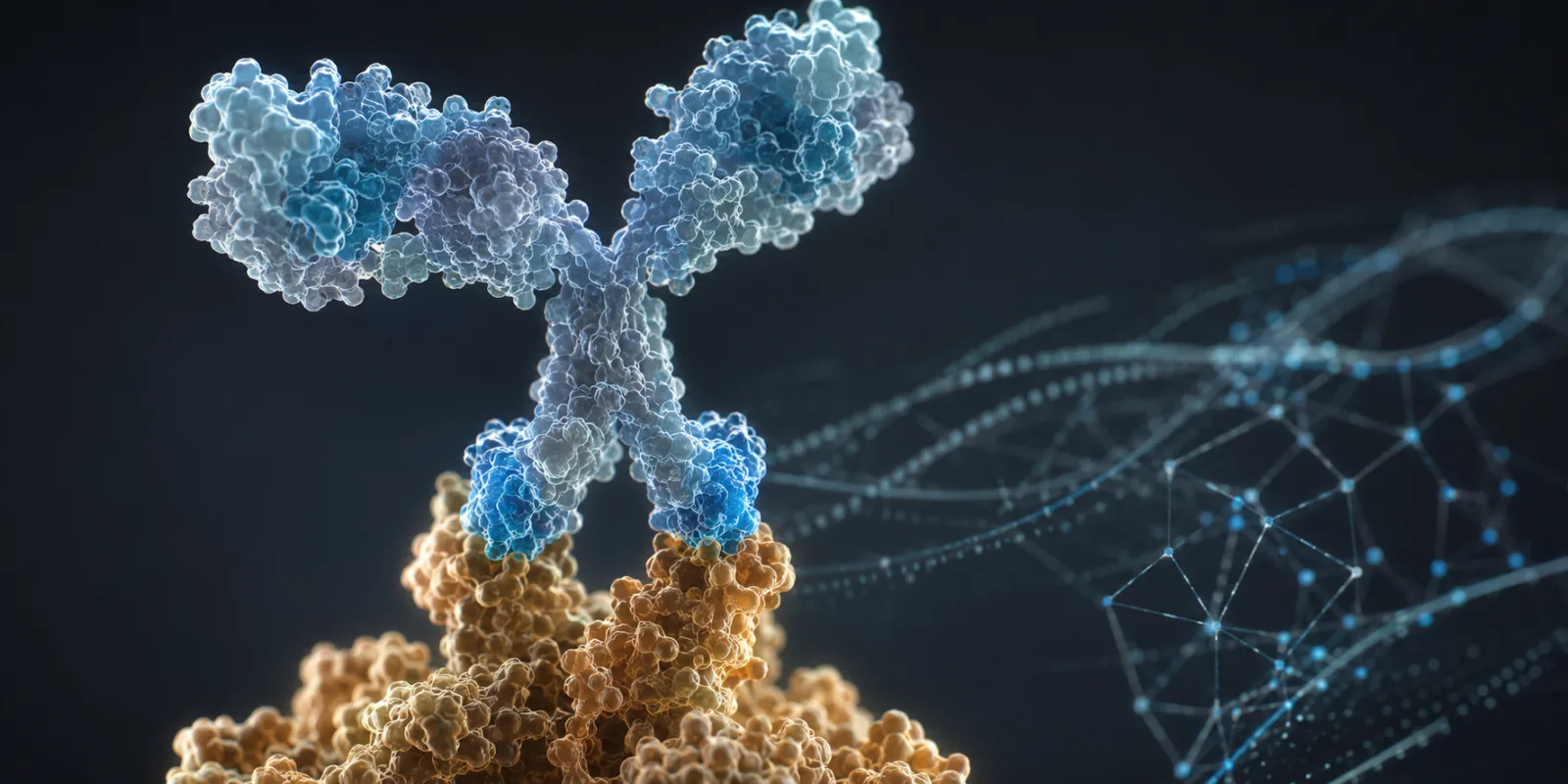
Researchers at Helmholtz Munich and the Technical University of Munich described a new category of RNA carrier they call Synthetic Transfer Vehicles, or STVs, in the journal Nature. Each vehicle pairs functional protein parts borrowed from nature with a structural protein invented by a generative AI model. That designed protein forms the scaffold, the outer shell that holds everything together, and it can take on shapes that do not exist in any natural virus or cell.
The team built and screened more than a hundred variants. The surprise was that some of the best performers had geometries with no natural equivalent. One candidate, named STV-C8, came out on top. In cell culture it delivered its RNA cargo more efficiently than both the virus-like particles and the lipid nanoparticles the researchers put it up against. To get the same amount of protein produced inside cells, STV-C8 needed considerably less RNA. It could also be reloaded with different cargoes and pointed at different target cells, which is the kind of modularity a delivery platform needs if it is going to be useful for more than one disease.
Then they moved into animals. Injected into the bloodstream of mice, STV-C8 mostly switched on its cargo in the lungs, and the researchers saw no signs of immune reaction or toxicity. In a more demanding test, they packed the vehicle with the CRISPR/Cas9 gene-editing system, injected it into the muscle of a pig, and removed a stretch of the dystrophin gene that is faulty in Duchenne muscular dystrophy. Getting a working edit done in a large-animal muscle is a meaningful step up from a dish of cells.
Why delivery, not design, is the hard part#
To see why this matters, it helps to separate two jobs that often get blurred together. The first is designing the drug. In an RNA therapy, the drug is a genetic message: a strand of RNA that tells a cell to make a particular protein, or, in the case of gene editing, to cut and repair a specific piece of DNA. We have become good at writing these messages. The COVID-19 vaccines were the mass-market proof that RNA drugs work.
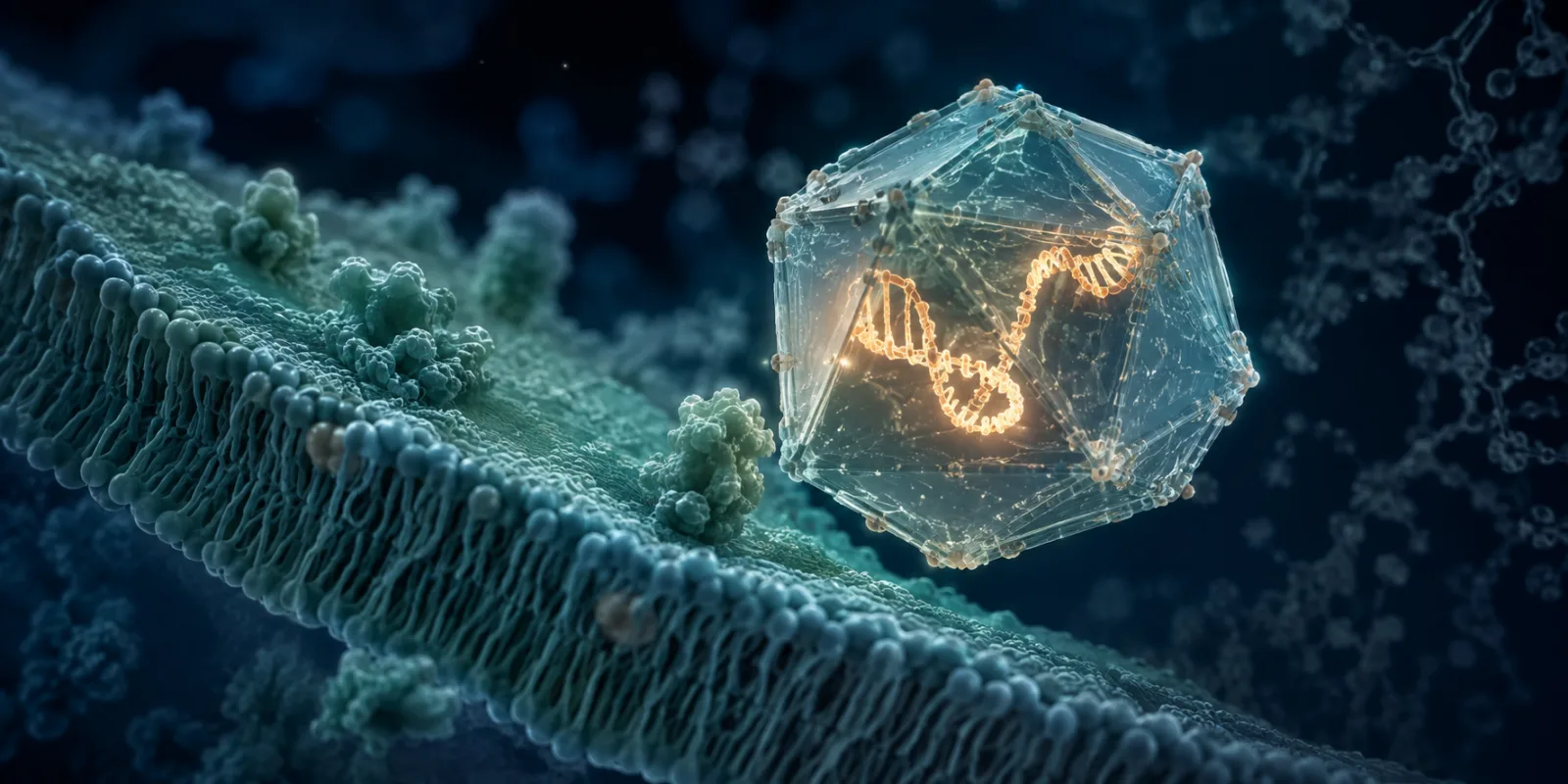
The second job is delivery. RNA is fragile and the body treats loose RNA as a threat, so the message has to be wrapped in a protective carrier that slips it inside the cell. Today there are two main options, and the Munich team's press materials note that both come with limits. Viral vectors, repurposed from real viruses, are efficient but can provoke immune responses and are awkward to manufacture. Lipid nanoparticles, the tiny fat droplets used in the mRNA vaccines, are easier to make but tend to accumulate in the liver after they enter the bloodstream. That liver bias is fine if the liver is your target and a real obstacle if it is not. Much of the recent work on nanoparticles has been about coaxing them to go somewhere else.
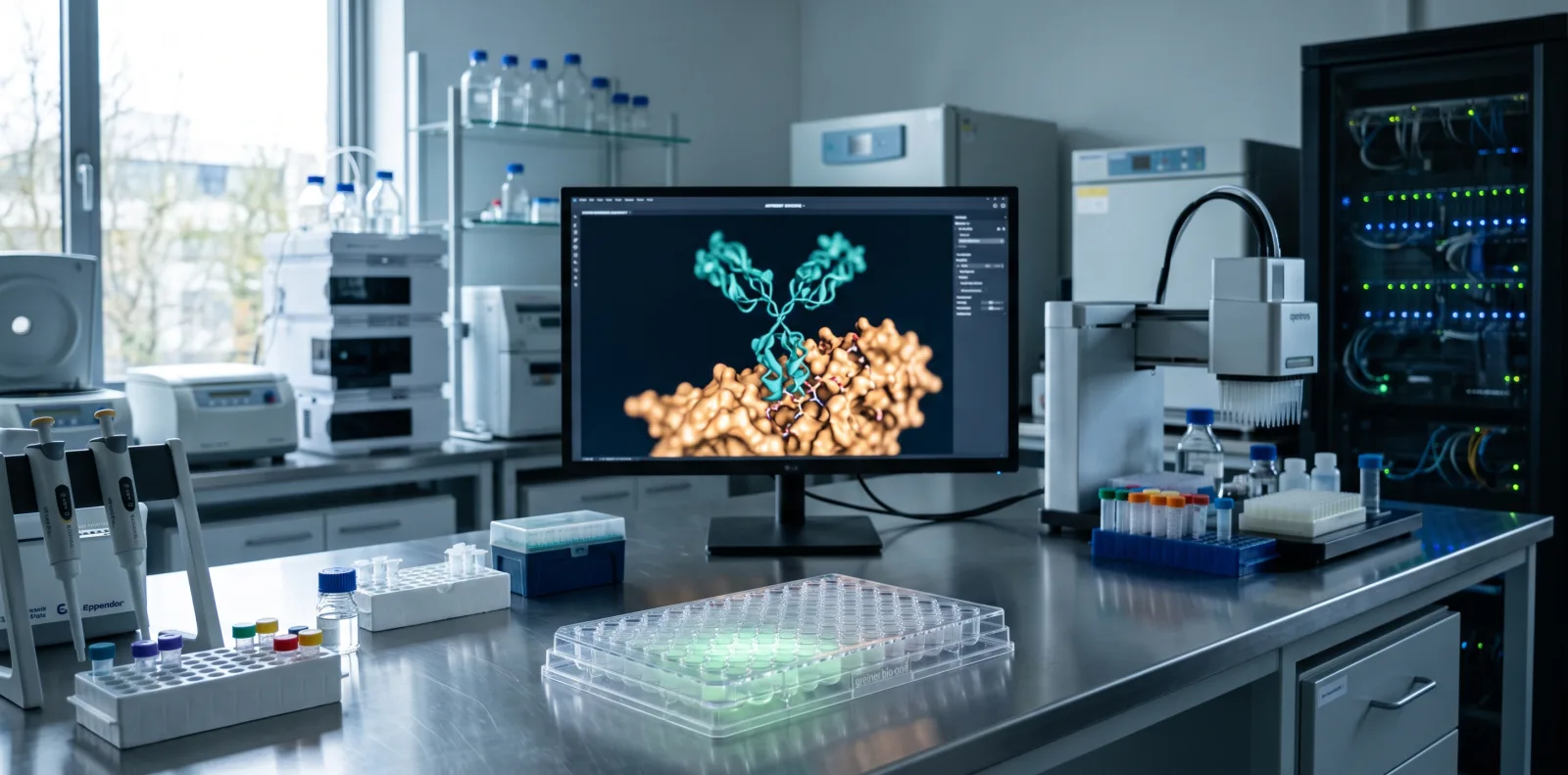
The STV approach sidesteps that history by designing the carrier rather than adapting an existing one. This is where the AI comes in. Over the past few years, generative models have learned to invent proteins that have never existed, specifying a shape and letting the software work out an amino-acid sequence that will fold into it. The field matured enough that the 2024 Nobel Prize in Chemistry went to David Baker for computational protein design and to Demis Hassabis and John Jumper for predicting protein structures with AlphaFold. Tools such as Baker's RFdiffusion turned protein design from a lottery into something closer to engineering. What the Munich group has done is aim that capability at the delivery problem specifically, building a shell whose only job is to carry RNA well.
Why this matters#
If the result holds up, the significance is less about one particle and more about the method. Delivery is the shared bottleneck across genetic medicine. A better editor, a cleverer RNA sequence, a smarter drug, all of it stalls at the same question: how do you get it into the cell you care about and nowhere else? A carrier that can be redesigned on demand, and steered toward chosen tissues, would loosen that bottleneck for a whole class of therapies rather than a single product.
The modularity is the commercially interesting part. Because the shell is designed rather than borrowed, its properties can in principle be dialled in: the cargo it carries, the cells it targets, how the immune system sees it. That is a different proposition from the current practice of screening large libraries of lipids and hoping one behaves. The Munich team is explicit that this is a starting platform, and they intend to spin the technology into a company.
There is also a pointed lesson about the AI itself. The best vehicles had non-natural geometries, structures evolution never produced. That is a small but telling argument that generative design can explore parts of the protein universe biology skipped, and occasionally find something better out there. For biotech founders and researchers, the takeaway is that the design space for delivery is far larger than the handful of viral and lipid formats the industry has been recycling.
Critical analysis#
A cooler read is warranted, because the claims are strong and the evidence is early. Start with the comparison. STV-C8 beat "the lipid nanoparticles tested," which is not the same as beating the best clinical-grade nanoparticle formulations that companies have spent years optimising. The size of the advantage will depend heavily on which benchmarks it is measured against, and independent groups will need to reproduce it.
The animal data, while encouraging, is preliminary. In mice, the vehicle expressed its cargo mainly in the lungs after intravenous injection. That is interesting, but lung tropism is a property to be characterised, not yet a targeting system you can aim. The pig experiment used a local injection straight into muscle, which bypasses the much harder challenge of surviving the bloodstream and reaching a distant tissue. The published summary reports that a disease-relevant edit was made; the field will want to see how efficient and how precise that edit was across the tissue.
Two familiar problems remain unsolved, and the authors say so plainly. The first is targeting: getting the vehicle to specific cell types and controlling where it goes in the body. The second, unstated but real for any protein-based carrier, is immunogenicity on repeat dosing. A protein shell the immune system has seen once may be cleared faster, or provoke a reaction, the second time. Manufacturing a designed protein assembly at consistent quality and scale is its own engineering project. None of this is fatal, but it is the reason the researchers describe STV-C8 as experimental and put clinical use some years away. This work is peer-reviewed, not a preprint, which raises the bar of confidence, yet peer review certifies the experiments, not the eventual medicine.
Expert perspective: designing the van, not the parcel#
The clearest way to place this work is against what came before it. For two decades, delivery innovation meant chemistry and repurposed biology: better ionisable lipids, engineered adeno-associated virus capsids, clever coatings. Even the recent wave of AI in this space mostly improved the payload. Jennifer Doudna's group, for instance, used AI to design new gene-editing enzymes earlier in 2026, better molecular scissors. That is designing the parcel.
The STV work designs the van. It treats the delivery shell as a first-class object to be invented, not a hand-me-down to be tuned, and it does so from the bottom up out of protein parts. That framing is what makes it genuinely different from lipid-nanoparticle optimisation or capsid engineering. It sits alongside the parallel effort to design AI protein capsids, but rather than trying to rebuild a natural viral shell more precisely, the Munich team let the model wander off the map of natural shapes and kept whatever worked. Whether designed vans or improved parcels win in the clinic is unknown. What is now clear is that both halves of a genetic medicine, the message and the messenger, are becoming design problems for AI.
Key takeaways#
- A generative AI designed the protein shell of a new RNA carrier, and in cell tests the winning design outperformed the lipid nanoparticles it was compared with while using less RNA.
- The system, called STV-C8, is modular: it can carry different RNA cargoes and be aimed at different cells, which matters more for a platform than any single result.
- It worked in living animals, expressing its cargo in mouse lungs without obvious toxicity and delivering a CRISPR edit to the dystrophin gene in pig muscle.
- The most effective shells had geometries with no natural equivalent, evidence that AI can find useful proteins evolution never made.
- It is early-stage and peer-reviewed but preclinical; targeting, repeat-dose immune response, and manufacturing remain open, and clinical use is years away.
Frequently asked questions#
What is a Synthetic Transfer Vehicle? It is a laboratory-built particle for carrying RNA into cells. It combines natural protein parts with an AI-designed scaffold protein that forms the outer shell. STV-C8 is the best-performing version the team found.
How is this different from the mRNA vaccines? The vaccines wrap their RNA in lipid nanoparticles, droplets of fat-like molecules. STVs replace that fatty droplet with a designed protein shell, aiming for more efficient and more targeted delivery.
Did the AI design the whole thing? No. The AI designed the structural scaffold, the shell. Functional protein building blocks that come from nature do other jobs, such as packaging the RNA. The novelty is that the shell's shape was invented rather than copied.
Does this cure Duchenne muscular dystrophy? No. The pig experiment showed the vehicle could deliver a CRISPR edit to the relevant gene in muscle. That is a proof of concept in an animal, not a treatment. Many steps remain before any human use.
Is it better than lipid nanoparticles? It outperformed the specific lipid nanoparticles the researchers tested, in cells. It has not been compared against every optimised clinical formulation, and independent replication is still needed.
Is this peer-reviewed or a preprint? Peer-reviewed. It was published in Nature. That strengthens confidence in the experiments, though it does not guarantee the approach will become a medicine.
When could this reach patients? The researchers describe it as experimental and plan to develop it through a spin-off company. Realistically that means years of further work on targeting, safety and manufacturing before clinical trials.
Glossary#
RNA therapeutic: A drug made of RNA that instructs cells to make a specific protein or to edit a gene, rather than a conventional small-molecule pill.
Lipid nanoparticle (LNP): A tiny droplet of fat-like molecules used to protect and deliver RNA, as in the COVID-19 vaccines. LNPs tend to concentrate in the liver after entering the blood.
Viral vector: A delivery system built from a modified virus. Efficient at entering cells but can trigger immune responses and is complex to manufacture.
Generative AI protein design: Software that invents new proteins by specifying a target shape and computing an amino-acid sequence that folds into it. RFdiffusion is a well-known example.
De novo protein: A protein designed from scratch, with a structure or function not found in nature.
CRISPR/Cas9: A gene-editing tool that uses a guide molecule to find a specific DNA sequence and an enzyme to cut it, allowing genes to be disabled or corrected.
Dystrophin: A protein that stabilises muscle cells. Faults in the dystrophin gene cause Duchenne muscular dystrophy, a severe muscle-wasting disease.
Tropism: The tendency of a delivery particle to end up in particular tissues, such as the liver or lungs.
References#
- Schuhmacher et al., 2026. "Creating bottom-up RNA transfer vehicles from synthetic protein assemblies." Nature. DOI: 10.1038/s41586-026-10952-3. Peer-reviewed primary source.
- Helmholtz Munich, 2 September 2026. "AI-Designed Proteins Enable a New Generation of RNA Transporters.". Official institutional announcement with author quotes.
- The Royal Swedish Academy of Sciences. "The Nobel Prize in Chemistry 2024" press release.. Official source on computational protein design and structure prediction.
- Hou et al., 2021. "Lipid nanoparticles for mRNA delivery." Nature Reviews Materials. Background on LNP delivery.
- Di et al., 2024. "Reformulating lipid nanoparticles for organ-targeted mRNA accumulation and translation." Nature Communications. On LNP liver accumulation and organ targeting.
- Nature News, July 2026. "CRISPR gets a power boost from AI-designed 'molecular scissors'.". Context on AI-designed gene-editing enzymes.
- EurekAlert / University of California, 2026. "AI model creates functional CRISPR-like nucleases beyond nature's designs.". Doudna group's AI-designed nucleases.
- C&EN, May 2026. "New AI-designed protein capsids go large for genetic medicine.". Parallel AI capsid design efforts.
- Chemistry World. "Protein design takes big leap forward as model produces enzymes almost as effective as nature's.". On RFdiffusion and de novo design.
- Duan et al., 2022. "Therapeutic Strategies for Dystrophin Replacement in Duchenne Muscular Dystrophy." Frontiers in Medicine. Background on DMD and the dystrophin gene.
This article is for information only and is not medical advice. It describes early-stage, preclinical research; findings in cells and animals do not always translate to people.