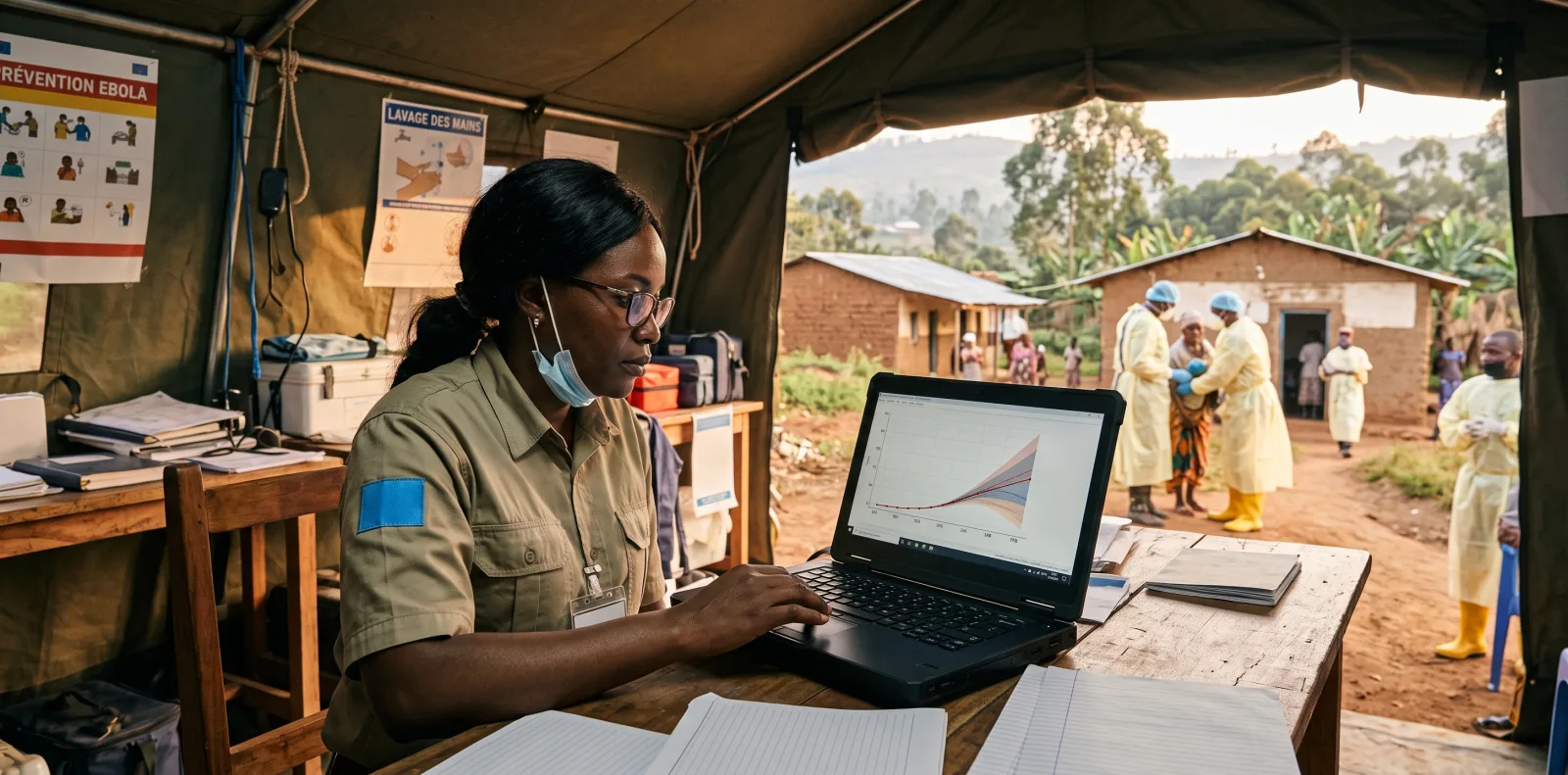
The official tally says one thing. A statistical model, refreshed every few days and partly written by an AI, says the real number is closer to double. As the Democratic Republic of the Congo's Bundibugyo Ebola outbreak becomes the largest the country has ever recorded, the figure that should worry us most is not the one health ministries publish. It is the one nobody can directly see.
Over the weekend of 22 to 23 August, the World Health Organization and Africa CDC warned that the outbreak in eastern DRC is on track to surpass the 2014 to 2016 West Africa epidemic, the deadliest Ebola event in history, which killed more than 11,000 people. As of 19 August, DRC had confirmed 5,290 cases and 2,516 deaths, and the United Nations described the epidemic as "growing exponentially", with half of all deaths occurring in the previous 20 days.
The confirmed count, though, is almost certainly a fraction of the truth. Africa CDC now estimates that only 30 to 40 per cent of infections are being detected. Here is where artificial intelligence enters the story. A team at the London School of Hygiene & Tropical Medicine runs a live Bayesian model that reads the surveillance data and works backwards to the outbreak that must have produced it. In its 15 August update, using data to 11 August, the model estimated roughly 8,600 to 10,300 total infections against 4,567 laboratory-confirmed cases at that point: between 1.5 and 3.2 times the official figure. One detail sets this apart from previous outbreaks. The developers note plainly that the model's code and analysis were "drafted by a language model, then reviewed and revised under human oversight".
How do you count an epidemic you cannot see?#
Ebola is not one virus but several. This outbreak is caused by Bundibugyo ebolavirus, a species first identified in Uganda in 2007 and, until this year, one of the more obscure members of the filovirus family. It causes the same brutal haemorrhagic disease as the better-known Zaire strain, but here is the trouble: there is no licensed vaccine and no approved treatment designed specifically for it. The therapies stockpiled over the past decade were built and tested against a different species.
Counting such an outbreak in real time is genuinely hard. Cases are confirmed only after someone falls ill, seeks care, is tested, and has that result reported, and each of those steps takes time and can fail. In a region fractured by armed conflict and displacement, most steps fail often. The technique used to see through this fog is called nowcasting: rather than predicting the distant future, it estimates the present that the data have not yet revealed. The LSHTM model treats infection as a renewal process, a mathematical description of how each case seeds the next, and fits several surveillance streams at once. From this it recovers the hidden quantities that matter: the true number of infections, the reproduction number (how many people each case infects on average), and the ascertainment rate (the share of infections that ever get counted).
A word on what "AI" means here, because the term is doing a lot of quiet work. This is not a deep-learning oracle that pattern-matches its way to an answer. It is a transparent statistical model whose code happened to be written with the help of a large language model, the same class of system behind chatbots, and then checked by named scientists who take responsibility for it. That distinction matters for how much trust the output deserves.
Why this matters#
The immediate value is that a hidden epidemic can now be given a number, and numbers drive decisions. If the real caseload is two to three times the confirmed figure, then vaccine doses, treatment beds and contact-tracing teams are being planned against a target that is far too small. On 18 August, the International Coordinating Group released 70,000 doses of the Ervebo vaccine from the global stockpile, 20,000 of them for a Phase 3 trial to test whether a vaccine licensed against the Zaire strain offers any protection against Bundibugyo. Knowing the probable scale of unseen transmission changes where those doses should go.
The wider significance is about how outbreaks are read at all. A decade ago, this kind of estimate would have arrived weeks late in a journal. Today it is open-source, rebuilt every time new data land, and public for any ministry or journalist to inspect. Computational epidemiology has quietly become part of the standard toolkit, and generative AI is starting to lower the effort of building the tools themselves. The same shift is visible elsewhere in this response: researchers at the Southwest Research Institute used AI molecular-screening software to identify 23 antiviral candidates aimed at Bundibugyo, and genomic sequencing of 139 viral samples let WHO estimate that transmission began as early as February 2026, months before anyone raised the alarm.
Critical analysis#
The honest limitation is the oldest one in computing: garbage in, garbage out. A model can only reconstruct an outbreak from the signals it is fed, and those signals are thinning. Since situation report 084 on 6 August, DRC's national institute has published a shorter brief that no longer includes the daily new-suspected-case stream, leaving the model to lean on just four data series for its most recent weeks. On the ground, contact tracing is reaching only 16 per cent of the contacts that case numbers imply should exist, and 97 per cent of deaths reported on 17 August happened in the community rather than in treatment centres. No amount of clever inference conjures information that was never collected.
The uncertainty is also wide, and the model is candid about it. Its estimate of whether the outbreak is currently growing or shrinking straddles zero: the latest reproduction number sits around 0.9 to 1.1, meaning the epidemic could be slowly receding or still climbing, and the data cannot yet say which. That ambiguity is not a flaw so much as an honest readout of thin surveillance.
Then there is the novelty itself. Scientific code drafted by a language model is efficient, but it raises real questions about verification and reproducibility. Models of this kind have a mixed record. During the 2014 epidemic, some widely reported projections overshot the eventual toll by a large margin because they assumed no change in behaviour or response. The CDC's own 2026 scenario projections for this outbreak show the same sensitivity, ranging from a few thousand cases to well over twenty thousand depending on how much isolation holds. The teams working today are far more careful to label their output as a situational assessment rather than a prediction. Even so, a plausible central estimate wrapped in a wide interval should be read as a working guide, not a settled fact.
Finally, AI cannot fix the parts of this crisis that are not technical. The reasons Bundibugyo has spread so far, the armed groups, the collapse in community trust, the shortage of protective equipment that has already killed 45 health workers, are human and political. A better estimate of the epidemic's size does not, by itself, put a single responder in a village.
Expert perspective#
Set against earlier outbreaks, the change is one of speed and openness rather than a single breakthrough. During the 2018 to 2020 Kivu epidemic, AI was used mainly to map where cases were emerging and how that overlapped with conflict zones. What is new in 2026 is that the analysis is continuous, public and, for the first time, partly authored by generative AI.
There are competing schools, too. The LSHTM group favours a renewal-process model that infers the hidden present; a WHO-led team publishing in The Lancet Infectious Diseases used a different stochastic simulation to project cross-border risk, estimating a 94 per cent chance the virus would reach Uganda and a 69 per cent chance of spillover into South Sudan, both since partly borne out. These approaches disagree in their machinery but increasingly agree in spirit: publish early, quantify the uncertainty, and update as reality intrudes.
The same pattern is emerging for the other pathogen on every preparedness watchlist, H5N1 avian influenza, where researchers have built AI tools that scan hospital records to flag likely human cases that clinicians might miss. The lesson repeats across diseases. AI earns its keep here by squeezing more signal out of imperfect surveillance, which is a good deal more modest than the crystal ball the marketing sometimes implies.
Key takeaways#
- Congo's 2026 Bundibugyo outbreak is the largest Ebola epidemic in the country's history, with 5,290 confirmed cases and 2,516 deaths as of 19 August, and is on course to become the largest ever recorded.
- A live, AI-assisted nowcasting model estimates the true number of infections at roughly 1.5 to 3.2 times the confirmed count, consistent with Africa CDC's judgement that only 30 to 40 per cent of cases are being detected.
- The "AI" here is a transparent Bayesian model whose code was drafted by a language model and checked by scientists, not an opaque predictive engine.
- The estimate is only as good as the shrinking data feeding it; contact tracing reaches just 16 per cent of expected contacts, and the model cannot yet say whether the epidemic is growing or receding.
- AI is reshaping outbreak response across surveillance, drug discovery and diagnostics, but it cannot substitute for vaccines, trust or safe access in a conflict zone.
Frequently asked questions#
What is Bundibugyo virus, and how is it different from other Ebola? It is one of the species that make up the Ebola virus family, first identified in Uganda in 2007. It causes similar severe haemorrhagic disease to the familiar Zaire strain but tends to be somewhat less transmissible. The critical difference is that no vaccine or treatment is licensed specifically against it.
How can a model estimate more cases than have been confirmed? By working backwards. Confirmed cases are only the infections that were tested and reported, which always lags real transmission. Nowcasting models use the timing and pattern of the data, plus what is known about the disease, to estimate how many infections must have occurred to produce what we observe.
Is the AI making predictions about the future? Not primarily. The main task is nowcasting: estimating the present that surveillance has not yet caught up with. The model does produce a short one-week-ahead forecast, but its authors stress these are situational assessments, not firm predictions.
Should I trust a model whose code was written by an AI? Cautiously, and for the right reasons. The AI drafted the code, but named scientists reviewed it and take responsibility, and the whole thing is open-source and inspectable. Trust should rest on that transparency and the wide, honestly reported uncertainty, not on the AI label.
Is this outbreak a threat outside Africa? WHO rates the risk as very high within DRC and high for neighbouring countries, particularly Uganda, South Sudan and the Central African Republic, but low for the wider world. Single imported cases have been handled in Uganda, France and Germany without onward spread.
What is being done about vaccines and treatment? The global stockpile has released 70,000 Ervebo doses, including 20,000 for a trial to test whether the Zaire-strain vaccine protects against Bundibugyo. A separate trial, PARTNERS, is testing antiviral therapies, and two purpose-built Bundibugyo vaccine candidates are in earlier development.
How does this compare with H5N1 preparedness? The theme is shared: AI is being used to strengthen weak surveillance, such as tools that scan medical records for likely H5N1 cases. In both diseases, AI amplifies imperfect data rather than replacing the hard work of detection and response.
References#
Note on sources: the nowcasting model discussed here is a live, self-published analysis that has not been through formal peer review.
- Global Biodefense. "Congo's Ebola Outbreak Could Be Three Times Its Confirmed Size as Vaccine Doses Finally Arrive." 23 August 2026.
- World Health Organization. "WHO Rapid Risk Assessment: Ebola Disease Caused by Bundibugyo Virus, DRC (v4)." 20 August 2026.
- Abbott S, Sherratt K, Brand S, Funk S. "BVDOutbreakSize: estimating the current size of the 2026 DRC Bundibugyo virus outbreak." London School of Hygiene & Tropical Medicine, live report, updated 15 August 2026. Live self-published analysis (not peer reviewed).
- MedPage Today. "Data Show How Congo's Ebola Outbreak Is on Track to Surpass History's Largest." 22 August 2026.
- UPI. "Ebola outbreak in DRC 'growing exponentially,' UN warns." 23 August 2026.
- Chamla D, et al. "Size of the 2026 Ebola outbreak and risk of cross-border spillover from Bundibugyo virus in Ituri Province, DR Congo." The Lancet Infectious Diseases, 25 June 2026.
- EurekAlert / The Lancet. "Growing DRC Ebola outbreak has already spread to Uganda with 70% chance of reaching South Sudan." 25 June 2026.
- UN News. "DR Congo receives 70,000 Ebola vaccine doses as Bundibugyo outbreak spreads." 20 August 2026.
- Drug Target Review. "AI identifies 23 antiviral drug candidates for rare Bundibugyo Ebola strain outbreak." 26 May 2026.
- US CDC. "Modeled Scenario Projections for the Ebola Disease Outbreak Caused by Bundibugyo Virus, 2026." MMWR, 2026.
- Semafor. "How AI is helping fight the latest Ebola outbreak." 12 June 2026.
- CIDRAP. "AI tool can help identify patients who may have H5N1 avian flu, researchers say."