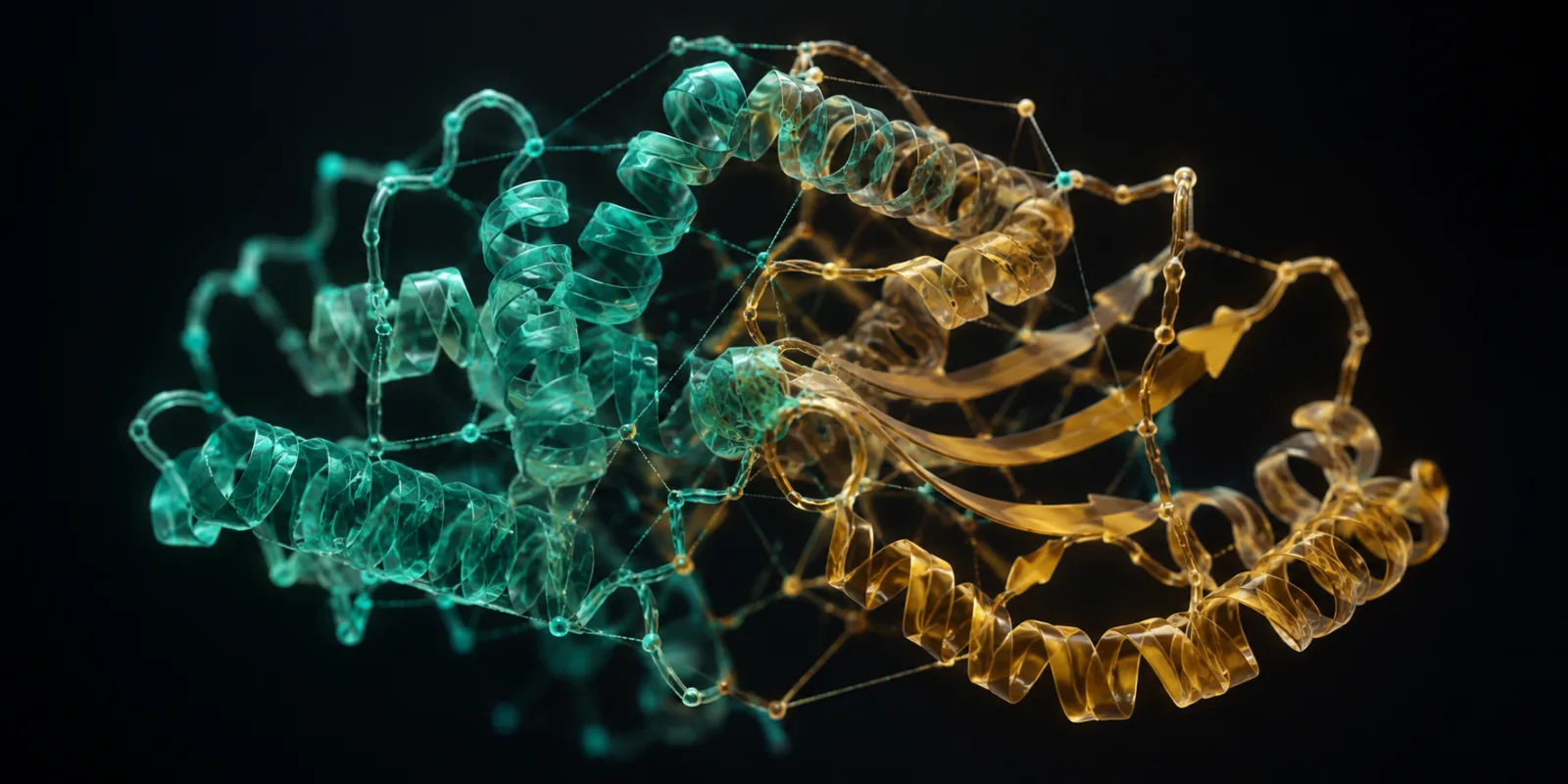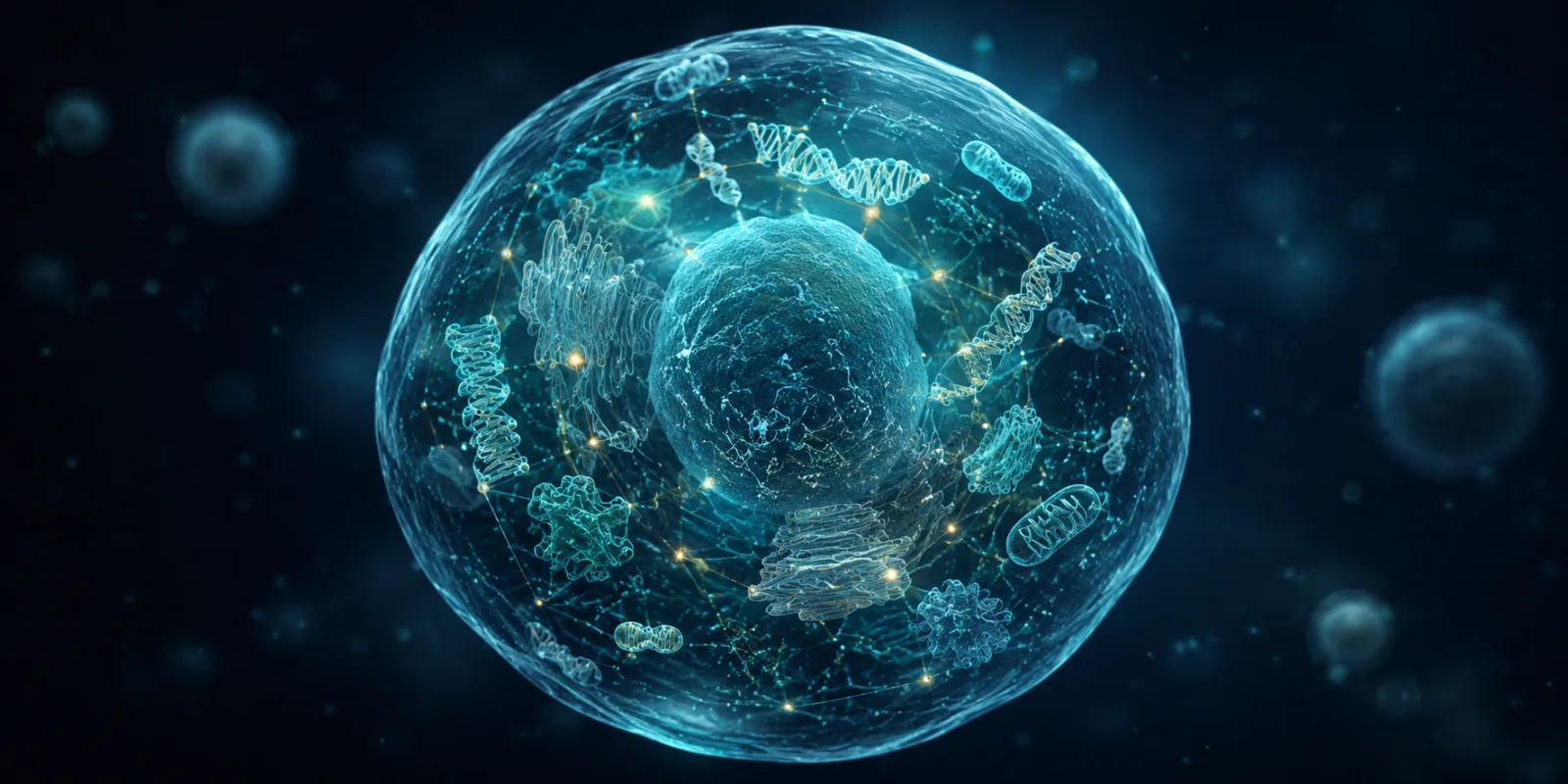
"Imagine Google Earth, but for a human cell." That is how one of the scientists behind AIDO Cell described it to STAT News: zoom in and, instead of streets, you find proteins, RNA and DNA; knock out a gene or add a drug, and the system predicts how the whole landscape shifts.
For most of the past decade, artificial intelligence in biology has been very good at predicting single pieces. One model guesses a protein's shape. Another scores how active a gene is. AIDO Cell, unveiled on 18 August 2026, is an attempt to model the pieces together, as one connected system. It arrived in the same week that the European Commission's in-house science service published a sweeping audit warning that biological AI is advancing faster than the checks meant to keep it trustworthy. That timing is worth sitting with.
What happened?#
The Palo Alto company GenBio AI announced AIDO Cell, which it calls a general-purpose simulator for cell biology, or a "world model of the human cell". Two properties set it apart from earlier tools. It is multiscale, meaning a change at one level (a gene edit, say) ripples through to RNA, protein and the cell's overall behaviour. And it is stateful: the simulated cell remembers what you did to it, so you can run a sequence of experiments that build on each other rather than starting fresh every time.
To measure a system this broad, GenBio built its own yardstick, the Virtual Cell Benchmark 1.0, which pools public biological atlases into 31 metrics across five task families: small-molecule perturbation, genetic knockout, protein structure, RNA splicing and genome regulation. By the company's own account, AIDO Cell is the only system that covers all five families, and it reaches state-of-the-art results on 24 of the 31 metrics, while specialist models such as AlphaFold 3 or the single-cell tool scGPT each address only one or two.
The first release simulates two long-studied human cell lines, K-562 and Hep-G2, derived from a leukaemia patient and a liver-cancer patient respectively. As an early demonstration, GenBio says the system reproduced the known action of the cancer drug imatinib in K-562 cells and, running the simulation in reverse, designed novel molecules that recovered 65 to 88 per cent of imatinib's gene-expression signature with quite different chemistry. Access is currently limited to the company and a handful of alpha collaborators, with a wider early-access programme in preparation.
One caveat matters up front. These claims come from GenBio's own technical report, which is available on their site rather than through a peer-reviewed journal. Independent coverage notes that the company has not yet disclosed full quantitative comparisons or prospective laboratory validation. Treat the numbers as a vendor's benchmark, not settled science.
The launch also coincided with an independent reality check. On 24 August, the European Commission's Joint Research Centre published a report on AI for biology, based on a dataset of 480 biological AI models. Its headline finding is directly relevant: this kind of AI is progressing fastest where data are rich and standardised, such as protein structure, and much more slowly in areas like single-cell biology, exactly the messy, data-scarce territory AIDO Cell is trying to conquer.
From protein shapes to whole-cell simulation#
Much of AI-for-biology rests on a simple analogy: the sequences of life resemble language. A protein is a string of amino acids; DNA is a string of bases. Feed enough of these strings into the same kind of model that powers chatbots, a foundation model, and it learns statistical patterns, or "grammar", that generalise to new sequences. That insight produced AlphaFold, which predicts a protein's three-dimensional shape from its sequence and helped earn its creators a share of the 2024 Nobel Prize in Chemistry, alongside GenBio co-founder David Baker for his separate work on protein design.
A cell, though, is more than a bag of protein shapes. Its behaviour comes from transcriptomics (which genes are switched on), regulation, splicing and physical structure, all interacting at once. Single-cell foundation models such as scGPT and Geneformer learned useful representations from gene-activity data, but they largely focused on that one modality. Stitching separate specialist models into a pipeline does not truly capture how the parts influence one another. Building a genuine "virtual cell" that integrates these layers has become a stated ambition for the field, laid out in a widely cited 2024 article in Cell.
AIDO Cell's twist is borrowed from a different corner of AI. A world model is the type of system that lets an AI simulate an environment, keep an internal record of its state, and predict how that state changes when an action is taken, the same idea used to build game engines that respond to a player. GenBio applies that to biology: the cell's condition is held as one shared internal state, an intervention modifies it, and any measurement, from chromatin to cell shape, can be read out from that single state. Because those readouts come from one representation, they stay consistent with each other. A perturbation, in this context, simply means any deliberate nudge to the cell, such as switching off a gene or adding a compound.
Why this matters#
The most immediate promise is in drug discovery. GenBio frames the problem starkly: of 10,000 compounds that enter the pipeline, on average only one reaches the clinic, after more than a decade and a cost the company puts above two billion dollars. A simulator that could triage bad ideas before the bench, or design a molecule for a desired cellular effect rather than a single protein target, might trim some of that waste. AIDO Cell's "in-context molecular design", generating candidates and testing them on cloned virtual cells in one loop, is a concrete example of that ambition.
There is a subtler point about data-scarce biology. GenBio reports early signs of cross-context scaling: training on several cell lines improved predictions on a cell line held out entirely from training. If that holds up, it hints that a model could reach conditions we cannot easily sample in the lab, such as rare-disease cells or living brain tissue, by borrowing knowledge from contexts it has seen. That is precisely the frontier the JRC report flags as underdeveloped, and where progress would matter most.
Finally, there is trust. The JRC coins a useful phrase, the "maturity paradox": models like AlphaFold and ESM3 are scientifically advanced yet sit at low-to-mid technology-readiness levels, and none has passed an integrated readiness assessment for clinical or industrial use. A more powerful virtual cell sharpens that gap between "impressive on a benchmark" and "safe to rely on", and raises biosecurity questions the report says need close attention.
Critical analysis#
A single shared state that spans DNA to cell shape, that remembers previous interventions, and that can run in both directions (predict a drug's effect, or design a drug for an effect) is a genuinely different design from the one-task tools that dominate the field. Covering five task families at once, if the benchmark holds, is an ambitious integration.
GenBio is fairly candid about several limitations. The results are not peer reviewed. The benchmark was built by the same team that built the model, and independent reporting notes the absence of disclosed head-to-head statistics and prospective wet-lab validation. Only two cancer cell lines are supported so far. And there is a deeper worry from the wider literature: several studies have questioned whether large cellular foundation models reliably beat much simpler methods on perturbation prediction, so being "state of the art" on a new benchmark is not the same as being useful in a lab.
The central unresolved question is whether AIDO Cell can predict biology it has never seen, and have that prediction survive experimental testing. GenBio acknowledges this, noting that wet-lab validation is underway and calling for a community "CASP for cell simulation", a reference to the blind competition that made protein-structure prediction trustworthy. Until such an independent standard exists, the honest verdict is: promising architecture, unproven in the field. On timelines, GenBio plans further versions through 2026 and 2027; meaningful clinical impact, if it comes, is years away, not months.
Expert perspective#
The clearest way to place AIDO Cell is against AlphaFold. AlphaFold solved one well-defined problem, protein shape, and earned trust because an external benchmark, CASP, repeatedly showed its predictions matched real experiments. Baker's own framing captures the contrast: AlphaFold is like learning about one house, whereas a virtual cell tries to model how the whole city works. The scope is far greater, and so is the difficulty of proving it right.
It is not the only contender. In March 2026, Xaira Therapeutics introduced X-Cell, a model trained on 25.6 million experimentally perturbed cells that focuses mainly on predicting transcriptional responses. Regulatory-genomics models such as AlphaGenome and structure predictors such as AlphaFold 3 each go deep on a slice of the problem. What GenBio is claiming is a difference in kind, not degree. Where the others go deep on one task, its pitch is a single stateful simulation in which a perturbation propagates across scales. The report from Europe's science service, arriving days later, is the sober counterweight, reminding funders and regulators that scientific novelty and real-world readiness are not the same thing.
Key takeaways#
- GenBio AI's AIDO Cell is a "world model" that tries to simulate a whole human cell across scales and remembers each intervention, going beyond single-task tools like AlphaFold.
- On the company's own Virtual Cell Benchmark 1.0, it reports state-of-the-art results on 24 of 31 metrics and is the only system spanning all five task families.
- The findings are not peer reviewed, cover just two cancer cell lines, and lack disclosed prospective lab validation. Read them as a strong prototype, not proof.
- A separate EU Joint Research Centre report, published the same week, warns of a "maturity paradox": biological AI is scientifically advanced but far from certified for real-world use.
- The decisive test will be whether AIDO Cell predicts unseen biology accurately in independent wet-lab experiments, and whether a shared, CASP-style benchmark emerges to judge it.
Frequently asked questions#
What is a virtual cell? A computational model that simulates how a real cell behaves and responds to changes, such as a drug or a gene edit, so researchers can run experiments in software before the lab.
How is AIDO Cell different from AlphaFold? AlphaFold predicts the shape of a single protein. AIDO Cell tries to simulate an entire cell, letting a change at the level of DNA or a drug ripple through RNA, protein and the cell's overall state.
What does "stateful" mean here? The simulated cell keeps a memory. You can apply one perturbation, then another, and the effects accumulate, closer to a multi-step bench experiment than a single one-off prediction.
Is AIDO Cell peer reviewed or available to use? Not yet peer reviewed; its technical report is available on request. It runs for GenBio's team and a small group of alpha collaborators, with a broader early-access programme in preparation.
Can it design drugs? It demonstrates "in-context molecular design", generating candidate molecules aimed at a desired cellular state. This is an early research capability, not a validated drug-discovery pipeline, and it is not medical advice.
What are the biggest limitations? Results come from an in-house benchmark, cover only two cancer cell lines, and have not been validated prospectively in the lab. Independent studies also question whether large cellular models consistently beat simpler ones.
Why does the EU report matter to this story? It offers an independent, same-week assessment showing that biological AI is racing ahead of the frameworks needed to judge its readiness and safety, the exact gap a powerful virtual cell widens.
Glossary#
Foundation model: A large AI model trained on broad data (here, biological sequences) that can be adapted to many downstream tasks.
World model: An AI system that keeps an internal representation of an environment and predicts how it changes when an action is taken, allowing step-by-step, interactive simulation.
Multiscale: Spanning several biological levels at once, from DNA and RNA through proteins to the whole cell.
Stateful: Retaining the results of previous actions, so a sequence of interventions builds on itself rather than resetting each time.
Perturbation: A deliberate change made to a cell, such as switching off a gene (knockout) or adding a compound, to see how it responds.
Transcriptomics: The measurement of which genes are switched on in a cell, and how strongly, via their RNA output.
Technology-readiness level (TRL): A scale describing how close a technology is to real-world deployment, distinct from how scientifically advanced it is.
CASP: A long-running, independent competition for protein-structure prediction that established trust in models like AlphaFold by testing them blind.
References#
- GenBio AI, "AIDO Cell: A General-Purpose Simulator for Cell Biology", 18 August 2026. Company technical announcement (not peer reviewed).
- Meghana Keshavan, "Prominent AI startup rolls out virtual cell model in race to speed up science", STAT News, 18 August 2026.
- AllSci, "GenBio AI unveils multiscale virtual cell model spanning DNA to phenotype", 18 August 2026.
- European Commission, Joint Research Centre, "Biological AI models: new paradigms to leverage the languages of life", 24 August 2026, and the underlying report Artificial Intelligence for Biology: Capabilities, Readiness, and Policy Implications.
- BigDATAwire/HPCwire, "Nobel Laureate David Baker Takes Aim at the Virtual Cell with GenBio AI", 20 August 2026.
- Bunne et al., "How to build the virtual cell with artificial intelligence: Priorities and opportunities", Cell, 2024.
- Boiarsky et al. (and related work), "Biology-driven insights into the power of single-cell foundation models", Genome Biology, 2025.
This article is for information only. It is not medical or investment advice. Facts are attributed to the sources above; interpretation and the "verdict" framing are the author's own. Company benchmark figures reflect GenBio AI's own not-yet-peer-reviewed report.