Virology
AI Just Mapped 2,812 Viruses to Outrun the Next Pandemic
AlphaFold has released free, AI-predicted protein complex structures for more than 2,812 human-infecting viruses. Here is what the pandemic preparedness update means for global science.
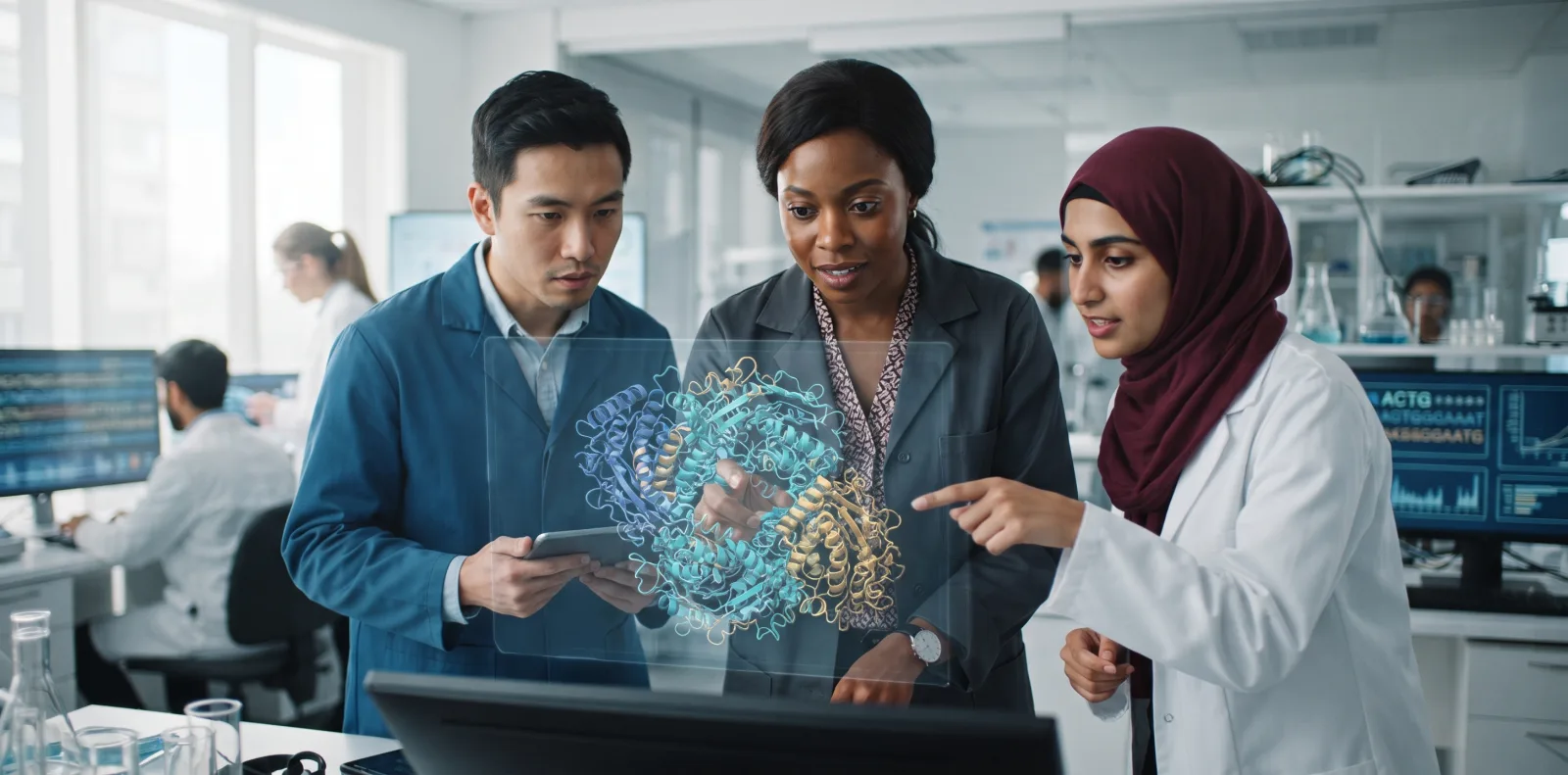
For years the AlphaFold Database gave biologists a gift that felt almost unfair: free, three-dimensional models of nearly every protein known to science. But it had a blind spot. Viruses, the very things most likely to trigger the next global health emergency, were poorly served. On 24 September 2026 that gap narrowed sharply. An international team released AI-predicted structures of protein complexes for more than 2,812 viruses and dropped them into the AlphaFold Database for anyone to download, from a well-funded lab in Boston to a stretched public-health unit responding to an outbreak with almost no budget (EMBL).
The timing was not an accident. The release landed a day before world leaders gathered at the United Nations to review their pandemic promises. It also points at a broader shift in how the global scientific community prepares for the next outbreak. Instead of waiting for a virus to appear and then scrambling, researchers are now mapping the machinery of thousands of viruses in advance, using artificial intelligence to do the heavy lifting.
Background: what actually changed, and why it is a big deal#
To see why this matters, it helps to understand what proteins do inside a virus, and why "complexes" is the important word here.
A protein is a chain of amino acids that folds into a specific three-dimensional shape, and that shape decides what the protein does. A virus is essentially a small set of these proteins wrapped around genetic material. Each protein has a job. Some break into a host cell, others copy the viral genome, others help assemble new virus particles. If you can see the shape of these proteins, you can start to see their weak points. That is the basis of most modern drug discovery and vaccine design.
AlphaFold, built by Google DeepMind, is an AI system that predicts these shapes from the amino-acid sequence alone. That was already revolutionary. But there was a catch. Most earlier structures showed single proteins in isolation, one molecule floating on its own. Real biology rarely works that way. Viral proteins usually operate in teams, physically locking together into what scientists call complexes.
"Many viral proteins do not act individually, they act in concert with partners," says Joe Grove, Professor of Molecular Virology at the MRC-University of Glasgow Centre for Virus Research, who worked on the release (Nature). Predicting a lone protein and predicting how two or more proteins snap together are very different problems. The second is far harder and far more useful, because the surface where two proteins meet is often exactly where a drug or antibody needs to bind.
The new release tackles that harder problem at scale. The team analysed sequences of 41,774 proteins from around 2,812 viruses and added more than 8,000 viral protein dimers, pairs of interacting molecules, to the database (Nature). The viruses come from 23 families, every one of which contains members that infect humans, and they sit inside a new Pandemic Preparedness Portal on the database's homepage (EMBL).
The unusual coalition behind the release#
One reason to take this seriously is the range of institutions that built it. This was not a single lab publishing a paper. It brought together EMBL's European Bioinformatics Institute, Google DeepMind, NVIDIA, Seoul National University, the University of Glasgow, the Swiss Institute of Bioinformatics, the Coalition for Epidemic Preparedness Innovations, and Sungkyunkwan University in South Korea, with additional complexes contributed independently by researchers at Lund University in Sweden (EMBL).
That mix tells you something. You have the group that runs the world's main open protein resource, the company that built the AI, a chip-maker supplying the computing muscle, an epidemic-preparedness funder steering priorities, and academic virologists checking that the outputs make biological sense. NVIDIA's team used its BioNeMo Inference Runtime to run the predictions at high throughput (EMBL). The choice of which viruses to prioritise was guided by the UK Health Security Agency's priority pathogen tool, so the coverage reflects genuine public-health risk rather than whatever happened to be convenient (EMBL).
The viruses included are not obscure. They cover mpox, measles and hepatitis B, alongside the Picornaviridae family responsible for many common colds (Nature). These are pathogens that already cause real disease, and some of them already worry public-health agencies.
Why "open" is the most important word#
The scientific content matters, but the licence matters just as much. Everything in this release is free to access. The AlphaFold Database has grown to more than 260 million protein and protein complex predictions since Google DeepMind and EMBL-EBI launched it over five years ago, and all of it is open (EMBL).
Jo McEntyre, Interim Director of EMBL-EBI, put the point plainly: "Making these data open is critical for understanding viral diagnostics and developing treatments and vaccines. They also cover lesser-studied viruses and lower the barriers for scientists in low-resource settings, who are confronting outbreaks first-hand" (EMBL).
This is where the global framing becomes concrete rather than a slogan. Outbreaks often begin in places without the equipment to isolate a virus, grow it safely and solve its structures the slow experimental way. A researcher in such a setting can now download a predicted structure for a dangerous pathogen the same afternoon a genome sequence appears, without any specialist hardware. Anna Koivuniemi, Head of Google DeepMind's Impact Accelerator, framed it as giving researchers everywhere "the free tools they need to protect public health" (EMBL).
The 100 Days Mission, and why this counts as preparedness#
The release plugs into a specific policy goal. After COVID-19, global health bodies rallied around the 100 Days Mission, an ambition to deliver safe and effective vaccines and treatments within 100 days of spotting a new pandemic threat (EMBL). Hitting that target means doing much of the groundwork before an outbreak, not during it.
Structural biology is a natural candidate for that pre-work. If you already hold a good model of how a virus family's proteins are built and where they bind human cells, you have a head start on designing a vaccine antigen or screening for drugs the moment a related virus emerges. That is the logic behind mapping 23 human-infecting families now, rather than waiting.
The urgency is not hypothetical. An analysis cited by the collaborators estimates a nearly 50% chance of the world facing a pandemic as severe as COVID-19 by 2050 (Center for Global Development). The dataset was unveiled at a roundtable hosted by CEPI and the World Economic Forum, timed to the UN General Assembly High-level Meeting on Pandemic Prevention, Preparedness and Response on 25 September, where governments reviewed the commitments they made in 2023 (EMBL).
The honest limits, and the biosecurity question nobody can ignore#
It would be easy to oversell this, so the collaborators did something useful. They spelled out what the data cannot do.
A predicted structure is a snapshot of what a protein probably looks like. It does not tell you how a virus behaves in a living host, how a mutation will change its danger, or why one virus spreads while another fizzles out. "A protein complex structure alone doesn't tell us what happens when a virus mutates," Grove cautioned. "The new dataset provides valuable foundational knowledge... but it doesn't shed light on why some viruses thrive and others don't, and it doesn't make it easier to engineer more dangerous pathogens" (EMBL). Anything a model predicts still has to be confirmed by experiments in a laboratory.
That last clause about engineering pathogens is doing deliberate work, because AI in virology has a darker recent headline. In August 2026, researchers linked to Stanford and the Broad Institute used generative AI to design bacteriophages, viruses that infect bacteria, and produced 16 viable ones that do not exist in nature. The work drew both excitement and pointed warnings about misuse (CNN; NPR). Days before the AlphaFold release, Anthropic reported that a swarm of AI agents had flagged an unexplained, CRISPR-like enzyme system in viral genomes, a finding shared as a preprint and not yet peer reviewed, (preprint, not peer reviewed) (Nature).
Set against that backdrop, the design of the pandemic-preparedness release looks careful rather than reckless. It publishes static structural pictures of natural viral proteins, not tools for building new pathogens, and its architects were explicit that the two are different. Whether that line holds as models grow more capable is one of the defining governance questions of the decade, and honest observers admit the safeguards are still catching up to the science.
Key takeaways#
Structural biology for pandemic-relevant viruses has shifted from scarce and slow to open and fast, with predicted complexes for more than 2,812 viruses now free to download.
Complexes, not just single proteins, are the real advance, because the surfaces where viral proteins meet are where drugs, antibodies and vaccines do their work.
This is preparedness infrastructure, built before an outbreak to support the 100 Days Mission of delivering countermeasures within roughly three months of a new threat.
Openness is the point. The biggest beneficiaries may be scientists in low-resource settings who face outbreaks first and previously lacked the tools to study them.
The same AI wave has a sharp edge. Recent work designing new viruses and probing viral genomes is exactly why the researchers stressed, repeatedly, that predicted structures are a starting point for legitimate research and not a shortcut to more dangerous pathogens.
Frequently asked questions#
Is this a new version of AlphaFold, or new data? It is new data produced with existing AlphaFold technology, added to the public AlphaFold Database as a dedicated Pandemic Preparedness Portal. The headline is the coverage of viral protein complexes, not a new model.
Are these structures experimentally confirmed? No. They are computational predictions. The collaborators are clear that predictions must be validated with laboratory experiments before anyone relies on them for a drug or vaccine (EMBL).
Which viruses are covered? Proteins from around 2,812 viruses across 23 families that infect humans, including mpox, measles, hepatitis B and common-cold picornaviruses (Nature).
Could this help someone build a dangerous virus? The researchers say no. Predicted structures show what proteins may look like, but do not reveal how mutations change a virus or how to make one more transmissible, and they do not make engineering pathogens easier (EMBL).
How do I access it? Through the homepage of the AlphaFold Database, free of charge, via the Pandemic Preparedness Portal.
Why release it now? To coincide with the UN's high-level pandemic meeting and to advance the 100 Days Mission of rapid countermeasure development (EMBL).
What is the underlying science? The viral structural work builds on peer-reviewed research describing a viral AlphaFold dataset of monomers and homodimers across viruses of bacteria, archaea and eukaryotes (Science Advances).
Glossary#
AlphaFold: An artificial-intelligence system from Google DeepMind that predicts the three-dimensional shape of a protein from its amino-acid sequence.
Protein complex: Two or more proteins physically bound together to do a job. Many viral functions depend on complexes rather than single proteins.
Protein structure prediction: Using computation, rather than slow laboratory experiments, to work out the likely 3D shape of a protein.
Dimer: A complex made of two protein units joined together. The release added more than 8,000 viral dimers.
Proteome: The full set of proteins that an organism, or in this case a virus, can produce.
Bacteriophage (phage): A virus that infects bacteria rather than humans, often used in research and, increasingly, in AI-driven virus design.
100 Days Mission: A global initiative to make safe, effective vaccines and treatments available within 100 days of identifying a new pandemic threat.
CEPI: The Coalition for Epidemic Preparedness Innovations, a funder that supports vaccine development against emerging infectious diseases.
References#
- EMBL. "AlphaFold Database adds viral protein complexes to support pandemic preparedness." 24 September 2026. https://www.embl.org/news/science-technology/alphafold-database-adds-viral-protein-complexes-to-support-pandemic-preparedness/
- Nature news. "AlphaFold 'goes viral': database adds protein complexes of common viruses." September 2026. https://www.nature.com/articles/d41586-026-03022-1
- AlphaFold Protein Structure Database (EMBL-EBI / Google DeepMind). https://alphafold.ebi.ac.uk/
- Phys.org. "New AlphaFold Database release adds viral protein complexes to support pandemic preparedness." September 2026. https://phys.org/news/2026-09-alphafold-database-viral-protein-complexes.html
- Science Advances. "The Viral AlphaFold Database of monomers and homodimers reveals conserved protein folds in viruses of bacteria, archaea, and eukaryotes." https://www.science.org/doi/10.1126/sciadv.adz8560
- Center for Global Development. "Estimated future mortality from pathogens of epidemic and pandemic potential." https://www.cgdev.org/sites/default/files/estimated-future-mortality-pathogens-epidemic-and-pandemic-potential.pdf
- 100 Days Mission / IPPS Secretariat. https://ippsecretariat.org/
- United Nations. "High-level Meeting on Pandemic Prevention, Preparedness and Response, 2026." https://www.un.org/en/civil-society/2026-pandemic-prevention-prepardness-response
- Nature news. "Anthropic's AI biolab finds 'CRISPR-like' DNA in viruses. What's next?" 23 September 2026. Preprint (not peer reviewed). https://www.nature.com/articles/d41586-026-03039-6
- CNN Health. "AI creates 16 new viruses from scratch." 6 August 2026. https://www.cnn.com/2026/08/06/health/ai-viruses-bacteriophages
- NPR. "Researchers have successfully used AI to create brand new viruses." 11 August 2026. https://www.npr.org/2026/08/11/nx-s1-5927074/researchers-have-successfully-used-ai-to-create-brand-new-viruses