Most of your gut's chemistry is unlabelled. AI just read a chunk of it.#
Sequence a handful of gut bacteria, and you get a torrent of genes. Ask what most of those genes actually do, and the honest answer is: nobody knows. Between 40 and 60 per cent of the protein-coding genes recovered from genomes and metagenomes have no confident functional label, a gap that microbiologists call the "dark matter" of the microbial world. That blind spot is not a footnote. It sits over questions about digestion, immunity, and disease.
On 19 August 2026, a team at Tsinghua University published a peer-reviewed study in Science Advances showing that a protein language model can shrink that blind spot at scale. Their tools read the sequences of unknown enzymes, predict what reactions those enzymes carry out, and then apply that across whole communities of gut microbes, including samples from patients with inflammatory bowel disease. It is a concrete demonstration of protein language models moving from clever demos towards useful, everyday biology.
What happened#
The Tsinghua group, led by Guanxiang Liang, built two things. The first is FEDKEA, an enzyme annotation tool. The second is MEnzMap, a pipeline that runs raw sequencing data through quality control, enzyme prediction, and downstream analysis without a specialist having to stitch the steps together by hand.
FEDKEA works by pairing a protein language model called ESM-2 with a simple classifier. ESM-2 converts each protein sequence into a numerical fingerprint that reflects its likely shape and chemistry. FEDKEA then compares that fingerprint against known enzymes using a distance-weighted nearest-neighbour method, and it respects the layered structure of the enzyme catalogue so that a confident broad call is not thrown away just because the fine detail is uncertain.
To show the pipeline earns its keep, the authors pointed MEnzMap at human gut samples from the Integrative Human Microbiome Project, which includes people with inflammatory bowel disease alongside healthy controls. The result was a map of the enzymes present across those communities, and a way to flag enzymes that differ between health and disease. The tool and a web platform were released for others to use.
What a protein language model actually does#
A protein language model borrows an idea from the systems behind chatbots. A large language model learns the statistical patterns of human text by reading enormous amounts of it. A protein language model does the same trick with the language of biology, training on hundreds of millions of protein sequences written in the twenty-letter alphabet of amino acids. It never sees a textbook definition of a fold or a function. It just learns which amino acids tend to sit together, and in doing so it picks up a surprising amount about structure and chemistry.
ESM-2, developed by researchers formerly at Meta, is one of the best known of these models and was strong enough to predict protein shapes directly from sequence. The output most useful here is the "embedding", a list of numbers standing in for a protein. Similar proteins land near each other in this numerical space, even when their letter-by-letter sequences have drifted far apart. That is the key advantage over older methods, which mostly matched new sequences against known ones by spelling similarity and went quiet when the match was poor.
Two more terms make the study legible. An Enzyme Commission number, or EC number, is a four-part code that classifies an enzyme by the reaction it performs, moving from a broad class down to a specific transformation. Predicting an EC number is a compact way of saying what an enzyme does. Metagenomics, meanwhile, means sequencing all the DNA in a sample at once, bugs and all, rather than growing each microbe separately. Most gut microbes refuse to grow in a dish, so metagenomics is how we see them, and it is exactly where the dark matter piles up.
Why this matters#
The immediate win is practical. Functional annotation is a bottleneck in nearly every microbiome study, and a tool that reads enzymes straight from sequence, without needing a close relative already in the database, chips away at it. For the gut microbiome specifically, enzymes are the business end of the community. They break down fibre, produce short-chain fatty acids, transform drugs, and generate metabolites that talk to the immune system. Knowing which enzymes are present, and which shift in disease, is a route to mechanism rather than mere correlation.
There is a medical thread too. By comparing healthy and inflammatory bowel disease samples, the authors point at enzymes that track with illness. That does not diagnose anyone, and it is not treatment advice. It does give researchers a shortlist of candidate players to test, which is how biomarker and target discovery usually begins.
The reach extends past the gut. The same approach fits any setting where sequences pile up faster than anyone can characterise them: soil and ocean surveys, hunts for industrial enzymes that work at high temperature or in odd solvents, and the wider project of AI-driven drug and enzyme discovery. Cheaper, homology-independent annotation makes all of that faster.
Critical analysis#
The strengths are easy to state. This is peer-reviewed work in a strong journal, it uses a real clinical dataset rather than a toy benchmark, and it ships as an open tool with a pipeline other labs can run. That combination is rarer than it should be.
The limits deserve equal billing. A predicted EC number is a hypothesis, not a measured activity. Confirming that an enzyme does what the model claims still needs wet-lab experiments, and only a fraction of predictions will ever be checked. There is a deeper ceiling: EC numbers describe reactions we already know about. A genuinely novel enzyme doing genuinely novel chemistry has no EC number to be assigned, so the truly alien end of the dark matter stays dark. The model is also anchored to the enzymes it learned from, which skews towards well-studied organisms, so performance on the strangest sequences is where scepticism should concentrate.
For the disease results, the usual caution holds. An enzyme that differs between patients and controls may be a cause, a consequence, or a bystander riding along with some other change in the community. Untangling that takes follow-up work that no annotation tool can do on its own. And because the underlying accuracy figures rest on chosen benchmarks, the sensible reading is qualitative: this is a meaningful step, not a solved problem. Realistically, the near-term payoff is faster hypothesis generation for researchers, with clinical or industrial impact arriving over years, not months.
Expert perspective: from spelling matches to meaning#
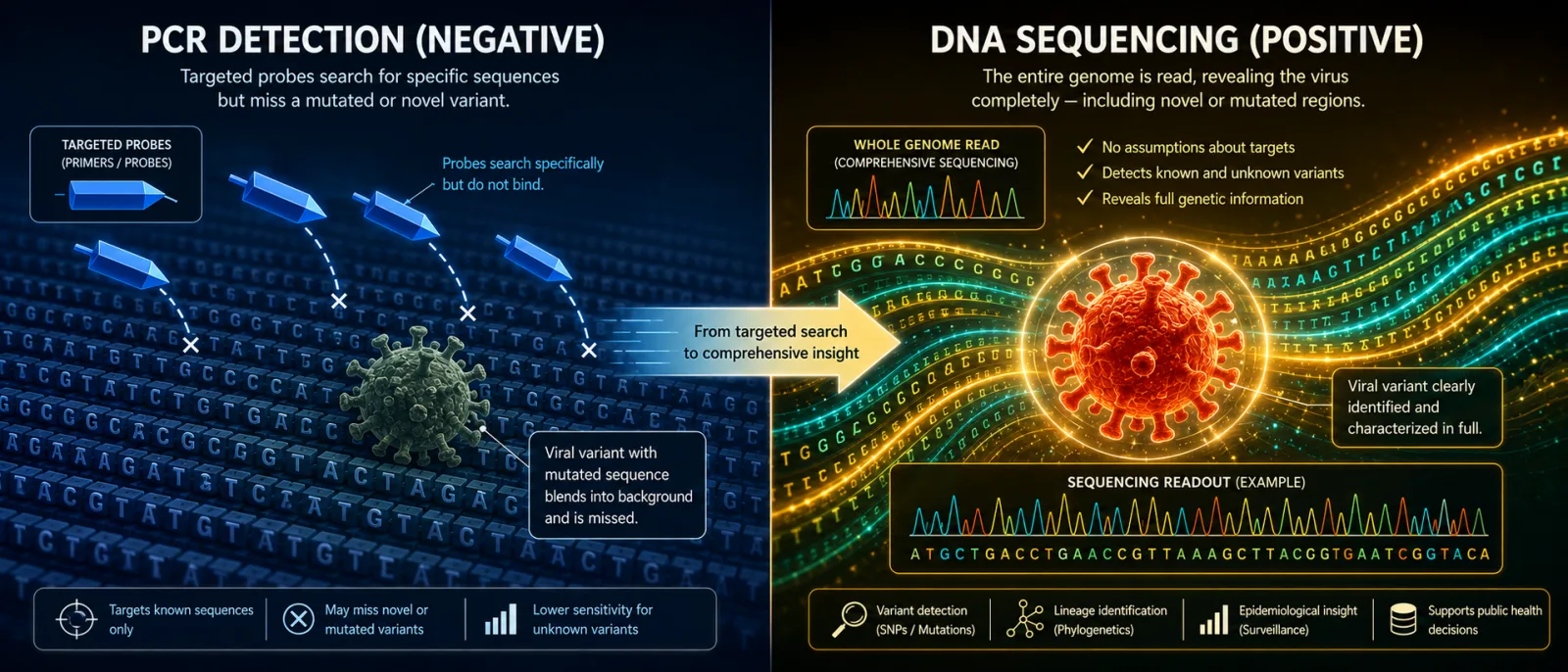
For decades the default way to guess a protein's function was homology search, most famously BLAST, which finds database entries whose sequences resemble your query. It works beautifully when a close relative is on file and fails quietly when one is not, which is precisely the dark-matter case.
Protein language models changed the terms. In 2023, the CLEAN method used contrastive learning on language-model embeddings to assign EC numbers more accurately and sensitively than BLAST, and it could flag mislabelled or under-studied enzymes. FEDKEA sits in this lineage but pushes on the deployment side: it is tuned for the messy, incomplete sequences typical of metagenomes and wrapped in a pipeline aimed at community-scale data rather than single, tidy proteins.
The timing is telling. The past few weeks have been busy for this field. A Cell paper in early August extended protein language modelling to protein-protein interactions with a compact model called MSA Pairformer, and a Trends in Microbiology article on 19 August described biological language models uncovering hidden bacterial antiviral defences that share no detectable similarity with known systems. The common thread across all three is that these models find function where sequence-matching sees nothing. FEDKEA's contribution is to take that capability and turn it on the gut, at the scale of whole communities, with disease samples in the mix.
Key takeaways#
- A Science Advances study from Tsinghua University uses a protein language model to predict enzyme functions directly from sequence, and applies it across gut microbial communities.
- The tools, FEDKEA and the MEnzMap pipeline, pair ESM-2 embeddings with a nearest-neighbour classifier and are released openly with a web platform.
- The approach targets "microbial dark matter", the 40 to 60 per cent of microbial genes that lack a confident function.
- Applied to inflammatory bowel disease samples, it flags enzymes that differ in disease, useful for research leads rather than diagnosis.
- Predictions are hypotheses that still need laboratory confirmation, and truly novel chemistry with no existing enzyme code remains out of reach.
Frequently asked questions#
What is a protein language model, in one sentence? It is an AI model trained on millions of protein sequences that learns patterns in the amino-acid "language" of proteins, letting it infer structure and function from sequence alone.
How is this different from AlphaFold? AlphaFold predicts a protein's three-dimensional shape. This work predicts a protein's function, specifically the reaction an enzyme catalyses, and does it across whole microbial communities rather than one protein at a time.
What is "microbial dark matter"? It is the large fraction of microbial genes, roughly 40 to 60 per cent, whose function is unknown because no close, well-studied relative exists in current databases.
Does this diagnose or treat inflammatory bowel disease? No. It highlights enzymes that differ between patients and healthy controls, which gives researchers candidates to investigate. It is not a diagnostic or a treatment, and it is not medical advice.
Can I use the tools? The authors released FEDKEA and the MEnzMap pipeline along with a web platform, so other labs can run their own metagenomic data through the same workflow, as described in the paper. The code for FEDKEA is available on GitHub.
What are the main limitations? Predictions need experimental confirmation; the model leans on enzymes it has already seen; and Enzyme Commission numbers only cover known reactions, so entirely new chemistry remains invisible.
References#
- Zheng L, Li B, Xu S, Chen J, Liang G. "Large language models enhance annotation of enzymes in metagenomes." Science Advances, 19 August 2026; 12(34): eaee4389. Indexed on PubMed. https://doi.org/10.1126/sciadv.aee4389
- Lin Z, et al. "Evolutionary-scale prediction of atomic-level protein structure with a language model." Science, 2023; 379: 1123-1130 (ESM-2). https://doi.org/10.1126/science.ade2574
- Yu T, et al. "Enzyme function prediction using contrastive learning." Science, 2023; 379: 1358-1363 (CLEAN). https://doi.org/10.1126/science.adf2465
- Rodríguez del Río Á, et al. "Functional characterization of prokaryotic dark matter: the road so far and what lies ahead." Current Research in Microbial Sciences, 2022 (40-60% unknown-function estimate). https://www.sciencedirect.com/science/article/pii/S2666517422000566
- Lloyd-Price J, et al. "Multi-omics of the gut microbial ecosystem in inflammatory bowel diseases." Nature, 2019; 569: 655-662 (iHMP / IBD dataset). https://doi.org/10.1038/s41586-019-1237-9
- Akiyama Y, et al. "Expanding the scope of protein language modeling to protein-protein interactions with MSA Pairformer." Cell, August 2026. https://tinyurl.com/37h6rv9z
- Viégas G, et al. "Biological language models uncover hidden bacterial antiviral immunity repertoires." Trends in Microbiology, 19 August 2026. Indexed on PubMed. https://doi.org/10.1016/j.tim.2026.07.009
- IUBMB Enzyme Nomenclature / ExplorEnz, the enzyme database (Enzyme Commission numbers). https://www.enzyme-database.org/