A clock that runs wrong when cancer is near#
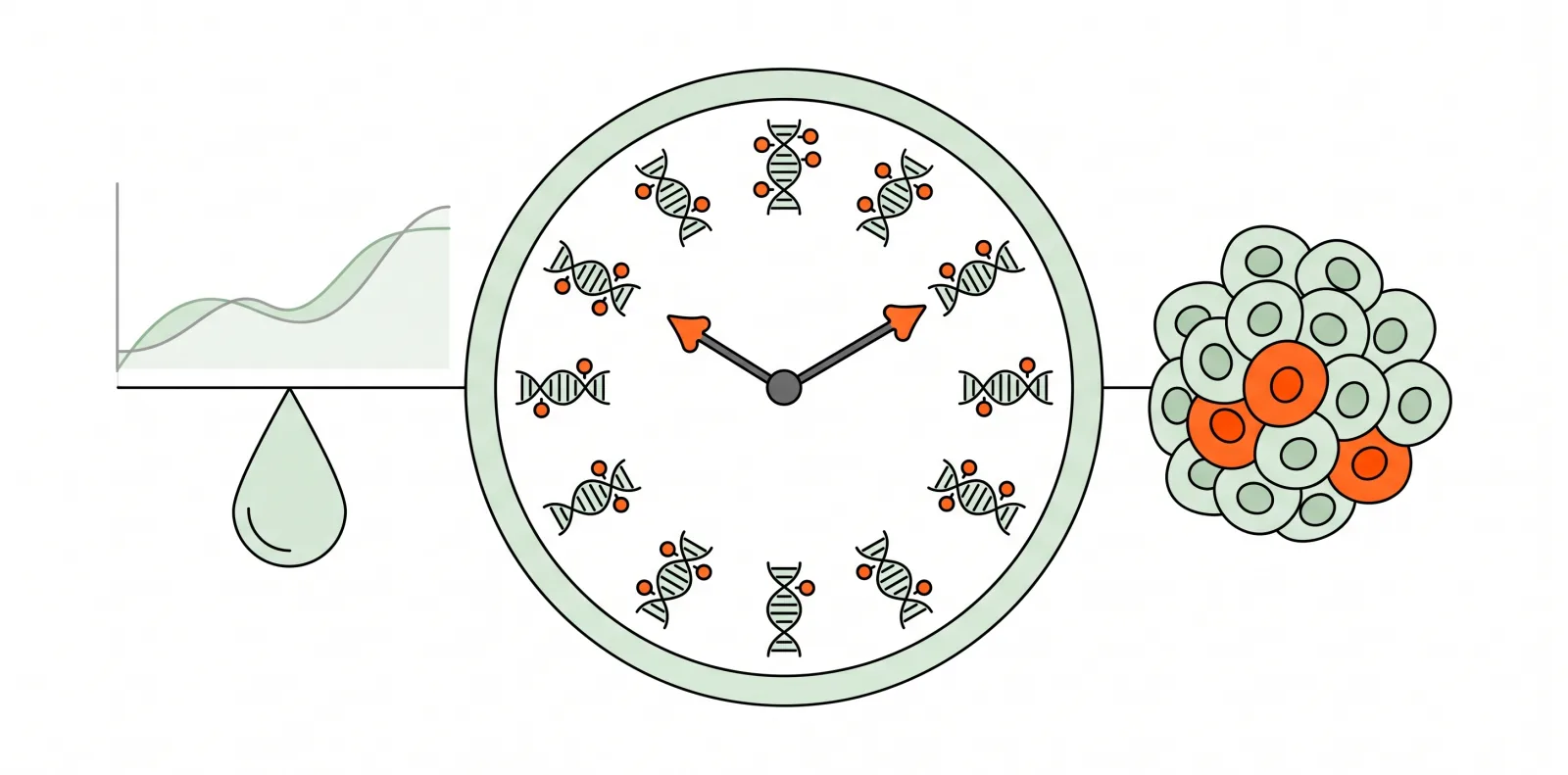
Every cell in your body carries a ledger of small chemical tags written on top of your DNA. Over a lifetime, those tags shift in patterns regular enough that a computer can read them and guess your age to within a few years. That is the idea behind the epigenetic clock, and it has been one of the more surprising tools to come out of ageing research.
Cancer is where the story gets interesting. A tumour does not just damage DNA. It also scrambles the tags, and when that happens the clock can start giving odd answers. In one 2026 study of a 74-site blood clock, patients with leukaemia were "aged" by a median of 37.6 years too many, while patients with solid tumours were off by a more modest 3.19 years (Clinical Epigenetics, 2026).
So the pitch writes itself. If cancer bends the clock, perhaps a clever algorithm can spot the bend before a tumour is large enough to cause symptoms. Headlines have run with that idea, sometimes with the word "AI" attached. This post asks a plainer question: what does the evidence actually show, and how much of it depends on the clock itself versus the machine learning bolted on top?
The short answer is that the clocks carry a real but modest signal, the most clinically advanced methylation tests are not really clocks at all, and the largest trial yet has delivered a result that is both encouraging and frustrating.
What an epigenetic clock actually measures#
Methylation, in plain language#
DNA is a long string of four chemical letters. Attached to some of those letters, particularly at spots called CpG sites (a C followed by a G), are tiny chemical flags called methyl groups. This is DNA methylation. The flags do not change the genetic code. They help decide which genes are switched up or down in a given cell.
Methylation at many CpG sites changes with age in a fairly predictable way. Some sites gain flags over the decades, others lose them. A clock is simply a statistical recipe that takes the methylation level at a chosen set of sites and converts it into an estimated age.
The first clock and what it found in tumours#
The best-known clock was published by Steve Horvath in 2013. It uses 353 CpG sites, chosen by a technique called elastic net regression, with 193 sites rising with age and 160 falling (Horvath, Genome Biology, 2013). It was built from about 8,000 samples across 82 datasets covering 51 healthy tissues and cell types, and on test data it predicted age with a correlation of 0.96 and an error of 3.6 years (Horvath, 2013).
Horvath also looked at cancer. Across about 6,000 samples from 20 cancer types, tumour tissue showed significant age acceleration, averaging 36 years (Horvath, 2013). That sounds dramatic, but it comes with a twist. Tumours with lower age acceleration tended to carry more somatic mutations, including in the TP53 gene, and age acceleration correlated only weakly with tumour grade and stage (Horvath, 2013). In other words, the clock does react to cancer, but not in a tidy, dose-dependent way.
Is a clock "AI"?#
Here is the part the headlines tend to skip. Most clocks are built with penalised regression, a classical statistical method, rather than the deep neural networks people usually mean by AI. It is machine learning in the broad sense, and it is certainly pattern recognition, but it is a long way from a large language model. Newer work is moving towards richer models and towards combining methylation with other molecular layers, a shift described in a 2026 review titled The Evolving Landscape of Clinical Aging Clocks: From Epigenetic to Multi-Omics Integration. Keeping that distinction in mind makes the evidence easier to read.
Can a clock predict who will get cancer?#
The breast cancer evidence#
The most carefully studied question is whether being "older" than your birth certificate says predicts cancer years later. In the Sister Study, researchers measured baseline blood methylation in 2,764 women, of whom 1,566 went on to develop breast cancer over roughly six years of follow-up (Kresovich et al., JNCI, 2019).
Each additional five years of age acceleration was linked to a higher hazard of breast cancer: 1.10 for the Hannum clock, 1.08 for the Horvath clock and 1.15 for the Levine clock (Kresovich et al., 2019). Those are real associations, and the Levine result was clearly statistically significant. They are also small. A hazard ratio of 1.15 means a modest nudge in risk across a population, not a sharp warning for any one woman.
What "modest" means for a single person#
Think of it like a weather forecast that says rain is 15 per cent more likely than usual. Useful for planning a city's drainage, much less useful for deciding whether you personally need an umbrella. For a screening tool to change what a doctor does, it has to separate people who will get cancer from people who will not far more cleanly than these figures suggest.
Adding machine learning to the methylation signal#
Researchers have tried to sharpen the signal with proper machine learning. In a 2026 Scientific Reports study, a team analysed blood methylation from 642 participants in an Italian cohort, 224 of whom were later diagnosed with breast cancer, and trained nine different models on 4,621 selected CpG sites (Mahmoud et al., Scientific Reports, 2026). The best performer, a random forest, reached an AUC of 0.849 and an accuracy of 0.798 (Mahmoud et al., 2026).
AUC is a score where 0.5 is a coin toss and 1.0 is perfect, so 0.85 looks respectable. The authors are candid about the weak points, though. The analysis used a single cohort with no external validation, lacked data on confounders such as smoking, BMI and blood-cell composition, and could not separate cell types (Mahmoud et al., 2026). A model that shines in one dataset can stumble badly in the next, which is why external validation matters so much.
Cheaper clocks that watch for cancer's fingerprints#
A targeted clock built for the clinic#
Standard clocks use microarray chips that read hundreds of thousands of sites, which is overkill for a screening test. A 2026 paper in Clinical Epigenetics took the opposite approach, building a clock from just 74 CpG sites across seven genes, read by a targeted sequencing method (Clinical Epigenetics, 2026).
It was trained on 610 people aged 2 to 89 and validated on a separate group of 188. Age error stayed around 3.4 to 4.1 years across the training, test and external sets (Clinical Epigenetics, 2026). That is good enough for a clock, and the compact design points towards something a hospital laboratory could realistically run.
Using the errors as the signal#
The clever twist is in what the authors did with the mistakes. Because cancer disturbs methylation, the clock's errors in cancer patients carry information. The leukaemia result at the start of this post is the clearest example (Clinical Epigenetics, 2026).
Two cautions apply. The study sampled people from eastern China only, covered a limited number of CpG sites and analysed blood alone, which limits what it can say about organ-specific cancers (Clinical Epigenetics, 2026). And a clock that "gets it wrong" in a leukaemia patient is a long way from a clock that flags a symptom-free person with an early pancreatic tumour.
The methylation test that actually reached a clinic#
From clocks to cell-free DNA#
The most advanced use of methylation in cancer detection does not involve age at all. Tumours shed fragments of DNA into the bloodstream, called cell-free DNA, and those fragments carry the methylation pattern of the tissue they came from. A classifier can read that pattern, decide whether a cancer signal is present and guess which organ it came from.
In an independent validation of one such test, involving 4,077 participants (2,823 with cancer and 1,254 without), specificity was 99.5 per cent and overall sensitivity was 51.5 per cent (ASCO Post, 2021). Specificity means few false alarms. Sensitivity means how many real cancers get caught.
Why early stages are the hard part#
Sensitivity varied sharply by stage: 16.8 per cent at stage I, 40.4 per cent at stage II, 77.0 per cent at stage III and 90.1 per cent at stage IV (ASCO Post, 2021). This is the central tension of the whole field. Small, early tumours shed very little DNA, so the cancers we most want to catch early are the ones the test finds least often. When it did detect a signal, it identified the tissue of origin correctly 88.7 per cent of the time (ASCO Post, 2021).
The NHS-Galleri trial: a landmark with an asterisk#
What the trial tested#
NHS-Galleri is the first large randomised trial of a multi-cancer early detection test. It enrolled roughly 143,000 symptom-free adults aged 50 to 79 in the UK and randomised them to annual testing plus standard screening or standard screening alone, with three years of follow-up (ASCO Post, 2026).
What it found#
The trial did not meet its predefined primary endpoint, which was a reduction in stage III and IV cancer diagnoses (ASCO Post, 2026). There were encouraging secondary signals: a 14 per cent reduction in stage IV diagnoses, 21 per cent fewer clinically detected cancers and 20 per cent fewer emergency presentations in the tested group (ASCO Post, 2026).
The test itself performed as advertised on the false-alarm front. Specificity ran between 99.5 and 99.6 per cent, and the overall positive predictive value, meaning the share of positive results that were real cancers, was 52.0 per cent (Nature Medicine, 2026). But episode sensitivity for all cancers was 37.2 per cent in the first round and fell to 26.7 per cent by the third (Nature Medicine, 2026). Across 12 prespecified cancer types it was 63.4 per cent in round one (Nature Medicine, 2026).
How to read a mixed result#
Reasonable experts can read this two ways. Supporters will point to the stage IV reduction as a sign the approach shifts diagnoses earlier. Sceptics will point to the missed primary endpoint and note that nobody yet knows whether earlier detection translates into longer survival. Coverage of the results reflects that uncertainty, noting that it is not yet known whether earlier detection ultimately improves survival, and that long-term mortality and cost-effectiveness data are still to come (ASCO Post, 2026).
Putting the evidence side by side#
The table below compares the main studies discussed in this post. The differences in what each one measures matter more than the headline numbers.
| Approach | What it reads | Sample | Headline result | Main caveat |
|---|---|---|---|---|
| Original age clock (Horvath, 2013) | 353 CpG sites | About 8,000 healthy samples; about 6,000 cancer samples | Age error 3.6 years; tumours showed average 36 years of age acceleration | Weak link between age acceleration and tumour stage |
| Clocks and breast cancer risk (Kresovich et al., 2019) | Blood methylation, three clocks | 2,764 women, 1,566 later with breast cancer | Hazard ratio 1.08 to 1.15 per 5 years of acceleration | Small effect per person; not a diagnostic test |
| Machine learning classifier (Mahmoud et al., 2026) | 4,621 CpG sites | 642 participants, 224 pre-diagnostic cases | Random forest AUC 0.849 | Single cohort, no external validation |
| Targeted 74-site clock (Clinical Epigenetics, 2026) | 74 CpG sites across 7 genes | 610 training, 188 validation | Age error about 3.4 to 4.1 years; leukaemia bias of 37.6 years | Blood only; one region of China |
| Cell-free DNA test, validation (ASCO Post, 2021) | Methylation of tumour DNA fragments | 4,077 participants | Specificity 99.5%; sensitivity 51.5% overall, 16.8% at stage I | Low sensitivity for early stages |
| Cell-free DNA test, randomised trial (Nature Medicine, 2026) | Methylation of tumour DNA fragments | About 142,000 randomised adults | PPV 52.0%; specificity 99.5 to 99.6% | Primary endpoint missed; survival benefit unknown |
Frequently asked questions#
Is an epigenetic clock the same as a cancer test? No. A clock estimates biological age from DNA methylation, and cancer can distort that estimate, but no clock is approved as a cancer diagnostic. The studies above show associations with cancer risk, not a ready-to-use screening tool (Kresovich et al., 2019).
Does "AI" really power these clocks? Mostly it is classical machine learning. Horvath's original clock used elastic net regression to pick its 353 sites (Horvath, 2013). More complex models, such as the random forest and neural networks tested in a 2026 breast cancer study, are being explored but have not yet been externally validated (Mahmoud et al., 2026).
How accurate is a methylation blood test for cancer? It is very good at avoiding false alarms but only moderate at catching cancers. One validation study reported 99.5 per cent specificity and 51.5 per cent overall sensitivity, with only 16.8 per cent sensitivity at stage I (ASCO Post, 2021).
Did the NHS-Galleri trial succeed? Partly. It missed its primary endpoint of reducing stage III and IV diagnoses, but showed a 14 per cent reduction in stage IV diagnoses (ASCO Post, 2026). Whether this saves lives is not yet known.
If my epigenetic age is high, am I more likely to get cancer? On average, slightly. In the Sister Study, each five years of age acceleration was linked to a hazard ratio of 1.08 to 1.15 for breast cancer (Kresovich et al., 2019). That is a population-level nudge and does not predict what will happen to you.
Why not just use cancer tissue to test the clock? Because screening needs to work before anyone knows where a tumour is. Tumour tissue showed large age acceleration in Horvath's analysis, but blood is what you can sample from a healthy person, and blood-based signals are subtler (Horvath, 2013).
What would make these tools clinically useful? Larger and more diverse cohorts, external validation, better sensitivity for early-stage disease and evidence that earlier detection improves survival. The authors of the 2026 studies cite single-region sampling, single cohorts and missing confounders as current limits (Clinical Epigenetics, 2026; Mahmoud et al., 2026).
References#
- Horvath S. DNA methylation age of human tissues and cell types. Genome Biology, 2013. https://link.springer.com/article/10.1186/gb-2013-14-10-r115
- Kresovich JK, et al. Methylation-based biological age and breast cancer risk. Journal of the National Cancer Institute, 2019. https://academic.oup.com/jnci/article/111/10/1051/5341521
- A targeted epigenetic clock for simultaneous assessment of biological aging and cancer-associated methylation drift. Clinical Epigenetics, 2026, 18, 107. https://link.springer.com/article/10.1186/s13148-026-02106-z
- Mahmoud NM, et al. Integrating DNA methylation biomarkers for breast cancer risk prediction using artificial intelligence. Scientific Reports, 2026. https://www.nature.com/articles/s41598-026-59983-w
- Performance of a multi-cancer early detection test in the randomized controlled NHS-Galleri trial. Nature Medicine, 2026. https://www.nature.com/articles/s41591-026-04652-8
- Annual Galleri screening reduced stage IV cancer diagnoses but missed primary endpoint in first randomized MCED trial. The ASCO Post, June 2026 (science journalism, used for trial-level figures; the primary paper is reference 5). https://ascopost.com/news/june-2026/annual-galleri-screening-reduced-stage-iv-cancer-diagnoses-but-missed-primary-endpoint-in-first-randomized-mced-trial/
- Assessment of targeted methylation-based multicancer early detection test in independent validation cohort. The ASCO Post, July 2021 (science journalism summarising the Annals of Oncology validation study; the primary paper is available at Annals of Oncology.
- Liu et al. The evolving landscape of clinical aging clocks: from epigenetic to multi-omics integration. Aging Cell, 2026. https://onlinelibrary.wiley.com/doi/full/10.1111/acel.70579