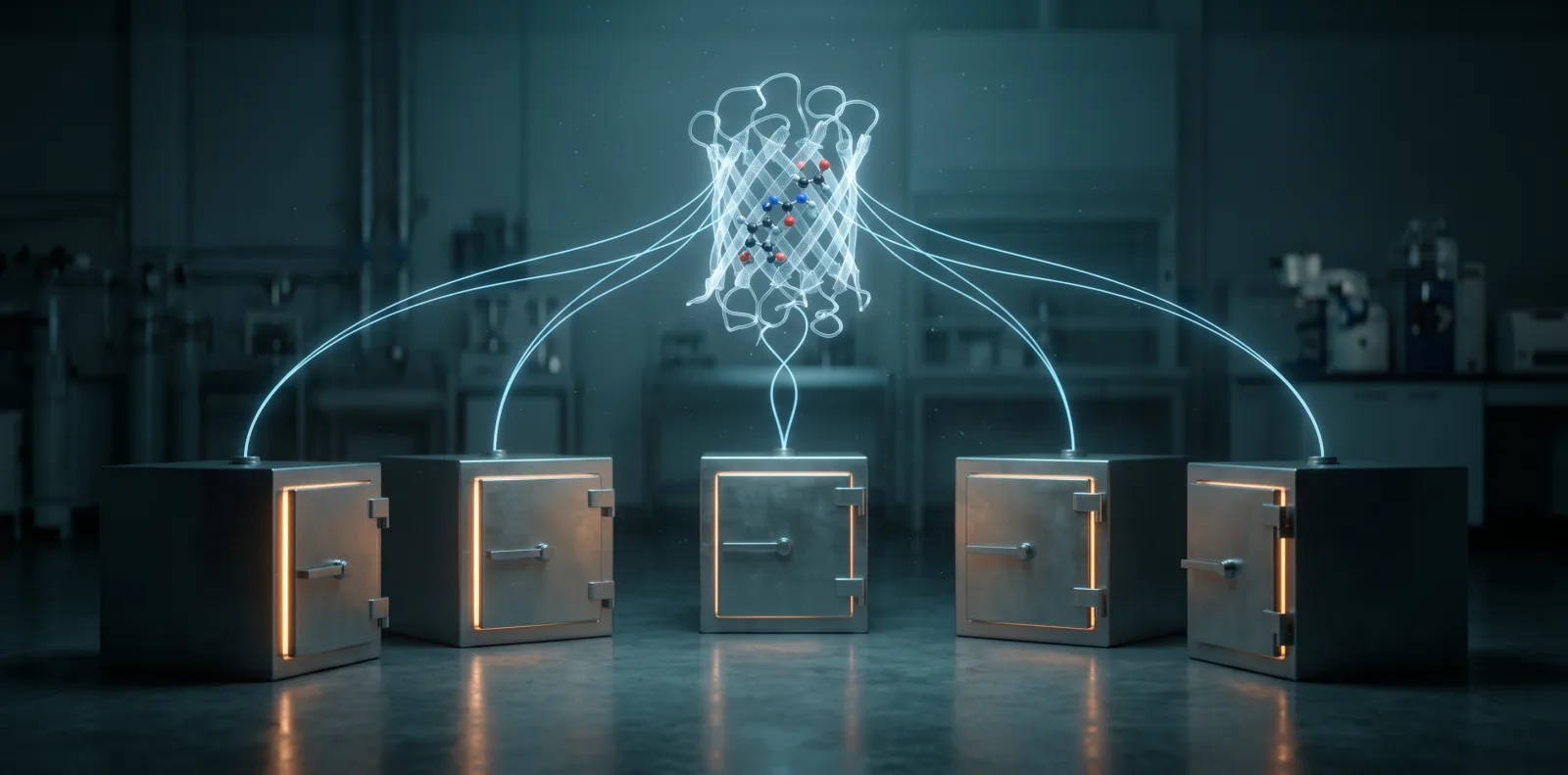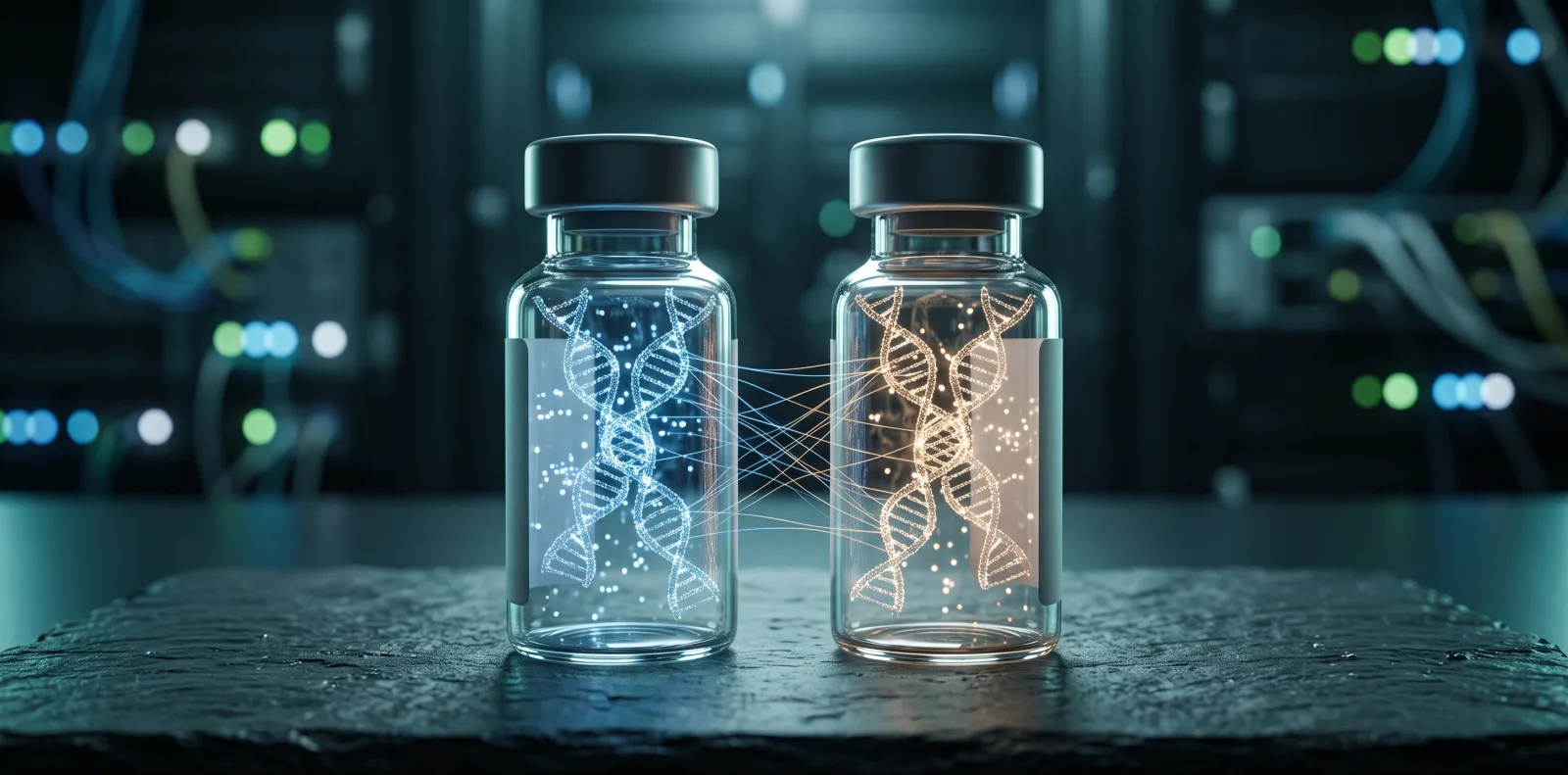
The most valuable datasets in biology and medicine are often the ones nobody outside a single institution can touch. A team at Stanford says it has found a way around that wall, and it has released one of its own locked cohorts to prove the point.
On 5 September 2026, researchers at Stanford University posted a preprint on bioRxiv introducing SPHERE, a method that turns a sensitive dataset into a shareable "synthetic twin" while the original records never leave the institution that holds them. The corresponding author is the Stanford biostatistician Zihuai He, and the author list includes some well-known names in computational biology and AI: Russ Altman, James Zou, and the ageing researcher Tony Wyss-Coray. This is a preprint and has not yet been peer reviewed.
According to the paper, the team tested SPHERE on 33 datasets spanning five scientific domains. They report that each synthetic twin reproduces the statistical backbone of the real data, its means, variances and correlations, while resisting attempts to re-identify individuals, and that a twin can be generated in seconds on a laptop. In their tests, a linear analysis run on the twin returned effect sizes and p-values that were numerically identical to the original, and AI agents let loose on the twin reached the same scientific conclusions as they did on the real records.
To move this from claim to demonstration, the team did something unusual. They published a fully synthetic version of the Stanford Alzheimer's Disease Research Center (ADRC) cohort, 644 participants across nine data types, from cognitive scores and blood biomarkers to amyloid PET brain imaging and blood-protein measurements, that any registered researcher can download without the usual ethics-approval paperwork. A dataset that was effectively closed is now, in synthetic form, open.
The bottleneck nobody talks about#
Here is the awkward truth behind the AI-for-science boom: the models are hungry, and the best food is fenced off. The data that makes AI most useful in the clinic, genomes, medical records, brain scans, is also the data that privacy law keeps under lock and key. Access to genomic data is tightly restricted because a leak can expose someone to genetic discrimination, and the consent forms people signed rarely imagined their data being fed to a foundation model.
The standard fix, simple de-identification, is weaker than it sounds. Strip out names and dates and a determined analyst can often re-identify people by cross-referencing what remains against public records, a technique known as a linkage attack. That failure has pushed the field towards three alternatives, each with a catch.
The first is synthetic data: instead of sharing real records, you share fake ones built to mimic the statistics of the real thing. It is a useful idea, but not automatically private. A generator trained too closely on its source can memorise and hand back real patients, and preserving the web of relationships between many variables at once is hard to do well in high-dimensional data. The second is differential privacy, which adds carefully calibrated mathematical noise to give a formal, provable guarantee that no single person's presence changes the result very much. The catch is the trade-off: turn the privacy up and the data's usefulness comes down. The third is federated learning, where the data never moves and only the model travels between institutions. It is private by design, but heavy to run, and awkward for the messy, exploratory work that most science actually is.
SPHERE stakes out a fourth position. It is described as "model-free", meaning it does not train a deep generative network that might quietly memorise its inputs. Instead it builds a twin engineered to carry the original's statistical structure forward. That is why the same regression on the twin can return the same answer as on the original, and why the method is fast enough to run on a laptop rather than a server farm.
Why it matters#
If SPHERE holds up to scrutiny, the implications reach well beyond one Alzheimer's cohort.
The most immediate is speed. Getting approved access to a protected dataset can take months of committee review and legal negotiation. A certified synthetic twin that any registered researcher can download turns that wait into a same-day job, useful for testing an idea, writing a grant, or teaching a class before committing to the real thing.
The second is reach. Datasets that are currently invisible to the wider research community, held by hospitals, biobanks or single labs, could become routine inputs to open science. That helps the groups who cannot easily negotiate bespoke data agreements: students, smaller universities, and researchers outside the wealthy institutions that already sit on the data.
The third is AI readiness. The Stanford team frames the twin as something you can hand straight to an AI agent, and it ships one that runs analyses on the synthetic data without ever seeing the real thing. That fits a wider 2026 push towards autonomous systems that carry out biomedical analysis from start to finish, seen in platforms such as PromptBio, also released this month as a preprint. Agents are only as good as the data they can legally reach, so a steady supply of shareable twins removes one of the bigger brakes on putting them to work on real health problems.
What to watch, and what not to oversell#
The central tension is between fidelity and privacy. A twin that reproduces means, variances and correlations exactly is, in effect, publishing the dataset's aggregate statistics. For linear models that is a feature, because you get the same answer, but it also means the privacy protection rests on how well individual-level information stays hidden once that structure is fixed. The paper reports resistance to specific re-identification attacks, which is an empirical result against the attacks tested, not the mathematical guarantee that differential privacy provides. Peer reviewers will want to see how SPHERE holds up against adversaries it was not tuned to expect, and the portal's flat promise that "no re-identification is possible" is the kind of absolute that independent testing tends to soften.
There is also a gap between "unlocking sensitive data" and what was actually released. The open ADRC twin is a curated subset: the genomics cover only Alzheimer's-associated variants rather than whole genomes, and the single-cell data are aggregated rather than provided cell by cell, with the full sequencing still held in a controlled repository. That is a sensible, cautious choice, but it means the demonstration covers a slice of the data rather than the raw article.
A third point is transparency. SPHERE is described on its own portal as a "proprietary" method, and the release comes wrapped in a data-use agreement that forbids commercial use. Open synthetic data built on a closed method sits a little awkwardly under the open-science banner, and reproducibility will depend on how fully the algorithm is eventually disclosed. None of this sinks the work. It marks the distance between a striking preprint and an accepted standard, and only time and peer review can close that.
How it compares#
Most of the AI milestones that make headlines are model-centric, from protein-structure prediction to DNA language models that learned to read the genome. SPHERE aims at a less glamorous but more universal bottleneck, the data itself. Where federated learning says "bring the model to the data" and differential privacy says "blur the data to protect it", SPHERE says "make a faithful stand-in and let the stand-in travel". Its bet is that you can hold statistical fidelity and privacy at the same time without the heavy machinery of a trained generator or a distributed computing network. Whether that holds across genomes, images and text, as the authors report it does, is the question the next year of testing will answer.
Key takeaways#
- A fourth way to share sensitive data. SPHERE, from a Stanford team, builds a synthetic "twin" of a protected dataset that keeps its statistical structure while the real records stay put.
- They opened a real cohort to prove it. The Stanford ADRC Alzheimer's dataset, 644 people across nine data types, can now be downloaded in synthetic form without ethics-approval paperwork.
- Speed is the clearest win. Twins generate in seconds and, for linear analyses, reproduce the original's results exactly, according to the preprint.
- The privacy claims need outside scrutiny. Resistance to tested attacks is not the formal guarantee that differential privacy offers, and "no re-identification is possible" is a strong promise.
- It is a preprint, and a partial demonstration. The work is not yet peer reviewed, the method is called proprietary, and the open release is a curated subset of the full data.
Frequently asked questions#
What is a "synthetic twin"? A synthetic dataset built to match the statistical patterns of a real one, the same averages, spreads and relationships between variables, but made of records that correspond to no real person.
How is this different from just anonymising data? Anonymised data is still real data with the labels removed, which leaves it open to linkage attacks. A synthetic twin contains no real individuals, so there is nothing to link back to.
Is SPHERE the same as differential privacy? No. Differential privacy offers a mathematical guarantee by adding noise. SPHERE is described as model-free and reports empirical resistance to re-identification attacks, which is a different kind of assurance.
Can I use the released Alzheimer's data now? The Stanford ADRC SPHERE portal lets registered researchers explore and download the synthetic cohort under a data-use agreement, for non-commercial research.
Has this been peer reviewed? Not yet. It is a preprint posted to bioRxiv on 5 September 2026 and should be read as a promising claim awaiting independent validation.
Could a company use this to train commercial AI? Not with the released Stanford data. The data-use agreement explicitly forbids commercial model training, and the method's own licensing will shape any wider use.
Does the twin capture everything in the real dataset? Not necessarily. The public ADRC release is a curated subset, with some genomic and single-cell detail deliberately reduced or held back.
Glossary#
Synthetic data: Artificially generated records designed to resemble real data statistically, used when the real data cannot be shared.
Re-identification: Working out the real person behind a supposedly anonymous record, often by combining it with other information.
Linkage attack: A re-identification technique that cross-references a dataset against public or external records.
Differential privacy: A framework that adds mathematical noise so that any one individual's data has a provably limited effect on the results.
Federated learning: An approach where a model is trained across several institutions without the underlying data ever being pooled or moved.
Foundation model: A large AI model trained on broad data that can be adapted to many downstream tasks.
AI agent: An AI system that plans and carries out multi-step tasks, here running data analyses, with limited human input.
Modality: A distinct type of data about the same subjects, such as imaging, genomics or cognitive testing.
References#
- He Z, Park J, Pulgrossi RC, et al. Unlocking Sensitive Data with SPHERE in the Age of AI. bioRxiv, 5 September 2026. Preprint (not peer reviewed). https://www.biorxiv.org/content/10.64898/2026.09.01.748580v1
- Stanford Alzheimer's Disease Research Center. SPHERE ADRC: Stanford ADRC Data Hub. https://adrc-sphere.stanford.edu/
- Zhang M, Gu W, Han B, et al. PromptBio: An Agentic Platform for End-to-End Computational Biomedical Research. bioRxiv, 6 September 2026. Preprint (not peer reviewed). https://www.biorxiv.org/content/10.64898/2026.09.02.748774v1
- Gonzales A, Guruswamy G, Smith SR. Harnessing the power of synthetic data in healthcare: innovation, application, and privacy. npj Digital Medicine, 2023. https://www.nature.com/articles/s41746-023-00927-3
- Synthetic Data and Health Privacy. arXiv, 2025. https://arxiv.org/pdf/2501.09031
- Differentially private synthetic data enables public release of behavioural health information with high utility. arXiv / JAMIA Open, 2026. https://arxiv.org/html/2507.02971v1
- Technical and legal aspects of federated learning in bioinformatics: applications, challenges and opportunities. PMC, 2026. https://pmc.ncbi.nlm.nih.gov/articles/PMC12669188/
- Federated Learning: Breaking Down Barriers in Global Genomic Research. PMC. https://www.ncbi.nlm.nih.gov/pmc/articles/PMC11728131/
- Stanford HAI. What is Synthetic Data? https://hai.stanford.edu/ai-definitions/what-is-synthetic-data