Biotechnology
AI Redesigned CRISPR's Molecular Scissors, and They Beat Nature's
Jennifer Doudna's lab used an AI protein-design model to build a synthetic gene-editing enzyme, SynTnpB, that edits human cells nearly twice as efficiently as the natural version. Here is what the Science paper actually shows, and what it does not.
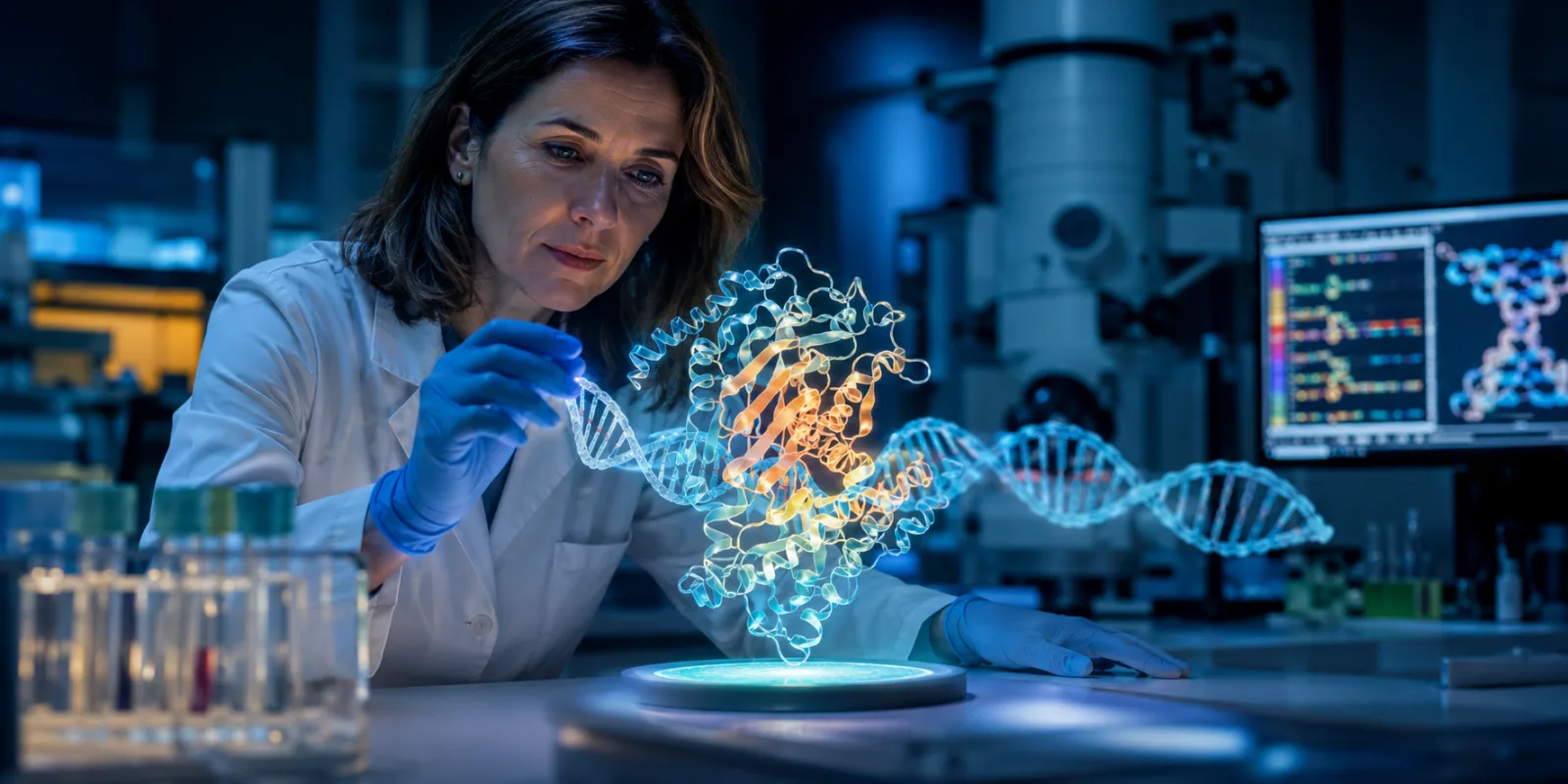
For a decade, the story of gene editing has been a story of borrowing. Scientists found CRISPR proteins inside bacteria, adapted them, and pointed them at human genes. The tools were powerful, but we were still using hardware that evolution built for its own purposes. A new paper from Jennifer Doudna's lab changes the premise. Her team used an artificial-intelligence model to design a gene-editing enzyme from the ground up, and in human cells the synthetic version cut DNA more efficiently than the natural one it was based on.
What happened#
A group led by Jennifer Doudna, the University of California, Berkeley biochemist who shared the 2020 Nobel Prize in Chemistry for CRISPR, reported in Science a framework for designing "minimal" RNA-guided nucleases using AI. The team redesigned a protein called TnpB, a small relative of the CRISPR enzymes most labs use, and produced synthetic variants they named SynTnpBs.
The headline numbers come from tests in human cells. Two of the redesigned enzymes edited a target gene at roughly 46% and 50% efficiency, against about 28% for the natural TnpB they started from, according to Chemical & Engineering News. Across bacterial, human and plant cells, several SynTnpBs matched or beat the natural enzyme, reaching up to about four times its activity at some human targets. The best variant also showed fewer off-target cuts, reports The Scientist, which is the property gene-editing researchers arguably care about most.
Molecular scissors, and why size is the problem#
CRISPR systems are, at heart, guided cutting tools. A protein does the cutting. A short piece of RNA acts as the address label, matching a specific stretch of DNA and telling the protein where to make its cut. Change the RNA guide and you change the target. That programmability is why CRISPR reshaped biology so quickly.
The famous protein is Cas9, and it works, but it is bulky, around 1,360 amino acids. That size is a practical headache. To fix a gene inside a living person, you usually have to deliver the editor into cells, and the most common delivery vehicles are adeno-associated viruses, or AAVs. An AAV can only carry roughly 4.7 kilobases of genetic cargo, and Cas9 plus its guide and the other bits of machinery strain against that ceiling. If the editor does not fit, it does not travel.
This is where TnpB comes in. TnpB is a compact ancestor of the Cas12 family, only about 400 amino acids, so it is small enough to leave real room to spare in a viral package, as the Innovative Genomics Institute explains. The catch is that small natural enzymes tend to be less efficient and fussier to engineer. TnpB is a "multidomain" protein, meaning different regions handle different jobs, so a mutation that improves one part can quietly break another. Tinkering by hand is slow and often backfires.
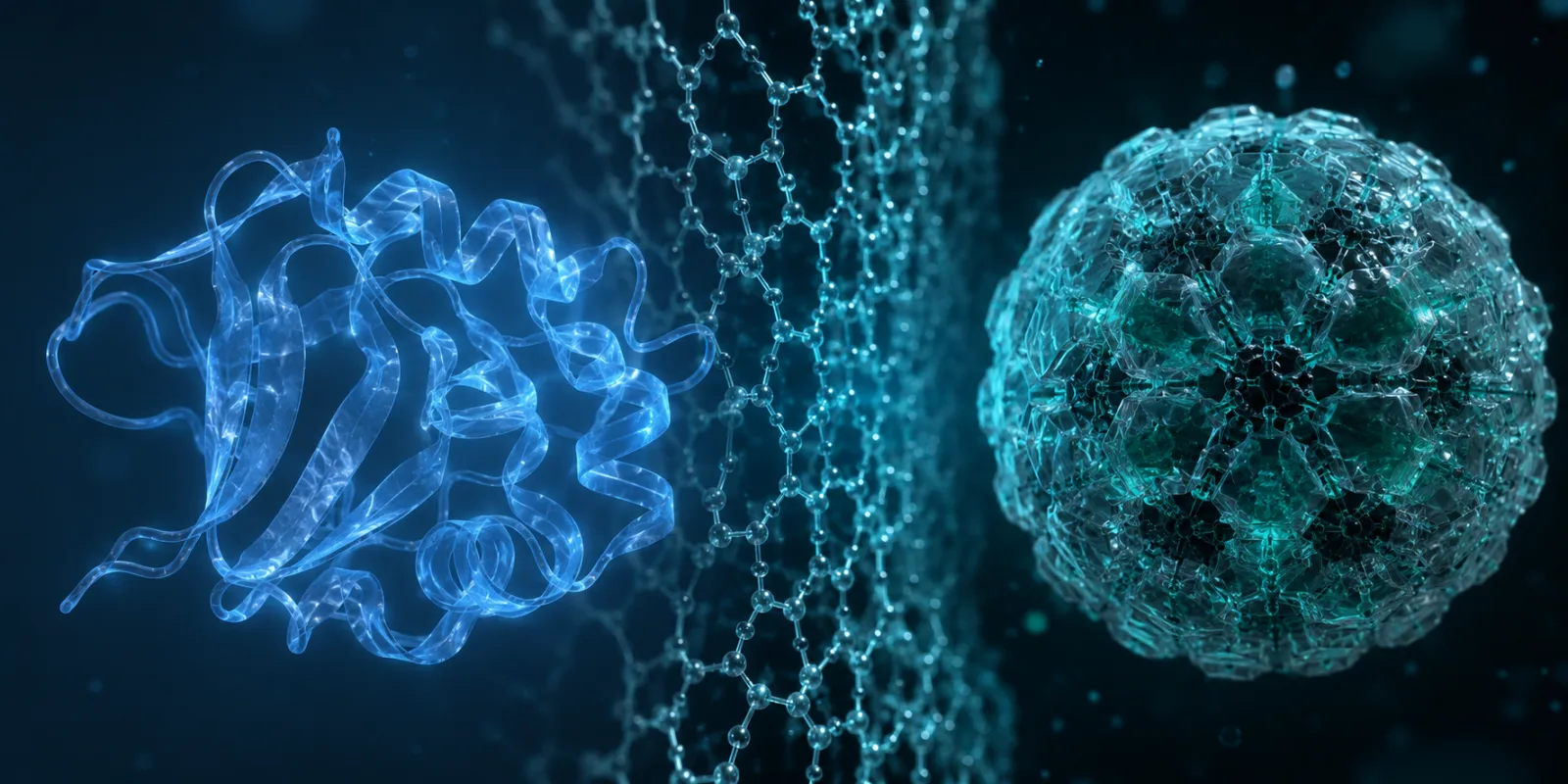
The AI approach here is a way to tinker cleverly. Doudna's team used inverse protein folding. Ordinary structure prediction, the kind that made AlphaFold famous, goes from a sequence of amino acids to a predicted 3D shape. Inverse folding runs the problem backwards: you specify the shape you want, and the model proposes sequences that should fold into it. The researchers used a model from the ESM family (Evolutionary Scale Modeling, a protein "language model" trained on hundreds of millions of natural sequences) to generate candidate TnpB sequences that kept the working shape while rewriting much of the underlying code.
That alone is not enough, and the paper is honest about it. Left to its own devices, the model introduced changes that would have disrupted how the enzyme grips its RNA guide and DNA target. So the team added constraints drawn from evolution, locking down the amino acids that natural TnpBs have kept conserved and preserving the co-evolved contacts between the protein and its nucleic-acid partners, per The Scientist. The result was a set of sequences that looked nothing like any natural TnpB on a family tree, yet still folded and functioned. A cryo-electron microscopy structure of the best variant showed why: the redesign had added new electrostatic and hydrogen-bond contacts right where the guide RNA meets the target DNA.
Why this matters#
The most immediate consequence is a better small editor. A compact nuclease that edits efficiently and misses less often is exactly what the field needs to make in-body gene editing more practical, especially for tissues and organs where every kilobase of viral cargo counts. Plant scientists want the same thing, because delivering large editors into crops is its own delivery bottleneck.
The deeper point is about method. For most of CRISPR's history, expanding the toolbox meant going prospecting: sequence more microbes, find more natural enzymes, characterise them, hope one has useful properties. That is bioprospecting, and it is limited to what evolution happened to make. This paper is a proof of principle that you can instead design the enzyme you want, using structure and evolutionary history as a scaffold, and end up with something that outperforms the natural starting material in the specific way you were aiming for. If that generalises, the pace of tool discovery stops depending on what is already out there.
It also lands in a busy moment for AI-designed biology. In 2024, Profluent used a protein language model to generate OpenCRISPR-1, a functional gene editor that did not exist in nature. Foundation models for DNA, such as the Arc Institute's Evo 2, can now generate genomic sequences across the tree of life. Doudna's contribution is narrower and, in some ways, more convincing, because the target is a specific, well-understood enzyme and the payoff is measured in editing efficiency and off-target rates inside living cells, not in abstract benchmarks.
Critical analysis#
The strengths are real. The enzymes were tested in bacterial, plant and human cells, not just modelled on a screen. The improvement over the natural enzyme is sizeable and, crucially, comes with a reduction in off-target activity rather than a trade-off against it. And the cryo-EM structure gives a mechanistic explanation for the gain, which is the difference between a lucky hit and a repeatable strategy.
The limits are just as real. Editing a reporter gene in cultured cells is a long way from correcting a disease-causing mutation in a patient. Efficiency at one target does not guarantee efficiency at another, and the paper's own results show SynTnpB performance varies by target. Off-target effects were reduced in the assays used, but the assays labs run rarely catch everything, and safety for any therapeutic editor has to be established target by target, tissue by tissue. None of the SynTnpBs is a drug. There are no clinical results here, and there will not be for years.
There are open questions the paper does not settle. Does the design strategy transfer to other enzyme families, or did TnpB happen to be unusually amenable? How well do these variants tolerate the messy conditions inside different human tissues, as opposed to a controlled cell line? There is also the governance question that shadows all of this work: tools that make it easier to design potent biological machinery are, like most powerful methods, usable in more than one direction. That is not a reason to stop, but it is a reason for the field to keep its biosecurity conversations current.
On timelines, my read is that the near-term impact is on research and agriculture, where a better compact editor can be adopted quickly. Therapeutic impact is a slower burn, measured in years of preclinical and clinical work. Treat anyone promising in-body SynTnpB therapies soon with healthy scepticism.
Expert perspective: what makes this different#
Compare it to the milestones around it. AlphaFold solved prediction: given a sequence, what shape? Profluent's OpenCRISPR-1 showed generation: a language model can dream up a working editor. Evo 2 pushed generation to the scale of whole genomes. What Doudna's team adds is a tight, evolution-guided design loop aimed at a concrete engineering goal, with the result verified where it counts, in cells, and explained by structure.
The competing approach is the one CRISPR has always leaned on, which is to keep mining nature. That still works, and it will keep producing surprises. But a purely generative model, turned loose, tends to wander off into sequences that fold into nice shapes and then fail to do the job, because folding is not the same as functioning. The move that makes this paper land is the marriage of a generative model with hard evolutionary constraints. The AI supplies creativity; evolution supplies the guardrails. That combination is probably the transferable lesson here, more than any single enzyme.
Key takeaways#
Doudna's lab used an AI inverse-folding model, guided by evolutionary constraints, to design synthetic TnpB gene editors that beat the natural enzyme in human cells (roughly 46 to 50% editing versus 28%), with fewer off-target cuts.
The win is partly about size. TnpB is about a third the size of Cas9, which matters for squeezing editors into viral delivery vehicles.
The method points beyond bioprospecting toward designing the enzymes you want, rather than hunting for them in nature.
It is a laboratory advance, not a therapy. Clinical use is years away and unproven, and the safety bar for any human editor is high.
Frequently asked questions#
- What is TnpB? A small, RNA-guided DNA-cutting protein found in bacteria and considered an evolutionary ancestor of the CRISPR-Cas12 enzymes. Its main appeal is size: at around 400 amino acids it is far more compact than Cas9.
- What does "AI-designed" actually mean here? The researchers used an inverse protein-folding model, part of the ESM family of protein language models, to propose new amino-acid sequences that fold into TnpB's working shape. They then filtered those proposals using evolutionary conservation data so the redesign would not break the enzyme's grip on its RNA guide and DNA target.
- Is SynTnpB better than Cas9? It is not a straight replacement for Cas9. It is a much smaller editor that, in this study, outperformed its own natural counterpart, TnpB. The advantage is a compact editor with high efficiency and lower off-target activity, useful where delivery space is tight.
- Can this edit genes in people now? No. The results are in bacterial, plant and cultured human cells. Turning any editor into a safe therapy requires years of additional preclinical and clinical testing.
- Why does the small size matter so much? Because many gene therapies are delivered by adeno-associated viruses, which can only carry about 4.7 kilobases of cargo. A smaller editor fits more comfortably, leaving room for the rest of the machinery.
- How is this different from AlphaFold? AlphaFold predicts a protein's shape from its sequence. This work runs that logic in reverse to design new sequences for a desired shape and function, then tests them in cells.
- Is this the same as OpenCRISPR-1 or Evo 2? It is related but distinct. OpenCRISPR-1 (2024) generated a novel editor with a language model, and Evo 2 generates DNA sequences at genome scale. Doudna's paper is narrower and more validated, targeting a specific enzyme and measuring editing performance and off-target rates in living cells.
- Should I be worried about biosecurity? Methods that make biological design easier deserve ongoing oversight, and researchers in this area generally treat that seriously. This particular paper is a controlled academic study, but the broader capability is a reasonable thing for the field and regulators to keep watching.
References#
- Skopintsev, P., et al. "Structure and evolution-guided design of minimal RNA-guided nucleases." Science (2026). DOI: 10.1126/science.aed6123. (Peer-reviewed paper, primary source.)
- Khedkar, S. "A Synthetic Nuclease Boosts CRISPR Editing Efficiency." The Scientist (2026). Link.
- "AI-designed nucleases build on nature's design." Chemical & Engineering News (2026). Link.
- "AI-designed gene-editing enzymes expand the CRISPR toolbox." Phys.org (2026). Link.
- "What are TnpBs? How Jumping Genes are Unlocking New Opportunities in Genome Editing." Innovative Genomics Institute. Link.
- Editing the Human Genome with AI. OpenCRISPR-1
- "Evo 2: DNA Foundation Model." Arc Institute. Link.
- "The Nobel Prize in Chemistry 2020" (Emmanuelle Charpentier and Jennifer A. Doudna). Link.