AI
AI vs. H5N1: How Artificial Intelligence Is Racing to Outsmart the Bird Flu Outbreak Sweeping Australia
Australia just logged its first H5N1 mass-mortality event. Here's how a new wave of AI tools — protein language models, generative antibody pipelines, AI-designed antigens — is being mobilised against the virus, and where the science still falls short.
84 dead seabirds#
On 1 August 2026, a helicopter crew surveying the waters off Cape Jaffa in South Australia counted 49 dead greater crested terns and 35 more visibly sick, all clustered on a small protected island called Baudin Rocks. By Monday, the CSIRO's Australian Centre for Disease Preparedness had confirmed what wildlife vets feared: it was H5N1. Australia's first mass-mortality event from highly pathogenic avian influenza [1].
Within 72 hours, the country's confirmed wild-bird case count quintupled, from 20 on 27 July to 102 by 4 August [2]. Federal Agriculture Minister Julie Collins told reporters bluntly: "Australians should expect to see more spread and larger numbers now of wildlife being affected" [1]. Environment Minister Murray Watt called it "the beginning" of a long road.
What caught my attention this week was not just the outbreak itself. It is what is being deployed against the virus at the same time (quietly, in parallel, mostly in preprints and pre-clinical announcements) and how much of the new armoury is, frankly, artificial intelligence. Three separate stories dropped into the same news cycle. Together, they sketch an early picture of what an AI-assisted pandemic response might actually look like, and where the seams still show.
What happened this week#
Let me line up the three pieces of news that converge here.
1. The outbreak. Greater crested terns started dying in unusually high numbers along Australia's southern coast in late July. Baudin Rocks, off South Australia, is the first site where aerial surveillance caught a true mass-mortality cluster (49 dead, 35 sick) in a single sighting. CSIRO sequencing confirmed H5N1 on 3 August. The virus has now been detected in wild seabirds in five Australian states. There are still no detections in poultry, and the human health risk is officially rated low [1][2][3].
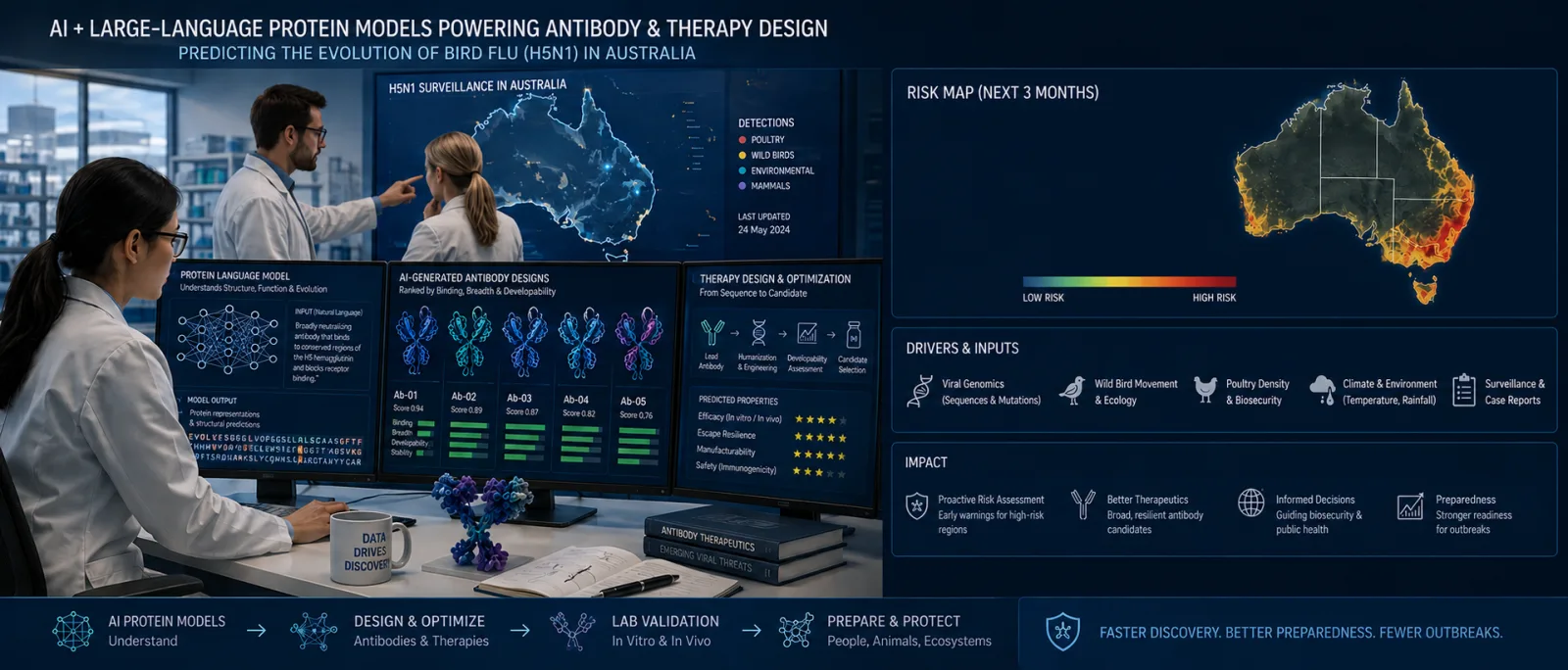
2. An open-source antibody pipeline against H5N1. A team at the University of North Carolina at Charlotte released the Frankies pipeline, a fully automated AI workflow that designs antibody fragments against the H5N1 hemagglutinin (HA1) protein. Using the protein-diffusion model EvoDiff, the structure predictor AlphaFold 3, and the docking engine HADDOCK3, the team generated 30 candidate Fv antibody fragments in 11 hours and 34 minutes of serial compute, about 21 minutes per candidate. Top candidates showed docking scores comparable to known therapeutic antibodies, and all 30 passed sequence validation. The code, sequences, and results are on GitHub [4]. This is a 2025 preprint, not yet peer-reviewed.
3. A real AI-designed H5 vaccine antigen, going into manufacturing. On 14 October 2025, CEPI (the Coalition for Epidemic Preparedness Innovations) announced up to US $16.4 million in funding for the Serum Institute of India to make and test two H5 antigens on a baculovirus platform: a wild-type version, and an AI-optimised, broad-spectrum H5 antigen designed by scientists at the Houston Methodist Research Institute. The goal is not just an H5N1 vaccine. It is a stress test for CEPI's "100 Days Mission": designing antigens by machine learning so a pandemic vaccine can start shipping three months after a threat is identified [5][6].
A fourth story sits behind these three. A multi-institutional team led by Vanderbilt University Medical Center showed in November 2025 that a protein language model called "Monoclonal Antibody Generator" (MAGE) can design functional human antibodies against H5N1 without needing any starting template from the target strain. Train MAGE on antibodies against one H5N1 strain, and it can generate binders against a related, previously unseen strain. That is the property that matters most when a virus is mutating weekly [7].
Why this matters: a different operating system for outbreak response#
The traditional pandemic playbook is painfully slow. You wait for an outbreak, isolate the virus, grow it, inactivate it, inject it into something, purify antibodies from survivors, and only then start thinking about a vaccine. That sequence is why the 2009 H1N1 vaccine arrived after the second wave, and why the world burned through most of 2020 waiting on COVID-19 shots.
What the new generation of AI tools changes is not necessarily which drugs or vaccines we end up with. It is the front end of the pipeline: the part that decides what to make, and how fast we can get to "first glass vial."
Reading viral sequences. A model called LucaVirus, published in National Science Review in June 2026 by a team at Sun Yat-sen University (Shenzhen) with virologist Edward C. Holmes, was trained on 25.4 billion nucleotide and amino-acid tokens spanning nearly all catalogued viral diversity. It can pull viral sequences out of metagenomic "dark matter," predict which unknown proteins are enzymes, forecast which viral lineages are most likely to evolve next, and propose antibody candidates, all from a single foundation model with one billion parameters. According to the paper, it matches AlphaFold 3 + CSM-Ab/DG-affinity pipelines for antibody-antigen binding while using a fraction of the parameters [8]. The version we are citing here is a peer-reviewed paper; a related bioRxiv preprint from June 2025 is the earlier version.
Designing antibodies from scratch. The Frankies pipeline cuts weeks of benchwork to under half a day of compute per candidate [4]. MAGE goes further by skipping the need for any antibody starting material from the new strain [7]. Neither has produced a clinically approved therapeutic yet, but the gap between "a sequence on a hard drive" and "a candidate in a vial" is shrinking fast.
Designing the antigen itself. Houston Methodist's AI-optimised H5 antigen is, as far as I can tell, the first AI-designed influenza antigen moving into industrial-scale baculovirus production under a CEPI partnership. If the head-to-head comparison with the wild-type antigen shows broader protection, the playbook for the next Disease X gets a lot shorter [5][6].
Put together, the architecture starts to look like a loop. Surveillance data → foundation model interprets sequences → generative model designs antibodies or antigens → docking or immunogenicity model scores the candidates → top hits go to the bench. Some labs are now running versions of this loop in days, not years.
The limitations: where the AI still falls short#
I want to be honest about the seams, because they are real and they are the part most AI-in-virology coverage underplays.
Most outputs are still predictions. The Frankies paper itself is candid: all 30 antibody candidates are in silico designs. They have favourable docking scores and structural motifs similar to known therapeutics, but nobody has put them in a mouse yet [4]. LucaVirus, MAGE, the Houston Methodist antigen: all of them need wet-lab validation before they are anything more than a very smart guess. The Frankies authors say so explicitly: the work "lays the foundation for future in vitro empirical validation."
Benchmarks in virology are noisy. Most virology AI papers train and test on data from a small set of well-studied viruses: SARS-CoV-2, H5N1, H1N1, HIV. Performance on a novel virus that has never been seen in a lab is essentially unmeasured. Luca's group argues their 25.4-billion-token training set covers "the vast majority of catalogued viral diversity," which is true, but "catalogued" is the operative word. The viruses that cause pandemics are usually not the well-catalogued ones.
Data bias and consent are unresolved. Training protein language models on sequences pulled from public databases (GenBank, UniProt, the Therapeutic Structural Antibody Database) is legally and ethically simpler than training on patient-derived antibody sequences, but it inherits decades of sampling bias. Viral sequences from well-funded wealthy-country labs are over-represented; sequences from wildlife surveillance in low- and middle-income countries are under-represented. The WHO and the Pasteur Institute have both flagged this as a fairness issue for AI in outbreak response. The CEPI/SII partnership, notably, includes an explicit "equitable access" clause for the outputs of the programme [5].
H5N1 itself has not become a human-transmissible virus. The joint FAO/WHO/WOAH assessment of 18 May 2026 still rates the global public-health risk from circulating H5N1 as "low," and notes that the virus would "require additional genetic changes to acquire efficient human-to-human transmission via respiratory droplets" [9]. Australia's current outbreak is in wild seabirds; no poultry or human cases have been detected there yet [1][2]. The fear of H5N1 driving a future pandemic is real and grounded in history, but it is a forward-looking risk, not the current situation.
The 100-day clock is not a guarantee. CEPI's 100 Days Mission is an aspiration. The UK mRNA H5N1 Phase 3 trial launched in April 2026, but as the launch coverage noted, "no efficacy or safety results are yet available" [10]. Even with AI-designed antigens, you still need manufacturing, regulators, and a clinical-trial infrastructure that can move fast.
What I am watching next#
A few concrete signals will tell us if the AI playbook is actually delivering:
- In vivo data on AI-designed H5N1 antibodies. The Frankies paper ends with "future in vitro empirical validation." When that data drops, we will know if in silico docking scores translate into actual neutralisation.
- CEPI/SII Phase 1 readout on the AI-optimised H5 antigen. A direct head-to-head with the wild-type antigen would be the first time an AI-designed influenza antigen is benchmarked against a conventional one in a regulated trial.
- Sustained human-transmission surveillance in Australia and South-East Asia. The Cambodia, Bangladesh, and India case cluster from 2025-2026 is the closer-to-home scenario: 12 human cases, 3 deaths, all linked to sick poultry [11]. If the virus picks up mammalian-adaptive mutations, the AI tools above will be the first line of triage, not the last.
- Independent audits of training data. Until we can see what the protein language models were trained on, claims of "comprehensive coverage" should be read with a sceptical eye.
FAQ#
Is AI being used in the current H5N1 response right now? Mostly in research and pre-clinical pipelines, not in clinical care. Outbreak containment in Australia is still being run by traditional wildlife surveillance, the CSIRO's Australian Centre for Disease Preparedness, and public-health authorities [1][2][3].
What is a protein language model? It is a neural network, usually a transformer, trained on huge numbers of protein sequences. It learns statistical patterns in amino-acid co-occurrence the way a text language model learns word co-occurrence, and it can use those patterns to predict structure, function, and the effect of mutations. ESM-2 (Meta), AlphaFold 3 (DeepMind/Isomorphic), and LucaVirus are three examples relevant to virology [8][12].
Are AI-designed antibodies safe? None have been approved for human use. The candidates from Frankies, MAGE, and similar pipelines are still at the in silico or in vitro stage. The Vanderbilt team, for example, only validated MAGE's H5N1 antibodies in cell-culture assays against an unseen influenza strain [7]. The Frankies candidates have not yet been tested even in cells [4]. This post is not medical advice. For personal health questions, please consult a qualified clinician.
Could AI have predicted Australia's H5N1 outbreak? Not the specific event. Models like VirHostPRED (a 2026 ESM-2-based tool that classifies a virus as human-infecting or not from a single protein sequence) can flag risk, but they cannot predict where and when an outbreak will surface in wildlife [12]. Outbreak prediction is still mostly a boots-on-the-ground, nets-in-the-marsh problem.
Why is H5N1 considered a pandemic risk at all if human cases are rare? Historical case-fatality rates are unusually high: about 48% across the 993 confirmed human cases reported to WHO between 2003 and early 2026 [3]. Even a small jump in transmissibility would be dangerous.
Should I be worried? The current public-health risk in Australia is rated low, and the global risk remains low according to the May 2026 joint FAO/WHO/WOAH assessment [9]. Standard food-safety practices (pasteurised milk, thoroughly cooked poultry and eggs) are still the right everyday precautions. The bigger story is the longer-term one: whether the AI tools landing right now meaningfully shorten the time between "novel virus detected" and "first doses shipped." That is still a TBD.
Source list#
- Al Jazeera. "Australia warns H5N1 likely to spread after first mass-mortality episode." 3 August 2026. https://www.aljazeera.com/news/2026/8/3/australia-warns-h5n1-likely-to-spread-after-first-mass-mortality-episode
- Flutrackers consolidated thread on Australia's 2026 H5N1 detections in wild birds. https://flutrackers.com/forum/forum/oceania/h5n1-tracking-ai/australia/1037077-australia-mainland-h5n1-in-wild-birds-2026-n-102-local-transmission-confirmed-by-csiro-mass-mortality-event-confirmed
- PAHO/WHO. "Epidemiological Update: Avian Influenza A(H5N1) in the Americas." 11 March 2026. https://www.paho.org/sites/default/files/2026/03/2026-march-11-phe-avian-influenza-update-final.pdf
- Santolla NF, Ford CT. "AI-Based Antibody Design Targeting Recent H5N1 Avian Influenza Strains." Computational and Structural Biotechnology Journal (2025); bioRxiv preprint 2025. https://pmc.ncbi.nlm.nih.gov/articles/PMC12270607/ — preprint / not yet peer-reviewed; code at https://github.com/Santollan/Frankies
- CEPI press release. "Serum Institute of India and CEPI supercharge pandemic response preparedness targeting H5N1." 14 October 2025. https://cepi.net/serum-institute-india-and-cepi-supercharge-pandemic-response-preparedness-targeting-h5n1
- CIDRAP. "CEPI announces new partnership with Indian vaccine maker." 14 October 2025. https://www.cidrap.umn.edu/avian-influenza-bird-flu/cepi-announces-new-partnership-indian-vaccine-maker
- Georgiev lab / Vanderbilt University Medical Center. "Generation of antigen-specific paired-chain antibodies using large language models." Cell,01135-3) and EurekAlerts
- Pan Y-F, et al. "Predicting the evolutionary and functional landscapes of viruses with a unified nucleotide-protein language model: LucaVirus." National Science Review 13(14), nwag376, published 17 June 2026. https://academic.oup.com/nsr/article/13/14/nwag376/8709798 — bioRxiv preprint at https://www.biorxiv.org/content/10.1101/2025.06.14.659722v1
- FAO/WHO/WOAH. "Updated joint public health assessment of Gs/Gd-like high pathogenicity avian influenza A(H5) viruses." 18 May 2026. https://www.woah.org/app/uploads/2026/05/2026-05-18-fao-woah-who-h5-assessment.pdf
- Global Biodefense. "UK Launches Phase 3 Trial of mRNA H5N1 Vaccine in Bid to Get Ahead of Next Pandemic." 23 April 2026. https://globalbiodefense.com/2026/04/23/uk-launches-phase-3-trial-of-mrna-h5n1-vaccine-in-bid-to-get-ahead-of-next-pandemic/
- CDC. "Global Summary of Human Cases of H5N1 Bird Flu from August 2025 to June 2026." 26 June 2026. https://www.cdc.gov/bird-flu/spotlights/global-summary-06262026.html
- Beltrán JF, et al. "Protein language models enable accurate viral host range prediction." Scientific Reports 16(1):7606, 25 February 2026. https://www.nature.com/articles/s41598-026-37765-8 — web server: https://www.biochemintelli.com/virhostpred/
Disclaimer: This article is for informational and educational purposes only. It is not medical advice. For personal health questions, please consult a qualified clinician. Statistics on outbreak counts were accurate as of 4 August 2026 and may have changed.