Five billion dollars and one very testable claim#
On 17 November, Isomorphic Labs announced a $5 billion Series C round, co-led by Greenoaks and Sequoia Capital, with Andreessen Horowitz joining and Alphabet continuing to invest (Isomorphic Labs news release). The London company says the money will scale its drug design engine, known as IsoDDE, and build infrastructure to take its drug candidates into clinical trials (Isomorphic Labs news release).
Funding rounds are not science, and a number that large invites eye-rolling. But this one rests on a technical claim that can be checked against published benchmarks: that an AI model can predict how tightly a drug-like molecule sticks to a protein as well as, or better than, expensive physics simulations. If that is true, it changes how chemists decide which molecules to make. If it is only partly true, it changes how much to believe the headlines.
This post goes through the evidence that is public. The funding news is recent. The technical report behind it dates from February 2026, so this is a story about a claim meeting its first serious bankroll, not about a brand-new result.
Background: why drug design needs both structure and affinity#
A drug usually works by binding to a protein, much as a key fits a lock, and changing what the protein does. Two questions follow. First, what does the lock look like with the key in it? That is structure prediction. Second, how tightly does the key stick? That is binding affinity, and it decides whether a molecule is potent enough to be worth developing.
DeepMind's AlphaFold transformed the first question for proteins, and the 2024 Nobel Prize in Chemistry recognised that work (C&EN). AlphaFold 3 extended the approach to complexes that include small molecules (Abramson et al.). Isomorphic Labs, which spun out of Google DeepMind in 2021 and is led by Demis Hassabis, builds on that lineage (C&EN).
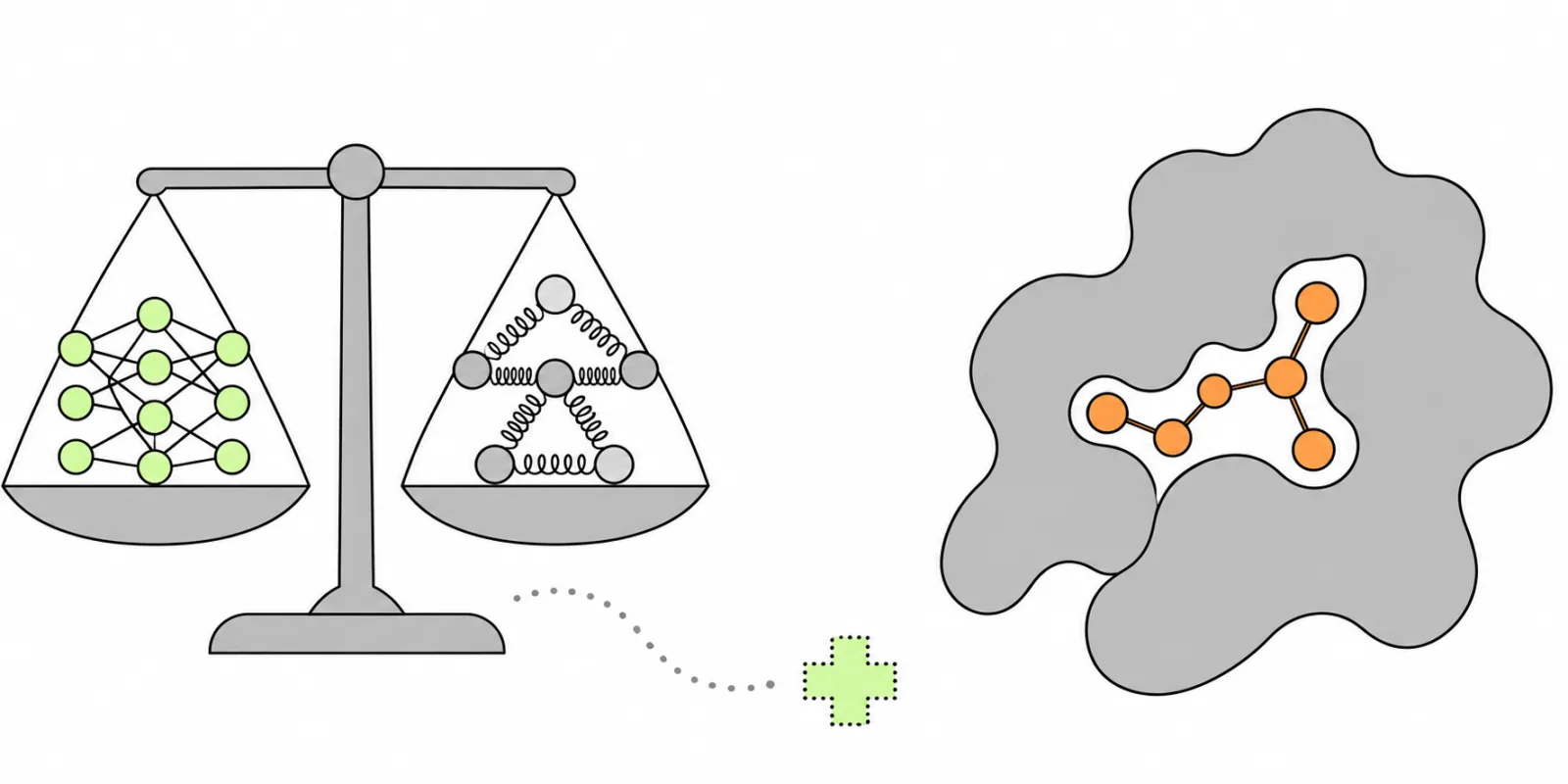
The second question has long been the territory of physics. Free energy perturbation (FEP) is a physics-based computational method used to predict the binding affinity between molecules and their protein targets. It is accurate but compute-intensive and depends on high-quality experimental structures (Isomorphic Labs). Deep-learning methods have brought speed to this task, but have lagged FEP on accuracy (Isomorphic Labs). Anyone doing structure-based drug design or computer-aided drug design will know the trade-off: fast and rough, or slow and careful.
Two more terms. A benchmark is a fixed test set used to compare methods. And generalisation means doing well on cases unlike the training data, which is where AI models tend to wobble.
What IsoDDE is meant to be#
IsoDDE is described as a unified computational drug-design system that goes beyond AlphaFold 3 in predictive accuracy and adds capabilities that bridge structure prediction and real-world drug discovery (Isomorphic Labs). The company says it combines a suite of foundational simulation models that work across therapeutic areas and drug modalities, together with agents that reason over complex biological systems (Isomorphic Labs news release).
A spokesperson put the difference this way: AlphaFold asks what a protein looks like, while IsoDDE moves towards how to design a drug that can bind to it, and whether that drug is likely to have a therapeutic effect (BioPharmaTrend). That is a reasonable one-line description, and a useful reminder that the company is selling a design engine, not a structure predictor.
One feature matters for everything that follows: the engine is proprietary. The February Nature news report described it as a major advance, while noting that scientists developing open-source tools are left guessing how to achieve similar results (Nature news). Compare that with AlphaFold 3, which was described in a peer-reviewed journal article (Abramson et al.). The evidence for IsoDDE is a company technical report, which has not been peer-reviewed (Isomorphic Labs technical report).
The hard protein-ligand cases#
The first test is generalisation, which matters for protein-ligand docking and structure prediction alike. Benchmarks showed that AlphaFold 3's accuracy dropped for structures dissimilar to its training examples (Isomorphic Labs). The company used the Runs N' Poses benchmark, designed to test generalisation to novel pockets and ligands (Škrinjar et al.), and reports that IsoDDE more than doubles AlphaFold 3's accuracy on the most difficult systems (Isomorphic Labs).
The figures in the report give the claim some texture. In the lowest similarity bin, IsoDDE's success rate is 50 per cent against 24 per cent for AlphaFold 3 on the full set. With similarity filtering and clustering, those numbers fall to 37.2 per cent against 16.7 per cent (Isomorphic Labs technical report). The gain survives the stricter test, which is a good sign, but the gap shrinks, and the confidence intervals are wide because the hardest bin contains only dozens of examples (Isomorphic Labs technical report).
The report also describes its guard against leakage, the quiet way benchmarks can flatter a model. It uses date cutoffs so that test structures were deposited after training data ended, and it applies similarity filters to the test interfaces (Isomorphic Labs technical report). Those are sensible controls. They are also controls that the authors chose and applied themselves.
Antibodies, a notoriously hard target#
Antibody-antigen complexes are harder than small-molecule complexes, because the contact surfaces are large and flexible. On a challenging, novel antibody-antigen test set, IsoDDE is reported to outperform AlphaFold 3 by 2.3 times and Boltz-2 by 19.8 times in the high-fidelity regime, defined as a DockQ score above 0.8 (Isomorphic Labs). DockQ is a score for how closely a predicted complex matches the experimental one.
The underlying percentages are more instructive than the multiples. With a single prediction seed, the report gives 39 per cent for IsoDDE, 17 per cent for AlphaFold 3 and 2 per cent for Boltz-2. With 1,000 seeds, it gives 58.5, 29 and 3 per cent (Isomorphic Labs technical report). A "19.8 times" headline is partly a statement about how low the comparison model's base rate is on this set. The honest reading is that roughly four in ten, rising to nearly six in ten, high-quality antibody predictions is a large step up, and that most such predictions still fall short of that quality bar.
Can it beat free energy perturbation?#
This is the claim that matters most to medicinal chemists. The company reports that IsoDDE surpasses all deep-learning methods by a considerable margin on three public benchmarks, FEP+ 4, OpenFE and the CASP16 blind affinity challenge, and can surpass physics-based methods such as FEP without needing experimental crystal structures (Isomorphic Labs).
The chart below plots the mean Pearson correlation between predicted and measured affinities, as given in the technical report. A correlation of 1 would be perfect prediction and 0 would be no better than chance.
On the FEP+ 4 set the report gives 0.85 for IsoDDE against 0.78 for FEP+ and 0.66 for Boltz-2. On the OpenFE set it gives 0.73 against 0.72 for FEP+ and 0.62 for Boltz-2. On CASP16 it gives 0.75 against 0.65 for Boltz-2 (Isomorphic Labs technical report). The lead over FEP+ is clear on one benchmark and a rounding error on the other, so "matches" is a safer word than "beats" for the physics comparison, while the lead over other deep-learning models looks more solid.
The report says it removed all training data for proteins with 90 per cent or greater sequence identity to the targets in the FEP+ 4 and OpenFE benchmarks (Isomorphic Labs technical report). That is a meaningful control. It still leaves a question that only outside groups can answer: how does the model behave on a new project, with new chemistry, in the hands of someone who did not build it?
From benchmark to clinic, and what is still missing#
The report also describes a pocket-finding test using cereblon. Given only the protein's sequence, IsoDDE reportedly predicted the location of both a known ligand site and a novel cryptic site, a pocket that opens only when a ligand arrives (Isomorphic Labs technical report). The report also notes that performance on the cryptic subset decreases, though it continues to outperform the comparison method it uses (Isomorphic Labs technical report).
Then there is the distance between a good prediction and a medicine. The Series C announcement describes positive preclinical results for internal programmes in oncology and immunology and with partners, and says this sets the stage for clinical entry (Isomorphic Labs news release). Chemical & Engineering News adds that the company has projects with pharmaceutical partners including Eli Lilly, Novartis and Johnson & Johnson (C&EN). "Preclinical" means lab and animal work. It does not mean a drug in a person.
That matters because the journey is long. Testing a molecule through the stages of clinical trials takes nearly a decade and close to $2 billion before approval (C&EN). Jack Scannell, founder of Etheros Pharmaceuticals, told C&EN that with funding at this scale Isomorphic will have to show it can do things faster, better and cheaper, and soon (C&EN). The company's own president says the models yield repeatable scientific advances every week (Isomorphic Labs news release). Both statements can be true at once, because better molecules at the design stage are not the same thing as better odds in a clinical trial.
Isomorphic is also not alone. Boltz, which builds protein and small-molecule foundation models, raised a $110 million Series A for what it calls programmable molecular design (Bessemer Venture Partners). The competition between proprietary and open approaches is likely to shape how quickly outsiders can test claims like these.
The key numbers at a glance#
The table below collects the main headline benchmarks from the company's report. It is a summary of company-run results, not of independent replication.
| Benchmark | IsoDDE | AlphaFold 3 | Boltz-2 |
|---|---|---|---|
| Runs N' Poses, lowest-similarity bin, full set (success rate) | 50% (report) | 24% (report) | Not comparable on this row |
| Antibody-antigen, DockQ above 0.8, one seed | 39% (report) | 17% (report) | 2% (report) |
| Affinity correlation, FEP+ 4 set | 0.85 (report) | Not reported | 0.66 (report) |
| Affinity correlation, CASP16 | 0.75 (report) | Not reported | 0.65 (report) |
How to read all this#
My reading is that the technical report describes a real, probably substantial, step forward in AI drug discovery, and that the $5 billion tells us how much the market believes it. Neither fact tells us how the engine performs outside its authors' hands. The next milestones to watch are independent benchmarks on blind data, peer-reviewed publication of the methods, and the first IsoDDE-designed molecule that enters a human trial. Until then, the sensible position is interested and unconvinced: the numbers are encouraging, the controls are reasonable, and the verification is still to come.
Frequently asked questions#
What did Isomorphic Labs announce? A $5 billion Series C round on 17 November 2026, co-led by Greenoaks and Sequoia Capital, to scale its drug design engine and advance candidates towards clinical trials (Isomorphic Labs news release).
What is IsoDDE? The Isomorphic Labs Drug Design Engine, a unified computational system that goes beyond AlphaFold 3 by predicting binding affinities and finding binding pockets as well as structures (Isomorphic Labs).
Is IsoDDE better than AlphaFold 3? On the company's own benchmarks, yes, including more than double the accuracy on the hardest protein-ligand cases, although the gain narrows under stricter filtering (Isomorphic Labs technical report).
Does it really beat physics-based methods? It is reported to exceed FEP+ on one benchmark and roughly match it on another, so "matches or beats on some benchmarks" is the fairest summary (Isomorphic Labs technical report).
Can other scientists use or test IsoDDE? Not freely. The model is proprietary, and the technical report offers little detail on how to reproduce it (Nature news).
Has an AI-designed Isomorphic drug reached patients? Not according to the announcement, which describes positive preclinical results and the aim of clinical entry (Isomorphic Labs news release).
Why does it take so long to get a drug to market? Clinical testing takes nearly a decade and close to $2 billion on average before marketing approval (C&EN).
References#
- Isomorphic Labs. Isomorphic Labs announces $5 Billion Series C funding. News release, 17 November 2026. https://storage.googleapis.com/isomorphiclabs-website-public-artifacts/ISOMORPHIC_LABS_FUNDING_17-11-26.pdf
- Isomorphic Labs Team. Accurate predictions of novel biomolecular interactions with IsoDDE. Technical report, February 2026 (company report, (not peer-reviewed)). https://storage.googleapis.com/isomorphiclabs-website-public-artifacts/isodde_technical_report.pdf
- Isomorphic Labs. The Isomorphic Labs Drug Design Engine unlocks a new frontier beyond AlphaFold. https://www.isomorphiclabs.com/articles/the-isomorphic-labs-drug-design-engine-unlocks-a-new-frontier
- Pratap, A. Isomorphic Labs raises $5 billion for AI drug discovery. Chemical & Engineering News, 18 November 2026. https://cen.acs.org/business/investment/isomorphic-labs-ai-drug-discovery/104/web/2026/11
- Callaway, E. "An AlphaFold 4": scientists marvel at DeepMind drug spin-off's exclusive new AI. Nature 651, 18 (2026). https://www.nature.com/articles/d41586-026-00365-7
- Abramson, J. et al. Accurate structure prediction of biomolecular interactions with AlphaFold 3. Nature 630, 493 (2024). https://doi.org/10.1038/s41586-024-07487-w
- Škrinjar, P. et al. Runs N' Poses benchmark. bioRxiv (2025) (not peer-reviewed). https://www.biorxiv.org/content/10.1101/2025.02.03.636309v3
- BioPharmaTrend. Isomorphic Labs presents an AI drug design engine that goes beyond AlphaFold 3 (trade press, used for the company spokesperson's description). https://www.biopharmatrend.com/news/isomorphic-labs-presents-an-ai-drug-design-engine-that-goes-beyond-alphafold-3-1493/
- Bessemer Venture Partners. Boltz: building towards programmable molecular design (investor announcement). https://www.bvp.com/news/boltz-building-towards-programmable-molecular-design