A language model that learned drug chemistry from sequences alone#
Most people picture drug design as a game of lock and key. You have a protein, with a pocket of a particular shape, and you hunt for a small molecule that fits. Computers have been playing this game for decades, usually with 3D models of the protein. A preprint posted on 10 November describes a different approach: feed a language model huge numbers of paired protein and molecule sequences, never show it a single 3D coordinate, and see what it works out for itself (arXiv, not peer-reviewed).
The model is called Bonbon. It was trained on approximately 3.2 trillion tokens of paired protein-ligand sequences. The author reports that it can tell, with no task-specific training, whether a molecule inhibits or activates a target, where on the protein it binds, and whether it forms a covalent bond (arXiv). The headline claim sits in the lab: in prospective testing across nine disease targets, the model reports a 61.5% dose-response hit rate on de novo compounds.
That is a striking number, and it deserves a careful read rather than a shrug or a cheer. This post focuses on the protein language model approach to drug design, explains what Bonbon actually did, and sets out what remains unverified. Everything below about Bonbon comes from the arXiv version of the paper, which is a preprint and has not been peer-reviewed. The page notes that it was accepted at NeurIPS 2026 as a main-track oral, a conference acceptance that we could not independently verify beyond the author's comment, and the accepted version may differ from the one we read.
Background: what is a protein language model, and why use one for drug design?#
A language model learns patterns in sequences of symbols. In ordinary language, the symbols are words. In biology, a protein is a chain of amino acids, written as a string of letters, so the same trick applies. A protein language model reads millions of protein sequences and learns which patterns tend to go together, much as a text model learns that "pH" tends to follow "buffer". Those patterns capture clues about structure and function without anyone labelling them.
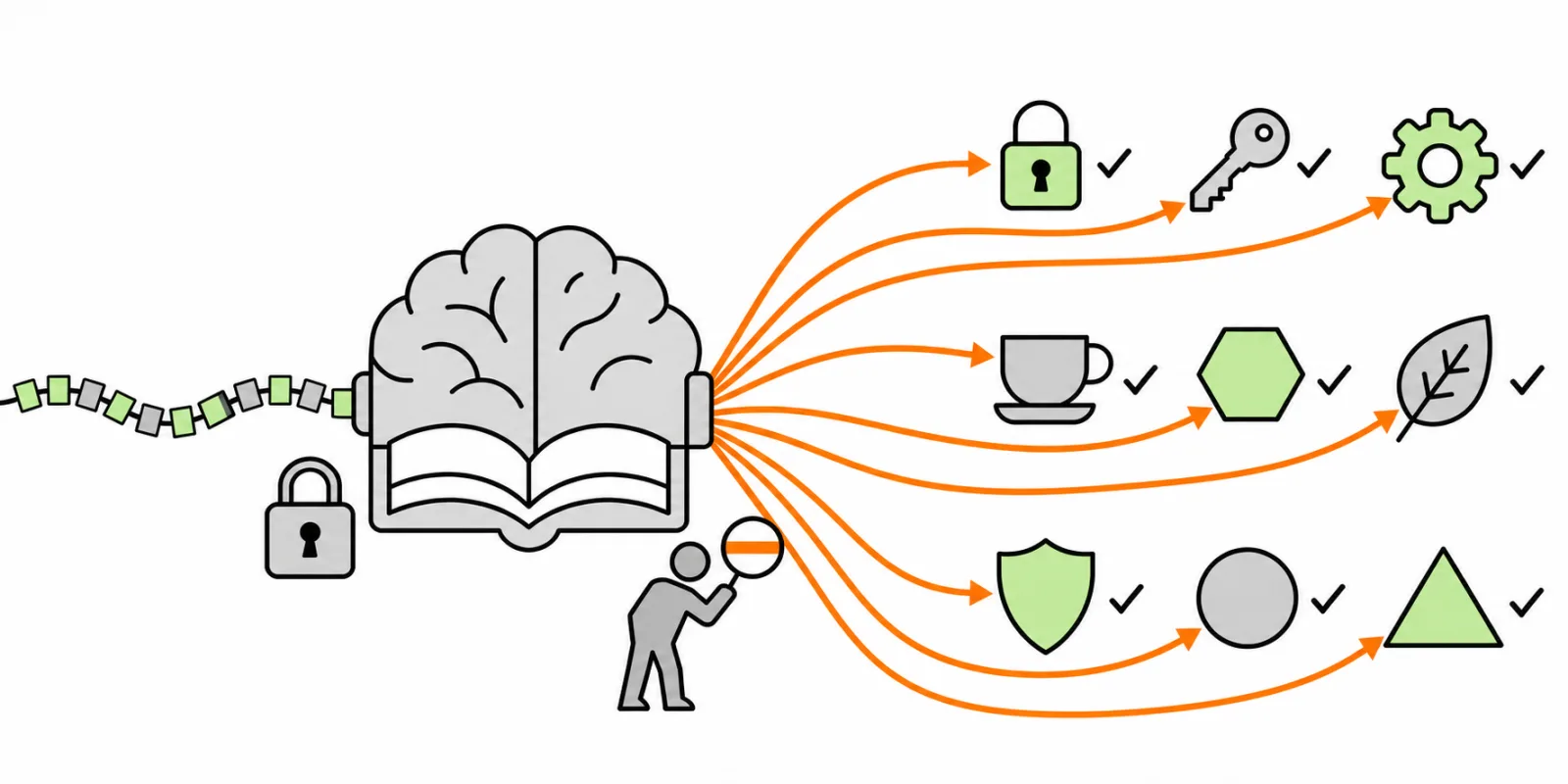
Drugs are usually small molecules, called ligands when they bind a protein. A ligand can also be written as a string, using a notation called SMILES. Bonbon takes the next step and reads proteins and ligands together, as pairs, so the model can learn which kinds of molecules go with which kinds of proteins. The architecture is a standard transformer with a 65,536-token context window designed for many-to-many relationships, meaning one protein can be paired with many molecules and vice versa.
Several terms will recur. Zero-shot means asking a model to do something it was never trained to do, with no extra examples. Mechanism of action is how a drug affects its target, for example by blocking it (an inhibitor or antagonist) or switching it on (an agonist). An orthosteric site is the protein's main, natural binding pocket, while an allosteric site is a separate spot where binding changes the protein's behaviour. A covalent drug forms a chemical bond with its target, while most drugs hold on more loosely. Virtual screening means ranking huge libraries of molecules by computer to pick a small number worth testing.
Finally, "co-folding" methods such as AlphaFold 3 predict the 3D structure of a protein and ligand together. They are accurate but slow, which is why people look for faster alternatives.
What Bonbon is trained on, and what is missing#
The training corpus is described as proprietary screening datasets enriched with synthetic interaction data. It spans soluble enzymes, membrane receptors, ion channels, transcription factors, small molecules, peptides and protein-protein interactions. The paper states that the model was trained on protein-ligand sequences alone, without any task-specific supervision and without structural coordinates.
Two limitations follow. First, the model weights and training data are not released publicly, with access for academic non-commercial research granted case by case. That limits independent replication. Second, the author is affiliated with a company, Output Labs, and the paper lists no funding source or competing-interests statement. None of this means the results are wrong. It does mean the usual safeguards of open data and independent checking are, for now, absent.
The authors give a biosecurity reason for withholding the model: a system that predicts mechanism and covalent binding could guide the design of molecules with harmful biological activity. They also note it predicts interaction properties, not organismal toxicity. Reasonable people may weigh openness against caution differently, but the trade-off is real.
Three skills nobody trained it to have#
The central scientific claim is about "emergent" abilities, meaning skills that appear without being directly trained for. The abstract reports three, all generalising to out-of-distribution complexes. Using the paper's numbers and bearing in mind that the author ran these tests.
For function, a simple signature computed from the model predicts mechanism of action across six classes with 81.1% macro precision on 107,027 interactions. It also distinguishes agonists from antagonists on the same receptor, reaching 85.5% balanced accuracy across 28,126 interactions on 222 GPCRs. GPCRs are a large family of cell-surface receptors that make up many drug targets.
For binding sites, orthosteric and allosteric pockets were separated with an AUROC of 0.834 across 6,032 out-of-distribution complexes, against 0.589 for a molecular fingerprint baseline. AUROC is a score where 1.0 is perfect and 0.5 is chance. Plain binding-site localisation is more modest: an F1 of 0.381 in-distribution and 0.388 out-of-distribution. F1 balances finding true sites against raising false ones, and the paper lists dedicated pocket finders scoring higher on a separate benchmark, so this is not a clean win.
For bond type, the model separates covalent from non-covalent engagement with an AUROC of 0.838 on 1,212 out-of-distribution pairs, against 0.72 for Morgan fingerprints. It also localises the reactive residue with 71.8% top-1 accuracy against a 5.8% chance baseline.
The scaling jump, and why it matters#
The most interesting experimental design is the scaling study. The author trained six versions, from 42 million to 1.6 billion parameters. Parameters are the adjustable numbers inside a model, loosely its size. The table below summarises what happened at the largest scale.
| Capability | Score at the five smaller scales | Score at 1.6 billion parameters |
|---|---|---|
| Mechanism of action (macro precision) | 0.567 to 0.608 | 0.811 |
| Orthosteric versus allosteric (AUROC) | 0.600 to 0.646, near the 0.589 fingerprint baseline | 0.834 |
| Covalent versus non-covalent (AUROC, warhead-free subset) | 0.638 to 0.659 | 0.775 |
Meanwhile, the training loss, the model's measure of its own prediction error, decreased smoothly. The author argues that this shows loss-based scaling laws alone are insufficient to predict when zero-shot emergent capabilities become available. If that holds up, it matters: it means a team cannot easily know in advance how big a biological model must be before useful skills appear.
A note of caution. Six models at six scales, trained once, is a thin basis for a general law, and the sharp jump occurs only at the single largest size. The result is intriguing, but it is one preprint's observation on one model family.
Virtual screening and speed against co-folding#
Bonbon is also pitched as a fast virtual-screening engine. The paper claims its frozen representations reach state-of-the-art binding and affinity prediction at five orders of magnitude greater speed than co-folding methods. In numbers, it processes about 2,500 pairs per second on the fly, or about 42,500 with cached representations, on a single H100 GPU, against 0.05 pairs per second for Boltz-2.
On accuracy, the paper reports an enrichment factor at 1% (EF1%) on a benchmark called LIT-PCBA-AF3. EF1% asks how many more true hits appear in the top 1% of a ranked list than you would expect by chance, so higher is better. The chart below plots the reported values.
Bonbon scored 16.6 against 9.3 for Boltz-2, with the other methods lower. On affinity prediction tasks, the picture is more even: on the FEP+4 set Bonbon's Pearson correlation was 0.78, matching the physics-based FEP+ method, and on an OpenFE set it scored 0.69 against 0.72 for FEP+. So the claim is competitive with expensive physics at far lower cost, not a clean sweep. As these comparisons were run by the model's author, independent replication would add real weight.
The wet-lab test, and how to read a 61.5% hit rate#
Benchmarks are one thing, and test-tube results are another. The paper reports prospective validation, in which the model's predictions are tested before the results are known. The nine targets were TYK2, PRMT5, JAK1, CDK1, HDAC6, MNK2, MMP-9, ELANE and VEGFR2, spanning seven protein families. The team tested 213 compounds, up to 24 per target.
A confirmed inhibitor had to be active in both a single-dose screen at 10 micromolar and a ten-point dose-response test that returned a measurable IC50, the concentration needed to halve the target's activity. The compounds also had to be novel: not a duplicate of a known active, with maximum ECFP4 Tanimoto similarity below 0.45 to any known active, and not a simple single-substituent variant of one. The paper reports confirmed inhibitors for all nine targets.
What should we make of this? It is a strong early signal, and the novelty rules are more demanding than many papers use. But three questions remain. Hit rates depend heavily on the target and the chosen threshold, and 10 micromolar is a relatively generous bar for a first-pass hit. A hit is not a drug: potency, selectivity, safety and manufacturability come much later. And without public weights, compound structures or independent re-testing, nobody outside the team can yet check the work. We could not confirm from the text we extracted exactly how the 61.5% figure was calculated, so we report it as the paper states it.
FAQs#
What is Bonbon? It is a foundation model for molecular interactions, trained on approximately 3.2 trillion tokens of paired protein-ligand sequences without structural coordinates, described in an arXiv preprint posted on 10 November 2026. (arXiv, not peer-reviewed)
Is Bonbon peer-reviewed? The paper is a preprint, which is not peer-reviewed. The arXiv comment says it was accepted at NeurIPS 2026 as a main-track oral, but we could not verify that independently.
What does "emergent" mean here? It means skills that appear without being trained for, such as predicting mechanism of action, binding site location and covalent versus non-covalent binding.
How good were the lab results? The paper reports confirmed novel inhibitors for all nine tested targets and a 61.5% dose-response hit rate, from 213 compounds tested.
Can researchers use the model? Model weights and training data are not public, and access for academic non-commercial research is granted case by case.
Is it faster than AlphaFold-style co-folding? The paper claims about five orders of magnitude greater speed than co-folding methods, with 2,500 pairs per second against 0.05 for Boltz-2 on an H100 GPU.
Does a 61.5% hit rate mean 61.5% of these compounds are drugs? No. A hit is a compound that shows activity in a test at a set threshold. Turning a hit into a drug takes optimisation for potency, selectivity and safety, which the paper does not cover.
References#
- Mashiach, A. Emergent Biological Capabilities in a Foundation Model for Molecular Interactions. arXiv:2611.14504, submitted 10 November 2026 (not peer-reviewed). Abstract: https://arxiv.org/abs/2611.14504. Full text: https://arxiv.org/pdf/2611.14504. The arXiv comment states acceptance at NeurIPS 2026 (main track, oral); the accepted version was not read.