A year and a half of lab work, matched in half an hour#
In 2024, a team at the Francis Crick Institute traced a cause of inflammatory bowel disease (IBD) to an overactive gene called ETS2 in immune cells, driven by a DNA variant sitting in a region of the genome far from any protein-coding sequence. The work took gene editing and sophisticated molecular biology.
On 11 November 2026, Google DeepMind announced a model that reproduced aspects of that finding computationally. James Lee, the immunologist who led the 2024 study, told Nature: "They've managed to figure out the answer in 30 minutes, and it took us a year and a half of experiments". He also called the result reassuring from his team's perspective (Callaway, Nature, 2026).
The model is AlphaGenome 2, and it deserves a careful look, both for what it can do and for what it cannot. Readers searching for "DeepMind's disease tracking AI" may expect an outbreak monitor. This is something different: a tool for understanding which genetic variants matter for disease, and in which cells. We explain the difference near the end. A note on sourcing: the performance claims come from DeepMind's own announcement and preprint, which has not been peer reviewed, so we flag them as the company's results throughout.
Background: the terms you need#
Every cell in your body carries essentially the same DNA, yet a heart muscle cell and an immune cell behave very differently. The difference lies in which genes are switched on or off. DeepMind describes this as each cell type and state reading the same blueprint differently (Gayoso et al., Google DeepMind, 2026).
Much of the control sits in non-coding DNA, the stretches that do not spell out proteins. Nature reports that these sequences make up 98% of the human genome and are among the hardest to decipher (Callaway, Nature, 2026). A variant is a single-letter difference in the DNA between people. An enhancer is a regulatory switch, often far from the gene it controls, that turns activity up or down in particular cell types (Callaway, Nature, 2026).
Genome-wide association studies (GWAS) scan many people's DNA and flag broad regions linked to a disease or trait. The difficulty, as DeepMind puts it, is finding the exact causal variant, the target gene and the cell type with high confidence (Gayoso et al., Google DeepMind, 2026). AlphaGenome 2 is built to help close that gap.
What AlphaGenome 2 is#
AlphaGenome 2 is a next-generation DNA sequence model that predicts how DNA sequences and their variations affect specific human cell types (Gayoso et al., Google DeepMind, 2026). It follows AlphaGenome 1, which took a million-letter DNA sequence and predicted properties across thousands of experiments from many tissues at once (Gayoso et al., Google DeepMind, 2026).
That earlier model has a limitation that researchers noticed. Lee told Nature that having something that cannot predict cell-type specificity "is a bit of a problem, which is why it hasn't been hugely useful for us" (Callaway, Nature, 2026). Two months before the new release, DeepMind published the AlphaGenome Atlas, predictions for every possible single-letter change in the human genome, about 9 billion variants, made with the first model (Callaway, Nature, 2026).
How the redesign works#
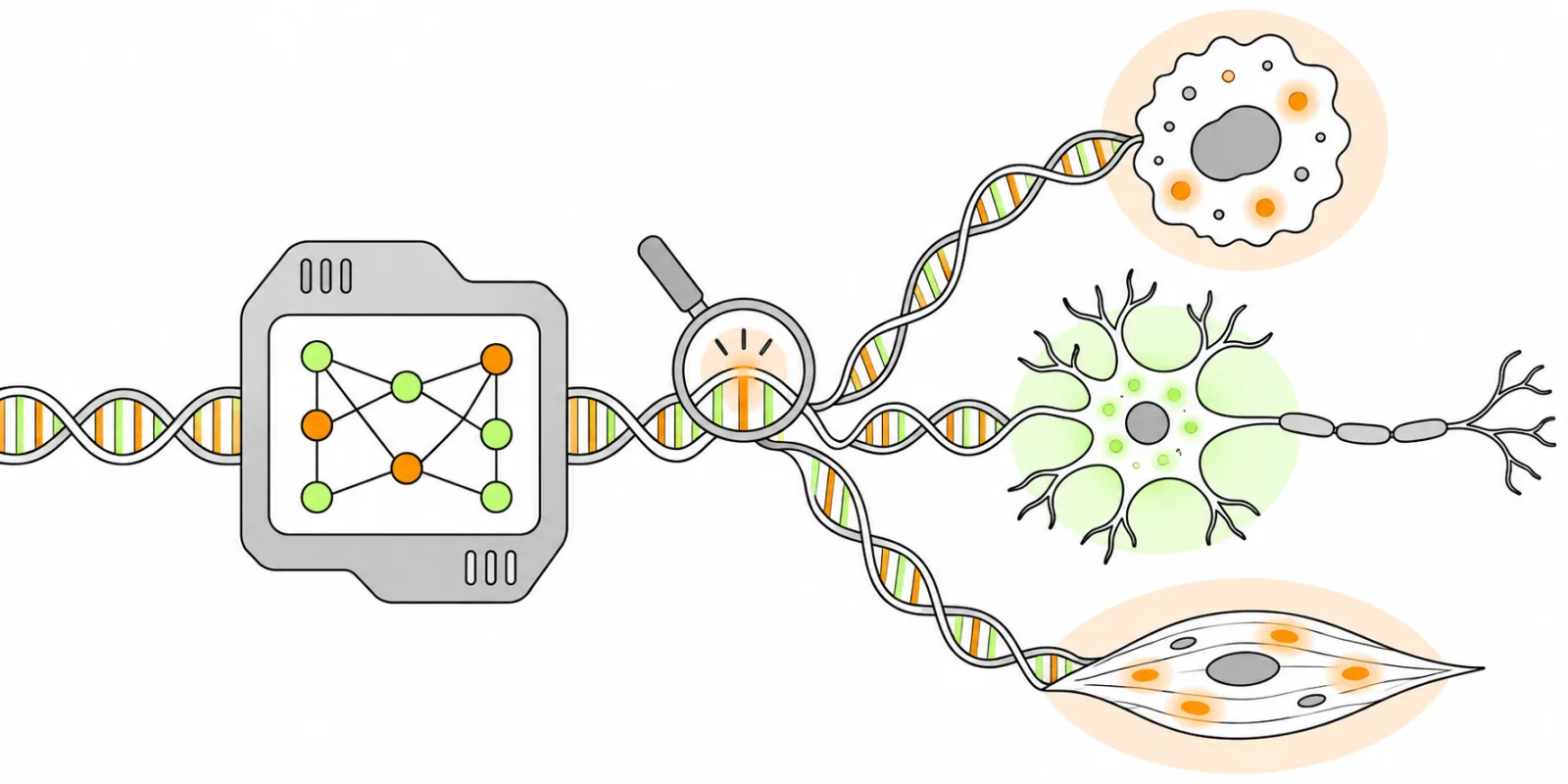
The key change is that AlphaGenome 2 is a conditional model. Instead of predicting many outputs in parallel, it predicts DNA effects for one condition at a time, where a condition is a tissue, cell type or cell state. It takes the target condition as an input at every stage of its architecture (Gayoso et al., Google DeepMind, 2026).
A simple analogy: the first model was like a single translator producing a hundred translations at once, with each one a little blurry. The second asks the translator to focus on one language at a time and to know which one it is working in. DeepMind says this lets the model learn how the same stretch of DNA is read differently across cell types (Gayoso et al., Google DeepMind, 2026).
The training data also changed. The team used gene activity and other measurements from more than 100 million individual cells across 68 tissues, whereas AlphaGenome 1 was fed data from bulk samples of mixed cells (Callaway, Nature, 2026). DeepMind reports training on bulk and single-cell data from human and mouse samples, including over 107 million individual cell profiles (Gayoso et al., Google DeepMind, 2026).
The model predicts gene expression, histone modifications and chromatin accessibility, and adds DNA methylation, a widely requested readout (Gayoso et al., Google DeepMind, 2026). It was trained on 637 types of human cells and 311 types of mouse cells, but researchers can supply new single-cell data, such as cells in a disease state, and still obtain variant predictions (Callaway, Nature, 2026).
The headline numbers, and how to read them#
On the TenK10K dataset, a single-cell map of 28 primary immune cell types, AlphaGenome 2 identified causal variants at a rate of 30%, against 16% for the original AlphaGenome fine-tuned on single-cell data and other specialised tools (Gayoso et al., Google DeepMind, 2026). For directional gene effects, which means whether a variant turns a gene up or down, the figures were 43% against 23% (Gayoso et al., Google DeepMind, 2026).
Those are large relative gains, and DeepMind describes the model as finding nearly twice as many variants that change gene expression in cells compared with its previous state-of-the-art model (Gayoso et al., Google DeepMind, 2026). Two cautions apply. First, a 30% rate means most causal variants in that benchmark were still not recovered. Second, these are the developer's own comparisons, reported in a preprint that has not been peer reviewed (Callaway, Nature, 2026). Independent groups will need to repeat them on their own data.
The bowel disease test and the COVID-19 example#
The ETS2 result is the most striking demonstration. DeepMind says that, making predictions across immune cell types in the gut, AlphaGenome 2 singled out the causal variant and showed that it selectively boosts ETS2 in gut macrophages, leaving other cell types and genes largely unaffected (Gayoso et al., Google DeepMind, 2026). The original discovery, published in 2024, showed that a variant in a distant regulatory switch drives IBD by overactivating ETS2 in gut macrophages (Nature, 2024).
Keep the logic in view. This was a test against a known answer. Recovering a finding that humans have already made proves the model can find a real signal, but it does not prove it will find new ones. Nature itself says DeepMind replicated "aspects of" the earlier finding (Callaway, Nature, 2026).
A second example moves closer to infectious disease. DeepMind says that, given unseen single-cell data from a COVID-19 mRNA vaccine study, AlphaGenome 2 distinguished vaccine-activated T cells from resting ones, and revealed that a variant linked to severe COVID-19 disrupts gene activity more strongly in the activated state. That effect would be missed in unactivated cells (Gayoso et al., Google DeepMind, 2026).
This capacity to adapt to new cell states without retraining is, to our mind, the most practically interesting feature. Scientists can upload a single-cell snapshot from as few as a few dozen cells, and DeepMind says the model can match or outperform models trained or fine-tuned directly on those datasets (Gayoso et al., Google DeepMind, 2026). Adam Gayoso of DeepMind says this could help researchers identify disease-underlying variants more quickly (Callaway, Nature, 2026).
Is this a "disease tracking AI"?#
Not in the outbreak-monitoring sense. AlphaGenome 2 reads human and mouse DNA to explain genetic risk. It does not scan wastewater, count cases or detect new pathogens.
DeepMind's separate bioresilience programme is where surveillance appears. There, the company says it is exploring whether technologies such as AlphaGenome could help detect and characterise pathogens from sequence data, and it describes this as exploration rather than a deployed system (Google DeepMind and Isomorphic Labs, 2026). The UK Cabinet Office also named DeepMind as a research partner of the new AI Biosecurity Lab, which aims to detect biological threats earlier (Cabinet Office, GOV.UK, 2026).
So the summary is that DeepMind's disease work spans two different things: tools that explain how our own genes shape disease, such as AlphaGenome 2, and plans to support pathogen surveillance, which are at an earlier stage. The COVID-19 example sits between them, because it concerns how human genetic variation interacts with an immune response to a virus, not how to spot the virus itself.
What researchers can do with it, and what they should not#
AlphaGenome 2 is available for non-commercial research through the AlphaGenome API and in private preview for commercial research (Gayoso et al., Google DeepMind, 2026). DeepMind also precomputed predictions for trait-associated variants across hundreds of human cell and tissue conditions, so researchers can look up scores without running large computations (Gayoso et al., Google DeepMind, 2026).
The company states that AlphaGenome and AlphaGenome 2 are intended for research use only and have not been validated or approved for clinical or diagnostic purposes (Gayoso et al., Google DeepMind, 2026). That rules out using it to interpret a patient's genome in a clinic.
Practically, the sensible way to use a model like this is as a prioritisation engine. It can rank which variants, genes and cell types to test first, and DeepMind describes cross-modality imputation, predicting unmeasured properties from a single measurement, as a way to help researchers prioritise which experiments to do next (Gayoso et al., Google DeepMind, 2026). The wet-lab experiment remains the arbiter.
At a glance#
| Question | What the sources say |
|---|---|
| What is it? | A conditional DNA sequence model predicting variant effects in specific human cell types (Gayoso et al., 2026) |
| Training data | More than 100 million cell profiles across 68 tissues (Callaway, 2026) |
| Benchmark result | Causal variants 30% vs 16%; directional effects 43% vs 23% on TenK10K (Gayoso et al., 2026) |
| Known-answer test | Reproduced the ETS2 variant effect in gut macrophages (Gayoso et al., 2026) |
| Evidence status | DeepMind preprint, not peer-reviewed (Callaway, 2026) |
| Access | Non-commercial API; private preview for commercial use (Gayoso et al., 2026) |
| Clinical use | Not validated or approved (Gayoso et al., 2026) |
Frequently asked questions#
What is AlphaGenome 2? It is Google DeepMind's next-generation DNA sequence model, announced on 11 November 2026, which predicts how DNA variants affect specific human cell types (Gayoso et al., Google DeepMind, 2026).
How is it different from the first AlphaGenome? The first model produced many tissue-level predictions in parallel from bulk data. The new one is conditional and predicts for one cell type or state at a time, trained on more than 100 million single cells (Callaway, Nature, 2026).
Did it really replicate a discovery that took 18 months? It reproduced aspects of the 2024 ETS2 finding. James Lee, who led the original study, said it reached the answer in 30 minutes compared with a year and a half of experiments (Callaway, Nature, 2026). It was a test against a known result.
Is the paper peer reviewed? No. Nature describes the paper on DeepMind's website as a preprint, so the benchmark figures are (not peer-reviewed) (Callaway, Nature, 2026).
Can doctors use it to interpret patients' genomes? No. DeepMind says it is intended for research use only and has not been validated or approved for clinical or diagnostic purposes (Gayoso et al., Google DeepMind, 2026).
Does it track outbreaks or infections? No. It models human and mouse gene regulation. DeepMind's separate bioresilience work says it is exploring AlphaGenome for pathogen detection from sequence data (Google DeepMind and Isomorphic Labs, 2026).
Who can use it today? Researchers can access it for non-commercial work through the AlphaGenome API, and commercial researchers can join a private preview (Gayoso et al., Google DeepMind, 2026).
References#
- Gayoso, A., Latysheva, N., Kohli, P. and Avsec, Ž. AlphaGenome 2: Deciphering how cells read DNA to better understand disease. Google DeepMind, 11 November 2026. https://deepmind.google/blog/alphagenome-2-deciphering-how-cells-read-dna-to-better-understand-disease/
- Google DeepMind. AlphaGenome 2 (technical paper, hosted by DeepMind) (not peer-reviewed). https://storage.googleapis.com/deepmind-media/DeepMind.com/Blog/alphagenome-2-deciphering-how-cells-read-dna-to-better-understand-disease/alphagenome-2.pdf
- Callaway, E. DeepMind's ultra-powerful AI for genome mapping wows scientists. Nature news, 11 November 2026. https://www.nature.com/articles/d41586-026-03673-0
- Landmark study linking a distant regulatory variant to inflammatory bowel disease through ETS2, as cited by DeepMind. Nature (2024). https://www.nature.com/articles/s41586-024-07501-1
- Google DeepMind and Isomorphic Labs. Our approach to bioresilience, 16 July 2026. https://deepmind.google/blog/our-approach-to-bioresilience/
- Cabinet Office. Introducing the AI Biosecurity Lab. GOV.UK, 24 October 2026. https://www.gov.uk/government/news/introducing-the-ai-biosecurity-lab