A bottle, a protein and a very long wait#
Almost 70 million tonnes of polyethylene terephthalate (PET), the plastic in drinks bottles and polyester clothes, are made every year, and the usual way of recycling it by melting and reshaping degrades its properties each time (Tournier et al., Nature, 2020). PET is also thought to make up around 12% of global solid waste (Lu et al., Nature, 2022). Less than 30% of it is recycled at all, and what is recycled usually ends up as lower-grade material (Jayasekara et al., 2023).
Enter the plastic eating enzymes. These are proteins that snip PET back into the two chemical building blocks it was made from, which can then be used to make new, virgin-quality plastic. The idea has been around since a Japanese team found a bacterium living on a bottle-recycling site. What changed recently is that artificial intelligence has started to do much of the enzyme designing. Machine learning models now propose the mutations, mine hundreds of millions of natural proteins for new candidates, and in some cases draw up enzymes from scratch.
So is the problem solved? Not quite. In the lab, the best designs can dismantle PET at high concentrations within hours. Outside it, the first large industrial plant built to use the technology has stalled while its financing is sorted out. This post follows the gap between those two facts, using peer-reviewed work wherever possible and flagging preprints (not peer reviewed) where they appear.
Background: what a PET-eating enzyme actually does#
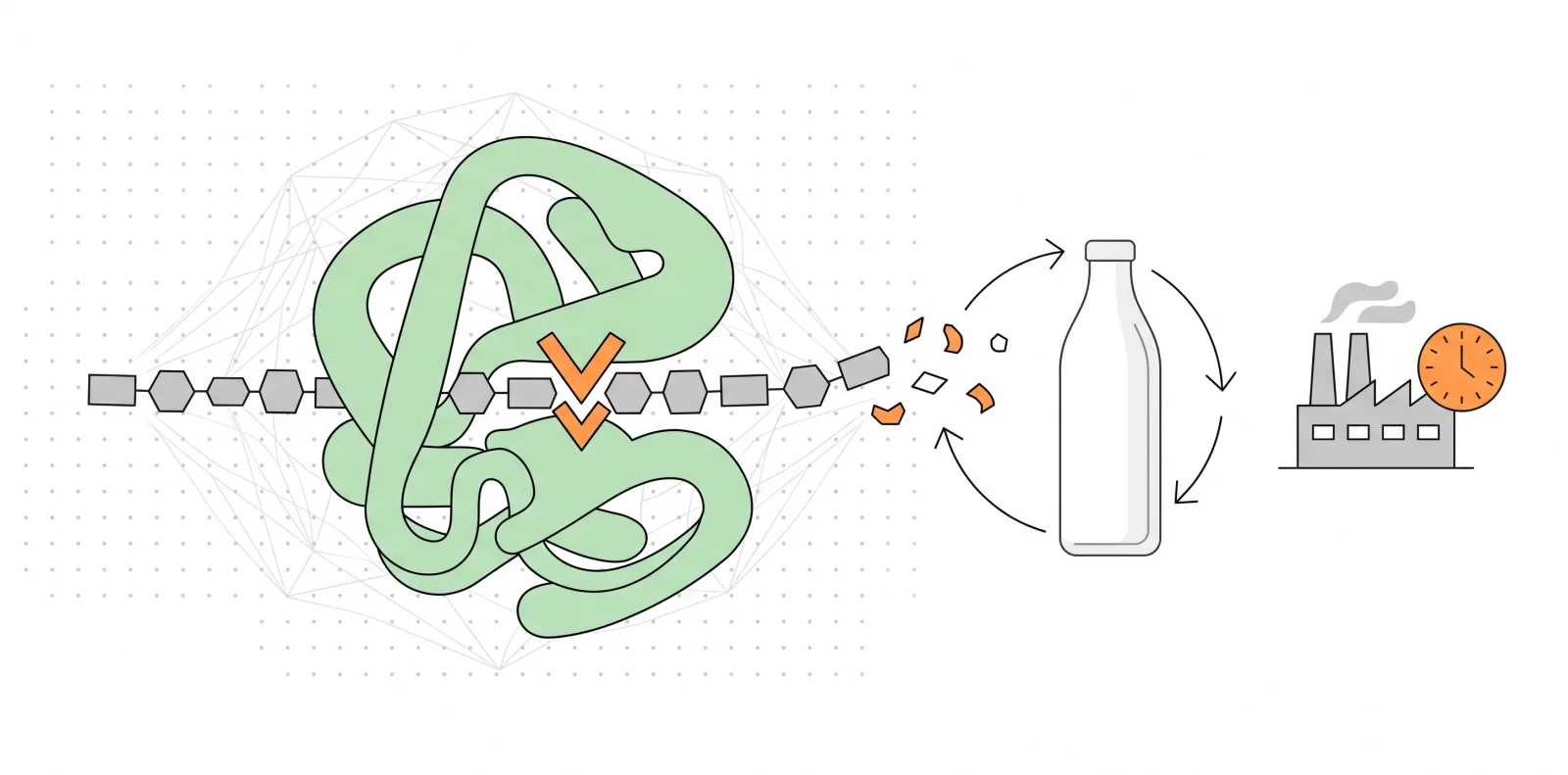
Think of it as a very long chain made of two repeating links, terephthalic acid and ethylene glycol, joined by what chemists call ester bonds. An enzyme that cuts ester bonds is called a hydrolase, because it uses a molecule of water to snap each link. The ones that work on PET are often called PET hydrolases, or PETases for short.
Cutting the chain is not difficult in principle. The difficulty is the surface. PET is a solid, so the enzyme can only attack the outside of a plastic particle, and it does best when the polymer chains are loose and wiggly. They loosen sharply once the temperature passes the glass transition temperature, roughly 40 °C at the surface of PET. Heat the plastic much beyond about 70 °C, however, and it begins to crystallise, packing its chains into tidy, tightly ordered blocks that enzymes struggle to penetrate (Thomsen et al., 2023). Enzymes therefore need to work hot enough to move the chains but not so hot that the plastic hardens against them, and they must survive that heat without falling apart.
That is a stiff specification for a protein. A 2022 review of PET hydrolase design listed the recurring problems: poor thermal stability, low activity at high temperature, and inhibition by partly digested fragments (Wei et al., ACS Catalysis, 2022). Nature's versions were never optimised for industrial reactors, which is where protein engineering comes in.
Two other terms are worth knowing before we go further. "Machine learning" here means statistical models trained on protein data to predict which changes to an amino acid sequence will improve performance. A "protein language model" is a similar model trained on millions of protein sequences, treating them a bit like sentences, so that it can judge which sequences look plausible and functional.
Machine learning as a mutation filter#
The simplest use of AI in this field is also the one with the clearest track record: narrowing down which mutations to try. A protein with 300 amino acids has an astronomical number of possible variants, and no lab can test them all.
In 2022 a team led by Hal Alper at the University of Texas at Austin trained a structure-based machine learning algorithm to pick promising mutations in a PETase. The result, named FAST-PETase, carries five changes from the wild-type enzyme, three suggested by the algorithm and two taken from an earlier engineering effort. It worked between 30 and 50 °C and across a range of acidity levels. It almost completely broke down untreated post-consumer PET from 51 different products within a week, and the team closed the loop by making new PET from the recovered building blocks (Lu et al., Nature, 2022). Chemistry World noted at the time that highly crystalline plastics still needed to be melted into an amorphous form first (Chemistry World).
Computational redesign has kept advancing. In 2024 a Chinese group reported TurboPETase, built by redesigning a hydrolase from a bacterium. It achieved nearly complete breakdown in 8 hours at a solids loading of 200 grams per kilogram, which is the sort of concentration an industrial reactor would need (Cui et al., Nature Communications, 2024). More recently, a deep-learning framework applied to an already strong enzyme produced a variant that converted 95.5% of pretreated post-consumer PET powder in 24 hours at 70 °C, with specific activity 2.0 times that of the benchmark enzyme ICCG (Shao et al., 2026).
A caution is useful here. These improvements are real, but the gains are often incremental, tens of percent rather than orders of magnitude, and they come from experiments run on different plastics, at different temperatures and with different pretreatments. We return to that problem below.
Letting language models search nature#
A second strategy asks a different question: rather than improving one enzyme, why not find better starting points? Nature has had billions of years to produce polyester-cutting enzymes, but we have only known about a handful.
A team at the US National Renewable Energy Laboratory and colleagues used an iterative machine learning strategy to pick 400 candidate PET hydrolases from natural sequences. Of more than 200 they purified and tested, 91 were previously unknown PET hydrolases, 35 of them still active on crystalline PET at an acidic pH of 4.5, and four matched or beat the benchmark enzyme LCC-ICCG under those difficult conditions (Norton-Baker et al., ACS Catalysis, 2025). Acidic conditions matter because they avoid the need for large quantities of chemicals to hold the reaction at a neutral pH.
Protein language models have joined the search. A pipeline called VenusMine combined language models with a structural "family tree" to select 34 proteins, 14 of which degraded PET. One, KbPETase from the bacterium Kibdelosporangium banguiense, melted at a temperature 32 °C higher than the famous Ideonella sakaiensis PETase and outperformed FAST-PETase in catalytic efficiency (Wu et al., Nature Communications, 2025). Another group mined 246 million protein sequences with deep learning and found AhPETase, which has less than 50% sequence similarity to known PET-degrading enzymes and works at 37 °C, roughly body temperature. An engineered version degraded post-consumer PET microplastics 34 times faster than a human-derived enzyme used for comparison, and reduced the toxicity of PET particles to human lung and colon cells in the dish (Wang et al., Advanced Science, 2026). That last result is a cell-culture finding, so it says nothing yet about what such an enzyme would do in a living person or the environment.
What about designing an enzyme from nothing? Generative tools such as RFdiffusion are beginning to do it for other reactions. A 2025 Science paper designed new serine hydrolases (a family that uses a built-in serine amino acid as its cutting tool) from minimal descriptions of the active site, reaching catalytic efficiencies up to 2.2 × 10^5 per molar per second (Lauko et al., Science, 2025). A follow-up model, RFdiffusion2, built scaffolds for all 41 active sites in a benchmark where its predecessor managed 16 (Ahern et al., Nature Methods, 2025). Neither paper was about PET, so a fully de novo plastic-eating enzyme that beats the engineered benchmarks is a promise, not a result. A benchmarking study of 13 generative protein models also found a trade-off: structure-based models gave confident designs with limited diversity, while language models gave more novel designs with lower confidence (Barnett et al., 2026).
The scoreboard: which enzyme is actually best?#
Headlines tend to crown a new champion every few months. A table is a more honest way to look at it, as long as you remember that the columns are not measured under identical conditions.
| Enzyme | How it was found or improved | Headline result | Source |
|---|---|---|---|
| LCC-ICCG | Engineered variant of a compost cutinase (benchmark) | At least 90% PET depolymerisation in 10 hours at 200 g/kg; later work reached 98% in 24 hours | Tournier 2020; Arnal 2023 |
| FAST-PETase | Structure-based machine learning plus scaffold changes | 51 untreated post-consumer products broken down in a week at 30 to 50 °C | Lu 2022 |
| TurboPETase | Computational redesign | Nearly complete breakdown in 8 hours at 200 g/kg | Cui 2024 |
| KbPETase | Protein language model mining of natural sequences | Melting point 32 °C above IsPETase; beat FAST-PETase and LCC in catalytic efficiency | Wu 2025 |
| NI-KYRF | Deep-learning guided redesign | 95.5% conversion of pretreated post-consumer PET powder in 24 hours at 70 °C | Shao 2026 |
| AhPETase M1 | Deep-learning mining of 246 million proteins | Active at 37 °C; degrades PET microplastics 34 times faster than a human-derived comparator | Wang 2026 |
The caveat is not minor. When a French and Dutch-led group re-tested four prominent enzymes under one standardised protocol designed for larger-scale reactions, LCC-ICCG came out clearly ahead, converting 98% of PET in 24 hours. FAST-PETase and HotPETase showed intrinsic limits, mainly low reaction rates, that may prevent their use at larger scale (Arnal et al., ACS Catalysis, 2023). FAST-PETase's real strength is that it works gently at moderate temperatures, which is a different selling point from raw speed.
The crystallinity wall#
If the enzymes are this good, why is the problem not solved? The most stubborn answer is crystallinity. Most PET bottles and textiles are semi-crystalline, with 30 to 50% of the material packed into ordered regions. Enzymes handle the disordered, amorphous parts well and the ordered parts badly.
The effect is severe. In one kinetic study, raising the crystalline fraction of PET from 8.6% to 12.2% cut the maximum reaction rate of LCC-ICCG roughly threefold (Thomsen et al., 2023). Another study found that during a reaction at 65 °C in water, recycled PET crystallised from about 10% to more than 30% in three days, so the plastic was becoming harder to digest while the enzyme worked on it (Patel et al., 2023). The practical lesson there is that a cheap, low dose of enzyme can backfire, because speed matters in the race against crystallisation.
A 2026 molecular simulation study put the problem in structural terms. It found that productive enzyme-substrate arrangements can form on crystalline chains, but at a steep energetic cost, since the enzyme has to pull tightly packed chains apart to fit them into its active site. The authors also noted that no enzyme had yet been shown to directly depolymerise crystalline PET, and suggested the standard enzyme architecture itself may need redesign (Di Pede-Mattatelli et al., 2026). A separate review reaches a similar verdict: crystalline PET remains a major bottleneck, and the pretreatments used to get around it consume substantial energy (Graefe et al., 2026).
Engineers have found workarounds. Melting and rapidly chilling the plastic ("pre-amorphisation") raised the conversion rate of PET fabrics 54-fold and bottles 404-fold compared with untreated samples (Cheng et al., 2024). Yet pretreatments account for a significant share of the electricity a process needs (Wain et al., Faraday Discussions, 2025). A newer approach, published in 2026, ground PET with a commercial cutinase under "moist-solid" conditions and reported nearly complete breakdown of PET with 42.5% crystallinity, at 40% solids or more, without prior amorphisation (Arciszewski et al., JACS, 2026). It is an interesting twist, and a reminder that process engineering may matter as much as clever proteins.
From bench to plant: money, energy and a paused factory#
Even a perfect enzyme has to compete on price. A techno-economic and life-cycle analysis from 2021 suggested that enzymatically recycled terephthalic acid could be cost-competitive with virgin material, with 69 to 83% lower supply-chain energy use and 17 to 43% lower greenhouse gas emissions per kilogram, though the authors stressed that the result depends on improving several process steps (Singh et al., Joule, 2021). That is a model, not a factory.
The real-world test case is the French company Carbios, which built a pilot-scale plant to turn waste PET bottles into new ones using derivatives of the compost cutinase enzyme (Oda and Wlodawer, Biochemistry, 2024). Its planned commercial plant in Longlaville is currently paused. The company has said its target for closing the financing by 30 September 2026 would not be met, pushing back production that had been expected in the first half of 2028, because several parties are still carrying out due diligence on a first-of-its-kind project (Petnology). In its first-half 2026 results Carbios reported €48 million in cash, a cut in its operating loss, and credit committees at a majority of the project's lenders having approved the financing. It also reported progress on a licensing deal and joint venture with the Chinese company Wankai, and an expanded validation of textile waste treatment (Capital.com).
None of this proves that the technology fails. First-of-a-kind chemical plants are expensive, slow and hard to insure, and delays are the norm. But it shows that the bottleneck is no longer only biology. The AI-designed enzymes in this article are mostly tested on small samples, and almost all of them are still PET specialists. Mixed household plastic, including polyethylene and polypropylene, is a different chemical problem, and the enzymes discussed here do not address it.
Researchers are looking beyond bottles. A machine-learning-assisted engineered enzyme broke down biodegradable PBAT mulch film within hours at 37 to 60 °C and returned terephthalic acid of at least 99% purity (Li et al., 2025). A preprint (not peer reviewed) has even released computer-generated, shrunken PETase designs for others to test, although none had been confirmed in the lab at the time of writing (Lála et al., bioRxiv, 2026). Treat results like that as hypotheses until independent laboratories reproduce them.
So where does this leave us?#
AI has genuinely changed the speed of this field. It has produced enzymes that run hotter, last longer, work faster at high solids loading, and come from far more varied biological sources. It has also turned a slow trial-and-error craft into a design-build-test loop that a graduate student can run in weeks. That is a real achievement, and it is not the same as a solved waste crisis.
Three things stand between the lab and the landfill. Crystalline plastic still resists direct attack. Comparisons between enzymes remain muddied by inconsistent test conditions. And a plant has yet to prove, at commercial scale, that the economics hold. The sensible reading of the evidence is cautious optimism: enzymatic recycling looks like a useful complement to mechanical recycling, especially for coloured, opaque and mixed PET, rather than a replacement for everything else (Arnal et al., 2023).
Frequently asked questions#
What are plastic eating enzymes? They are proteins that cut the chemical bonds holding plastic polymers together. The best studied ones, PET hydrolases, split PET into terephthalic acid and ethylene glycol, which can be used to make new plastic (Tournier et al., 2020).
Is FAST-PETase the best PET-degrading enzyme? Not on every measure. It works well at moderate temperatures and degraded 51 untreated products in a week, but a standardised comparison found LCC-ICCG performed better at larger scale, because FAST-PETase's reaction rate is relatively low (Lu et al., 2022; Arnal et al., 2023).
How does AI help design these enzymes? Models predict which mutations will improve stability or activity, search huge databases of natural proteins for new candidates, and in some cases generate new designs. A structure-based algorithm helped create FAST-PETase, and protein language models helped find KbPETase (Lu et al., 2022; Wu et al., 2025).
Can these enzymes break down any plastic? No. The best developed ones target PET and, in some cases, related polyesters such as PBAT and PBT. Common plastics such as polyethylene and polypropylene are chemically different and are not addressed by the enzymes discussed here (Shao et al., 2026; Li et al., 2025).
Why can enzymes not just eat whole plastic bottles? Bottle PET is partly crystalline, with tightly packed chains that enzymes cannot easily reach, so the plastic is usually melted or ground into a more amorphous form first. No enzyme has yet been shown to directly depolymerise crystalline PET in the strict sense used by one 2026 study (Di Pede-Mattatelli et al., 2026; Thomsen et al., 2023).
Is enzymatic recycling better for the environment than conventional recycling? A modelling study estimated 69 to 83% lower energy use and 17 to 43% lower greenhouse gas emissions per kilogram of terephthalic acid compared with virgin production, but these are projections that depend on process improvements (Singh et al., 2021).
When will enzymatic plastic recycling reach industrial scale? That is uncertain. Carbios' planned Longlaville plant has missed its September 2026 financing target, and production once expected in the first half of 2028 has been pushed back, with no new date announced (Petnology; Capital.com).
Could a PET-eating enzyme help with microplastics? Possibly. One 2026 study reported an engineered enzyme that degraded PET microplastics at body temperature and reduced their toxicity to human cells in culture, but this has not been tested in animals or people (Wang et al., 2026).
References#
- Tournier V, et al. An engineered PET depolymerase to break down and recycle plastic bottles. Nature, 2020. https://doi.org/10.1038/s41586-020-2149-4
- Lu H, et al. Machine learning-aided engineering of hydrolases for PET depolymerization. Nature, 2022. https://doi.org/10.1038/s41586-022-04599-z
- Cui Y-L, et al. Computational redesign of a hydrolase for nearly complete PET depolymerization at industrially relevant high-solids loading. Nature Communications, 2024. https://doi.org/10.1038/s41467-024-45662-9
- Shao C, et al. Deep learning-driven synergistic engineering of PET hydrolase for post-consumer PET depolymerization. Synthetic and Systems Biotechnology, 2026. https://doi.org/10.1016/j.synbio.2026.06.003
- Norton-Baker B, et al. Machine learning-guided identification of PET hydrolases from natural diversity. ACS Catalysis, 2025. https://doi.org/10.1021/acscatal.5c03460
- Wu B, et al. Harnessing protein language model for structure-based discovery of highly efficient and robust PET hydrolases. Nature Communications, 2025. https://doi.org/10.1038/s41467-025-61599-z
- Wang Y, et al. Deep learning-driven discovery and engineering of an efficient PETase for depolymerization and detoxification of PET microplastics under physiological conditions. Advanced Science, 2026. https://doi.org/10.1002/advs.77163
- Lauko A, et al. Computational design of serine hydrolases. Science, 2025. https://doi.org/10.1126/science.adu2454
- Ahern W, et al. Atom-level enzyme active site scaffolding using RFdiffusion2. Nature Methods, 2025. https://doi.org/10.1038/s41592-025-02975-x
- Barnett AJ, et al. Benchmarking generative AI protein models reveals differences between structural and sequence-based approaches. Genomics, Proteomics & Bioinformatics, 2026. https://doi.org/10.1093/gpbjnl/qzag014
- Arnal G, et al. Assessment of four engineered PET degrading enzymes considering large-scale industrial applications. ACS Catalysis, 2023. https://doi.org/10.1021/acscatal.3c02922
- Wei R, et al. Mechanism-based design of efficient PET hydrolases. ACS Catalysis, 2022. https://doi.org/10.1021/acscatal.1c05856
- Jayasekara S, et al. Trends in in-silico guided engineering of efficient PET hydrolyzing enzymes to enable bio-recycling and upcycling of PET. Computational and Structural Biotechnology Journal, 2023. https://doi.org/10.1016/j.csbj.2023.06.004
- Thomsen TB, et al. Significance of PET substrate crystallinity on enzymatic degradation. New Biotechnology, 2023. https://doi.org/10.1016/j.nbt.2023.11.001
- Thomsen TB, et al. Enzymatic degradation of PET: identifying the cause of the hypersensitive enzyme kinetic response to increased PET crystallinity. Enzyme and Microbial Technology, 2023. https://doi.org/10.1016/j.enzmictec.2023.110353
- Patel A, et al. Aqueous buffer solution-induced crystallization competes with enzymatic depolymerization of pre-treated post-consumer PET waste. Polymer, 2023. https://www.sciencedirect.com/science/article/abs/pii/S0032386123007000
- Di Pede-Mattatelli A, et al. Why do PETases struggle with crystalline PET? Catalytic ensemble sampling reveals molecular bottlenecks. The Journal of Physical Chemistry Letters, 2026. https://doi.org/10.1021/acs.jpclett.6c00308
- Graefe N, et al. Enzymatic degradation of crystalline polyethylene terephthalate: challenges, strategies, and perspectives towards sustainable recycling. Catalysts, 2026. https://doi.org/10.3390/catal16070580
- Cheng Y-H, et al. Closed-loop recycling of PET fabric and bottle waste by tandem pre-amorphization and enzymatic hydrolysis. Resources, Conservation and Recycling, 2024. https://www.sciencedirect.com/science/article/abs/pii/S0921344924003008
- Wain B, et al. Is solvent-based dissolution and precipitation an effective substrate pretreatment for the enzymatic depolymerisation of PET? Faraday Discussions, 2025. https://doi.org/10.1039/d5fd00061k
- Arciszewski J, et al. Moist-solid biocatalysis enables processive depolymerization of crystalline PET. Journal of the American Chemical Society, 2026. https://doi.org/10.1021/jacs.6c05858
- Singh A, et al. Techno-economic, life-cycle, and socioeconomic impact analysis of enzymatic recycling of poly(ethylene terephthalate). Joule, 2021. https://doi.org/10.1016/j.joule.2021.06.015
- Oda K, Wlodawer A. Development of enzyme-based approaches for recycling PET on an industrial scale. Biochemistry, 2024. https://doi.org/10.1021/acs.biochem.3c00554
- Li X, et al. Integrating rational design and machine learning to engineer a novel plastic depolymerase to break down PBAT-based mulch film for sustainable recycling. Journal of Hazardous Materials, 2025. https://doi.org/10.1016/j.jhazmat.2025.140581
- Lála J, et al. An energy landscape approach to miniaturizing enzymes using protein language model embeddings. bioRxiv, 2026. (not peer reviewed). https://www.biorxiv.org/content/10.64898/2026.03.04.709378v1
- Petnology. Carbios updates on further delay to recycling plant project. https://www.petnology.com/online/news-detail/carbios-updates-on-further-delay-to-recycling-plant-project (company announcement reported by trade press; used because the primary press release was not retrievable).
- Capital.com. Carbios reports first-half 2026 results. https://capital.com/en-gb/news/carbios-reports-first-half-2026-results (reporting of company results).
- Chemistry World. AI-engineered enzyme eats entire plastic containers. https://www.chemistryworld.com/news/ai-engineered-enzyme-eats-entire-plastic-containers/4015620.article (science journalism, cited for expert commentary on the 2022 paper).