Ask a room of researchers whether AI can help diagnose leprosy, leishmaniasis or schistosomiasis and most will say yes. Ask how many of the published models have been tested on patients from a different clinic, and the room goes quiet. A systematic review published on 5 November in PLOS Neglected Tropical Diseases now puts numbers on that silence.
The review, led from the University of São Paulo, screened work from 2015 to July 2025 and identified 69 prediction-model studies. Of those, 89.9% showed a high risk of bias. The main culprit was missing external validation, which affected 82.6% of studies. In the authors' words, quantitative output outpaces methodological maturity.
That is not a verdict that AI cannot help. It is a warning about how we know. For the more than one billion people affected by neglected tropical diseases (NTDs), a diagnostic tool that looks superb in a paper and stumbles in a clinic is worse than no tool, because it spends scarce money and trust (PLOS NTDs). So this post, which focuses on neglected tropical diseases (our primary keyword for today), asks a plain question: what does good evidence look like here, and how far are we from it?
I read the full open-access text. Percentages below are as the authors report them, and because some studies covered more than one disease, a few categories overlap.
Background: what are NTDs, and what does "AI for diagnosis" mean?#
Neglected tropical diseases are a diverse group of infections that mostly affect poorer communities in warm regions. They get less research funding than their burden would suggest. Unsafe sanitation is one driver: the World Health Organization lists it as a major factor in several NTDs, including intestinal worms, schistosomiasis and trachoma.
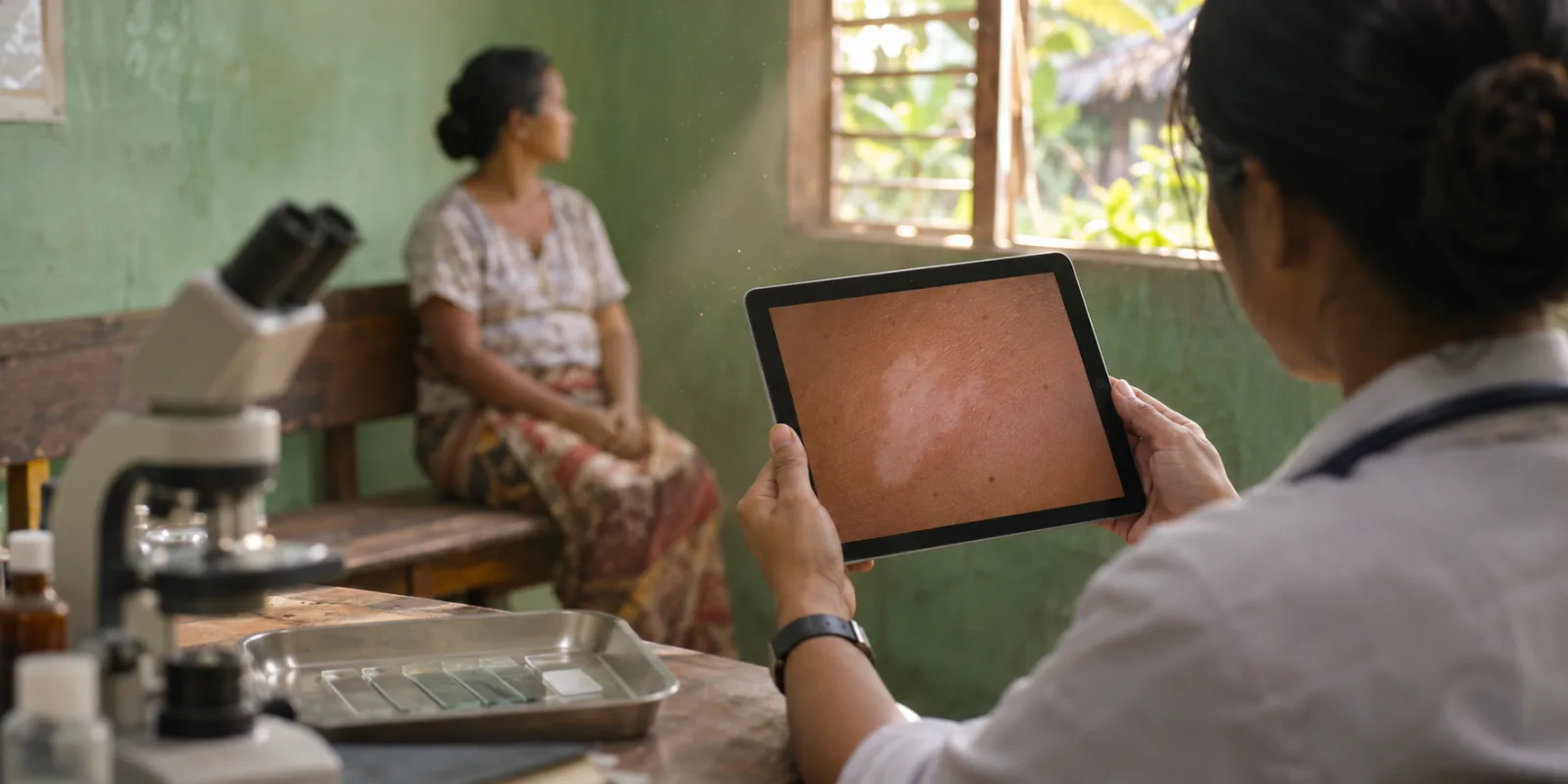
The review covers three of them. Leprosy is a chronic bacterial infection that damages skin and nerves. Leishmaniasis is a parasitic disease spread by sandflies, with skin and visceral forms. Schistosomiasis is caused by parasitic flatworms, and it is typically diagnosed by finding eggs under a microscope. All three need trained staff to interpret signs or slides, which is where AI enters the story.
Most of the AI in these studies is machine learning applied to images. Images, macroscopic or microscopic, were the main input in 62.3% of studies. Typical tasks include spotting Schistosoma mansoni eggs in stool smears, finding Leishmania parasites on slides, and classifying leprosy from photographs or blood signatures. A model is "trained" on labelled examples, then asked to label new ones.
A few terms will recur. AUC (area under the curve) is a score where 1.0 is perfect and 0.5 is a coin toss. F1 balances how many true cases a model finds against how many false alarms it raises. External validation means testing a model on data from a different place or time than it was built on. Risk of bias, in this context, means design flaws that could make reported accuracy look better than it will be in practice.
How the review was done, and why it deserves trust#
Systematic reviews follow a fixed protocol so the authors cannot cherry-pick. This one was registered in advance on PROSPERO (CRD420251137960) and searched five databases, including IEEE Xplore, the ACM Digital Library, PubMed, Web of Science and the Virtual Health Library. Including computing databases alongside medical ones matters, because much AI work never reaches a medical journal.
The authors graded each study using two tools. PROBAST+AI assesses methodological rigour and the potential for biased results. TRIPOD+AI assesses the completeness and transparency of reporting. Think of the first as asking "was the experiment built soundly?" and the second as asking "did the authors tell us enough to check?"
There are limits. The search covered English and Portuguese only, and the authors list indexing lag and publication bias among their caveats. High heterogeneity across studies also prevented a meta-analysis, so there is no single pooled accuracy figure. That is itself informative: the studies are too different to add up.
Where the field is, and what it is aiming at#
The literature is young and growing fast. 89.9% of the 69 studies were published after 2020. Leprosy was the most studied condition at 43.5%, followed by schistosomiasis at 31.9% and leishmaniasis at 29.0%.
Geography is telling. Brazil led with 21.7% of publications, followed by India (17.4%) and China (11.6%). Together they produced more than half of the work. Endemic countries leading the research is encouraging.
Most studies aim to help a clinician decide whether someone has the disease. Diagnostic support accounted for 81.2%, while prognosis, meaning predicting who will suffer adverse outcomes, made up only 18.8%. Prognosis is arguably the more valuable question for conditions like leprosy, where complications such as nerve damage shape lifelong disability (my reading, not the authors'), yet it gets far less attention.
The headline numbers look good, and that is the problem#
On accuracy measures, the models look strong. The mean AUC across studies was 0.86 (interquartile range 0.80 to 0.94), and the mean F1 score was 0.90. If you only read results tables, you would conclude the problem is nearly solved.
The trouble lies beneath those figures. The table below pulls together what the review found about how those numbers were produced.
| What the review looked at | Finding | Why it matters |
|---|---|---|
| Overall risk of bias | 89.9% high risk | Reported accuracy may overstate real-world performance |
| External validation | Absent in 82.6% | No evidence models work on new patients or sites |
| Missing data handling | Not reported or handled properly in 66.7% | Gaps in records can quietly skew results |
| Comparison baseline | 69.6% compared only against another AI model; 7.2% used a clinical gold standard | Beating another algorithm does not show clinical benefit |
| Source code | Unavailable in 76.8% | Others cannot reproduce or reuse the work |
| Data access | Absent in 42.0% | Independent checking is difficult |
The chart below shows the same figures at a glance.
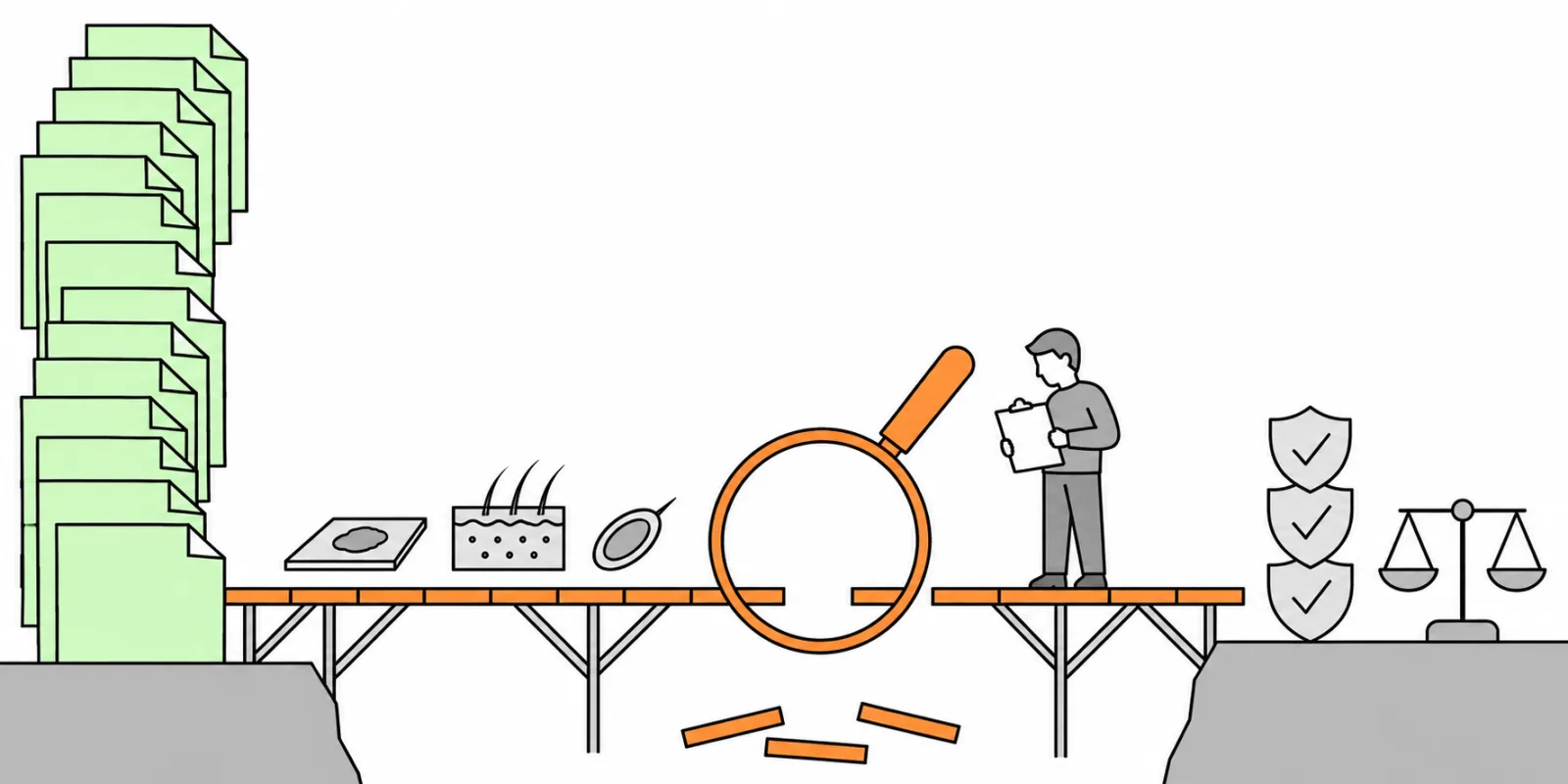
It is worth pausing on why those two gaps matter more than the glossy accuracy figures. A model trained on photographs from one hospital can quietly learn quirks of that hospital, such as the camera, the lighting or even the way records are labelled, instead of learning the disease. Without a test on independent data, there is no way to tell the difference. The review found that this check was missing in 82.6% of studies, so for most of the field the question remains open rather than answered badly.
Missing data raises a similar worry. Real clinic records have blanks: a lab test not done, a field left empty. If a study does not say how it dealt with those blanks, readers cannot judge whether the model was shown only tidy cases. Two thirds of the studies did not report or handle missing data properly.
A concrete analogy helps. Imagine a student who sits an exam after memorising last year's paper, then marks their own answers. They could score 90% and still struggle with a fresh paper. External validation is the fresh paper. Comparing a model only with another model is like ranking students against one another and never against the syllabus.
From proof of concept to clinic#
How far have these tools actually travelled? One in three studies, 33.3%, was a preliminary proof of concept, and 27.5% were interpretability analyses. Only 27.5% proposed a concrete clinical tool. That implies most of the field is still in the "can we do this?" stage, not the "does it help patients?" stage.
Commercial and programme-level tools are appearing anyway, and the review is a useful lens for judging them. This week, for instance, the consumer health company Haleon announced a dengue forecasting tool that predicts potential outbreaks up to six weeks in advance, launching first in Colombia. The announcement is a company press release rather than a peer-reviewed evaluation, and dengue was not among the diseases in the review, so I cannot say how well it performs. The reader's question is the same one the review asks: where is the independent validation?
None of this makes AI a dead end. The Royal Society of Tropical Medicine and Hygiene has launched a new open-access journal, Artificial Intelligence in Global Health, which suggests the community wants a proper home for this work. The task now is to make the evidence as strong as the ambition.
It is also worth being clear about what the review does not say. It does not name which individual tools are good or bad, and it does not claim that any particular model fails in the field. It reports that, for the large majority of published models, the evidence needed to judge them is missing or weak (PLOS NTDs). Absence of proof is not proof of absence, and some of these models may well hold up once properly tested. That is exactly why the testing matters.
What better evidence would look like#
The authors call for a culture of rigour, reproducibility and transparency. Their recommendations are practical. Adhere more closely to reporting guidelines such as TRIPOD+AI, share curated data and source code, compare against existing standards of care, and test models on independent data (PLOS NTDs). They also encourage research beyond diagnostic aid into prognostic models.
The authors practise what they preach: their data and code are available on GitHub. That means anyone can check the counts, rerun the analysis or extend it to other NTDs. The study was supported by the São Paulo Research Foundation (FAPESP) and Brazil's National Council for Scientific and Technological Development (CNPq).
Here is what I would suggest to different readers, and these are my inferences, not the paper's conclusions. Researchers could budget for an external test set from the start, since adding one afterwards is far harder. Funders could make code and data sharing a condition of grants. Programme managers could ask any vendor three questions: was this tested on people like ours, against what standard, and can someone else rerun it? Founders in this space have an opening, because rigorous validation is scarce and therefore valuable.
FAQs#
What did the new review find? It found that among 69 studies of AI for leprosy, schistosomiasis and leishmaniasis, 89.9% were at high risk of bias, mainly from missing external validation and poor handling of missing data. (PLOS NTDs)
Does this mean AI does not work for neglected tropical diseases? No. The models often report high accuracy, with a mean AUC of 0.86, but the evidence for real-world performance is weak because most were not tested on independent data. (PLOS NTDs)
What is external validation? It means testing a model on data from a different place or time than the data used to build it. The review found it missing in 82.6% of studies. (PLOS NTDs)
Which countries are leading the research? Brazil produced 21.7% of the publications, followed by India at 17.4% and China at 11.6%. (PLOS NTDs)
Are the tools available for others to reuse? Often not. Source code was unavailable in 76.8% of studies, and data access was absent in 42.0%. (PLOS NTDs)
Does the review cover every neglected tropical disease? No. It covers leprosy, leishmaniasis and schistosomiasis, and only English and Portuguese publications from January 2015 to July 2025. (PLOS NTDs)
Where can I check the authors' work? The paper states that the data and code are available on GitHub, and the review was registered on PROSPERO as CRD420251137960. (PLOS NTDs)
References#
- Franco, F. O., Souza, L. G., dos Anjos, C. N. & Chiavegatto Filho, A. D. P. Artificial intelligence for the diagnosis and prognosis of leprosy, leishmaniasis, and schistosomiasis: A systematic review. PLOS Neglected Tropical Diseases 20(11): e0014833 (2026). https://doi.org/10.1371/journal.pntd.0014833. Open-access full text: https://pmc.ncbi.nlm.nih.gov/articles/PMC13754222/
- World Health Organization. Sanitation (fact sheet), 5 November 2026. https://www.who.int/news-room/fact-sheets/detail/sanitation
- Haleon. Haleon launches new AI tool to predict dengue outbreaks earlier (company press release), 12 November 2026. https://www.haleon.com/news/press-releases/corporate/2026/haleon-launches-new-ai-tool-to-predict-dengue-outbreaks-earlier. Used only as an example of a newly announced, not independently evaluated, tool.
- Royal Society of Tropical Medicine and Hygiene, Transactions of the RSTMH: Artificial Intelligence in Global Health journal announcement. https://academic.oup.com/trstmh