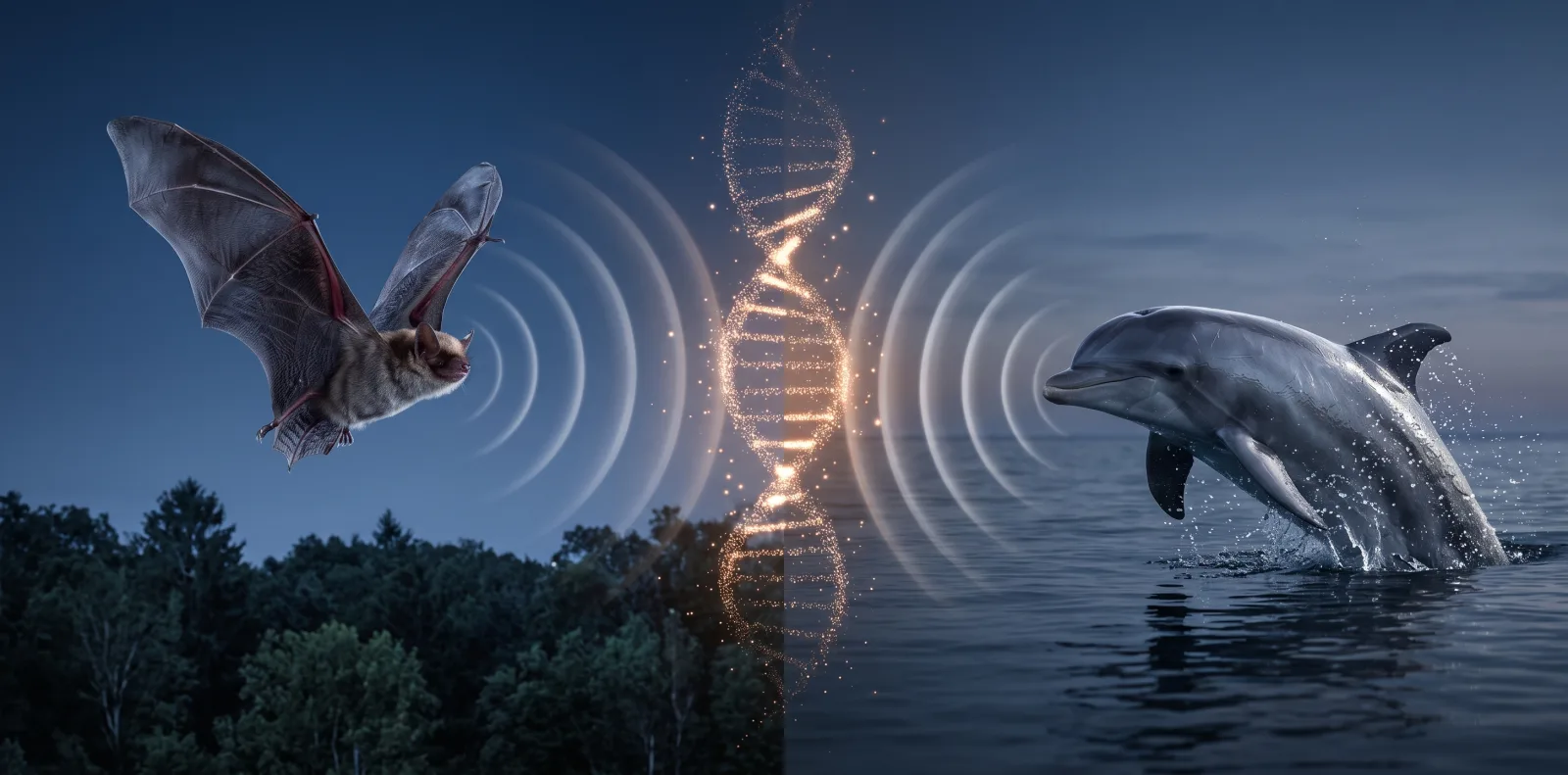
Why does nature keep inventing the same thing twice?#
A little brown bat and a bottlenose dolphin last shared an ancestor tens of millions of years ago, and neither inherited sonar from it. Yet both hunt by shouting into the dark and listening for the echo. Five separate groups of crustaceans have, independently, flattened their bodies and tucked their tails underneath to become crab-shaped, a pattern so persistent that biologists gave it a name, carcinization, more than 140 years ago (Wolfe et al., 2021). Ostriches, emus, rheas and the extinct moa all lost the ability to fly, and they did it separately (Sackton et al., 2019).
This is convergent evolution, and it poses one of the oldest puzzles in biology. If evolution is a chancy process driven by random mutation, why does it so often arrive at the same answer? And when it does, is it using the same genetic recipe each time, or cooking up the same dish from different ingredients?
For decades, those questions were hard to test. Genomes are enormous, the signal of a shared adaptation is faint, and coincidence is everywhere. Over the past few years, machine learning has started to change that. Algorithms can now sift thousands of genes across hundreds of species and flag the handful that seem to track a trait. The question in the headline, whether AI could rewrite evolutionary theory, sounds like hype. The more interesting story is quieter: AI is giving biologists a way to measure how predictable evolution really is.
What is convergent evolution? A quick primer#
Some vocabulary first, because the field is full of terms that sound alike.
Convergent evolution is the independent appearance of the same trait in two or more lineages, usually because they faced similar environmental pressures (Cao et al., 2025). Wings in bats and birds are the textbook case. Divergent evolution is the opposite direction of travel: related species drifting apart as they adapt to different niches. The convergent vs divergent evolution distinction, in other words, comes down to whether lineages are becoming more alike or less alike over time.
Biologists also talk about parallel evolution, where closely related lineages make the same change, often through the same genetic route. The line between "parallel" and "convergent" is fuzzy, and many researchers now use convergence as the umbrella term.
To study any of this, you need phylogenetics: the science of building family trees of species from their DNA. A phylogenetic tree lets you tell whether two species share a trait because they inherited it from a common ancestor (no convergence) or because they evolved it separately (convergence).
At the molecular level there is a further distinction. A gene is a stretch of DNA that encodes a protein, and proteins are chains of building blocks called amino acids. If bats and dolphins both swap the same amino acid at the same position in a hearing protein, that is site-level convergence. But proteins can also converge in subtler ways, changing different amino acids yet ending up with similar shapes or electrical charges. Catching that second kind requires tools that look beyond individual letters of the sequence.
Finally, a word on machine learning. In this context it means algorithms that learn patterns from labelled examples ("these species echolocate, these do not") and then pick out which features of the data best predict the label. A protein language model is a particular kind: a neural network trained on hundreds of millions of protein sequences until it learns the "grammar" of proteins, much as a chatbot learns the grammar of English.
Lesson one from the echolocation wars: coincidence is a sneaky opponent#
Echolocation became the proving ground for molecular convergence, and its history is a cautionary tale.
Early work looked promising. A 2010 study found that echolocating bats and whales shared convergent changes in prestin, a protein that helps the cochlea amplify sound (Li et al., 2010). Then, in 2013, a team compared 805,053 amino acid positions across 2,326 genes in 22 mammals and reported signs of convergence in nearly 200 loci, many tied to hearing (Parker et al., 2013). The authors concluded that genome-wide convergence was "much more pervasive than previously recognized".
The claim did not survive scrutiny well. Two independent reanalyses argued that the statistical test used was flawed. When Thomas and Hahn compared convergent substitutions across all pairs of species, echolocators showed "no surprising excess of convergence", even in sensory genes (Thomas & Hahn, 2015). Zou and Zhang reached a similar verdict, finding that the reported signal largely reflected background levels of chance convergence (Zou & Zhang, 2015).
The lesson matters for anyone building AI tools today. Over millions of years, random mutations will inevitably produce identical changes in unrelated species, simply because proteins have a limited number of ways to vary. Any method that hunts for convergence must first prove it can tell adaptation from accident. That bar shapes everything that follows.
Lesson two: sparse learning can find the genes behind repeated traits#
The most rigorous recent attempt to clear that bar comes from Sudhir Kumar's lab at Temple University. Their method, called evolutionary sparse learning with paired species contrast (ESL-PSC), was published in Nature Communications in April 2025 (Allard et al., 2025).
"Sparse learning" means the algorithm is penalised for using too many genes. It is forced to explain a trait with the smallest possible set of genetic features, which keeps the results interpretable. The "paired species contrast" part is the clever bit. Instead of throwing every species into one pot, the method pairs a trait-positive species with a close relative that lacks the trait, and draws those pairs from independent branches of the tree. That design cancels out much of the noise from shared ancestry (Allard et al., 2025).
The team tested it on C4 photosynthesis, a more efficient way of fixing carbon that grasses have evolved many times. Working with 67 chloroplast proteins from 64 grass species, the best model used just five proteins, led by RuBisCO, the enzyme that captures carbon dioxide. It correctly classified 36 of 37 held-out C4 species and all 15 held-out C3 species, and it reached 100% accuracy on independent clades that played no part in building the model (Allard et al., 2025). Crucially, a naive version without the paired design managed only a 64% true positive rate in those independent clades, against 94% with pairing.
Figure: ESL-PSC accuracy on C4 photosynthesis. The gap between the orange and grey bars shows how much the paired species design matters.
Then came echolocation. Scanning 14,509 protein alignments, the top 100 genes ESL-PSC flagged were strongly enriched for the sensory perception of sound. Familiar hearing genes such as prestin, TMC1 and CDH23 ranked highly, alongside newer candidates including CHRNA9 and GRXCR2 (Allard et al., 2025). Unlike the 2013 study, the team ran the controls that critics had demanded: reversing the trait labels, using only near-neutral DNA positions, and simulating alignments with no real convergence. None produced the hearing signal.
The authors are candid about the limits. Echolocation evolved in only two independent groups (bats and toothed whales), which constrains the statistics, and none of the new candidate genes has yet been tested in a laboratory (Allard et al., 2025). A 2026 follow-up packaging the method as graphical software, and extending it to continuous traits such as body mass, is currently a preprint (Allard & Kumar, 2026, not peer reviewed).
Lesson three: protein language models see convergence that sequence alignments miss#
Sparse learning still works with individual amino acid positions. But what if two proteins converge in function without sharing any specific changes?
A team led by Zhengting Zou at the Chinese Academy of Sciences tackled that question with protein language models. They converted each protein sequence into an "embedding", a list of numbers that summarises what the model has learned about that protein, including properties linked to its 3D shape. In four previously reported cases, functionally convergent proteins had similar embeddings even with no site-level convergence at all (Cao et al., 2025).
Their pipeline, ACEP (Adaptive Convergence by Embedding of Proteins), picked up known and new candidate genes for echolocation and for crassulacean acid metabolism, a water-saving form of photosynthesis found in cacti and pineapples. The convergent signals were linked to shared physicochemical features, notably net electric charge density (Cao et al., 2025).
This is a conceptual step forward. It suggests that a good deal of molecular convergence may be invisible to classic methods, because evolution can reach the same functional destination by different sequence roads. The obvious caveat is that embeddings are hard to interpret. A neural network can tell you two proteins look alike in its internal space without telling you, in plain chemistry, why.
Lesson four: regulation, not just proteins, drives repeated evolution#
Proteins are only part of the story. Much of the genome consists of regulatory DNA: switches that control when and where genes are turned on. Several studies now suggest that convergence often happens in these switches.
In flightless birds, a Bayesian analysis of 284,001 conserved non-coding elements found 2,355 independent accelerations along flightless lineages. The authors concluded that convergent evolution of regulatory regions, "more so than protein-coding genes", was common in developmental pathways linked to the loss of flight (Sackton et al., 2019).
A similar pattern turned up in hairless mammals such as whales, naked mole-rats and humans. Using a method called RERconverge, which looks for genes evolving unusually fast or slow in trait-bearing species, researchers scanned 19,149 genes and 343,598 conserved non-coding regions across 62 mammals. Protein-coding changes tended to hit hair shaft structure, while regulatory changes clustered near genes controlling hair growth cycles, and the two often did not overlap (Kowalczyk et al., 2022). Evolution, it seems, tinkers with both the parts and the wiring, in different places.
The scale is growing fast. A study published in Nature in November 2025 compared 154 genomes from 21 animal phyla to reconstruct 11 separate moves from water to land. Each transition had its own pattern of gene gains and losses, yet similar biological functions emerged again and again. The authors argue that "in large part, adaptation to life on land is predictable" (Wei et al., 2025).
Lesson five: AI can turn "looks similar" into a number#
Convergence is not only genetic. It also shows up in how organisms look, and judging visual similarity has traditionally been subjective.
Heliconius butterflies are a classic example of Müllerian mimicry, in which unrelated toxic species evolve matching warning patterns so that predators learn to avoid them all. In 2019, researchers trained a deep neural network on 2,468 butterfly photographs covering 38 subspecies. The network measured overall wing-pattern similarity and found significant convergence between co-mimics of different species, a quantitative test of a prediction from mimicry theory, which the authors describe as evolutionary biology's oldest mathematical model (Hoyal Cuthill et al., 2019). The analysis also supported mutual convergence, with both species shifting towards each other rather than one simply copying the other.
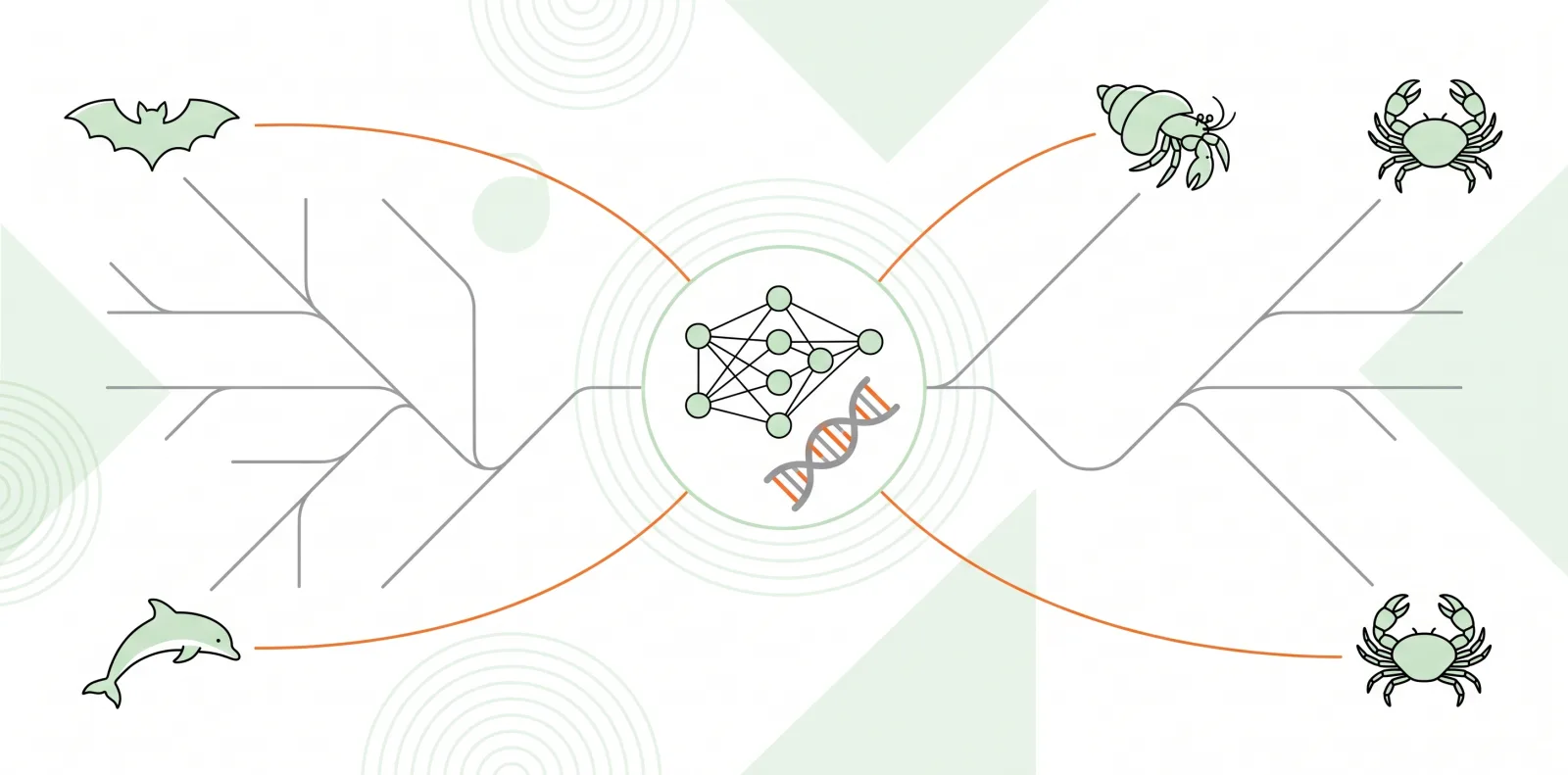
That kind of tool could, in principle, be applied to crabs. The carcinization review notes that the crab body plan has been gained at least five times and lost several times, and calls for studies of its genomic basis and predictability (Wolfe et al., 2021). Quantifying "crabness" from images and linking it to genomes is exactly the sort of job these methods suit.
How the main approaches compare#
| Approach | What it looks for | Example result | Main limitation |
|---|---|---|---|
| Site-by-site convergence tests | Identical amino acid changes in unrelated lineages | Nearly 200 loci reported in echolocators (Parker et al., 2013) | Easily fooled by chance convergence (Thomas & Hahn, 2015) |
| Error-corrected convergence rates (CSUBST) | Convergence rates corrected for noise and tree errors | Explored over 20 million branch combinations in vertebrates (Fukushima & Pollock, 2023) | Still focused on individual sites |
| Evolutionary rate methods (RERconverge) | Genes evolving unusually fast or slow with a trait | Coding and regulatory hair genes in 62 mammals (Kowalczyk et al., 2022) | Needs many independent origins of the trait |
| Sparse learning (ESL-PSC) | Smallest gene set that predicts a trait | 98.5% balanced accuracy for C4 grasses (Allard et al., 2025) | Few independent origins for some traits |
| Protein language model embeddings (ACEP) | Similarity in higher-order protein features | Echolocation and CAM candidates without site convergence (Cao et al., 2025) | Embeddings are hard to interpret |
| Deep learning on images | Overall visual similarity | Mimicry convergence in 38 butterfly subspecies (Hoyal Cuthill et al., 2019) | Measures appearance, not genetic cause |
So, is AI rewriting evolutionary theory?#
Not in the sense the headline implies. Nothing here overturns natural selection, inheritance or common descent. What the new tools do is sharpen an old argument about contingency and determinism.
Stephen Jay Gould famously wondered whether replaying the "tape of life" would produce the same outcomes. A 2018 review of the experimental and comparative evidence concluded that evolution tends to be "surprisingly repeatable among closely related lineages", but outcomes diverge more as the footprint of history grows deeper (Blount, Lenski & Losos, 2018). The machine learning results fit that picture. Grasses evolving C4 photosynthesis lean on a small, recurring set of chloroplast proteins. Animals moving onto land reuse similar functions while taking different genetic routes (Wei et al., 2025).
There is a lively debate about whether evolutionary theory needs broadening to account for developmental bias, plasticity and other factors (Laland et al., 2014). Data on how often, and how, evolution repeats itself are relevant to that debate. If convergence turns out to be common and channelled through predictable genetic routes, it supports the idea that development and molecular constraints steer evolution, not just selection.
Some scepticism is healthy. A 2024 review of machine learning in phylogenetics found that deep learning had "not yet" shown a clear advantage over traditional methods for building trees, beating them only in narrow settings (Mo, Hahn & Smith, 2024). The echolocation saga shows how quickly an exciting genome-wide signal can dissolve under a better null model. And a gene flagged by an algorithm is a hypothesis, not a mechanism, until someone tests it in cells or animals.
The best recent studies build in the controls that sank earlier claims, test their models on species they never saw, and report the failures as well as the hits. That is how a field matures. AI won't rewrite evolutionary theory any time soon, but it may finally let us put numbers on one of its oldest questions: how often does life find the same answer, and why?
Frequently asked questions#
What is convergent evolution in simple terms?
It is when unrelated species independently evolve the same trait, usually because they face similar challenges. Echolocation in bats and toothed whales is a well-studied case (Allard et al., 2025).
What are some examples of convergent evolution?
Echolocation in bats and dolphins, flightlessness in ostriches, emus and moa (Sackton et al., 2019), C4 photosynthesis in grasses, reduced body hair in whales and naked mole-rats (Kowalczyk et al., 2022), and the crab-like body plan in decapod crustaceans (Wolfe et al., 2021).
What is the difference between convergent vs divergent evolution?
Convergent evolution makes unrelated lineages more alike. Divergent evolution makes related lineages less alike as they adapt to different environments. Both are driven by the same processes of mutation and selection.
What is carcinization?
Carcinization is the repeated evolution of a crab-like body, wide and flat with a folded abdomen. It has happened at least five times in decapod crustaceans, and the body plan has also been lost several times, a process called decarcinization (Wolfe et al., 2021).
How does machine learning help study convergent evolution?
Algorithms can scan thousands of genes across many species and pick out the few that best predict a trait. Sparse learning finds compact gene sets (Allard et al., 2025), while protein language models detect similarity in protein properties that simple sequence comparisons miss (Cao et al., 2025).
Does convergent evolution mean evolution is predictable?
Partly. Evidence suggests evolution is surprisingly repeatable among close relatives but less so across deep time (Blount, Lenski & Losos, 2018). The transition to land shows recurring functions alongside lineage-specific routes (Wei et al., 2025).
Is deep learning better than traditional phylogenetics?
Not yet, overall. A 2024 review found neural networks outperformed traditional tree-building methods only in limited conditions (Mo, Hahn & Smith, 2024).
Why were early genome-wide convergence claims disputed?
Because chance alone produces identical mutations in unrelated species. Reanalyses of the 2013 echolocation study found no excess convergence once the proper comparisons were made (Thomas & Hahn, 2015; Zou & Zhang, 2015).
References#
- Allard, J. B., Sharma, S., Patel, R., Sanderford, M., Tamura, K., Vucetic, S., Gerhard, G. S. & Kumar, S. (2025). Evolutionary sparse learning reveals the shared genetic basis of convergent traits. Nature Communications, 16, 3217. https://doi.org/10.1038/s41467-025-58428-8
- Allard, J. B. & Kumar, S. (2026). ESL-PSC Toolkit: a graphical software environment for linking shared genetic changes to convergent phenotypes. arXiv 2605.27677. (not peer reviewed) https://arxiv.org/abs/2605.27677
- Blount, Z. D., Lenski, R. E. & Losos, J. B. (2018). Contingency and determinism in evolution: Replaying life's tape. Science, 362(6415), eaam5979. https://doi.org/10.1126/science.aam5979
- Cao, Z., Zhang, H. & Zou, Z. (2025). Language models reveal a complex sequence basis for adaptive convergent evolution of protein functions. Proceedings of the National Academy of Sciences, 122(39), e2418254122. https://doi.org/10.1073/pnas.2418254122
- Fukushima, K. & Pollock, D. D. (2023). Detecting macroevolutionary genotype-phenotype associations using error-corrected rates of protein convergence. Nature Ecology & Evolution, 7(1), 155-170. https://doi.org/10.1038/s41559-022-01932-7
- Hoyal Cuthill, J. F., Guttenberg, N., Ledger, S., Crowther, R. & Huertas, B. (2019). Deep learning on butterfly phenotypes tests evolution's oldest mathematical model. Science Advances, 5(8), eaaw4967. https://doi.org/10.1126/sciadv.aaw4967
- Kowalczyk, A., Chikina, M. & Clark, N. (2022). Complementary evolution of coding and noncoding sequence underlies mammalian hairlessness. eLife, 11, e76911. https://doi.org/10.7554/eLife.76911
- Laland, K., Uller, T., Feldman, M., Sterelny, K., Müller, G. B., Moczek, A., Jablonka, E. & Odling-Smee, J. (2014). Does evolutionary theory need a rethink? Nature, 514, 161-164. https://doi.org/10.1038/514161a
- Li, Y., Liu, Z., Shi, P. & Zhang, J. (2010). The hearing gene Prestin unites echolocating bats and whales. Current Biology, 20(2), R55-R56. https://doi.org/10.1016/j.cub.2009.11.042
- Mo, Y. K., Hahn, M. W. & Smith, M. L. (2024). Applications of machine learning in phylogenetics. Molecular Phylogenetics and Evolution, 196, 108066. https://doi.org/10.1016/j.ympev.2024.108066
- Parker, J., Tsagkogeorga, G., Cotton, J. A., Liu, Y., Provero, P., Stupka, E. & Rossiter, S. J. (2013). Genome-wide signatures of convergent evolution in echolocating mammals. Nature, 502, 228-231. https://doi.org/10.1038/nature12511
- Sackton, T. B., Grayson, P., Cloutier, A., Hu, Z., Liu, J. S., Wheeler, N. E., Gardner, P. P., Clarke, J. A., Baker, A. J., Clamp, M. & Edwards, S. V. (2019). Convergent regulatory evolution and loss of flight in paleognathous birds. Science, 364(6435), 74-78. https://doi.org/10.1126/science.aat7244
- Thomas, G. W. C. & Hahn, M. W. (2015). Determining the null model for detecting adaptive convergence from genomic data: a case study using echolocating mammals. Molecular Biology and Evolution, 32(5), 1232-1236. https://doi.org/10.1093/molbev/msv013
- Wei, J., Pisani, D., Donoghue, P. C. J., Álvarez-Presas, M. & Paps, J. (2025). Convergent genome evolution shaped the emergence of terrestrial animals. Nature, 649, 638-646. https://doi.org/10.1038/s41586-025-09722-4
- Wolfe, J. M., Luque, J. & Bracken-Grissom, H. D. (2021). How to become a crab: Phenotypic constraints on a recurring body plan. BioEssays, 43(5), e2100020. https://doi.org/10.1002/bies.202100020
- Zou, Z. & Zhang, J. (2015). No genome-wide protein sequence convergence for echolocation. Molecular Biology and Evolution, 32(5), 1237-1241. https://doi.org/10.1093/molbev/msv014