
A pandemic virus with no name yet#
Somewhere in a cave, a roof void or a fruit orchard, a virus that nobody has named is replicating inside a bat. Most of the time it will stay there. Very occasionally, it will meet a person, a pig or a camel in just the right way, and a small outbreak will begin.
The World Health Organization (WHO) has a placeholder for that scenario. It calls it "Disease X", meaning an unknown pathogen that could cause a serious international epidemic (WHO, 2022). The name is slightly theatrical, but the problem is not. If you cannot name the threat, you cannot stockpile a vaccine for it.
So a different question has taken hold in laboratories from Glasgow to Wuhan: could a computer read a virus's genome, or a bat's, and tell us which viruses deserve our attention first? Machine learning, the branch of artificial intelligence that finds patterns in large datasets, is now being tested on exactly that. The early results are more interesting, and more modest, than the headlines suggest.
This article walks through what the models actually do, what the best studies have shown, and why the humble matter of who has been sampling which bats may matter as much as the algorithm.
Background: what Disease X is, and why bats keep coming up#
Disease X is not one disease. WHO uses it as shorthand for a threat that has not been identified yet, so that planning does not stop at the pathogens we already know. The same announcement described over 300 scientists reviewing evidence on more than 25 virus families and bacteria, with the aim of guiding investment in vaccines, tests and treatments (WHO, 2022).
Most new human infections begin in animals, and the process of a virus crossing from an animal host into people is called spillover. Diseases that spread this way are called zoonotic diseases. The animal that carries a virus long term without being devastated by it is called the reservoir host.
Bats are a favourite suspect for good reasons. Three coronaviruses that caused widespread outbreaks in people, including SARS-CoV-2, have ancestral origins in bats. More than 4,000 coronavirus sequences from 14 bat families have been identified, and the true diversity is probably much greater (Ruiz-Aravena et al., 2021). One global survey found 100 distinct clusters of coronaviruses, 91 of them in bats (Anthony et al., 2017).
A word on jargon before we go on. A genome is the complete set of genetic instructions in an organism or virus. A coronavirus genome is a single strand of RNA, a chemical cousin of DNA. "Sequencing" means reading that code letter by letter. A "model" in this context is a program that learns from examples, then makes predictions about cases it has not seen.
Reading a virus's genome like a fingerprint#
The first idea is simple. A virus that has spent millions of years living in one kind of animal picks up that animal's habits in its own genetic text. The pattern is subtle, like a regional accent. You would not spot it in a single sentence, but you might spot it across a whole book.
A 2018 study in Science tested this directly. The researchers showed that animal reservoirs, and whether a virus uses an arthropod vector such as a tick or mosquito, can be predicted from viral genome sequences by machine learning. The models made predictions for 69 viruses whose reservoirs or vectors had been elusive or never investigated (Babayan et al., 2018).
A follow-up asked the sharper question: can a genome alone tell you whether a virus can infect humans? Using 861 viral species with known zoonotic status, the Glasgow team built models that outperformed an approach based only on how closely a virus is related to known human-infecting viruses, reaching an area under the curve (AUC) of 0.773 (Mollentze et al., 2021). AUC is a score where 0.5 means a coin toss and 1.0 means perfect ranking, so 0.77 is useful but far from a verdict.
When the team ran the model on 645 animal-associated viruses that were left out of training, it flagged 272 as high risk and 41 as very high risk. In a second test, the models could have identified SARS-CoV-2 as a relatively high-risk coronavirus, and that did not require prior knowledge of the SARS-related coronaviruses that had already infected people (Mollentze et al., 2021).
Coronaviruses have had their own dedicated treatment. A random forest model (a method that combines many simple decision trees) trained on spike protein and whole-genome sequences reached about 73% accuracy in predicting which of nine host groups a coronavirus belonged to. It classified SARS-CoV-2 sequences as bat-hosted, which fits the suspected origin of the pandemic (Brierley and Fowler, 2021).
The figure below shows two numbers that frame the whole field: how little of our coronavirus data comes from bats, and how a genome-based model sorted one set of unfamiliar viruses.
Predicting which bats carry what#
A second family of models works from the other end. Instead of looking at the virus, it looks at the bat: its lifespan, range, group size and relatives.
One machine learning study found that bat species with longer lifespans, broad distributions in the eastern hemisphere and large group sizes carry more viruses overall. The same models predicted 54 bat species as likely carriers of zoonotic viruses despite not currently being considered reservoirs (Guy et al., 2020).
The most convincing test of this approach is unusually honest. In early 2020, a team built an ensemble of eight statistical models to predict which bats host betacoronaviruses, the coronavirus group that includes SARS-CoV-2. Over more than a year, they tracked the discovery of 47 new bat hosts and checked the predictions against them (Becker et al., 2022).
The result was split. Models based on ecological traits performed well, while network methods, which infer missing links from existing host-virus records, did about as well as or worse than random guessing. The updated models predicted more than 400 bat species globally that could be undetected betacoronavirus hosts (Becker et al., 2022). That is a useful lesson for anyone building these tools: test the predictions against what is found later, and throw away the methods that fail.
Where the bat genomes themselves fit in#
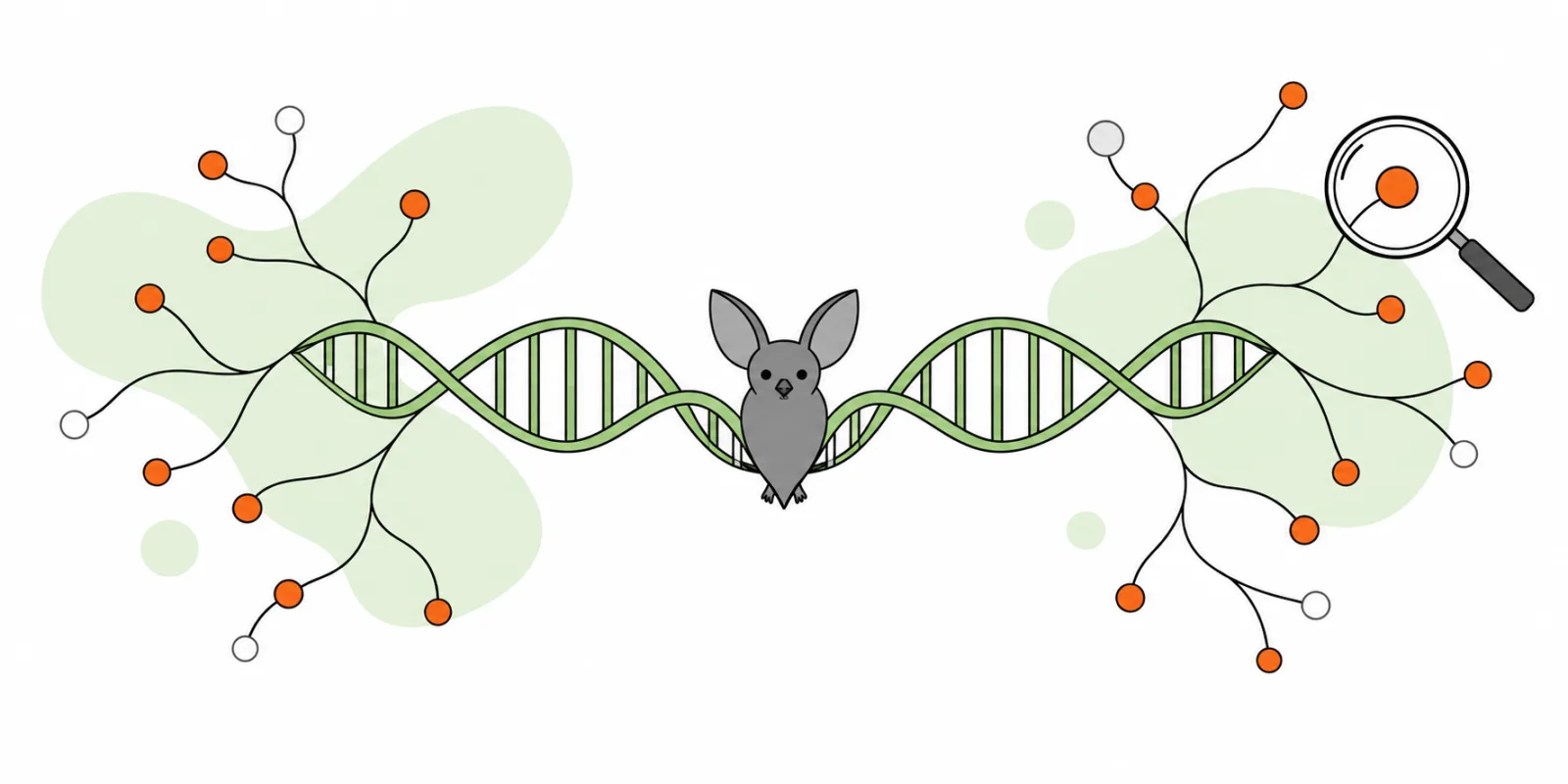
So far, the "bat genome" in the title has been mostly a viral story. The bat's own genome tells a different one, which is why it keeps appearing in this field.
The Bat1K consortium produced six reference-quality bat genomes and compared them with 42 other mammals (Jebb et al., 2020; Max Planck Institute of Molecular Cell Biology and Genetics, 2020). The genomes show expansions of antiviral genes and the loss of some genes involved in inflammation, which may help explain how bats tolerate coronaviruses. They also contain "fossilised" viral sequences, traces of old infections that the animals survived.
Here is where a careful reader should slow down. The press summary describes these findings as possibly explaining tolerance, which is a hypothesis, not a proven mechanism. Bat genomes are best treated as a map of how the reservoir copes with viruses. They do not, on their own, predict which virus will jump.
Combining the two views is the sensible direction. A model that knows both what a virus looks like and what its likely host is equipped to do should, in principle, rank threats better than either alone.
What the newest studies add#
Recent work has pushed in three directions: finding the molecular door, testing sampling bias, and scaling up.
On the molecular door, a 2026 paper in Nature reported that alphacoronaviruses from heart-nosed bats use human CEACAM6 to enter cells (Nature, 2026). A companion news piece described it as a previously unknown gateway (Nature news, 2026). Which receptor a virus uses is a specific, testable detail, and it sits alongside the broader sequence habits that genome-composition models pick up. Separately, a study of 149 individual bats from Yunnan, China, found frequent co-infection and a novel recombinant SARS-like coronavirus that could use the human ACE2 receptor in laboratory assays (Wang et al., 2023). Co-infection matters because two viruses in one animal can swap genetic material.
On tooling, a 2026 Nature Communications paper introduced RAISE, a computational tool for evaluating the spillover potential of sarbecoviruses, the subgenus that contains SARS-CoV and SARS-CoV-2 (Nature Communications, 2026). Another 2026 Nature Communications study used a method called Dynamic Positive-Unlabelled learning on 5,330 mammal species and 33 viral families, and estimated an 8.6-fold increase in the total number of mammal-virus family associations compared with what is recorded (Pignalberi et al., 2026). In plain terms, our records of who infects whom may be vastly incomplete.
Language-model architectures are arriving too. A model called BERT-infect, pre-trained on large amounts of nucleotide sequence, improved prediction across 26 viral families and worked even on partial sequences such as short reads from metagenomic data (Kawasaki et al., 2024). A preprint on avian influenza reports an ensemble reaching an AUROC of 0.95 on held-out sequences (not peer reviewed) (Brierley et al., 2025). Preprint results like that one are early signals, not settled findings.
Where the models still fall short#
If the field had a motto, it would be "garbage in, garbage out", and the garbage here is mostly absence. Bats have not been sampled evenly.
A systematic review of bat coronavirus sampling covered 110 studies and 89,752 samples. Fewer than one in five studies collected longitudinal data (repeat sampling over time), and sampling before the pandemic was concentrated in China, with gaps in South Asia, the Americas and sub-Saharan Africa (Cohen et al., 2023). Only 6% of coronavirus sequences in GenBank come from bats (Anthony et al., 2017). A model trained on that record learns the habits of the researchers as much as the habits of the viruses. One team has proposed adding "pseudo-negative" species and correcting for sampling effort to reduce false positives (Tonelli et al., 2025).
There are also specific blind spots. The BERT-infect authors found that current models struggle to flag the human risk of certain zoonotic lineages, SARS-CoV-2 among them (Kawasaki et al., 2024). In a case study of viruses from vampire bats, a model using only evolutionary relatedness ranked all the new viruses similarly, while a model using genome composition separated them, flagging one of four hepeviruses and two of three picornaviruses for further study (Bergner et al., 2021). That is encouraging, but it is a ranking for lab prioritisation, not a measure of outbreak likelihood.
The wider research effort is lopsided too. A scoping review of 966 machine learning studies on zoonotic disease found that 72.8% focused on COVID-19, only 1.96% examined the animal-human interface, and none explicitly targeted spillover prevention (Zhang et al., 2026). Reviewers have also noted that how useful predictions turn out depends on better data generation in laboratory, field and clinical settings, not only on better algorithms. Whether large virus-discovery programmes can be justified on these predictions is also described as controversial (Mollentze et al., 2023).
So can AI find Disease X? Not by name. What it can do is shrink a haystack. A ranked list of 40 viruses to test in the laboratory first is far more useful than a list of 4,000. The harder part of the work remains sending people to sample bats in the places we have ignored, and then checking the predictions against what turns up.
Frequently asked questions#
What is Disease X? It is a WHO placeholder name for an unknown pathogen that could cause a serious international epidemic. It exists so that preparedness plans cover threats that have not been identified yet (WHO, 2022).
Can AI predict which virus will cause the next pandemic? No. Current models rank viruses by how likely they are to infect humans or which hosts they use. The best genome-based model in one major study reached an AUC of 0.773, which is useful for triage but well short of certainty (Mollentze et al., 2021).
Why are bats linked to so many dangerous viruses? Three coronaviruses behind major human outbreaks, including SARS-CoV-2, have ancestral origins in bats (Ruiz-Aravena et al., 2021). Bat genomes show expanded antiviral genes and fewer inflammation-related genes, which may help explain how they tolerate such viruses (Max Planck Institute of Molecular Cell Biology and Genetics, 2020).
Do these models need a bat's genome, or just the virus's? Most of the strongest results use only the viral genome, which is cheaper to obtain from field samples (Mollentze et al., 2021). Bat ecology data, such as lifespan and group size, can predict likely carriers without any bat genome at all (Guy et al., 2020).
How accurate have bat host predictions been in real tests? One prospective test tracked 47 newly discovered bat hosts of betacoronaviruses against earlier predictions. Trait-based models did well, while network-based methods did no better than chance or worse (Becker et al., 2022).
What is the biggest weakness of these AI tools? Biased and incomplete data. Bat sampling has been concentrated in particular countries, and fewer than one in five coronavirus studies in bats collected repeat samples over time (Cohen et al., 2023).
Should the public worry about AI-flagged "high risk" viruses? A high-risk label means a virus deserves laboratory follow-up, not that an outbreak is coming. In one study, 313 of 645 held-out viruses were flagged as high or very high risk, a long list that shows why ranking and follow-up testing matter (Mollentze et al., 2021).
References#
- World Health Organization. WHO to identify pathogens that could cause future outbreaks and pandemics. 21 November 2022.
- Babayan SA, Orton RJ, Streicker DG. Predicting reservoir hosts and arthropod vectors from evolutionary signatures in RNA virus genomes. Science 2018;362(6414):577-580.
- Mollentze N, Babayan SA, Streicker DG. Identifying and prioritizing potential human-infecting viruses from their genome sequences. PLoS Biology 2021;19(9):e3001390.
- Brierley L, Fowler A. Predicting the animal hosts of coronaviruses from compositional biases of spike protein and whole genome sequences through machine learning. PLoS Pathogens 2021;17(4):e1009149.
- Bergner LM, Mollentze N, Orton RJ, et al. Characterizing and evaluating the zoonotic potential of novel viruses discovered in vampire bats. Viruses 2021;13(2):252.
- Guy C, et al. The influence of bat ecology on viral diversity and reservoir status. Ecology and Evolution 2020.
- Becker DJ, et al. Optimising predictive models to prioritise viral discovery in zoonotic reservoirs. The Lancet Microbe 2022.
- Jebb D, et al. Six reference-quality genomes reveal evolution of bat adaptations. Nature 2020.
- Max Planck Institute of Molecular Cell Biology and Genetics. The genetic basis of bats' superpowers revealed. Press release, 2020 (institutional summary of reference 8).
- Ruiz-Aravena M, et al. Ecology, evolution and spillover of coronaviruses from bats. Nature Reviews Microbiology 2021.
- Anthony SJ, et al. Global patterns in coronavirus diversity. Virus Evolution 2017.
- Cohen LE, et al. Coronavirus sampling and surveillance in bats from 1996-2019: a systematic review and meta-analysis. Nature Microbiology 2023.
- Wang J, et al. Individual bat virome analysis reveals co-infection and spillover among bats and virus zoonotic potential. Nature Communications 2023.
- Heart-nosed bat alphacoronaviruses use human CEACAM6 to enter cells. Nature 2026.
- A bat coronavirus can enter human cells through a previously unknown gateway. Nature news, 2026.
- RAISE: A computational tool for evaluating sarbecovirus spillover potential. Nature Communications 2026.
- Pignalberi G, et al. Predicting unknown mammalian viral hosts with Dynamic Positive-Unlabeled learning. Nature Communications 2026.
- Kawasaki J, et al. Hidden challenges in evaluating spillover risk of zoonotic viruses using machine learning models. Communications Medicine 2024.
- Brierley L, et al. An AI for an AI: identifying zoonotic potential of avian influenza viruses via genomic machine learning. bioRxiv 2025. (not peer reviewed).
- Tonelli A, et al. A framework to predict zoonotic hosts under data uncertainty: a case study on betacoronaviruses. Methods in Ecology and Evolution 2025.
- Zhang Y-S, et al. A scoping review of machine learning applications across epidemiological stages of zoonotic disease. Transboundary and Emerging Diseases 2026.
- Mollentze N, et al. Predicting zoonotic potential of viruses: where are we? Current Opinion in Virology 2023.