
A record year, and a race against the mosquito calendar#
In 2024 the World Health Organization received reports of 14,434,584 dengue cases, including 11,201 deaths, from more than 100 countries. It was the highest global burden ever recorded (WHO). Brazil alone reported over 10 million cases and 6,321 deaths (WHO). The Americas accounted for more than 90% of the world's total (WHO).
Hospitals in those places did not simply run short of beds. They ran short of warning. Dengue arrives in waves, and a health service that knows a wave is six weeks away can stock rehydration fluids, call in staff, and send teams to clear standing water. One that finds out when the waiting rooms fill has already lost the first round.
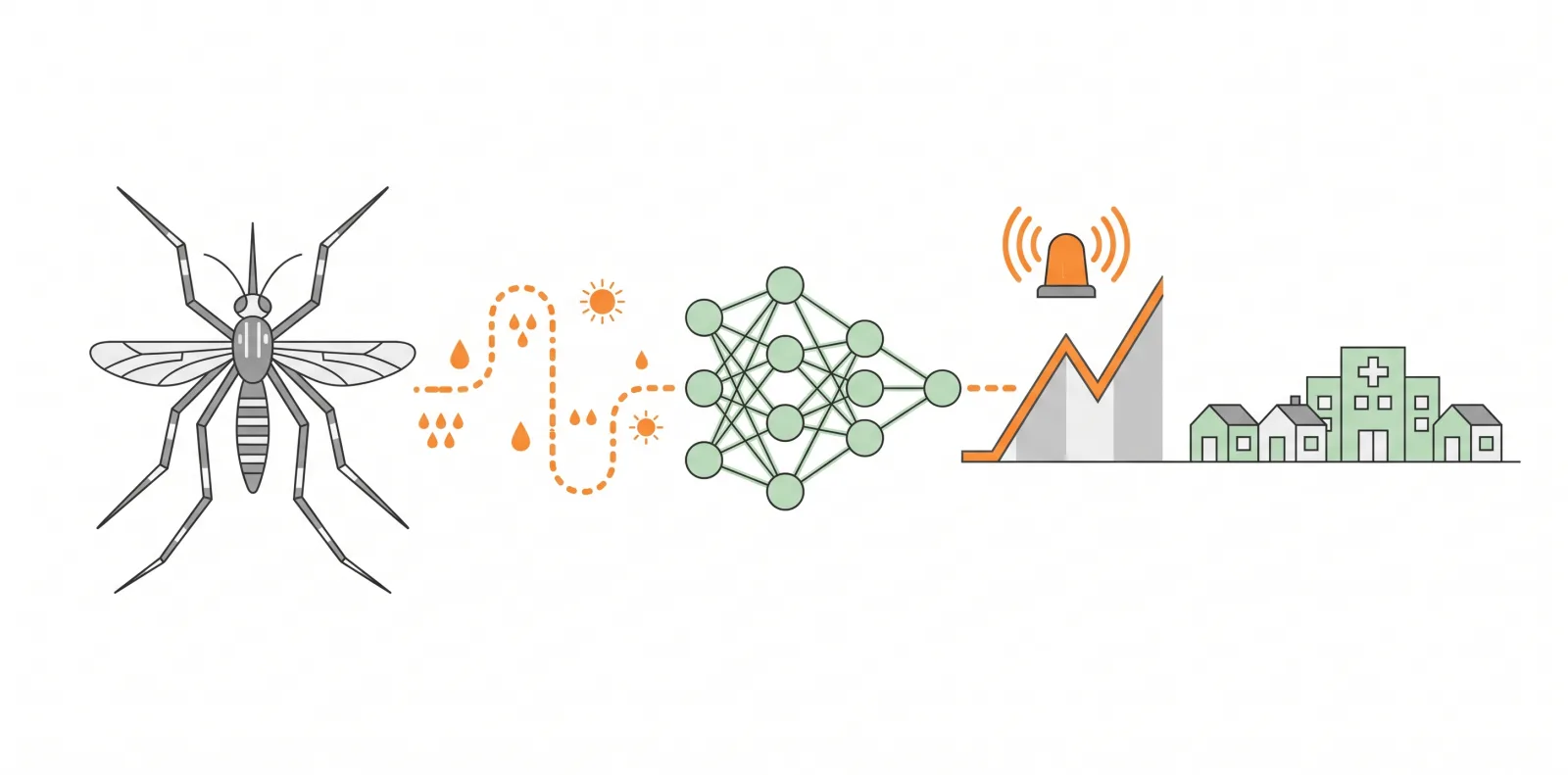
That is the promise behind dengue outbreak prediction: use weather, past cases and human movement to estimate what is coming, and do it early enough to matter. Artificial intelligence, mostly in the form of machine learning, now sits at the centre of that effort. The results are interesting, uneven, and in places humbling. This article walks through what the models do, where they succeed, and where even the cleverest of them were caught out by the record-breaking season of 2024.
What makes dengue so hard to forecast#
Dengue is a viral illness spread by Aedes mosquitoes, the best known being Aedes aegypti. The WHO links the recent surge to the virus's growing sensitivity to climate and to the spread of these mosquitoes into urban areas (WHO). Several things then pile on top of one another.
First, the mosquito responds to weather with a delay. A warm, wet spell does not produce cases the next day. Mosquito populations need time to grow, and people need time to fall ill and be diagnosed. Forecasters therefore work with "lags", which simply means that today's rainfall and humidity are matched to case counts a few weeks later. One 2026 study from southern Vietnam found that the most useful predictors were humidity, soil moisture, wet-bulb temperature and rainfall measured one to four weeks earlier (Dang, 2026).
Second, reporting is messy. Cases are counted late, revised, and sometimes confused with similar illnesses. Third, people move, and they carry the virus with them. Fourth, outbreaks are rare events at the top of a long tail, so the seasons that matter most are the ones with the fewest examples to learn from.
A few terms are worth defining before we go on. A machine learning model is a program that finds patterns in past data and uses them to make predictions, rather than following rules written by a person. A neural network is a type of model loosely inspired by the brain, built from layers of simple calculating units. An LSTM (long short-term memory network) is a neural network designed for sequences such as weekly case counts. A forecast ensemble is a blend of several models, much like averaging the opinions of several experts.
What the models actually look at#
Most dengue forecasting systems feed a model three kinds of information: past case counts, weather, and increasingly, how people travel.
Weather is the workhorse. A systematic review of 99 dengue prediction models from 64 studies found that every one of them used climate predictors, and 70.7% used climate factors alone (Leung et al., 2023). A study of Bangladesh suggested that transmission peaks inside a fairly narrow envelope, with temperatures of 26 to 30°C, rainfall of 200 to 600 mm and humidity above 75% (Faruk, 2026).
Movement data is the newer ingredient. Researchers building an LSTM model for Brazilian cities added "imported cases" adjusted for human mobility, reasoning that a virus can arrive in a city on a bus as easily as on the wind. The mobility-aware model beat versions that used only case counts, only climate, or climate plus neighbouring areas, and it was also better at flagging outbreak periods (Chen et al., 2025).
There is a catch that gets too little attention. Weather does not always help. In a comparison across three cities, adding climate data improved forecasts in Iquitos in Peru, but in Natal in Brazil the best forecast used past cases alone, and in Barranquilla in Colombia humidity plus cases did best (da Silva et al., 2024). Local context decides what works.
From random forests to graph networks: the models in play#
The toolbox is wide. Classical statistical models, such as seasonal autoregressive models, sit alongside tree-based methods, recurrent networks like LSTMs, Transformers (the architecture behind many modern language tools) and graph neural networks, which treat neighbouring districts as linked nodes so that an outbreak in one place can inform predictions in the next.
In Vietnam, an attention-enhanced LSTM predicted dengue incidence and outbreak months up to three months ahead, with accuracy slipping at longer horizons (Nguyen et al., 2022). More recently, a study of Ba Ria-Vung Tau province compared many approaches on weekly district data. Tree ensembles, Gaussian process models and recurrent networks reached R² values of roughly 0.46 to 0.57 (where 1.0 would be perfect), while a Transformer reached 0.813 and graph neural networks reached 0.874 (Dang, 2026).
In Brazil, a reproducible ensemble produced one-month-ahead state-level forecasts for all 27 federal units and transferred to Peru, though its authors acknowledge it struggles with extreme values, especially where incidence is low (Sebastianelli et al., 2024).
The table below collects some of the studies mentioned in this article, so you can compare what each one actually showed.
| Study | Place | Method | Headline result | Main caveat |
|---|---|---|---|---|
| Nguyen et al., 2022 | 20 provinces, Vietnam | Attention-enhanced LSTM | Predicted incidence and outbreak months up to 3 months ahead | Accuracy fell at longer horizons |
| Chen et al., 2025 | Brazilian cities | LSTM with mobility and climate | Beat case-only, climate-only and neighbour-based versions | Tested on selected cities |
| Sebastianelli et al., 2024 | Brazil, then Peru | Ensemble machine learning | One-month-ahead forecasts for 27 states; transferred to Peru | Weak on extreme values and low-incidence areas |
| Dang, 2026 | Ba Ria-Vung Tau, Vietnam | Transformer and graph neural networks | R² of 0.874 for graph networks versus 0.46 to 0.57 for classical models | One province, one 3-year test window |
| Faruk, 2026 | Bangladesh | Negative binomial, XGBoost, LSTM, SARIMAX | Statistical SARIMAX model had lowest test error (MAE 17.0) | Machine learning models overfitted |
| Al Mobin and Begum, 2026 | Bangladesh | Many deep learning models | A plain neural network did best (97.05% accuracy) | Relies on statistically downscaled daily data |
When the simple model wins#
If the story ended with graph networks beating everything, it would be neat and probably misleading. Several studies point the other way.
In the Bangladesh comparison of four approaches, the machine learning models overfitted the test data, meaning they memorised quirks of the past rather than learning durable patterns. The older SARIMAX model, a statistical method that combines seasonal trends with outside variables, generalised better and gave the lowest test error. The authors concluded that robustness mattered more than algorithmic complexity (Faruk, 2026). A separate Bangladeshi study tested a wide range of deep learning designs and found that a simple feed-forward neural network outperformed the recurrent and attention-based ones (Al Mobin and Begum, 2026).
Data balance also matters more than most headlines suggest. In a Malaysian study, a support vector machine looked fairly accurate overall, yet it picked up only 14% of true outbreak periods. After the researchers rebalanced the training data, sensitivity rose to 63.54% (Salim et al., 2021). A forecaster that misses most outbreaks is of little use, however good its average score.
None of this means complex models are a mistake. It means that a fancy architecture is not a substitute for careful testing, and that the winner changes with the place, the time window and the quality of the surveillance data.
The stress test: forecasting challenges and the 2024 shock#
The cleanest way to judge forecasters is to make them predict the future in public. In 2019, researchers ran an open challenge in which 16 teams forecast dengue seasons in Iquitos, Peru, and San Juan, Puerto Rico. Skill varied widely. Many teams did well on midseason updates, but early-season skill was low, and skill was generally lowest in high-incidence seasons, the very ones where a forecast would be most valuable (Johansson et al., 2019). Ensembles of models, whether built within one team or across several, consistently outperformed individual models (Johansson et al., 2019).
Brazil repeated the exercise at national scale. A preprint describing the 2024 Dengue Forecasting Sprint (not peer reviewed) reports that six teams from four countries submitted seven models for five Brazilian states (Mosqlimate Sprint preprint, medRxiv, 2025). The authors report that no single model excelled across all targets, that ensembles reduced forecast uncertainty, and that no model captured the exceptionally severe 2024 season well (medRxiv preprint). They also raise the possibility that Oropouche fever, which has similar symptoms, may have been reported as dengue and muddied the data (medRxiv preprint). Because this work has not completed peer review, its conclusions should be treated as provisional.
Taken together, the lesson is consistent. Forecasts are decent when a season behaves like earlier ones. They struggle when something unprecedented happens, and unprecedented seasons are exactly what climate-driven spread makes more likely.
The evidence gap: validation, honesty and what comes next#
The same systematic review that counted 99 models asked a harder question: how well were they tested? About 20.2% reported no validation at all, and only 5.2% reported external validation, meaning a check on data from a different place or period. Just 59.6% adjusted for the delay between infection and reporting, and machine learning accounted for 39.4% of the models (Leung et al., 2023).
A 2025 narrative review of 20 AI studies, using Vietnam's Ba Ria-Vung Tau province as a worked example, reached similar conclusions. Deep learning and hybrid pipelines often beat classical baselines on held-out tests, but external validation was uncommon, uncertainty was inconsistently reported, and code and data were rarely shared (Dang, 2025). The reviewers called for stronger validation, honest uncertainty ranges, and attention to cost, governance and staffing, not just algorithms (Dang, 2025).
There is a second half to the question, which is what a health service does with a warning. Prediction is not control. One of the most convincing control tools is the release of mosquitoes carrying Wolbachia bacteria, which interfere with dengue transmission. In a cluster randomised trial in Yogyakarta, Indonesia, areas receiving these mosquitoes saw a 77% reduction in virologically confirmed dengue and an 86% reduction in hospitalisations compared with untreated areas, with similar protection across all four dengue serotypes (Utarini et al., 2021). A good forecast can tell a city where and when to concentrate that kind of effort.
Where this leaves us#
AI can already help with dengue forecasting. It does so best over short horizons, in places with decent surveillance, and when several models are blended rather than a single favourite being trusted. It does worst on the extremes, which is awkward, because extremes are what health systems fear.
The sensible reading of the evidence is modest. Neural networks, graph models and Transformers have posted impressive numbers in individual studies, but simple statistical models have beaten them in others, and most published models have never been tested on outside data. For researchers, the useful next steps are dull and important: open code, shared data, external validation and honest uncertainty. For health agencies, the practical move is to treat a forecast as a risk range, not a verdict, and to pair it with actions that already work.
Frequently asked questions#
How far ahead can AI predict a dengue outbreak? It depends on the setting and the model. A Vietnamese study predicted incidence and outbreak months up to three months ahead, though accuracy dropped slightly compared with short-term forecasts (Nguyen et al., 2022). Early-season skill was low in an open forecasting challenge, so long lead times remain hard (Johansson et al., 2019).
Is machine learning more accurate than traditional statistics for dengue? Not always. Some studies found deep learning beat classical baselines, while a Bangladeshi comparison found a statistical SARIMAX model generalised better than machine learning models that overfitted (Faruk, 2026).
What data do dengue forecasting models use? Typically past case counts and weather such as temperature, rainfall and humidity, increasingly with human mobility data. Every one of 99 models in a major review used climate predictors (Leung et al., 2023), and adding mobility improved outbreak detection in Brazilian cities (Chen et al., 2025).
Why did forecasters miss the 2024 dengue season in Brazil? A preprint (not peer reviewed) from the 2024 Brazilian forecasting sprint reports that no model captured the exceptionally severe season well. It suggests that long lead times and possible confusion with Oropouche fever contributed (medRxiv preprint).
Do dengue forecasts need weather data to work? Weather often helps, but not everywhere. In one three-city comparison, climate data improved forecasts in Iquitos, while in Natal the best forecast used past cases alone (da Silva et al., 2024).
Can prediction actually reduce dengue cases? A forecast cannot prevent illness by itself, but it can focus control efforts. Wolbachia mosquito releases cut virologically confirmed dengue by 77% in a randomised trial in Yogyakarta, which shows what well-aimed control can achieve (Utarini et al., 2021).
How reliable are published dengue prediction models? Reliability is often unclear. Roughly one in five models in a large review reported no validation, and only 5.2% reported external validation (Leung et al., 2023).
References#
- World Health Organization. Dengue: global situation, surveillance and progress, 2024 update. Weekly Epidemiological Record. https://www.who.int/publications/i/item/who-wer10052-665-678
- Johansson MA, et al. An open challenge to advance probabilistic forecasting for dengue epidemics. Proceedings of the National Academy of Sciences, 2019;116(48):24268-24274. https://doi.org/10.1073/pnas.1909865116
- Leung XY, et al. A systematic review of dengue outbreak prediction models: current scenario and future directions. PLOS Neglected Tropical Diseases, 2023;17(2):e0010631. https://doi.org/10.1371/journal.pntd.0010631
- Nguyen HV, et al. Deep learning models for forecasting dengue fever based on climate data in Vietnam. PLOS Neglected Tropical Diseases, 2022. https://doi.org/10.1371/journal.pntd.0010509
- Dang TA. Causal and spatiotemporal deep learning for dengue forecasting and extreme outbreak risk under climate variability: a framework from Vietnam. International Journal of Biometeorology, 2026. https://doi.org/10.1007/s00484-026-03151-2
- Dang TA. Harnessing artificial intelligence for dengue forecasting in climate-vulnerable regions: a narrative review with insights from Ba Ria-Vung Tau, Vietnam. Acta Tropica, 2025. https://doi.org/10.1016/j.actatropica.2025.107909
- Chen X, et al. Dengue forecasting and outbreak detection in Brazil using LSTM: integrating human mobility and climate factors. Infectious Disease Modelling, 2025. https://doi.org/10.1016/j.idm.2025.11.002
- Sebastianelli A, et al. A reproducible ensemble machine learning approach to forecast dengue outbreaks. Scientific Reports, 2024. https://doi.org/10.1038/s41598-024-52796-9
- da Silva ST, et al. When climate variables improve the dengue forecasting: a machine learning approach. The European Physical Journal Special Topics, 2024. https://doi.org/10.1140/epjs/s11734-024-01201-7
- Faruk O. Climate-driven advanced machine learning approach for dengue incidence forecasting in Bangladesh. Health Science Reports, 2026. https://doi.org/10.1002/hsr2.72207
- Al Mobin, Begum M. Modelling climatic and temporal dynamics of dengue transmission in Bangladesh using deep learning models. PLOS Global Public Health, 2026. https://doi.org/10.1371/journal.pgph.0006405
- Salim NAM, et al. Prediction of dengue outbreak in Selangor Malaysia using machine learning techniques. Scientific Reports, 2021. https://doi.org/10.1038/s41598-020-79193-2
- Leveraging probabilistic forecasts for dengue preparedness and control: the 2024 Dengue Forecasting Sprint in Brazil. medRxiv, 2025. (not peer reviewed). https://www.medrxiv.org/content/10.1101/2025.05.12.25327419.full.pdf
- Utarini A, et al. Efficacy of Wolbachia-infected mosquito deployments for the control of dengue. New England Journal of Medicine, 2021;384(23):2177-2186. https://doi.org/10.1056/NEJMoa2030243