A verdict that a committee cannot fudge#
Some time this month, an independent technical committee will sit down with a year's worth of viral genome sequences and decide whether the United States and Mexico still get to say they have eliminated measles.
The Pan American Health Organization confirmed in March that the review would happen at the November 2026 annual meeting of its Regional Verification Commission for the Elimination of Measles, Rubella and Congenital Rubella Syndrome, and that the assessment window runs for one year from the start of each country's outbreak: 20 January 2025 for the United States and 1 February 2025 for Mexico (PAHO, 2026).
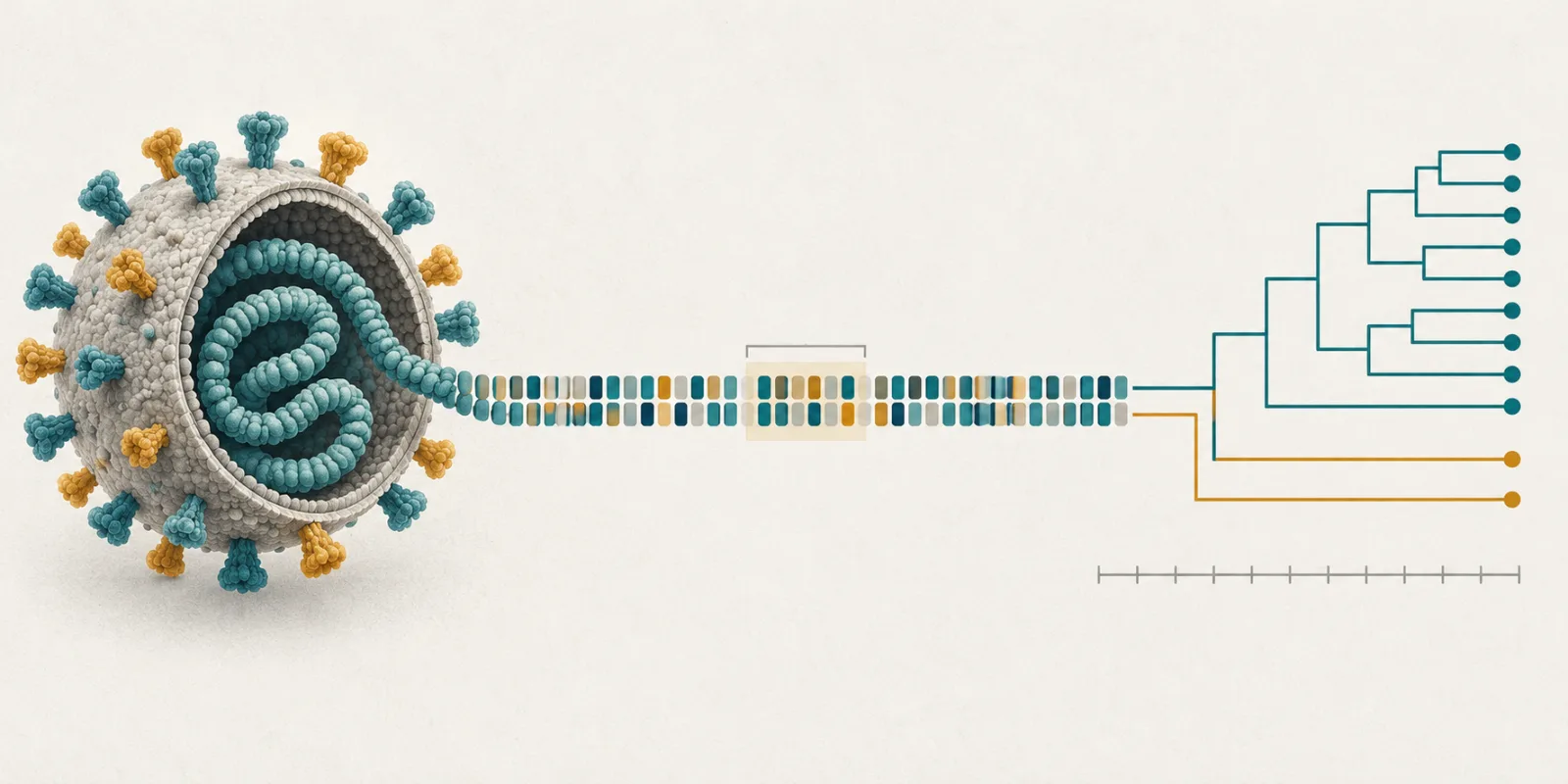
What makes this interesting, rather than merely bureaucratic, is the criterion. The commission is not asked whether a country has too many cases, or whether its vaccination policy is sensible. It is asked a narrow factual question about the virus itself. Re-established endemic transmission is defined as uninterrupted circulation of the same virus genotype and lineage for twelve months or more in a given geographic area.
That phrasing puts a laboratory technique at the centre of an international public health judgement. To answer it you have to sequence measles virus genomes from cases scattered across a continent and work out whether they form one continuous family tree or a series of unrelated introductions from abroad. As we will see, the standard tool for doing that is 450 nucleotides long, and it is not always up to the job.
Background: what elimination means, and what gets sequenced#
Measles virus is a single-stranded RNA virus in the genus Morbillivirus. Its genome is about 16,000 nucleotides long and encodes six main proteins. It spreads through the air, lingers in a room after an infected person leaves, and is among the most transmissible human pathogens known.
Elimination does not mean zero cases. It means no continuous chain of local transmission for at least twelve months. A country with elimination status can still have outbreaks, as long as each one traces back to an importation and then burns out. Endemic transmission is the opposite: the virus has set up residence and no longer needs re-importing.
Genotype and lineage are the labels used to tell measles viruses apart. There are 24 recognised measles genotypes, though global diversity has collapsed as vaccination has spread, and since 2021 the B3 and D8 lineages have accounted for most circulating virus worldwide (Stanley et al., Journal of Clinical Virology, 2026).
N450 is the workhorse of measles molecular surveillance. Laboratories sequence 450 nucleotides at the end of the nucleoprotein gene, the most variable stretch of the measles genome, and compare that short barcode against a global database. The approach is standardised worldwide, which is exactly what makes it useful: a sequence from Lagos can be compared directly with one from Leeds. Molecular surveillance of this kind serves as a line of evidence for the absence of endemic circulation and as a way to track chains of transmission (Bankamp et al., Vaccines, 2024).
MF-NCR is the extended window that laboratories increasingly add. It is the non-coding region sitting between the matrix and fusion protein genes, and it is more variable than N450, which gives finer resolution when many cases share an identical barcode (Jacqueline et al., Frontiers in Microbiology, 2023).
Why 450 nucleotides stopped being enough#
Here is the problem the commission faces. When a country eliminates measles, the diversity of virus circulating in it drops. Imports arrive from a handful of globally dominant lineages, so a great many unrelated cases end up carrying the same or nearly the same N450 barcode. The tool that was designed to distinguish outbreaks starts returning the same answer for everything.
Israel's experience shows how sharply this bites. Between 2018 and 2019 the country recorded over 4,300 measles cases with more than 100 documented importation events, and a retrospective analysis found that conventional epidemiological investigation plus N450 genotyping lacked the resolution to distinguish sustained local transmission from multiple independent introductions. Whole genome sequencing, applied afterwards, resolved multiple distinct transmission chains that the short window had blurred together (Indenbaum et al., Viruses, 2025).
Canada hit the same wall. Work on Canadian post-elimination surveillance data from 2018 to 2020 concluded that because so few genotypes still circulate, documenting the absence of an endemic strain requires sequence information beyond the standard window (Hiebert et al., Frontiers in Microbiology, 2024).
This is why PAHO's March statement included a detail that reads as dry housekeeping but is actually the crux of the matter. The decision to move the review to the regular annual meeting took account of ongoing analysis by US health authorities that includes complete viral genome sequencing and the development of a bioinformatics platform for detailed molecular data analysis.
In other words, the United States is not arguing about case counts. It is building the capability to sequence whole measles genomes and argue, from the genomes, that the chain broke somewhere and restarted. Whether that argument succeeds depends on data that did not exist when the outbreak began.
One point deserves emphasis, because it is easy to misread. The burden of proof runs towards demonstrating interruption. Elimination is retained by showing that continuous transmission stopped, not by showing that nobody can prove it continued. Ambiguous sequence data therefore does not help a country keep the label.
What the American numbers look like#
The epidemiology supplies the context in which those sequences will be read.
As of 29 October 2026, the US Centers for Disease Control and Prevention had recorded 4,852 confirmed measles cases for the year, reported from 47 jurisdictions, with 43 new outbreaks and 96% of cases outbreak-associated. Of those outbreak-associated cases, 1,384 belong to outbreaks that began back in 2025 (CDC, 2026). That last figure is the one to watch, because outbreaks straddling the year boundary are the signature of chains that never stopped.
The trajectory is steep. The full-year total for 2025 was 2,289, and for 2024 it was 285.
Three deaths have been recorded in 2026, matching the 2025 total, and 11% of cases have been hospitalised, rising to 16% among children under five. Among confirmed cases, 96% were in people who were unvaccinated or whose vaccination status was unknown.
The geography is lumpy rather than national. Pennsylvania alone accounts for 1,411 cases, with South Carolina at 670, Utah at 535 and Wisconsin at 323. This is what measles does: it finds the pockets.
Why measles is always the first to come back#
Measles is the canary. When immunisation coverage slips, it is the first pathogen to notice, and the reason is arithmetic.
The share of a population that must be immune to stop sustained spread rises with transmissibility. For measles the conventional figure is about 95% with two doses, which is why that number appears in every target. The underlying transmissibility estimate is less settled than textbooks imply. A systematic review of published basic reproduction number estimates for measles found they varied far more widely across settings than the frequently quoted range of 12 to 18 suggests, and cautioned against treating any single value as universal (Guerra et al., The Lancet Infectious Diseases, 2017). The practical implication is not reassuring: in dense, well-mixed settings the threshold can be higher still.
American coverage has drifted below the line. MMR vaccination among kindergarteners fell from 95.2% in the 2019 to 2020 school year to 92.4% in 2025 to 2026, leaving roughly 280,000 kindergarteners unprotected in that single cohort (CDC, 2026). National averages also hide the pockets that matter. Idaho reported 75.2% kindergarten coverage, Wisconsin 85.1% and Minnesota 85.7%, while Connecticut and West Virginia both exceeded 98%.
The vaccine itself is not in question. Two doses are 97% effective against measles and one dose is 93%, and breakthrough infections run at roughly a tenth of cases, consistent with previous years.
Globally the picture is worse and better at once. WHO estimated 11 million measles infections and 95,000 deaths in 2024, with first-dose coverage at 84% and second-dose at 76%, and 59 countries experiencing large or disruptive outbreaks. The same analysis found measles deaths down 88% since 2000, with nearly 59 million lives saved (WHO, 2025). Both things are true. The vaccination programme has been one of the most successful interventions in medical history, and it is currently losing ground.
Canada went first, and the region fell with it#
The Americas already lost regional measles elimination. In November 2025 the verification commission concluded that endemic transmission had been re-established in Canada, where the virus circulated uninterrupted for at least twelve months, and under the regional framework documented endemic transmission in any one country costs the whole region its status.
So the November 2026 decision is not about whether the Americas have a measles problem. That question was answered a year ago. It is about whether two more countries get individually reclassified.
What would change if they are? Less than the headlines suggest, and more than officials might like. There is no penalty, no sanction and no automatic policy consequence. Reclassification is a statement about virology, not a punishment.
The real costs are slower. Elimination status is a benchmark that national programmes organise themselves around, and losing it removes a visible metric that has justified investment for a quarter of a century. Regaining it is not quick either: a country must demonstrate a full twelve months of interrupted transmission, which means the earliest possible restoration is a year after the last chain genuinely breaks.
There is also a surveillance irony worth naming. Proving interruption requires the very detection capability that has to be funded and staffed. A country that cannot sequence enough cases cannot demonstrate that its chains broke, regardless of whether they did.
The long shadow: immune amnesia, and an honest caveat#
One more piece of virology belongs in any serious account of why measles cases matter beyond the acute illness.
Measles virus infects immune cells, and in doing so it appears to erase part of the immunological memory a person has already built. A study using high-throughput antibody profiling found that measles infection eliminated between 11% and 73% of the antibody repertoire across individuals, stripping away protection against pathogens the person had previously encountered (Mina et al., Science, 2019). A companion study found that reconstitution of B cell populations after measles is genetically incomplete, offering a mechanism for immunosuppression lasting months to years (Petrova et al., Science Immunology, 2019).
This phenomenon, immune amnesia, is often presented as settled. It is not entirely. When members of the same research group tested the long-term prediction against childhood infectious disease mortality data from Brazil, they found no evidence of measles immunomodulation extending beyond one year (Xia et al., The Journal of Infectious Diseases, 2022). Others have argued that the effect attributed to immune amnesia may partly reflect non-specific benefits of the vaccine itself (Aaby and Benn, Journal of Infection, 2023).
The immunological mechanism is well documented in the laboratory. How much population-level mortality it explains, and for how long, remains genuinely contested. That nuance is worth preserving, because overstating a real finding gives people a reason to dismiss the rest.
What is not contested is the acute picture, and the acute picture is bad enough: 11% of American cases hospitalised this year, three deaths, and a virus that finds unvaccinated children with unusual efficiency.
Frequently asked questions#
What does measles elimination status actually mean? It means a country has gone at least twelve months without continuous local transmission of the virus. Imported cases and short outbreaks are compatible with elimination, provided each chain ends. Re-established endemic transmission is defined as uninterrupted circulation of the same genotype and lineage for twelve months or more (PAHO, 2026).
Why does the decision depend on genetic sequencing? Because case counts alone cannot distinguish one long chain from many separate importations. Molecular surveillance provides the evidence for or against endemic circulation and lets investigators trace chains of transmission (Bankamp et al., Vaccines, 2024).
What is N450, and why is it sometimes inadequate? It is a 450-nucleotide window at the end of the measles nucleoprotein gene, used worldwide as a standard genotyping barcode. In post-elimination settings so few lineages circulate that many unrelated cases share a nearly identical barcode. One analysis of a large Israeli outbreak found N450 could not separate sustained local transmission from repeated introductions, while whole genome sequencing could (Indenbaum et al., Viruses, 2025).
How many measles cases has the United States had in 2026? As of 29 October 2026 the CDC had confirmed 4,852 cases across 47 jurisdictions, with 43 outbreaks and three deaths (CDC, 2026). That is the highest annual total since 1991.
Has the region already lost its status? Yes. In November 2025 the verification commission determined that endemic transmission had been re-established in Canada, and because regional status falls when any member country has documented endemic transmission, the Americas lost it then.
What happens if the United States is reclassified? Nothing automatic. There is no sanction attached. The practical consequence is the loss of a long-standing benchmark, and the requirement to demonstrate a further twelve months of interrupted transmission before the status can be restored.
Why is 95% vaccination coverage the target? Because measles is extremely transmissible, so the immune fraction needed to stop sustained spread is very high. Published estimates of its basic reproduction number vary widely between settings, and one systematic review warned against treating the familiar range of 12 to 18 as universal (Guerra et al., 2017). US kindergarten MMR coverage is currently 92.4%.
Is measles immune amnesia real? The immunological mechanism is well evidenced: infection has been shown to remove a large share of a person's existing antibody repertoire (Mina et al., Science, 2019). How much excess long-term mortality it causes is still debated, and at least one analysis found no effect beyond one year (Xia et al., 2022). Treat the mechanism as established and the long-term population effect as contested.
References#
- Pan American Health Organization (2026). Update on the review of measles elimination status. Washington, D.C., 2 March 2026. https://www.paho.org/en/news/2-3-2026-update-review-measles-elimination-status
- US Centers for Disease Control and Prevention (2026). Measles Cases and Outbreaks. National Center for Immunization and Respiratory Diseases, Division of Viral Diseases. Data as of 29 October 2026, page updated 30 October 2026. https://www.cdc.gov/measles/data-research/index.html
- Bankamp B, Kim G, Hart D, Beck A, Ben Mamou M, Penedos A, Zhang Y, Evans R, Rota PA (2024). Global update on measles molecular epidemiology. Vaccines 12(7), 810. https://doi.org/10.3390/vaccines12070810
- Indenbaum V, Bucris E, Friedman K, Kushnir T, Eliyahu H, Azar R, Levin T, Kanaaneh Y, Haas EJ, Singer SR, Lustig Y, Mendelson E, Erster O, Zuckerman NS (2025). Measles sequencing: lessons learned from a large-scale outbreak. Viruses 17(7), 913. https://doi.org/10.3390/v17070913
- Hiebert J, Zubach V, Schulz H, Severini A (2024). Genomic tools for post-elimination measles molecular epidemiology using Canadian surveillance data from 2018-2020. Frontiers in Microbiology 15, 1475144. https://doi.org/10.3389/fmicb.2024.1475144
- Jacqueline C, Gavilan AM, Lopez-Perea N, Penedos AR, Masa-Calles J, Echevarria JE, Fernandez-Garcia A (2023). Utility of MF non-coding region for measles molecular surveillance during post-elimination phase, Spain, 2017-2020. Frontiers in Microbiology 14, 1143933. https://doi.org/10.3389/fmicb.2023.1143933
- Stanley S, Patrick RC, Elkan M, Fink J, Oh B, Sun Y, Schroeder C, Potter RF (2026). Genomic epidemiology of two travel-associated pediatric measles viruses within the B3 lineage. Journal of Clinical Virology, 105966. https://doi.org/10.1016/j.jcv.2026.105966
- Guerra FM, Bolotin S, Lim G, Heffernan J, Deeks SL, Li Y, Crowcroft NS (2017). The basic reproduction number (R0) of measles: a systematic review. The Lancet Infectious Diseases 17(12), e420-e428. https://doi.org/10.1016/S1473-3099(17)30307-9
- World Health Organization (2025). Measles deaths down 88% since 2000, but cases surge. News release, 28 November 2025. https://www.who.int/news/item/28-11-2025-measles-deaths-down-88--since-2000--but-cases-surge
- Mina MJ, Kula T, Leng Y, Li M, de Vries RD, Knip M, Siljander H, Rewers M, Choy DF, Wilson MS, Larman HB, Nelson AN, Griffin DE, de Swart RL, Elledge SJ (2019). Measles virus infection diminishes preexisting antibodies that offer protection from other pathogens. Science 366(6465), 599-606. https://doi.org/10.1126/science.aay6485
- Petrova VN, Sawatsky B, Han AX, Laksono BM, Walz L, Parker E, Pieper K, Anderson CA, de Vries RD, Lanzavecchia A, Kellam P, von Messling V, de Swart RL, Russell CA (2019). Incomplete genetic reconstitution of B cell pools contributes to prolonged immunosuppression after measles. Science Immunology 4(41), eaay6125. https://doi.org/10.1126/sciimmunol.aay6125
- Xia S, Gullickson CC, Metcalf CJE, Grenfell BT, Mina MJ (2022). Assessing the effects of measles virus infections on childhood infectious disease mortality in Brazil. The Journal of Infectious Diseases. https://doi.org/10.1093/infdis/jiac233
- Aaby P, Benn CS (2023). Measles vaccination and reduced child mortality: prevention of immune amnesia or beneficial non-specific effects of measles vaccine? Journal of Infection 87(4), 356-358. https://doi.org/10.1016/j.jinf.2023.07.010