From one mouse cell to 300 million: the hook#
In 2009 a team at the Gurdon Institute in Cambridge sequenced the messenger RNA of a single mouse blastomere, an embryo cell a few divisions old, and detected 75% more genes than a microarray could (Tang et al., 2009). One cell. It was a technical stunt, and a very good one.
Sixteen years later, the Arc Institute launched a public atlas holding data from more than 300 million cells (Arc Institute, 2025). Somewhere in that jump, from one cell to hundreds of millions, biology stopped being short of data and started being short of ways to make sense of it.
That gap is what the new AI layer of bioinformatics is trying to fill. Transformer models, the same family of architecture behind chatbots, are now trained on tens of millions of single cell profiles. Their builders say they can label cell types, find drug targets and, eventually, simulate how a cell will react to a gene being switched off. Some of that is already working. Some of it, according to several independent tests published over the past eighteen months, is not working yet. This piece tries to sort one from the other.
What single cell sequencing actually measures: the background#
Every cell in your body carries roughly the same DNA. What makes a liver cell different from a neuron is which genes are switched on, and you can read that by counting the messenger RNA molecules a cell is producing. Each RNA copy is a working note telling the cell's machinery to build a particular protein.
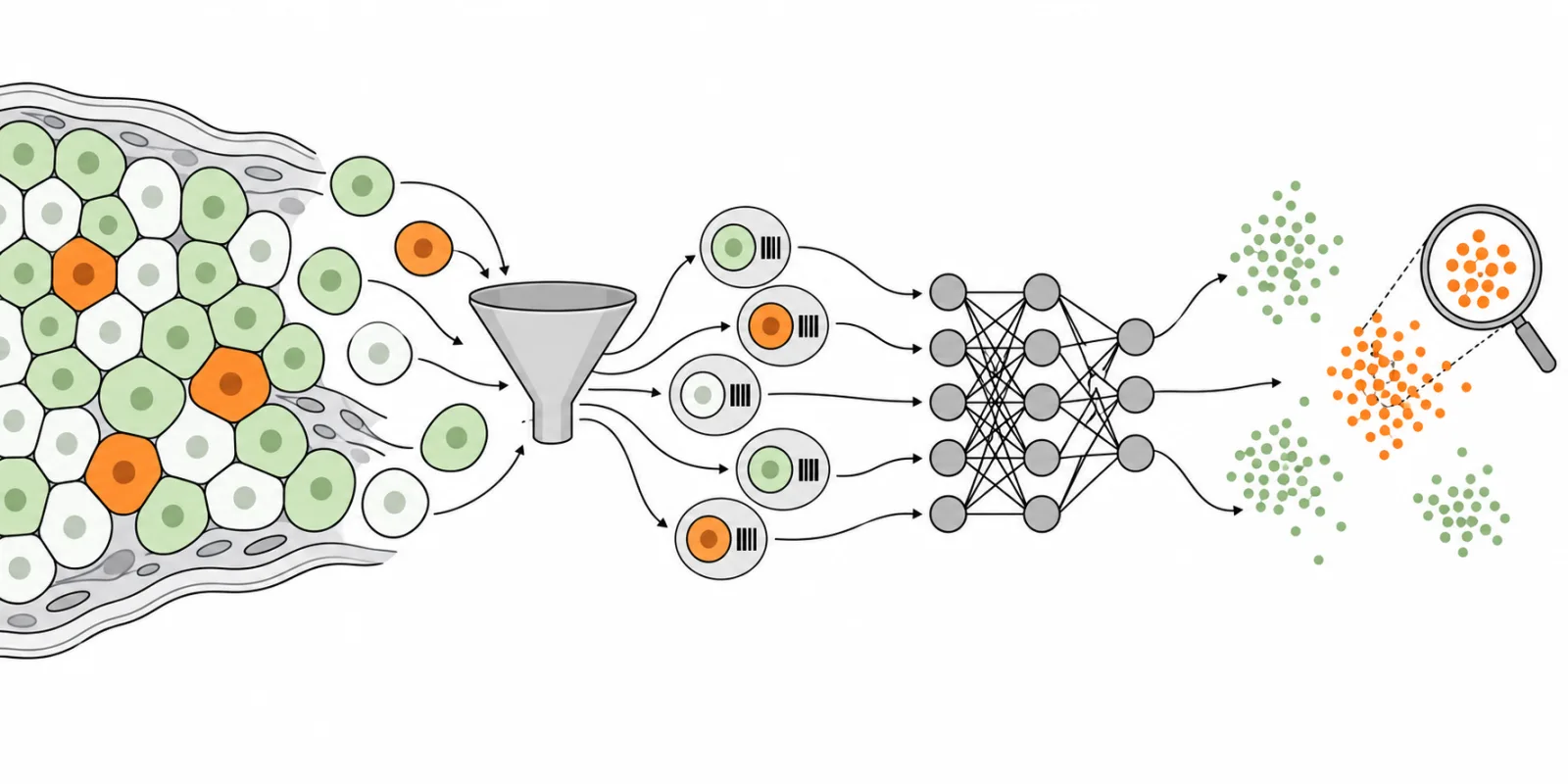
Older "bulk" RNA sequencing grinds up a tissue sample and measures the average. That is like judging a city's mood by blending every resident's diary into one smoothie. Single cell RNA sequencing, usually shortened to scRNA-seq, keeps the diaries separate. Cells are isolated, typically in tiny droplets or wells, and each cell's RNA is tagged with a molecular barcode before sequencing, so every read can be traced back to the cell it came from. Improvements in these methods drove exponential growth in the number of cells a single experiment could handle (Svensson, Vento-Tormo and Teichmann, 2018).
The output is a giant table. Rows are cells, columns are around 20,000 genes, and most entries are zero because any one cell expresses only a fraction of its genes and the chemistry misses many molecules. Analysing that table is the job of bioinformatics: cleaning it, grouping similar cells into clusters, naming those clusters as cell types and comparing healthy with diseased samples. The two workhorse toolkits are Scanpy in Python (Wolf, Angerer and Theis, 2018) and Seurat in R (Hao et al., 2024).
A few more terms will help:
- Batch effects are technical differences between experiments (different labs, machines or days) that can masquerade as biology. Removing them while keeping real biological differences is called data integration.
- Spatial transcriptomics measures gene activity while keeping track of where each cell sits in a tissue slice. Nature Methods named spatially resolved transcriptomics its Method of the Year for 2020 (Marx, 2021).
- A foundation model is a large AI model pre-trained on a broad dataset without specific labels, then adapted ("fine-tuned") for particular tasks. Zero-shot use means applying it with no extra training at all.
- An embedding is a compact list of numbers the model produces to summarise a cell. Cells with similar biology should end up with similar embeddings.
The atlas era: building a reference map of the human body#
You cannot spot an abnormal cell without knowing what a normal one looks like. That is the logic behind the Human Cell Atlas, an international consortium that now counts more than 3,500 members in over 100 countries (Chan Zuckerberg Initiative, 2024). In November 2024 Nature published a collection of more than 40 peer-reviewed papers from the effort (Chan Zuckerberg Initiative, 2024).
Individual atlases show what the approach can deliver. The Tabula Sapiens project profiled nearly 500,000 cells from 24 tissues and organs, many from the same donors, and characterised more than 400 cell types (Tabula Sapiens Consortium, 2022). The integrated Human Lung Cell Atlas went further on one organ, combining 49 datasets into a reference of over 2.4 million cells from 486 people (Sikkema et al., 2023). Because it was large and diverse, it could pick out a shared cell state, profibrotic macrophages marked by the gene SPP1, across COVID-19, pulmonary fibrosis and lung cancer (Sikkema et al., 2023).
Stitching studies together depends on good integration. A large benchmark of 68 method and preprocessing combinations, run across more than 1.2 million cells, found that deep learning tools such as scVI and scANVI performed well on complex integration tasks (Luecken et al., 2022). scVI itself is a neural network that models the noisy counts of scRNA-seq data directly (Lopez et al., 2018). This is worth stressing: AI was quietly inside the single cell stack years before anyone used the phrase "foundation model".
The data then needed a home. CZ CELLxGENE Discover, run by the Chan Zuckerberg Initiative, held over 93 million unique cells from more than 1,550 datasets as of October 2024, all standardised to a common format (CZI Cell Science Program, 2025). Standardisation sounds dull. It is the reason anyone can train a large model at all.
Foundation models: teaching transformers the grammar of cells#
The central bet behind the single cell foundation model is an analogy. A sentence is a sequence of words; a cell can be described as a ranked list of its active genes. Train a transformer on enough of those lists and perhaps it learns the "grammar" of gene regulation.
Geneformer, from Christina Theodoris and colleagues, was pre-trained on about 30 million single cell transcriptomes (Theodoris et al., 2023). The authors reported that its attention weights, the internal scores a transformer uses to decide which inputs matter, encoded aspects of gene network hierarchy without being told about them. Applied to heart muscle disease with limited patient data, the model nominated candidate therapeutic targets for cardiomyopathy (Theodoris et al., 2023).
scGPT, from Bo Wang's group in Toronto, used a generative pre-trained transformer across more than 33 million cells. The paper reported strong results after fine-tuning on cell type annotation, batch integration, multi-omic integration, perturbation prediction and gene network inference (Cui et al., 2024).
Not every successful model is a giant language-style transformer. Genentech's SCimilarity uses metric learning, a method that trains the model to place similar cells close together, so that researchers can search tens of millions of profiles for cells resembling a query (Heimberg et al., 2024). Searching a 23.4 million cell atlas drawn from 412 studies, the team found that fibrosis-associated macrophages from interstitial lung disease had close relatives in other fibrotic conditions. The top laboratory hit was a 3D hydrogel culture, which the team then showed experimentally reproduced that cell state (Heimberg et al., 2024). That last step matters: a prediction was checked at the bench.
Models are also learning geography. Nicheformer was pre-trained on a curated corpus of over 57 million dissociated cells and 53 million spatially resolved cells from 73 tissues (Tejada-Lapuerta et al., 2025). Its authors found that models trained only on dissociated data failed to capture the complexity of tissue neighbourhoods, which argues for feeding spatial transcriptomics data into the next generation of models (Tejada-Lapuerta et al., 2025).
The scale of the training data#
The chart below shows how quickly the number of cells involved has grown, on a logarithmic scale (each gridline is ten times the one below).
Sources: Tang et al. (2009); Tabula Sapiens Consortium (2022); Sikkema et al. (2023); Heimberg et al. (2024); Theodoris et al. (2023); Cui et al. (2024); CZI Cell Science Program (2025); Arc Institute (2025). Asterisked entries are described in preprints (not peer reviewed).
The benchmark backlash: when simple methods keep winning#
Here is where the story gets more interesting, and less flattering. Several groups outside the model-building labs have started testing these tools on their own terms.
Researchers at Oxford and Microsoft Research evaluated Geneformer and scGPT in the zero-shot setting, using the embeddings straight out of the box. They found the models could face reliability problems and were in some cases outperformed by simpler methods (Kedzierska et al., 2025). This matters more than it might seem. In discovery work you often do not have labels to fine-tune on, so zero-shot performance is what you actually get.
The sharper result came from Heidelberg. Constantin Ahlmann-Eltze, Wolfgang Huber and Simon Anders compared five foundation models and two other deep learning models against deliberately simple baselines at predicting how the transcriptome changes after one or two genes are perturbed. None of the deep learning models beat the baselines (Ahlmann-Eltze, Huber and Anders, 2025). Perturbation prediction is the headline promise of the field, so this is not a side issue.
Clinical prediction looks similar. A Dana-Farber team tested 12 foundation models against three baselines (highly variable genes, PCA and scVI) on seven cancer tasks. They reported that the foundation models "did not consistently outperform conventional baselines", that performance did not rise with model size, and that SCimilarity, a comparatively small 31 million parameter model, beat much larger ones on patient-level outcome prediction. The authors also cautioned that cohorts were small, often a few tens of patients (Roman et al., 2025, preprint, not peer reviewed).
None of this says the models are useless. Foundation models matched baselines on telling cell types apart and did well on tumour microenvironment annotation in the cancer study (Roman et al., 2025, preprint, not peer reviewed). It says that bigger is not automatically better, and that a well-chosen boring method deserves a place in every comparison.
Virtual cells: the race to simulate biology#
The most ambitious goal is a "virtual cell": a model that can take a cell, apply a change (a drug, a gene knockout) and predict the result accurately enough to skip some lab experiments.
The data for that is arriving fast. Tahoe Therapeutics (formerly Vevo) released Tahoe-100M, a perturbation dataset of 100 million cells measuring the effects of 1,100 small-molecule drugs across 50 cancer cell lines, about 60,000 drug and cell line interactions in all (Arc Institute, 2025; Zhang et al., 2025, preprint, not peer reviewed). The Arc Institute's companion scBaseCount resource reprocessed observational data from more than 200 million cells across 21 species, using AI agents to curate public repositories (Arc Institute, 2025). Arc's own State model was reportedly trained on about 170 million observational and over 100 million perturbational cells across 70 human cell lines (Arc Institute, 2025, preprint, not peer reviewed).
To test claims in public, Arc ran the first Virtual Cell Challenge in 2025. More than 5,000 people from 114 countries registered and more than 300 teams made final submissions (GEN, 2025). BioMap Research took first place, and Altos Labs won a separate Generalist Prize (GEN, 2025). The organisers were candid about the results. Arc's Hani Goodarzi said models were "not yet consistently outperforming naive baselines across all metrics", and no entry beat the baseline on mean absolute error (GenomeWeb, 2025). Winning approaches blended deep learning with classical statistics, and Goodarzi said plainly: "We don't think we have a virtual cell yet" (GenomeWeb, 2025).
I find that admission more encouraging than any leaderboard. A field that publishes its own negative results is a field that is learning. A 2026 edition of the challenge has opened with a harder, zero-shot task: predicting knockdown responses across several cell lines without task-specific examples (RuntimeWire, 2026).
The new bioinformatics stack, layer by layer#
Put together, the stack for mapping disease at cellular resolution now looks something like this:
| Layer | What it does | Representative tools or resources | Evidence status |
|---|---|---|---|
| Measurement | Profiles RNA in individual cells, with or without tissue location | scRNA-seq; spatial transcriptomics (Svensson et al., 2018; Marx, 2021) | Mature, widely used |
| Core analysis | Quality control, clustering, visualisation | Scanpy (Wolf et al., 2018); Seurat (Hao et al., 2024) | Mature, community standard |
| Integration | Removes batch effects across studies | scVI, scANVI (Lopez et al., 2018; Luecken et al., 2022) | Well benchmarked |
| Reference data | Standardised atlases of healthy and diseased cells | Human Cell Atlas; CELLxGENE (CZI, 2025); HLCA (Sikkema et al., 2023) | Growing rapidly |
| Foundation models | General cell and gene embeddings, fine-tuned for tasks | Geneformer (Theodoris et al., 2023); scGPT (Cui et al., 2024); SCimilarity (Heimberg et al., 2024); Nicheformer (Tejada-Lapuerta et al., 2025) | Mixed in independent benchmarks |
| Perturbation and "virtual cell" models | Predict cell responses to drugs or gene edits | State; Virtual Cell Challenge entries (GenomeWeb, 2025) | Early; often matched by simple baselines |
Read the right-hand column from top to bottom and the pattern is clear. Confidence falls as ambition rises. That is normal for a young technology, and it is useful for anyone deciding where to spend money or a PhD.
For founders and lab heads, the practical takeaways are modest but real. Use the mature lower layers without hesitation. Treat foundation models as one candidate among several, and always run a simple baseline alongside them, as the benchmarking studies did (Ahlmann-Eltze, Huber and Anders, 2025). And prize experimental validation: SCimilarity's hydrogel result is persuasive precisely because someone tested it in the lab (Heimberg et al., 2024).
What would change the picture#
Three things seem likely to decide whether the AI layer earns its keep.
The first is better data, not just more of it. The perturbation benchmarks suggest that current training sets may not contain the right signal for prediction, and the 2026 challenge's move to new, purpose-generated experimental data is a response to exactly that (RuntimeWire, 2026).
The second is space. Nicheformer's finding that dissociated data alone misses tissue context suggests that disease, which often lives in the relationships between neighbouring cells, will need spatial measurements in the training mix (Tejada-Lapuerta et al., 2025).
The third is honest evaluation. Independent, zero-shot, baseline-aware testing has already changed how the field talks about itself (Kedzierska et al., 2025). If that habit sticks, the claims that survive will be worth believing.
Frequently asked questions#
What is single cell sequencing in simple terms? It is a set of methods that read the genetic activity of individual cells rather than an average across a tissue. Each cell's RNA is tagged with a barcode, so results can be traced back to the cell they came from (Svensson et al., 2018).
How is single cell RNA sequencing different from spatial transcriptomics? Standard scRNA-seq separates cells from their tissue, so their location is lost. Spatial transcriptomics measures gene activity while recording where each cell sits in a tissue slice (Marx, 2021).
What is a single cell foundation model? It is a large AI model, such as Geneformer or scGPT, pre-trained on tens of millions of cell profiles and then adapted for tasks such as labelling cell types or predicting gene networks (Theodoris et al., 2023; Cui et al., 2024).
Do scGPT and Geneformer outperform traditional methods? Not consistently. Independent zero-shot tests found they were sometimes beaten by simpler approaches, and a perturbation benchmark found no deep learning model beat simple linear baselines (Kedzierska et al., 2025; Ahlmann-Eltze et al., 2025).
What is the Human Cell Atlas? It is an international project to map every cell type in the human body. It has more than 3,500 members in over 100 countries and published a collection of more than 40 papers in Nature in 2024 (CZI, 2024).
What is a virtual cell, and does one exist yet? A virtual cell is a model that predicts how a cell responds to drugs or genetic changes. The organisers of the 2025 Virtual Cell Challenge said openly that the field does not have one yet (GenomeWeb, 2025).
Has single cell AI found anything clinically useful? It has produced promising leads rather than approved treatments. Geneformer nominated candidate targets for cardiomyopathy, and SCimilarity identified a lab culture system that reproduces a fibrosis-linked macrophage state (Theodoris et al., 2023; Heimberg et al., 2024).
Should a small lab or start-up invest in foundation models now? Use them where they help, but benchmark them against simple methods on your own data. A cancer study found model size did not predict performance, though that work is still a preprint (not peer reviewed) (Roman et al., 2025).
References#
- Ahlmann-Eltze, C., Huber, W. and Anders, S. (2025). Deep-learning-based gene perturbation effect prediction does not yet outperform simple linear baselines. Nature Methods, 22, 1657 to 1661. https://doi.org/10.1038/s41592-025-02772-6
- Arc Institute (2025). Arc Virtual Cell Atlas launches, combining data from over 300 million cells. https://arcinstitute.org/news/arc-virtual-cell-atlas-launch
- Arc Institute (2025). State: predicting cellular responses to perturbation (manuscript). (not peer reviewed) https://arcinstitute.org/manuscripts/State
- Chan Zuckerberg Initiative (2024). Nature publishes collection of papers advancing the Human Cell Atlas. https://chanzuckerberg.com/newsroom/nature-publishes-collection-papers-advancing-human-cell-atlas/
- CZI Cell Science Program et al. (2025). CZ CELLxGENE Discover: a single-cell data platform for scalable exploration, analysis and modeling of aggregated data. Nucleic Acids Research, 53(D1), D886. https://academic.oup.com/nar/article/53/D1/D886/7912032
- Cui, H. et al. (2024). scGPT: toward building a foundation model for single-cell multi-omics using generative AI. Nature Methods, 21, 1470 to 1480. https://doi.org/10.1038/s41592-024-02201-0
- GEN: Genetic Engineering and Biotechnology News (2025). NeurIPS 2025: Altos Labs wins Generalist Prize at Arc's Virtual Cell Challenge. https://www.genengnews.com/topics/artificial-intelligence/neurips-2025-altos-labs-wins-generalist-prize-at-arcs-virtual-cell-challenge (science journalism; used for competition statistics)
- GenomeWeb (2025). Virtual Cell Challenge results. https://www.genomeweb.com/node/646871 (science journalism; used for organiser quotes)
- Hao, Y. et al. (2024). Dictionary learning for integrative, multimodal and scalable single-cell analysis. Nature Biotechnology, 42, 293 to 304. https://doi.org/10.1038/s41587-023-01767-y
- Heimberg, G. et al. (2024). A cell atlas foundation model for scalable search of similar human cells. Nature, 638, 1085 to 1094. https://doi.org/10.1038/s41586-024-08411-y
- Kedzierska, K. Z., Crawford, L., Amini, A. P. and Lu, A. X. (2025). Zero-shot evaluation reveals limitations of single-cell foundation models. Genome Biology, 26, 101. https://doi.org/10.1186/s13059-025-03574-x
- Lopez, R. et al. (2018). Deep generative modeling for single-cell transcriptomics. Nature Methods, 15, 1053 to 1058. https://doi.org/10.1038/s41592-018-0229-2
- Luecken, M. D. et al. (2022). Benchmarking atlas-level data integration in single-cell genomics. Nature Methods, 19, 41 to 50. https://doi.org/10.1038/s41592-021-01336-8
- Marx, V. (2021). Method of the Year: spatially resolved transcriptomics. Nature Methods, 18, 9 to 14. https://doi.org/10.1038/s41592-020-01033-y
- Roman, A., Johri, S., Conci, R., Van Allen, E. M. and Elmarakeby, H. (2025). Empirical evaluation of single-cell foundation models for predicting cancer outcomes. bioRxiv. (not peer reviewed) https://doi.org/10.1101/2025.10.31.685892
- RuntimeWire (2026). Arc Institute opens 2026 Virtual Cell Challenge with zero-shot cell predictions. https://runtimewire.com/article/arc-institute-2026-virtual-cell-challenge-zero-shot (technology journalism; primary announcement not retrievable)
- Sikkema, L. et al. (2023). An integrated cell atlas of the lung in health and disease. Nature Medicine, 29, 1563 to 1577. https://doi.org/10.1038/s41591-023-02327-2
- Svensson, V., Vento-Tormo, R. and Teichmann, S. A. (2018). Exponential scaling of single-cell RNA-seq in the past decade. Nature Protocols, 13, 599 to 604. https://doi.org/10.1038/nprot.2017.149
- Tabula Sapiens Consortium (2022). The Tabula Sapiens: a multiple-organ, single-cell transcriptomic atlas of humans. Science, 376, eabl4896. https://doi.org/10.1126/science.abl4896
- Tang, F. et al. (2009). mRNA-Seq whole-transcriptome analysis of a single cell. Nature Methods, 6, 377 to 382. https://doi.org/10.1038/nmeth.1315
- Tejada-Lapuerta, A. et al. (2025). Nicheformer: a foundation model for single-cell and spatial omics. Nature Methods, 22, 2525 to 2538. https://doi.org/10.1038/s41592-025-02814-z
- Theodoris, C. V. et al. (2023). Transfer learning enables predictions in network biology. Nature, 618, 616 to 624. https://doi.org/10.1038/s41586-023-06139-9
- Wolf, F. A., Angerer, P. and Theis, F. J. (2018). SCANPY: large-scale single-cell gene expression data analysis. Genome Biology, 19, 15. https://doi.org/10.1186/s13059-017-1382-0
- Zhang, J. et al. (2025). Tahoe-100M: a giga-scale single-cell perturbation atlas for context-dependent gene function and cellular modeling. bioRxiv. (not peer reviewed) https://doi.org/10.1101/2025.02.20.639398