The clock that nobody has beaten yet#
On 15 May 2026, the Democratic Republic of the Congo declared an outbreak of Bundibugyo ebolavirus, and the WHO Director-General declared a Public Health Emergency of International Concern the same day (WHO AFRO). There was no licensed vaccine for that species of ebolavirus, and there still isn't.
Fifty-seven days later, the University of Oxford launched the world's first Phase I trial of a Bundibugyo-specific candidate (University of Oxford). Seventy-eight days after the declaration, the first volunteer received Moderna's mRNA-1469 in Truro, Nova Scotia (CEPI).
By the standards of vaccine development, that is extraordinarily quick. By the standard that global health agencies have set themselves, it is only the opening move. The 100 Days Mission asks for something much harder: a vaccine ready for initial authorisation and for manufacturing at scale within 100 days of recognising a pathogen with pandemic potential (CEPI). Not a first dose in a Phase I. An authorised product, in volume.
Nobody has done it. The question worth asking is whether artificial intelligence changes that, and the answer is that it changes part of it, and not the part where most of the time is lost.
Background: what the 100 Days Mission actually asks for#
The mission was launched in 2021 under the UK's G7 presidency, and it has a specific origin in a specific grievance. COVID-19 vaccines were, historically speaking, miraculously fast. A safe and effective vaccine reached rollout under emergency authorisation 326 days after the viral genome was first published in January 2020 (CEPI). Moderna's Phase I trial of mRNA-1273, with 45 volunteers across three dose groups, had begun months before that, and the sequence-to-first-dose interval became one of the defining statistics of the pandemic (Jackson et al., New England Journal of Medicine, 2020).
Fast was still not fast enough. Modelling by Imperial College London, cited in CEPI's 2026 policy report, estimates that a vaccine available within 100 days could have averted roughly 8.3 million excess deaths by the end of 2021, along with $1.4 trillion in lost productivity and $63 billion in hospitalisation costs (CEPI).
A few terms are worth unpacking before going further, because the rest of the argument depends on them.
An antigen is the piece of a pathogen that a vaccine shows to your immune system so it learns to recognise the real thing. Design the antigen badly and nothing downstream saves you. A platform technology is a reusable delivery chassis: mRNA wrapped in lipid nanoparticles, or a harmless chimpanzee adenovirus carrying a gene, as in Oxford's ChAdOx1. Swap the genetic payload, keep the chassis. Prototype pathogen preparedness is the strategy of building and testing vaccines against a representative virus from each dangerous viral family in advance, so that when a relative emerges you are editing a known design rather than starting from nothing. CEPI's current plan covers seven prototype families, including Filoviridae (the Ebola and Marburg family), Coronaviridae and Paramyxoviridae, and aims to reach about 75% of the viral families that experts rank as highest risk (CEPI 3.0 Strategy).
Finally, reverse vaccinology means starting from the pathogen's genome sequence rather than from the cultured organism, and reasoning computationally towards a candidate antigen. That is the door through which machine learning entered vaccinology, and it is the part AI has genuinely changed.
Where AI has actually delivered, with trial data attached#
Three contributions have peer-reviewed evidence behind them rather than press releases.
The first is sequence optimisation. For any given protein, there is an astronomical number of mRNA sequences that encode it, because the genetic code is redundant. Roughly 2.4 × 10^632 candidate sequences encode the SARS-CoV-2 spike protein, and they are not equivalent: structural stability and codon choice both affect how long the mRNA survives and how much protein it makes. A team borrowing lattice parsing from computational linguistics built LinearDesign, which finds an optimal sequence for spike in 11 minutes and raised antibody titres in mice by up to 128 times compared with a standard codon-optimisation benchmark (Zhang et al., Nature, 2023).
The second is forecasting immune escape. EVEscape combines a deep learning model trained on historical sequences with biophysical and structural information, and the useful property is its timing: trained only on data available before 2020, it anticipated SARS-CoV-2 variation about as accurately as high-throughput experimental scans, and generalised to influenza, HIV, Lassa and Nipah (Thadani et al., Nature, 2023). According to PubMed, that matters because experimental escape mapping needs polyclonal antibodies from infected people, which by definition do not exist in week one.
The third is computational antigen design reaching humans. SKYCovione (GBP510) uses a self-assembling nanoparticle displaying 60 copies of the spike receptor-binding domain, a structure that came out of computational protein design. In a Phase III trial across 38 sites in six countries, it produced a neutralising antibody geometric mean titre ratio of 2.93 against ChAdOx1-S, meeting its superiority endpoint (Song et al., EClinicalMedicine, 2023).
The most direct test arrived in 2026. Researchers at the University of Cambridge and the spinout DIOSynVax used machine learning on sarbecovirus surveillance sequences to identify features shared across the group and fold them into a single antigen, pEVAC-PS, intended to cover coronaviruses that have not infected humans yet. A Phase I dose-escalation study in 39 volunteers aged 18 to 50, delivered needle-free as a DNA vaccine, found no significant safety concerns and detected immune responses against SARS-CoV-2, SARS and related bat viruses (Journal of Infection, 2026).
Thirty-nine people is thirty-nine people. A Phase I tells you about safety and immunogenicity, not protection, and a Phase II is planned. But the claim that AI-designed antigens are a laboratory curiosity no longer holds.
The bottleneck moved, and it was never the molecule#
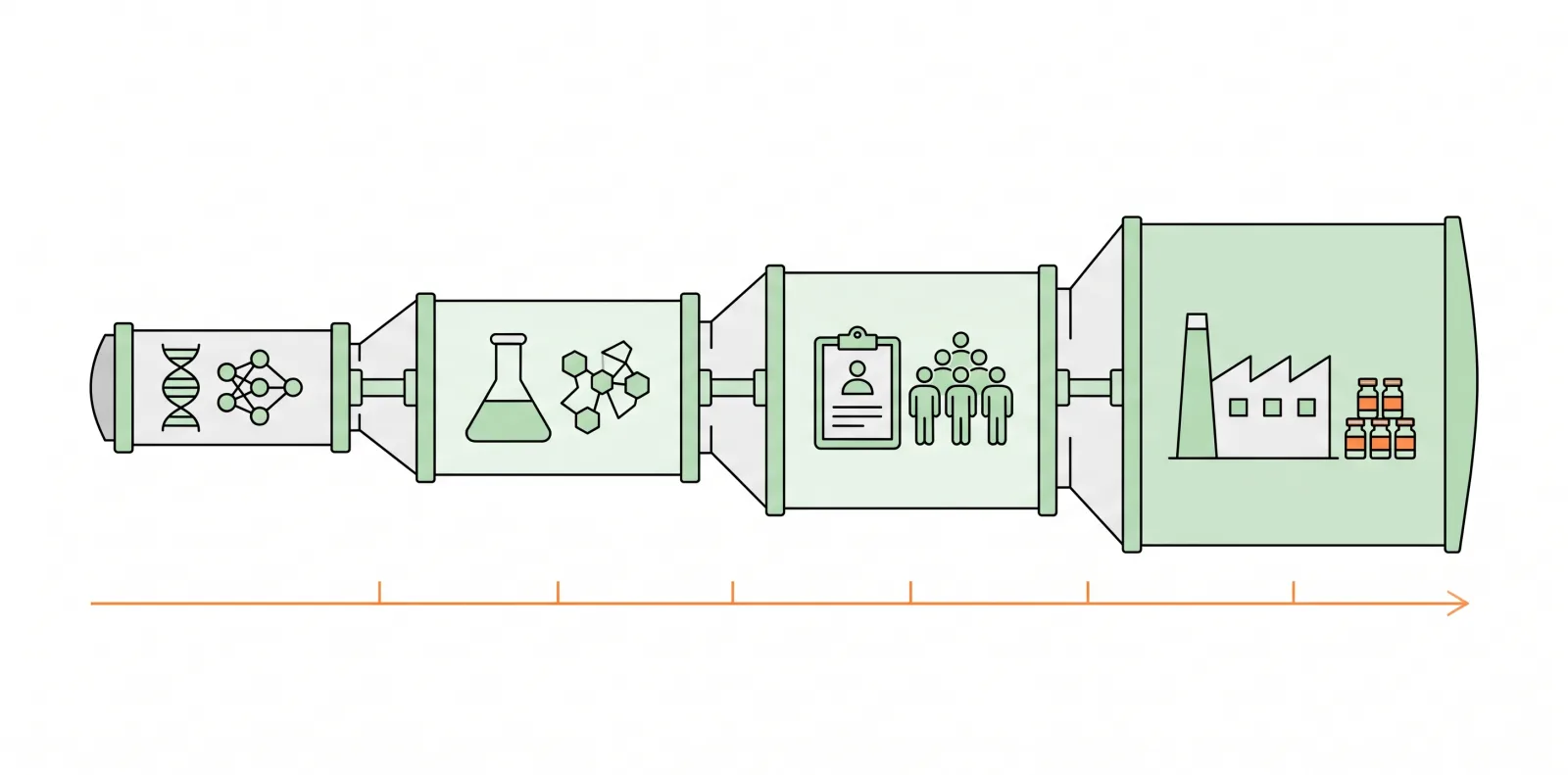
Here is the uncomfortable arithmetic. Antigen design, in the cases above, takes days to weeks. The Bundibugyo response shows what fills the remaining time.
| Stage | What happened in the 2026 Bundibugyo response | Elapsed from 15 May PHEIC | Is AI the binding constraint? |
|---|---|---|---|
| Pathogen identified and sequenced | Outbreak and PHEIC declared same day | Day 0 | No. Sequencing is routine |
| Candidate selected from existing library | ChAdOx1 BDBV and mRNA-1469 drawn from prior filovirus work | Weeks, mostly pre-existing | Partly. Prototype libraries and design tools help here |
| Manufacture of investigational doses | Serum Institute of India produced ~620,000 doses in two weeks; 4,000 supplied to the trial | Overlapping | No. Fill-finish capacity and raw materials |
| Regulatory review for trial start | Oxford trial launched pending regulatory review | Day 57 | No. National review timelines |
| First human dose | mRNA-1469 dosed in Nova Scotia, 3 August | Day 78 | No |
| Phase 2/3 efficacy trial | Awaiting WHO prioritisation advice and regulatory approval | Not started as of September | No. Trial readiness and governance |
| Authorisation at scale | Not achieved | Beyond 100 days | No |
Sources: WHO AFRO, University of Oxford, CEPI, CEPI epidemic intelligence awards.
Read down the right-hand column. One row out of seven is meaningfully AI-limited. CEPI's own policy report reaches a similar conclusion from a different direction: many of the capabilities needed already exist, and the barriers are operational rather than scientific, in that they are under-financed, poorly connected, weakly governed and rarely exercised (CEPI).
The report's recommendations are revealing for what they are not about. Regulatory reliance, where an emergency authorisation from a WHO-listed authority triggers an abridged national review. Pre-agreed civil-military logistics. Standing finance for at-risk manufacturing. Pre-positioned trial networks. None of that is a modelling problem.
The money is going the wrong way#
The fifth 100 Days Mission implementation report, published in Paris on 27 January 2026 by the International Pandemic Preparedness Secretariat, concluded that the 100-day target is not yet achievable in many areas (IPPS).
Investment in countermeasure R&D kept falling through FY2024, with the steepest decline in therapeutics, and the funding base is narrow and dependent on a handful of funders. Pipelines for diagnostics, therapeutics and vaccines cluster in early stages with limited movement into mid and late development. Ifedayo Adetifa of FIND described diagnostics as the least funded part of global preparedness. Luis Pizarro of DNDi called the therapeutics pipeline particularly dire. Jimmy Rosen of READDI put it most bluntly: preparedness is a funding problem, not a science problem, against more than $16 trillion in global economic losses from COVID-19 (IPPS).
Policy has not been helping. In August 2025 the US Department of Health and Human Services cancelled roughly $500 million across 22 mRNA vaccine development projects. mRNA is the platform that makes a 100-day timeline arithmetically conceivable in the first place. On the governance side, negotiations on the Pathogen Access and Benefit-Sharing annex to the WHO Pandemic Agreement were extended rather than concluded at the Seventy-ninth World Health Assembly in May 2026. Rapid sequence sharing is the input to every AI method described above.
CEPI's own 2027 to 2031 plan asks for $3.6 billion, of which $2.5 billion is still unraised against $1.1 billion secured, with Ethiopia, Norway and the UK committing $240 million so far (CEPI). Its AI component, a platform called the Pandemic Preparedness Engine for Disease X, is described as integrated across the R&D continuum, alongside a commitment to advance four new exemplar vaccines to at least Phase I and to test the mission through exercises in four to six countries (CEPI 3.0 Strategy).
The same tools cut the other way#
Any account has to include this. The methods that design a better antigen also design a better toxin, and CEPI's policy report explicitly flags growing risk of AI misuse enabling engineered pathogens (CEPI).
It is not hypothetical. A 2025 study found that generative protein design tools could produce variants of hazardous proteins that slipped past the sequence-screening systems used by commercial DNA synthesis providers, and the researchers worked with those providers to patch the gap before publishing (Microsoft Research). The patch is reassuring. The exercise is not, because the screening systems were state of the art and the bypass was found by people looking for it rather than by people hiding it.
Biosecurity and biosafety belong inside preparedness budgets rather than beside them, which is roughly what CEPI's seventh recommendation says.
So is the moonshot realistic?#
Partly, and the current version is less satisfying than either the hype or the dismissal.
The molecular design stage has genuinely compressed. Prototype libraries, computationally designed antigens, optimised mRNA sequences and escape forecasting are real capabilities with trial data behind them, and the Bundibugyo response moved from declaration to first human dose in 57 and 78 days using exactly that kind of groundwork. That is the 100 Days Mission working as intended for the first third of the pipeline.
Everything after that is unmoved. Trial start-up, regulatory review, efficacy demonstration and manufacturing at volume are governance, finance and logistics problems. An AI that designs a perfect antigen on day three still waits for ethics approval, a national regulator, a fill-finish line and a trial network. Meanwhile the funding for those parts is falling, the pathogen-sharing framework that feeds the models is unresolved, and the single most relevant manufacturing platform lost half a billion dollars of US support in a year.
CEPI's phrase for what it wants is making the mission an operational reality. The word doing the work there is operational. On present trends the next outbreak will probably see a candidate in a syringe faster than anyone expected five years ago, and an authorised vaccine roughly as slowly.
FAQs#
Has any vaccine actually been developed in 100 days? No. The fastest documented COVID-19 sequence-to-rollout interval was 326 days under emergency authorisation, and the 2026 Bundibugyo response reached a first Phase I dose at day 57 with no authorised product. The 100-day target has never been met.
Is an AI-designed vaccine in human trials? Yes. pEVAC-PS, a pan-sarbecovirus antigen designed using machine learning at the University of Cambridge and DIOSynVax, completed a Phase I dose-escalation study in 39 volunteers with no significant safety concerns. A Phase II is planned. Phase I results speak to safety and immune response, not protection.
If AI can design antigens in days, why do vaccines still take years? Because design is a small fraction of the timeline. Clinical trial start-up, regulatory review, efficacy demonstration and manufacturing at scale dominate, and none of them are computational problems. CEPI's own analysis describes the barriers as operational rather than scientific.
What is a prototype pathogen library? A set of vaccines developed and tested in advance against a representative virus from each high-risk viral family, so that an emerging relative can be addressed by modifying a known design. CEPI currently works across seven prototype families and aims to cover about 75% of the families ranked highest risk.
Does AI help with outbreak detection as well as vaccine design? It is being funded for that, with caution about maturity. CEPI awarded $3.9 million across three projects in the 2026 Bundibugyo outbreak for real-time epidemic intelligence, outbreak scenario modelling and ring vaccination modelling. CEPI's own policy work notes that health sector participants were more cautious than defence participants about how ready and affordable these tools are.
Could the same AI tools be used to create a pathogen? That risk is now formally recognised in preparedness policy. A 2025 study showed generative protein design tools producing hazardous protein variants that evaded the screening used by commercial DNA synthesis providers, with the gap patched before publication. CEPI's 2026 report lists AI misuse enabling engineered threats among its concerns.
Is pandemic preparedness funding rising or falling? Falling. The fifth 100 Days Mission implementation report found countermeasure R&D investment declining through FY2024, steepest in therapeutics, with a narrow funder base. The US cancelled about $500 million across 22 mRNA projects in August 2025, and CEPI's 2027 to 2031 plan remains $2.5 billion short of its $3.6 billion ask.
References#
Primary and official sources
- World Health Organization Regional Office for Africa. Ebola disease outbreak, Democratic Republic of the Congo, 2026. Outbreak and PHEIC declared 15 May 2026.
- Coalition for Epidemic Preparedness Innovations. Realising the 100 Days Mission: Accelerating Defence and Health Collaboration. Policy report, August 2026.
- Coalition for Epidemic Preparedness Innovations. CEPI 3.0 Strategy 2027 to 2031. February 2026.
- International Pandemic Preparedness Secretariat. Pandemic preparedness slipping just as global risks grow, new 100 Days Mission report warns. Fifth Implementation Report, 27 January 2026.
- University of Oxford. World's first Phase I Bundibugyo ebolavirus vaccine trial launched. 13 July 2026.
- Coalition for Epidemic Preparedness Innovations. Moderna's Bundibugyo ebolavirus vaccine candidate enters first human trial. 4 August 2026.
- Coalition for Epidemic Preparedness Innovations. New research set to strengthen epidemic intelligence and modelling for Bundibugyo virus response. 16 September 2026.
- Coalition for Epidemic Preparedness Innovations. Ethiopia, Norway and UK commit US$240 million to CEPI's global plan.
- United Nations News. New Ebola vaccine trial launches as outbreak spreads in DR Congo. August 2026. Case figures as of 1 August 2026.
Peer-reviewed papers
- Zhang H, et al. Algorithm for optimized mRNA design improves stability and immunogenicity. Nature, 2023. Retrieved via PubMed.
- Thadani NN, Gurev S, Notin P, et al. Learning from prepandemic data to forecast viral escape. Nature, 2023;622(7984):818-825. Retrieved via PubMed.
- Song JY, et al. Immunogenicity and safety of SARS-CoV-2 recombinant protein nanoparticle vaccine GBP510 adjuvanted with AS03: interim results of a randomised, active-controlled, observer-blinded, phase 3 trial. EClinicalMedicine, 2023. Retrieved via PubMed.
- Jackson LA, et al. An mRNA Vaccine against SARS-CoV-2: Preliminary Report. New England Journal of Medicine, 2020. Retrieved via PubMed.
- Phase I trial of pEVAC-PS, a candidate pan-Sarbecovirus vaccine. Journal of Infection, 2026;92(6):106759. Research led by Prof Jonathan Heeney (University of Cambridge and DIOSynVax), with Prof Saul Faust (University of Southampton) as chief investigator, per the institutional announcement.
Policy, regulatory and biosecurity
- Microsoft Research. Strengthening nucleic acid biosecurity screening against generative protein design tools. 2025.