The alarm that always rings late#
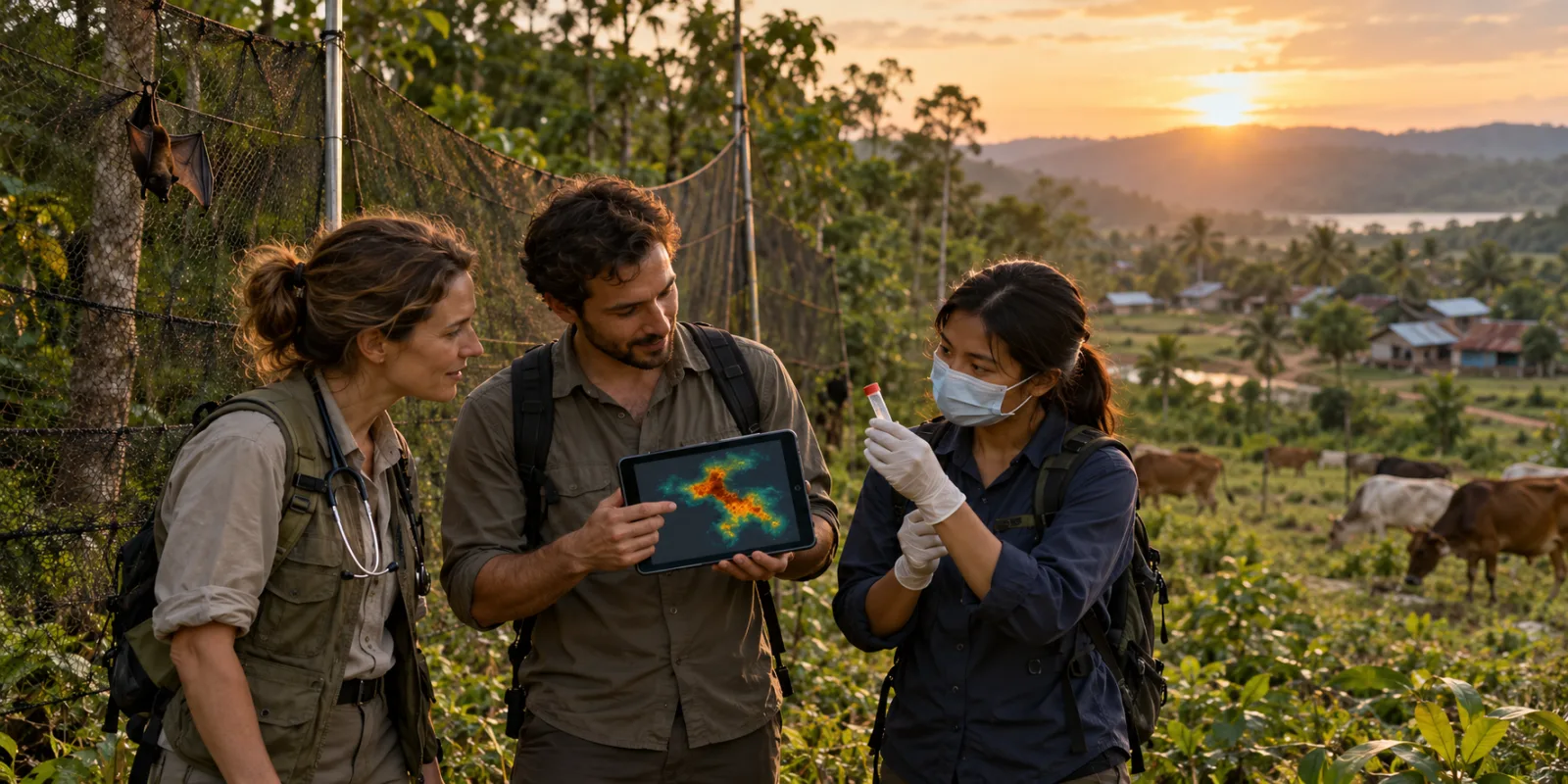
Most outbreak alerts arrive after the fact. A cluster of patients turns up in a clinic, a clinician gets suspicious, a sample goes to a laboratory, and by the time anyone names the pathogen it has usually been circulating for weeks. For a disease that jumps from animals to people, that delay is the whole problem. The interesting moment is the jump itself, and almost nobody sees it.
That is why global health agencies have started to put real money and credibility behind the idea that machine learning could move the alarm earlier. In April 2026 the World Health Organization (WHO), working with the PREZODE initiative, published a technical document on standardised indicators of human exposure to zoonotic pathogens, designed to estimate the risk of emergence and to show whether prevention strategies are working. WHO and PREZODE tested those indicators against documented avian influenza and MERS-CoV events and found they tracked them.
So can algorithms really predict zoonotic spillover? The answer is "partly, for some questions, with caveats that matter." This article walks through what the models read, what they have achieved, where critics say the evidence is weaker than the headlines, and what agencies are building on top of it.
Spillover, explained without the jargon#
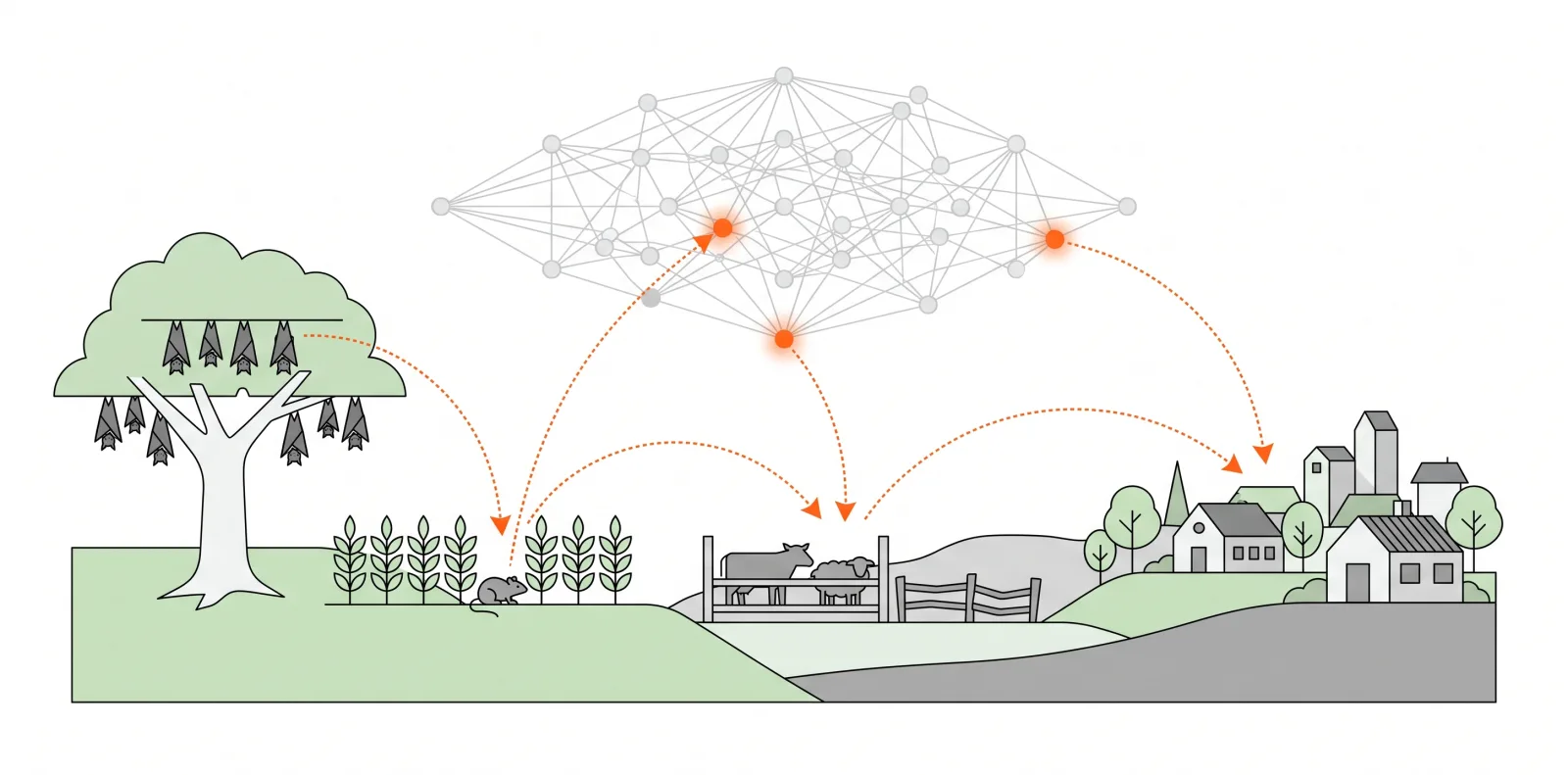
A zoonotic disease is an infection that passes from animals to people. Spillover is the moment of crossing: a virus that has been living quietly in, say, a bat or a pig finds its way into a human host. Most crossings go nowhere. The virus infects one person, or a handful, and fizzles out. A few acquire the ability to pass between people, and those are the ones that make news.
Prediction is hard for three reasons. First, there are simply too many candidates. A 2022 analysis estimated that at least 10,000 virus species can infect humans, yet the vast majority are circulating silently in wild mammals. Carlson et al., Nature Second, spillover is rare and sporadic, so there are few examples for a model to learn from. Third, the outcome depends on a chain of events (the virus, the animal, the landscape, the human contact) that is rarely measured all at once.
Machine learning is useful here because it can handle many weak signals together. Rather than asking an expert to guess which bat species or which farm region deserves attention, a model can be shown thousands of known virus-host relationships and asked to find patterns. Think of it as a very patient research assistant who has read every record in the database and notices that certain traits keep turning up together. The catch, as we will see, is that the assistant can only learn from what scientists have bothered to record.
Reading the genome: ranking viruses by risk#
The most direct approach asks whether a virus's genetic sequence hints that it could infect people.
An early landmark used traits rather than sequences. Olival and colleagues analysed mammalian host-virus relationships and showed that the proportion of zoonotic viruses per species is predictable from factors such as relatedness to humans, host taxonomy and human population within a species' range. Their work also flagged taxa and regions with the most "missing viruses" and so the highest value for future surveillance. Olival et al., Nature
Genome-based models went a step further. A group at the University of Glasgow trained machine learning models on 861 viral species with known zoonotic status and reported an area under the curve (a standard score where 0.5 is a coin toss and 1.0 is perfect) of 0.773, better than models that relied on a virus's family tree alone. Applied to 645 animal-associated viruses excluded from training, the model narrowed the list to 272 high-risk and 41 very-high-risk candidates. It also suggested that SARS-CoV-2 would have been flagged as a relatively high-risk coronavirus without prior knowledge of SARS-related viruses. Mollentze et al., PLoS Biology
More recent work borrows from large language models, the same family of technology behind chatbots, but trained on genetic letters instead of English. The BERT-infect model, built on nucleotide-pretrained language models and datasets across 26 viral families, improved performance on segmented RNA viruses and still worked on partial sequences such as short sequencing reads. Kawasaki et al., Communications Medicine That matters because field surveillance rarely produces a tidy complete genome.
A related line of work uses protein language models, which treat the amino-acid sequence of a protein like a sentence. A 2026 preprint used embeddings from the ESM-2 model to predict which animal families an influenza protein is adapted to, reporting weighted precision and recall of 0.95, and then fed those outputs into a six-class zoonotic-risk model with scores of about 0.90. Longest et al., bioRxiv (not peer reviewed). It is promising, but it should be read as an early result, not as a validated surveillance tool.
Reading the landscape: where is spillover most likely?#
Genomes tell you which viruses worry you. They do not tell you where people and animals actually meet. For that, researchers turn to maps, land-use data and climate projections.
One 2025 study combined stacked machine learning models with structural equation modelling to explain where spillover events have been reported over three decades. It found that intermediate levels of human pressure on the land facilitated spillover, that cropping intensity mediated part of the effect, and that livestock distribution acted as a useful indicator of hotspots. The authors also reported that high spillover risk extends beyond the tropics, including regions under intense human modification. Zhang et al., Environmental Health Perspectives That is a useful corrective to the lazy assumption that spillover is a problem for somewhere else.
Climate adds another layer. Carlson and colleagues combined a model of mammal-virus networks with projected range shifts for 3,139 mammal species under climate and land-use scenarios for 2070. They predicted that species will gather in new combinations, particularly at high elevations, in biodiversity hotspots and in densely populated parts of Asia and Africa, producing an estimated 4,000 cross-species virus transmissions. Bats, because they can fly, account for most of the novel sharing, and the authors found that keeping warming below 2 °C would not reduce the effect. They concluded that viral surveillance should be paired with biodiversity surveys that track where species are moving. Carlson et al., Nature
At a finer scale, researchers have used computer vision on aerial photographs to predict where the rodent reservoir of Lassa virus is likely to live in Sierra Leone and Guinea. Layman et al., Ecology Letters Another team separated the risk caused by a pathogen being present in the reservoir from the risk of it actually reaching people, which matters because the two call for different interventions. Basinski et al., PLoS Computational Biology
What each approach can and cannot tell you#
The methods answer different questions, and mixing them up is a common source of overconfidence. The table below sets them side by side.
| Approach | What it uses | What it tells you | Main limitation reported | Key source |
|---|---|---|---|---|
| Trait-based models | Host taxonomy, relatedness to humans, human population in range | Which animal groups and regions deserve surveillance | Depends on how well each species has been studied | Olival et al., 2017 |
| Genome-based models | Viral sequences | Which newly found viruses look capable of infecting humans (AUC 0.773 in one study) | Trained on known viruses, so it inherits their gaps | Mollentze et al., 2021 |
| Language-model classifiers | Nucleotide or protein sequences | Human infectivity, even from partial sequences | Struggles with some lineages, including SARS-CoV-2 | Kawasaki et al., 2025 |
| Landscape and climate models | Land use, livestock, species ranges, climate scenarios | Where spillover reports cluster, and where animals will meet in future | Based on reported events, which vary by country | Zhang et al., 2025; Carlson et al., 2022 |
| Protein-language-model classifiers (preprint) | Influenza protein sequences | Host tropism and zoonotic class of influenza strains | Not peer reviewed; not yet field-validated | Longest et al., 2026 (not peer reviewed) |
Reading across the rows, no single model predicts a spillover event in the way a weather model predicts rain. They rank, prioritise and narrow. That is still valuable when the alternative is sampling everything or sampling nothing.
The sceptics have a point#
The strongest criticism is not that the algorithms are bad. It is that the data feeding them are patchy.
Wille, Geoghegan and Holmes argued that the virological data used in zoonotic risk assessment are incomplete, biased and rapidly changing, so that such assessments may mostly identify the host groups that have been studied most intensively. They suggested that surveillance at the human-animal interface may be more productive. Wille et al., PLoS Biology
A related result from Mollentze and Streicker is even more awkward for the "watch the bats" instinct. Using a dataset of 415 viruses and their reservoir hosts, they found that the number of zoonoses per animal order rose with species richness, and that bats and rodents were unexceptional once group size was accounted for. They concluded that current approaches to finding and predicting novel zoonoses may need reconsidering. Mollentze and Streicker, PNAS This sits in tension with the earlier finding that bats harbour a higher proportion of zoonotic viruses, Olival et al., Nature and the field has not fully settled the disagreement.
Even good models have blind spots. The BERT-infect authors reported that models trained on data up to 2018 predicted most viruses identified afterwards, yet struggled to flag the human infection risk of specific lineages, including SARS-CoV-2. Kawasaki et al., Communications Medicine A model that misses the virus everyone is worried about is a useful reminder to treat scores as hypotheses.
Then there is the question of where the research effort goes. A 2026 scoping review covering 966 studies on 14 priority zoonotic diseases found that 72.8% focused on COVID-19, only 1.96% examined the animal-human interface, and no machine learning models explicitly targeted spillover prevention. All of the spillover studies came from high-income or upper-middle-income countries. Zhang et al., Transboundary and Emerging Diseases In other words, the places where spillover is most likely are often not the places where the models are built.
From papers to policy: what agencies are actually doing#
If the science is this uneven, why are agencies betting on it? Partly because the alternative, waiting for cases, has a known cost. Mostly because the bets they are placing are modest and practical.
PREZODE describes itself as an international initiative that uses a One Health approach (treating human, animal and environmental health as linked) to understand how zoonotic diseases emerge and to strengthen the ability to respond. It promotes affordable, sensitive pathogen monitoring in wild and domestic animals and alert systems so that responses can start at the source. PREZODE
The WHO and PREZODE indicators document published on 17 April 2026 is the clearest sign of where this is heading. It aims to develop and validate standardised indicators that model how pathogens circulate in animals and spread to humans, and to make them actionable so they show whether a prevention strategy is working. Simulations of strategies targeting specific transmission pathways suggested the indicators could guide prevention. WHO Notice the framing: the goal is measurement and monitoring, not a headline forecast.
Prediction also depends on the rules for sharing pathogens. In March 2026, WHO Member States agreed to extend negotiations on the Pathogen Access and Benefit Sharing (PABS) annex to the Pandemic Agreement, with a view to the annex being considered at the World Health Assembly in May. WHO The stated aim is rapid sharing of pathogens with pandemic potential alongside fair sharing of the benefits. WHO We did not find a source confirming the outcome of that May discussion, so we will not guess. What is clear is that models trained on sequences need sequences to arrive quickly and from everywhere, and the legal plumbing decides whether they do.
So what should a sensible reader take away?#
Treat spillover prediction as triage. A genome score can tell a laboratory which of a thousand new viruses to study first. A risk map can tell a ministry where to put a limited number of animal-sampling teams. An indicator framework can tell a funder whether a prevention programme is doing anything. None of these tells you that an outbreak will begin next Tuesday in a particular village.
The most useful near-term gains probably lie in fixing the inputs: more sampling at the human-animal interface, more studies led from the countries with the highest exposure, and shared data that arrive in days rather than months. The scoping review's finding that almost no work targets the interface is, in a way, a to-do list. Zhang et al., Transboundary and Emerging Diseases
Frequently asked questions#
Can AI predict the next pandemic?
Not in the sense of naming a date and a place. Current models rank viruses, hosts and landscapes by risk, which helps decide where to look. For example, a genome-based model reached an area under the curve of 0.773 for flagging human-infecting viruses. Mollentze et al., PLoS Biology
What is zoonotic spillover?
It is the moment a pathogen crosses from an animal host into people. Most crossings fizzle out, and only a few lead to sustained spread between humans. Researchers estimate that at least 10,000 virus species can infect humans, most of them circulating silently in wild mammals. Carlson et al., Nature
Are bats really the main source of new viruses?
The evidence is mixed. One analysis found bats harbour a higher proportion of zoonotic viruses than other mammal orders, Olival et al., Nature while another found that bats and rodents were unexceptional once the number of species in each group was considered. Mollentze and Streicker, PNAS
Why do critics say the predictions may be unreliable?
The training data are incomplete and biased towards well-studied animals, which means models may mostly rediscover where scientists have already looked. Wille et al., PLoS Biology
Does climate change increase spillover risk?
A modelling study projected that range shifts under climate and land-use change could produce about 4,000 new cross-species virus transmissions by 2070, mainly involving bats. Carlson et al., Nature These are projections, not observations.
What is WHO doing about it?
In April 2026 WHO and PREZODE published indicators of human exposure to zoonotic pathogens, intended to measure emergence risk and the effect of prevention strategies. WHO
Is most of the research focused on spillover?
No. A scoping review of 966 machine learning studies found that 72.8% focused on COVID-19 and only 1.96% examined the animal-human interface. Zhang et al., Transboundary and Emerging Diseases
References#
- WHO and PREZODE (2026). Indicators for human exposures to zoonotic pathogens. World Health Organization, 17 April 2026. https://www.who.int/publications/i/item/B09677
- PREZODE. About PREZODE: preventing zoonotic disease emergence. https://prezode-initiative.org/en/
- WHO (2026). WHO Member States agree to extend negotiations on key annex to the Pandemic Agreement, 28 March 2026. https://www.who.int/news/item/28-03-2026-who-member-states-agree-to-extend-negotiations-on-key-annex-to-the-pandemic-agreement
- Olival KJ, et al. (2017). Host and viral traits predict zoonotic spillover from mammals. Nature 546:646-650. https://doi.org/10.1038/nature22975
- Mollentze N, Streicker DG (2020). Viral zoonotic risk is homogenous among taxonomic orders of mammalian and avian reservoir hosts. PNAS 117(17):9423-9430. https://doi.org/10.1073/pnas.1919176117
- Mollentze N, Babayan SA, Streicker DG (2021). Identifying and prioritizing potential human-infecting viruses from their genome sequences. PLoS Biology 19(9):e3001390. https://doi.org/10.1371/journal.pbio.3001390
- Wille M, Geoghegan JL, Holmes EC (2021). How accurately can we assess zoonotic risk? PLoS Biology 19(4):e3001135. https://doi.org/10.1371/journal.pbio.3001135
- Carlson CJ, et al. (2022). Climate change increases cross-species viral transmission risk. Nature 607:555-562. https://doi.org/10.1038/s41586-022-04788-w
- Kawasaki J, Suzuki T, Hamada M (2025). Hidden challenges in evaluating spillover risk of zoonotic viruses using machine learning models. Communications Medicine 5:187. https://doi.org/10.1038/s43856-025-00903-w
- Zhang Y, et al. (2025). An integrated machine learning framework to understand zoonotic spillover emergence across anthropogenically modified landscapes. Environmental Health Perspectives. https://doi.org/10.1289/EHP15937
- Zhang Y, et al. (2026). A scoping review of machine learning applications across epidemiological stages of zoonotic disease. Transboundary and Emerging Diseases 2026:2215823. https://doi.org/10.1155/tbed/2215823
- Layman NC, et al. (2023). Predicting the fine-scale spatial distribution of zoonotic reservoirs using computer vision. Ecology Letters. https://consensus.app/papers/details/1294e77e67175052bed2b6cb8d3f7266/
- Basinski AJ, et al. (2021). Bridging the gap: using reservoir ecology and human serosurveys to estimate Lassa virus spillover in West Africa. PLoS Computational Biology. https://consensus.app/papers/details/4159f1e87bf959a8b2f1f984bc7b21d9/
- Longest A, et al. (2026). Predicting influenza virus host tropism and zoonotic spillover risk from protein sequences. bioRxiv. https://consensus.app/papers/details/0a96225aa192584baeefd90ef506300e/ (not peer reviewed).