A catalyst with no family tree#
Imagine handing a chemist a recipe for a molecular machine that no living thing has ever built. They synthesise it, drop it into a test tube with its target chemical, and watch the reaction speed up. That is no longer a thought experiment. In 2023, researchers showed that a language model trained on protein sequences could write artificial lysozymes, enzymes that cut bacterial cell walls, with sequence identity to natural proteins as low as 31.4% (Madani et al., 2023).
Enzymes are the working molecules of biology. They also run a good part of the chemical industry, from detergents to drug manufacture. So the idea that software could draft new ones from scratch matters to researchers, biotech founders and anyone who has watched a plastic bottle outlast their grandchildren.
But the evidence is more mixed than the headlines suggest. In one carefully controlled study, a protein language model produced 36 sequences for a first round of tests and not one of them worked (Johnson et al., 2025). In the same study, a sensible filter then lifted the success rate dramatically. That gap between promise and bench result is the real story of the field in 2026, and it is more interesting than either hype or scepticism.
This article walks through what protein language models are, what they have achieved with enzymes, where they stumble, and which rival approaches are catching up.
Background: how a language model learns the grammar of proteins#
A protein is a chain of amino acids, of which life uses twenty. Think of them as an alphabet. A typical enzyme is a few hundred letters long, and the order of those letters determines how the chain folds into a three-dimensional shape. The shape, in turn, creates a pocket called the active site, where the chemical reaction happens.
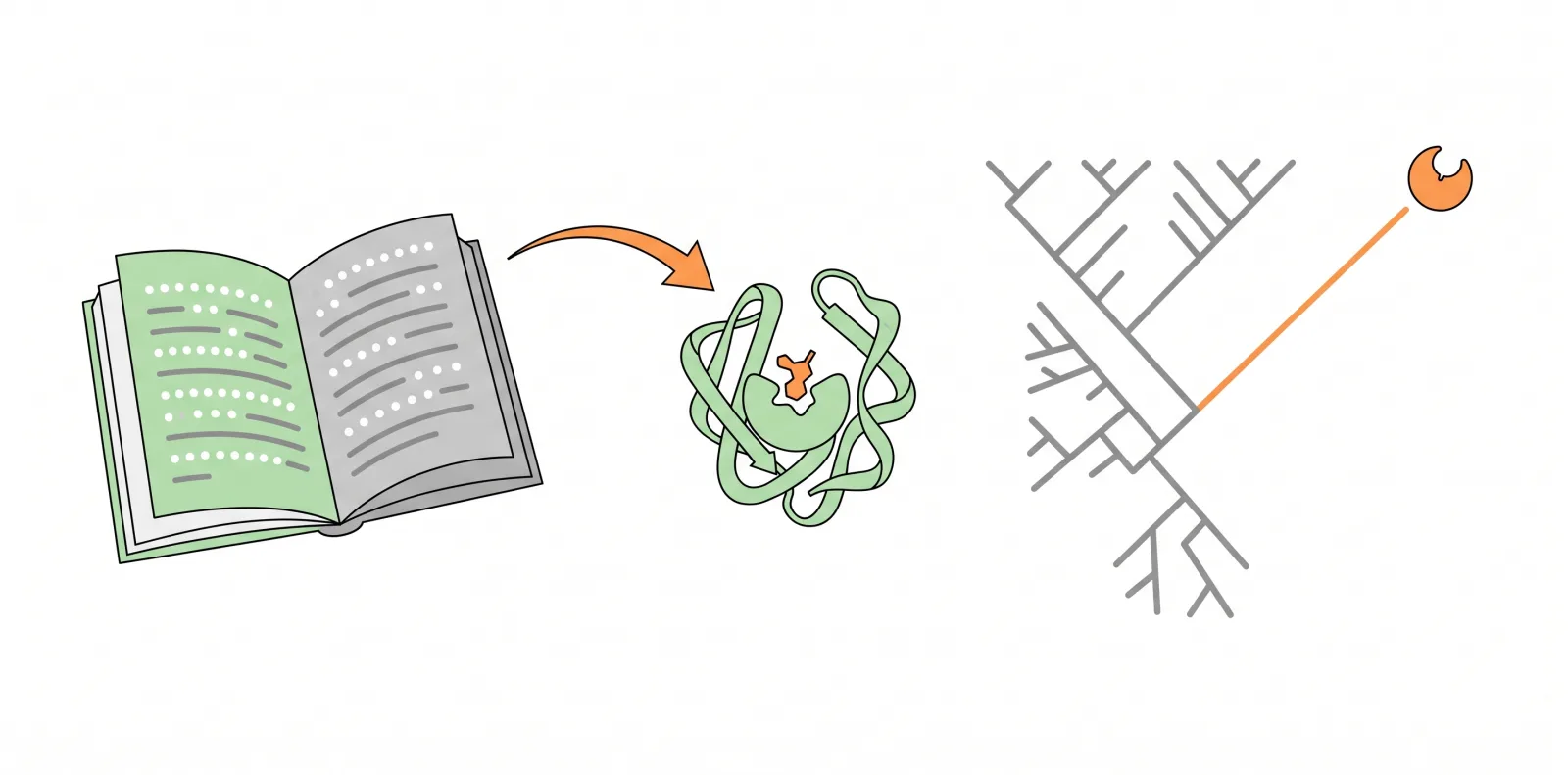
A protein language model borrows the trick behind chatbots. Instead of reading millions of web pages, it reads millions of protein sequences and learns to predict missing or next letters. To do that well, it has to pick up the rules that evolution has enforced, such as which amino acids tend to sit together and which positions can never change without breaking the protein. Nobody tells it about folding or chemistry. That knowledge emerges from the statistics.
The scale is striking. Meta's ESM-2 model, with up to 15 billion parameters (the adjustable numbers inside a model), learned enough about sequences that its internal representations contained an atomic-level picture of structure. The same work predicted structures for more than 617 million metagenomic proteins, which are proteins from environmental DNA of organisms nobody has cultured (Lin et al., 2023).
That is the "reading" half. The "writing" half is generation: asking the model to produce new sequences that look like they belong to a family, or that follow a prompt. Which brings us to the older method it hopes to improve on. Directed evolution, the established method, mutates a protein repeatedly and screens for improvements, but it faces experimental complexity, trouble optimising several properties at once, and a tendency to get stuck on local peaks (Jiang et al., 2025). Language models promise to skip some of those laborious rounds.
From reading proteins to writing them#
The first proof that generation could work came from ProGen, trained on 280 million sequences from more than 19,000 protein families, with control tags that let users specify properties such as the family they want. After fine-tuning on five lysozyme families, its artificial proteins showed catalytic efficiencies similar to natural lysozymes (Madani et al., 2023).
Then the models got broader. ESM3, a multimodal model that reasons over sequence, structure and function together, was prompted to generate fluorescent proteins. Among the sequences the team synthesised was a bright fluorescent protein with only 58% sequence identity to known ones, which the authors estimated is equivalent to 500 million years of evolution (Hayes et al., 2025).
A fair caveat: fluorescent proteins are not enzymes, and "equivalent to 500 million years" is the authors' own estimate, not a measurement. Still, the result shows these models can travel a long way from known sequences and keep a protein working. If that holds for chemical catalysts, the pool of designable enzymes is far larger than the pool nature happened to sample.
Why is "far from known" the key phrase? Because copying nature is easy. A model that merely recites variants of familiar enzymes saves little time compared with mining existing databases. The value lies in sequences that natural selection never reached, perhaps because they would have been useless to an ancient microbe, but would be excellent in an industrial reactor.
The filter problem: most generated sequences do not work#
Here is where the story needs a cold shower. A team led by Sean Johnson and Kevin Yang tested sequences from three generators for two enzyme families, malate dehydrogenase and copper superoxide dismutase. The generators were ancestral sequence reconstruction (a statistical method that infers extinct ancestors), a generative adversarial network, and a protein language model called ESM-MSA (Johnson et al., 2025).
In the first round, ancestral reconstruction produced 19 active enzymes out of 36. The generative adversarial network managed 2 out of 36. The language model produced none out of 36.
Rather than give up, the team scored the sequences with 20 computational metrics and built a filter called COMPSS, which combines sequence-quality checks, a language-model score and an inverse-folding score. With COMPSS-selected sequences, 74% were active (53 of 72), and the language model's own hit rate rose to 35 of 36 (Johnson et al., 2025).
The chart below plots those figures. It uses only the numbers reported in the paper, so it compares one study's two enzyme families rather than all of the field.
The lesson is not that language models fail. It is that raw generation is only half a pipeline. Picking the right candidates before spending lab time is worth almost as much as the generator itself, a point worth remembering whenever a press release quotes a single impressive design.
Few-shot learning: a language model as directed-evolution assistant#
Designing from nothing is the glamorous goal. A more immediate use is helping scientists improve an enzyme they already have. EVOLVEpro does this with few-shot active learning, a method that learns from a handful of experimental results and proposes which mutations to try next, instead of relying on the model's guesses alone (Jiang et al., 2025).
In the paper, the approach improved desired properties by up to 100-fold across six proteins used in RNA production, genome editing and antibody binding (Jiang et al., 2025). The authors also argue that this small-data loop beats zero-shot predictions, where a model proposes changes with no feedback from the lab (Jiang et al., 2025).
We find this the most sober and most useful part of the field. It treats the language model as a well-read assistant that still needs to be corrected by experiments, which is precisely how good scientists treat any model. It also fits the evidence from the previous section: models are strongest when a real measurement keeps them honest.
Finding enzymes rather than inventing them#
Between redesigning a protein and inventing one lies a third task: searching the enormous space of natural sequences for useful candidates. A team in China combined a protein language model with a representation tree to hunt for PET hydrolases, enzymes that break down the plastic in drinks bottles. They started from the structure of a known enzyme, IsPETase, and screened candidates for predicted stability and solubility (Wu et al., 2025).
Of 34 candidates tested, 14 showed PET-degrading activity across 30 to 60 degrees Celsius. The lead enzyme, KbPETase, had a melting temperature about 32 degrees higher than IsPETase and, at its optimal temperature, around 5.7 times the activity of the benchmark enzyme LCC under matched conditions. The authors note that the headline 97-fold gain over IsPETase compares each enzyme at its own best temperature, so the like-for-like figure is the more modest one (Wu et al., 2025).
A 41% hit rate (14 of 34) from sequences that nature already invented is encouraging, though these enzymes are discovered, not designed. They show the practical payoff of the same machinery, and they are a reminder that "AI-designed plastic eaters" in news stories often hide this distinction.
Beyond language: where structure-based design is catching up#
Protein language models are not the only route to new enzymes, and the competition is fierce. In a December 2025 paper in Nature, Markus Braun and colleagues described Riff-Diff, a hybrid of machine learning and atomistic modelling that scaffolds a chosen arrangement of catalytic amino acids into a brand-new protein (Braun et al., 2026). Note that Riff-Diff is not a language model, though it sits in the same wider family of AI design tools.
The numbers are impressive. Of 35 retro-aldolase designs, 32 (91%) were active, and the best, RAD29, reached a catalytic efficiency of 290 per molar per second, close to the 320 of a laboratory-evolved benchmark. One design delivered 99% enantiomeric excess, a measure of how cleanly an enzyme produces one mirror-image form of a molecule. Six crystal structures confirmed the active sites matched the designs closely (Braun et al., 2026).
Yet the same paper also shows the limits. For the Morita-Baylis-Hillman reaction, a non-biological chemistry, the best design was about 45 times slower than the best laboratory-evolved enzyme. A 2026 review from the Weizmann Institute agrees that recent approaches have produced catalysts approaching natural efficiencies, while high catalytic rates and complex, multistep mechanisms remain challenging (Listov and Fleishman, 2026).
The table below pulls the key studies together.
| Study | Approach | What was tested | Headline result | Peer reviewed? |
|---|---|---|---|---|
| Madani et al., 2023 | ProGen language model | Artificial lysozymes | Activity similar to natural enzymes; identity as low as 31.4% | Yes |
| Johnson et al., 2025 | ESM-MSA plus COMPSS filter | Two enzyme families | 74% of filtered sequences active; unfiltered language model 0 of 36 | Yes |
| Jiang et al., 2025 | EVOLVEpro active learning | Six proteins | Up to 100-fold improvement | Yes |
| Wu et al., 2025 | Language model plus structure search | PET hydrolases | 14 of 34 candidates active | Yes |
| Braun et al., 2026 | Riff-Diff (not a language model) | Retro-aldolases, MBH enzymes | 91% of retro-aldolase designs active | Yes |
| We et al., 2026 | AlphaProtein Novo (diffusion model, not a language model) | Five reactions, over 5,600 designs | Hit rates up to 80% in best cases; activity still far below evolved enzymes | No (preprint) |
Language models are also changing how scientists interact with design tools. A September 2026 commentary in Nature Computational Science describes MutexaGPT, a system of collaborating language-model agents that translates plain-language enzyme-engineering goals into physics-based design workflows (Sztain, 2026). The full text of that commentary and its companion paper were not accessible for this article, so treat it as a signpost rather than evidence of performance. A February 2026 review by Middendorf and Ferruz argues that generative models are mature enough for industrial enzyme work, but it is a preprint and has not been peer reviewed (Middendorf and Ferruz, 2026).
AlphaProtein Novo: DeepMind's attempt at new-to-nature chemistry#
The newest entrant arrived last week. In early October 2026, Google DeepMind, working with Caltech and the University of Pittsburgh, posted a bioRxiv preprint titled "Designing enzymes for new-to-nature chemistry and non-natural substrates with AlphaProtein Novo" (Wu et al., 2026). This is a preprint and has not been peer reviewed.
AlphaProtein Novo, or AP Novo, is not a protein language model. It is a diffusion model, the same family of technique behind many image generators, that builds a protein backbone and its amino acid sequence together around a fixed catalytic motif, meaning the arrangement of side chains and the target molecule needed for a reaction. Candidates are then filtered using metrics derived from AlphaFold 3 structure predictions (MPost, 2026). The filtering echoes the lesson of the COMPSS study: generate widely, then judge hard.
The reported headline is scale. More than 5,600 designs were tested across five reactions, with hit rates up to 80% in the best cases. Two examples stand out:
- For piperidine synthesis, a ring structure common in medicines, the lead design (GDM_NT_270) reached 99:1 selectivity for piperidine over a related ring, 94% enantiomeric excess and 22 turnovers, while none of 188 natural and engineered variants exceeded 30:70.
- For degrading DEHP, a plastic softener and pollutant, seven new structural families were active, with a hit rate of 11% for novel scaffolds. One 191-residue enzyme was 14-fold more active at 90 degrees Celsius than at room temperature and tolerated 75% acetonitrile, a harsh solvent.
The authors also report that scoring each backbone with an ensemble of sequences, rather than a single one, raised serine esterase hit rates by up to 30-fold If that holds up, it is the same message as before in a new form: the selection step matters as much as the generator.
Why it matters#
Three implications seem fair, though each rests on a preprint. First, it widens the target. Much earlier work improved enzymes that nature already made. Here the goal is chemistry with no natural enzyme, such as the nitrene transfer reactions behind piperidine, which is where de novo design is hardest and potentially most valuable. The Weizmann review made the same point about what the field still lacks (Listov and Fleishman, 2026).
Second, it lowers the entry cost. The code is released under an Apache-2.0 licence, although the pretrained weights are separate downloads under their own terms of use, and the repository does not say whether commercial use is allowed, so start-ups should read those terms before building on it. A summary of the paper says code and weights are released for non-commercial use. The repository also notes that its example settings are reduced from those in the paper and may not reproduce the published results (GitHub, 2026).
Third, it shows what "good" now looks like. Hit rates of tens of per cent were out of reach for de novo enzymes a few years ago, and the Riff-Diff paper reports similar success rates by a different route (Braun et al., 2026).
What to be careful about#
The caveats are large. According to the summary, catalytic activities remain orders of magnitude below natural or directed-evolution-optimised enzymes, the DEHP designs are less active than natural enzymes in water, building the starting motif needs reaction-specific expertise, and the models do not yet meaningfully capture the physics of catalysis. Hit rate is also not the same as usefulness: an enzyme that is merely active may still be too slow for industry. The repository itself describes its outputs as predictions of varying confidence (GitHub, 2026).
One more point of transparency. A mirror of the preprint abstract states that some authors have commercial interests in the work and that author-affiliated entities have filed a US provisional patent application (Lifeboat Foundation, 2026). That does not undermine the data, but it is a reason to wait for independent replication and peer review.
What to watch next#
Three questions will decide how fast this field moves. First, can models design for reactions with no natural precedent, where there is no family of sequences to learn from? AlphaProtein Novo makes a first claim, but it awaits peer review. Second, can filters like COMPSS become standard so that laboratories test fewer, better candidates? Third, will the results hold up as other groups replicate them on harder targets?
The design of useful enzymes is plainly feasible, and the best results pair a generator with a strict filter and a real experiment. The dream of typing a reaction and receiving a finished, fast enzyme remains just that, for now.
Frequently asked questions#
Q: What is a protein language model?
A: It is a machine-learning model trained on millions of protein sequences to predict missing or next amino acids. Through that task it picks up the rules of protein structure and function, and can then score or generate sequences (Lin et al., 2023).
Q: Can these models really design enzymes that do not exist in nature?
A: Yes, within limits. ProGen produced artificial lysozymes with sequence identity to natural proteins as low as 31.4% that retained catalytic efficiency similar to natural lysozymes (Madani et al., 2023). Designing for entirely new chemistry is harder and remains an open challenge (Listov and Fleishman, 2026).
Q: Why did one language model produce no working enzymes in an early test?
A: In round one of a controlled comparison, none of 36 ESM-MSA sequences were active. Filtering sequences with computational scores later raised the language model's success to 35 of 36 (Johnson et al., 2025).
Q: How is this different from directed evolution?
A: Directed evolution mutates a protein and screens large numbers of variants in the lab. Methods such as EVOLVEpro use a language model plus a small amount of experimental data to choose which variants to test, with improvements of up to 100-fold reported across six proteins (Jiang et al., 2025).
Q: Can AI-designed enzymes break down plastic?
A: Language-model-guided searches have found natural PET hydrolases with strong activity and heat tolerance, such as KbPETase, with 14 of 34 tested candidates active (Wu et al., 2025). Those enzymes were discovered, not invented from scratch, and large-scale recycling needs further testing.
Q: Are protein language models the only AI route to new enzymes?
A: No. Riff-Diff, which is not a language model, produced active retro-aldolases in 91% of tested designs (Braun et al., 2026). Many groups combine several methods.
Q: What is AlphaProtein Novo?
A: It is a Google DeepMind system, described in a bioRxiv preprint, that uses a diffusion model to design enzymes around a chosen catalytic motif, then filters them with AlphaFold 3-based metrics (DeepMind et al., 2026; MPost, 2026). It has not been peer reviewed.
Q: Should I trust claims that AI has solved enzyme design?
A: Treat them with caution. A 2026 review in a structural biology journal says that high catalytic rates and complex, multistep mechanisms remain challenging (Listov and Fleishman, 2026). Look for laboratory validation, hit rates and comparisons with evolved enzymes.
References#
- Madani, A. et al. (2023). Large language models generate functional protein sequences across diverse families. Nature Biotechnology 41, 1099-1106. https://doi.org/10.1038/s41587-022-01618-2
- Lin, Z. et al. (2023). Evolutionary-scale prediction of atomic-level protein structure with a language model. Science 379, 1123-1130. https://doi.org/10.1126/science.ade2574
- Hayes, T. et al. (2025). Simulating 500 million years of evolution with a language model. Science 387, 850-858. https://doi.org/10.1126/science.ads0018
- Johnson, S. R. et al. (2025). Computational scoring and experimental evaluation of enzymes generated by neural networks. Nature Biotechnology 43, 396-405. https://pmc.ncbi.nlm.nih.gov/articles/PMC11919684
- Jiang, K. et al. (2025). Rapid in silico directed evolution by a protein language model with EVOLVEpro. Science 387, eadr6006. https://doi.org/10.1126/science.adr6006
- Wu, B. et al. (2025). Harnessing protein language model for structure-based discovery of highly efficient and robust PET hydrolases. Nature Communications 16, 6211. https://doi.org/10.1038/s41467-025-61599-z
- Braun, M. et al. (2026). Computational enzyme design by catalytic motif scaffolding. Nature 649, 237-245. https://www.nature.com/articles/s41586-025-09747-9
- Listov, D. and Fleishman, S. J. (2026). De novo enzyme design: controlling structure to design function. Current Opinion in Structural Biology 98, 103252. https://doi.org/10.1016/j.sbi.2026.103252
- Sztain, T. (2026). Intuitive enzyme design with LLM agents (News & Views). Nature Computational Science. https://www.nature.com/articles/s43588-026-01052-3
- Middendorf, L. and Ferruz, N. (2026). Generative AI for enzyme design and biocatalysis. arXiv:2602.03779. (not peer reviewed). https://arxiv.org/abs/2602.03779v1
- Google DeepMind and collaborators (2026). Designing enzymes for new-to-nature chemistry and non-natural substrates with AlphaProtein Novo. bioRxiv. (not peer reviewed). https://www.biorxiv.org/content/10.64898/2026.10.01.756017v1
- Google DeepMind (2026). AlphaProtein Novo code repository. GitHub. https://github.com/google-deepmind/alphaprotein-novo
- MPost (2026). AlphaProtein Novo: Google DeepMind's pipeline designs enzymes for reactions nature never evolved. https://mpost.io/alphaprotein-novo-google-deepminds-pipeline-designs-enzymes-for-reactions-nature-never-evolved/
- Lifeboat Foundation (2026). Designing enzymes for new-to-nature chemistry and non-natural substrates with AlphaProtein Novo. https://lifeboat.com/blog/2026/10/designing-enzymes-for-new-to-nature-chemistry-and-non-natural-substrates-with-alphaprotein-novo