A Number That Sounds Like a Verdict#
You post off a few drops of blood, or a vial of saliva, and a fortnight later an app tells you that you are 41 although your passport says 47. It feels like good news. It also feels like a result.
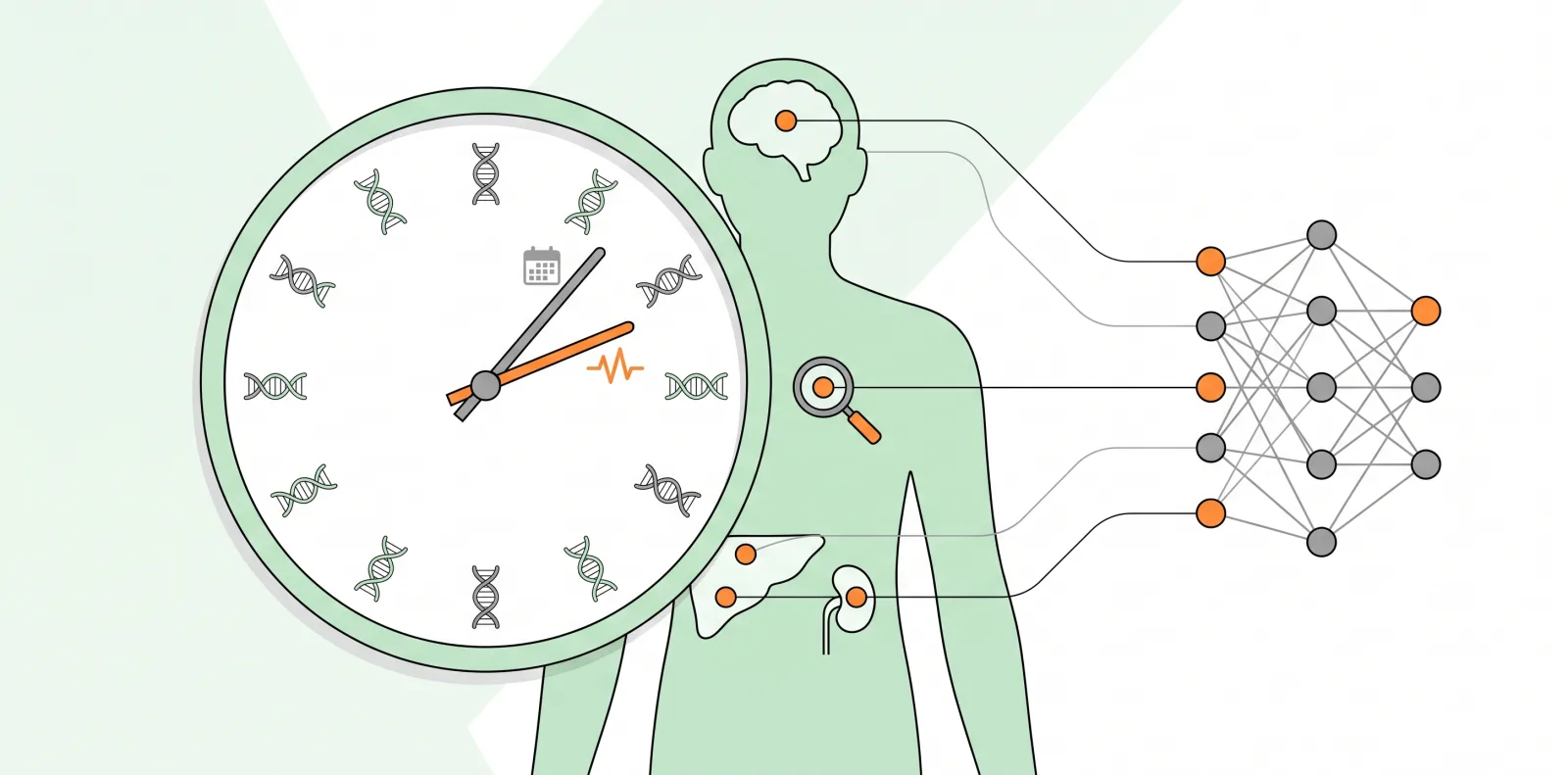
That feeling is the whole business model of the modern biological age test. Longevity clinics and direct-to-consumer companies now promote these tests, often with the promise that targeted interventions can slow ageing, a framing that a recent review in an insurance-medicine journal examined for scientific validity (Meagher, 2026). Meanwhile, researchers are adding artificial intelligence, so that the clocks read not just your blood but, in principle, your organs one by one.
So how much can an AI-assisted ageing clock actually tell you? The honest answer is "more than a horoscope, less than a diagnosis", and the details matter. This article walks through how the tests work, what the best studies show, where the weak points are, and how a sensible reader might use one.
Background: What "Biological Age" Actually Means#
Your chronological age is the number of birthdays you have had. Your biological age is an attempt to estimate how worn your body is, regardless of the calendar. Two people aged 60 can differ a great deal in fitness, disease risk and remaining years, and biological age tries to capture that difference with a single figure.
Researchers call the tools that do this ageing biomarkers. A widely cited framework in Cell, written by a large group of ageing researchers, argues that the field still lacks agreed standards for what makes an ageing biomarker reliable, which hinders clinical use (Moqri et al., 2023). That is a striking admission from the people building the tools, and it is worth keeping in mind as the products multiply.
Most commercial tests rest on DNA methylation. Methylation is a chemical tag, a small cluster of atoms called a methyl group, that attaches to certain positions in your DNA. These tags do not change the genetic code itself. They change how readily genes are switched on, and their pattern shifts with age in a surprisingly regular way. An epigenetic clock is a statistical model that reads the methylation levels at a few hundred to a few thousand positions and converts them into an age estimate.
Think of it as judging a book's age by its yellowing pages. You are not reading the story, only the wear.
The Four Generations of Epigenetic Clock#
Not all clocks measure the same thing, and the label "biological age" hides this. The main families differ in what they were trained to predict.
First-generation clocks, such as those by Horvath and Hannum, were trained to predict chronological age and do so very accurately. Later models, including PhenoAge, GrimAge and DunedinPACE, were trained with health-related variables and functional measures, which widened their relevance to disease risk and the pace of ageing (Ibáñez-Cabellos et al., 2026).
GrimAge combines methylation-based estimates of seven plasma proteins with an estimate of smoking exposure, and it predicted time to death, heart disease and cancer more strongly than earlier clocks in large validation data (Lu et al., 2019). DunedinPACE took a different route. It was trained on how fast 19 indicators of organ health declined in the same people over two decades, so it reports a pace (roughly, how many biological years you add per calendar year) rather than a lifetime total (Belsky et al., 2022).
Clocks trained on health outcomes also tend to do better against real-world measures. In 1,446 Canadian adults, clocks trained on phenotype or mortality, with GrimAge strongest, tracked frailty better than clocks trained on chronological age alone (Verschoor et al., 2021).
| Clock family | Trained to predict | What the number means | Example | Main caution |
|---|---|---|---|---|
| First generation | Chronological age | How "old" your methylation pattern looks | Horvath, Hannum | Accurate for age, weaker for health risk (Ibáñez-Cabellos et al., 2026) |
| Second generation | Health or mortality risk | Estimated risk-adjusted age | PhenoAge, GrimAge | Depends on the training cohort (Lu et al., 2019) |
| Pace-of-ageing | Rate of organ decline over two decades | Biological years gained per calendar year | DunedinPACE | Strong test-retest reliability, but a rate is not a diagnosis (Belsky et al., 2022) |
| Organ and AI-based | Organ-specific protein or image signals | An age for each organ | Plasma proteomic organ clocks | Newer, with fewer independent replications (Oh et al., 2023) |
Where AI Comes In#
Strictly speaking, every epigenetic clock is already machine learning. Most use a method called penalised regression, which automatically picks the most informative methylation sites from hundreds of thousands. DunedinPACE, for example, was built with elastic-net regression (Belsky et al., 2022).
What is new is deep learning, the family of methods behind image recognition and chatbots, which can in principle capture more complicated patterns. The catch is that these models are often black boxes: they give an age but cannot say why. A 2026 review identified six "explainable AI" clocks (XAI-AGE, DL-XAI, EpInflammAge, PathwayAge, EXP.REACTOME and EXP.TFT) that convert raw methylation sites into higher-level concepts such as biological pathways. The review concluded that explainability is compatible with accurate age prediction, but that the pathway-level models are harder to interpret and less actionable than one that uses proxies for well-understood inflammation markers (Johnson and Shokhirev, 2026). Note that both authors work at a company that sells an epigenetic age test, which is worth knowing when weighing their conclusions.
Not every clock needs methylation. Researchers in Singapore applied principal component analysis, a technique that boils many correlated measurements down to a few underlying signals, to ordinary clinical data. Their "LinAge" clock kept its predictive power with far fewer inputs, and in a caloric-restriction trial it suggested that two years of mild restriction reduced biological age (Fong et al., 2024). That points to a future in which a routine blood panel does much of the work.
Reading Organs, Not Just Bodies#
The most exciting recent work moves from one age per person to one age per organ. The logic is sensible: your liver and your brain need not age at the same speed.
A Stanford-led team used machine learning on blood plasma proteins that originate in specific organs to estimate the age of 11 major organs in five independent cohorts covering 5,676 adults. Nearly 20% of people showed strongly accelerated ageing in one organ, and 1.7% were "multi-organ agers". Accelerated organ ageing was linked to 20 to 50% higher mortality risk, and people with an accelerated heart had a 250% higher risk of heart failure (Oh et al., 2023).
A later UK study applied the same approach to 6,235 middle-aged participants of the Whitehall II cohort and followed them for about 20 years. Larger organ age gaps predicted 30 diseases, and, after adjustment, several organ gaps predicted people developing diseases in two or more organ systems (Kivimäki et al., 2025). The chart shows the hazard ratios, where a value of 2.0 means roughly double the risk per standard deviation of age gap.
Imaging offers another route. A 2026 Nature Medicine study from Vienna trained AI vision models on tissue slides from 983 people and 40 tissue types in the GTEx project, producing organ-specific "tissue clocks" with a mean prediction error of 4.9 years. The team also linked blood gene-activity patterns to tissue age gaps, flagging signals tied to conditions such as Alzheimer's disease and diabetes (Abila et al., 2026). These details come from the authors' reported results; as with the other organ-level work, independent replication will be needed.
Why One Number Can Mislead#
Here is the uncomfortable part. Population studies show that clocks predict outcomes across thousands of people. Reading a single person's result is a different problem, like knowing that tall people tend to weigh more but being unable to guess your own weight from your height.
Reliability is the first issue. Measurement noise can move a score by a surprising amount, and high-noise clocks are the least trustworthy. DunedinPACE was deliberately built from methylation sites with good test-retest reliability, and it showed high reliability in testing (Belsky et al., 2022). Not every commercial product has been held to that standard.
Intervention studies show a second trap. A bioRxiv preprint (not peer reviewed) examined six datasets in which people received an intervention. In five of them only a single clock showed a significant change, and in each case it was a first-generation clock that its more robust counterpart did not corroborate. Four of those five lost significance after correcting for multiple testing. The authors argue that one clock moving is probably a false positive, whereas several clocks moving together is more convincing (preprint, 2024). The same preprint cites a report that epigenetic age can vary by up to two years within a single day. As a preprint, this is a signal to watch rather than established fact.
Third, the field has no agreed gold standard. The Cell framework stresses that validation steps and standards are still being worked out (Moqri et al., 2023). A review of clocks entering direct-to-consumer testing makes a related point: many multi-site clocks depend on costly high-throughput technology, and the authors call for simpler assays validated in diverse populations (Ibáñez-Cabellos et al., 2026). Finally, a result of "6 years younger" cannot tell you what to do next, because few studies show that moving the number moves your health.
So Should You Buy One? A Practical Reading Guide#
If you are curious, a test is unlikely to harm you, and it can be a prompt to look after sleep, exercise and blood pressure. The risk lies in over-reading it. A few habits keep you on solid ground.
Ask which clock is used. A test built on chronological-age training answers a different question from one built on mortality or pace of ageing. Ask whether the company publishes its reliability data, and whether repeat samples are consistent. Treat a single result as a snapshot with a wide margin of error and look for trends across repeated tests instead.
Discount any promise of reversing ageing, and be wary when a test comes bundled with supplements. If you want something clinically actionable, ordinary measures such as blood pressure, cholesterol, kidney function and blood sugar still carry the best evidence, and the clinical-data clocks above are largely built from them (Fong et al., 2024).
For researchers and founders, the opportunity is plain. The next useful products will probably report organ-specific results, publish reliability, and show that changes track real outcomes. Until then, the sensible reading of any biological age is as a conversation starter with your doctor, not a verdict.
Frequently Asked Questions#
What is a biological age test? A biological age test estimates how old your body appears biologically rather than chronologically, usually by reading DNA methylation patterns in blood or saliva and feeding them to a statistical model called an epigenetic clock. Different clocks are trained to predict different things, so results are not interchangeable (Ibáñez-Cabellos et al., 2026).
Are biological age tests accurate? Accuracy depends on the clock and the use. Clocks trained on health outcomes, such as GrimAge, predicted mortality strongly across large cohorts (Lu et al., 2019), but a single person's result carries measurement noise and no universally agreed standard exists (Moqri et al., 2023).
What is DunedinPACE and how is it different? DunedinPACE estimates your pace of ageing, meaning how quickly your body is declining relative to the calendar, using changes in 19 organ-health indicators tracked in the same people over two decades. It showed high test-retest reliability and was associated with morbidity, disability and mortality (Belsky et al., 2022).
Can AI really tell how fast I am ageing? AI can find patterns that predict ageing outcomes across groups, including organ-specific signals in blood proteins (Oh et al., 2023) and in tissue images (Abila et al., 2026). Turning those group-level findings into a reliable personal verdict is still an open research question.
Can I take a free biological age test online? Free online quizzes usually ask about lifestyle and routine health measures rather than measuring your biology, so they are closer to a risk questionnaire than a clock. Clinical-data clocks do exist in research, built from standard blood measures (Fong et al., 2024), but a quiz is not equivalent to those validated models.
Does a lower biological age mean I will live longer? Not necessarily. Clocks predict risk at population level, and showing that deliberately lowering your score extends life has not been established. Evidence from intervention datasets also warns that single-clock changes may be false positives (preprint, 2024, not peer reviewed).
How often should I repeat a biological age test? There is no consensus schedule. Because day-to-day variation and noise can be substantial (preprint, 2024, not peer reviewed), comparing several tests over time, ideally with more than one clock, is more informative than reacting to a single change.
References#
- Abila E, Buljan I, Zheng Y, et al. Histological aging signatures for monitoring tissue-specific aging and disease. Nature Medicine (2026). https://doi.org/10.1038/s41591-026-04566-5
- Belsky DW, Caspi A, Corcoran DL, et al. DunedinPACE, a DNA methylation biomarker of the pace of aging. eLife 11 (2022). https://doi.org/10.7554/eLife.73420
- Fong S, Pabis K, Latumalea D, et al. Principal component-based clinical aging clocks identify signatures of healthy aging and targets for clinical intervention. Nature Aging 4(8):1137-1152 (2024). https://doi.org/10.1038/s43587-024-00646-8
- Ibáñez-Cabellos JS, García-Giménez JL, Escobar J, Pallardó FV, Mena-Mollá S. From the lab to lifestyle: epigenetic clocks in personalized aging and health. Biogerontology 27(3) (2026). https://doi.org/10.1007/s10522-026-10447-8
- Johnson AA, Shokhirev MN. Explainable epigenetic aging clocks: an overview of existing AI models and approaches. Expert Review of Molecular Diagnostics 26(8):695-707 (2026). https://doi.org/10.1080/14737159.2026.2693031
- Kivimäki M, Frank P, Pentti J, et al. Proteomic organ-specific ageing signatures and 20-year risk of age-related diseases: the Whitehall II observational cohort study. The Lancet Digital Health 7(3):e195-e204 (2025). https://doi.org/10.1016/j.landig.2025.01.006
- Lu AT, Quach A, Wilson JG, et al. DNA methylation GrimAge strongly predicts lifespan and healthspan. Aging 11(2):303-327 (2019). https://doi.org/10.18632/aging.101684
- Meagher T. Biological Clocks: Ready for Prime Time? Journal of Insurance Medicine 53(2):221-225 (2026). https://doi.org/10.17849/insm-53-2-1-5.1B
- Moqri M, Herzog C, Poganik JR, et al. Biomarkers of aging for the identification and evaluation of longevity interventions. Cell 186(18):3758-3775 (2023). https://doi.org/10.1016/j.cell.2023.08.003
- Oh HS, Rutledge J, Nachun D, et al. Organ aging signatures in the plasma proteome track health and disease. Nature 624:164-172 (2023). https://doi.org/10.1038/s41586-023-06802-1
- Verschoor CP, Lin DTS, Kobor MS, et al. Epigenetic age is associated with baseline and 3-year change in frailty in the Canadian Longitudinal Study on Aging. Clinical Epigenetics 13:163 (2021). https://doi.org/10.1186/s13148-021-01150-1
- Preprint on false positives in epigenetic clock intervention studies, bioRxiv (2024). (not peer reviewed). https://doi.org/10.1101/2024.10.22.619720