
The Idea Is Free. The Hardware Is Not.#
Picture a graduate student with a good idea for a protein model. The maths is sound, the dataset exists, and the supervisor is keen. Then comes the question nobody put in the grant: where will it run?
For a growing share of scientific AI, that question decides everything. Training a modern biology model is less like writing a paper and more like booking a very large, very expensive piece of kit, for months, in competition with companies that spend hundreds of billions of dollars on it. A May 2026 report from the Center for a New American Security (CNAS) says chip manufacturing is "becoming a binding constraint" on the pace of the AI compute build-out, and that demand is outrunning supply (CNAS, 2026).
This article looks at what that means for researchers. It covers why the bottleneck exists, who it hits hardest, what the evidence says about how bad it is for science in particular, and which remedies look genuinely useful rather than merely hopeful. The short version is that the picture is mixed. Some fixes are real. Some of the gloom is overstated. But the days when a clever idea and a laptop were enough to reach the frontier are not coming back.
Background: What "Compute" Actually Means#
Before the argument, a few terms.
Compute is the amount of arithmetic a computer performs. Researchers usually count it in FLOP, short for floating-point operations, which are single sums or multiplications on decimal numbers. A model's training compute is the total number of those operations needed to teach it. The numbers get silly quickly, so they are written in powers of ten: 1e24 means a 1 followed by 24 zeros.
A GPU (graphics processing unit) is a chip originally designed to draw video-game graphics. It turns out to be excellent at doing huge numbers of simple calculations at once, which is exactly what neural networks need. Modern AI training uses thousands of them wired together.
HBM (high-bandwidth memory) is a special stacked memory that sits right next to the processor and feeds it data quickly. A fast chip with slow memory is like a brilliant chef with a tiny pantry door. CNAS notes that HBM needs three to four times as many memory wafers per gigabyte as ordinary DRAM, so building more of it squeezes the supply of everything else (CNAS, 2026).
A scaling trend is the observation that bigger models, trained on more data with more compute, tend to perform better. It is the reason labs keep asking for more chips. It is not a law of nature, and it does not apply equally to every scientific problem, a point we return to below.
1. The Appetite: Compute Demand Grows Faster Than Almost Anything#
The independent research group Epoch AI has tracked the training compute of notable models since 2010. It estimates that frontier training compute has grown by about 4 to 5 times per year, which works out as a doubling roughly every five to six months. For the top ten models by compute, the central estimate is 5.3 times a year to May 2024 (Epoch AI, 2024).
To make that concrete, Epoch estimates GPT-3 (2020) at about 3e23 FLOP, GPT-4 (2023) at about 2e25 FLOP, and Google's Gemini Ultra (December 2023) at about 5e25 FLOP (Epoch AI, 2024). These are estimates, not company disclosures. The chart below puts a well-documented science model on the same scale.
The orange bar is ESM3, a protein language model (an AI trained on protein sequences the way chatbots are trained on text). According to its authors' preprint, the largest version has 98 billion parameters, saw 771 billion tokens, and used 1.07e24 FLOP (Hayes et al., Science, 2025. That is more than three times GPT-3's estimated budget, yet well under a tenth of the biggest chatbots. Science models are still smaller, but they are climbing the same curve.
2. The Supply Side: Why Chips Cannot Simply Be Made Faster#
If demand doubles twice a year, why not build more chips? Because chips are made through a chain with very few links, and each link is slow to widen.
According to CNAS, TSMC makes roughly 90 per cent of the world's most advanced chips. The company's chief executive said in November 2025 that demand ran about three times ahead of its advanced-node capacity, and new fabrication plants take two to four years or more to build. Memory is concentrated too: Samsung, SK Hynix and Micron now dominate, down from more than 20 significant producers in the 1990s.
The knock-on effects are visible in prices. The same report says DRAM prices rose by more than 600 per cent in 2025, and that H100 rental prices are now higher than they were a few years ago, reversing the usual pattern of computing getting cheaper over time. It also reports that Meta said it would keep some older servers running for longer because new ones cannot be bought quickly enough (CNAS, 2026).
One caveat is worth stating. CNAS is a policy think tank, and several of its figures are attributed to company executives or industry analysts. The direction of travel is clear. The exact numbers will move.
There is also a twist on the usual story. Power supply was the main constraint on AI data centres in 2024 and 2025, and CNAS reports that by early 2026 some AI company executives said their binding constraint had shifted from power to chips (CNAS, 2026). Bottlenecks move.
3. Who Gets the Chips? The Academic Squeeze#
A shortage is never shared equally. When supply is tight, buyers with the deepest pockets are served first.
CNAS reports that Microsoft, Alphabet, Amazon, Meta and Oracle plan roughly $700 billion of capital spending in 2026, mostly on AI infrastructure. Set against that, Congress approved $30 million for the National AI Research Resource (NAIRR) through fiscal 2026, which CNAS puts at roughly $23,000 of private investment for every government dollar (CNAS, 2026).
The research community has been saying this for a while. A 2024 Nature news report described a survey of academics at dozens of institutions worldwide who were frustrated by the computing power available to them (Kudiabor, Nature, 2024). A June 2026 editorial in Nature Computational Science goes further. It says GPU capacity is concentrated in a few countries, with the United States hosting most of it and China a distant second, while research institutions in the Global South often work with computing budgets "orders of magnitude smaller" than those in high-income countries (Nature Computational Science, 2026).
The editorial also points to a study of nearly 170,000 papers from leading computer-science venues by Ahmed and Wahed, which links the concentration of top-tier AI research in large firms and elite universities largely to differences in access to computing. The editorial adds that limited access can push researchers towards older benchmarks, smaller models or simplified problems, and can weaken the community's ability to check and reproduce big results (Nature Computational Science, 2026). That last point matters for science specifically. A result nobody else can afford to reproduce is hard to call settled.
4. A Closer Look: What Big Biology Models Actually Cost#
Abstract numbers only go so far, so consider one real example from genomics.
Evo 2, from the Arc Institute, is a model trained to read and write DNA. According to the institute, it used more than 2,000 NVIDIA H100 GPUs, learned from over 9.3 trillion nucleotides drawn from more than 128,000 genomes, and trained for several months on NVIDIA's DGX Cloud service via AWS (Arc Institute, 2025). Few university departments could assemble that on their own. Notice, too, how it was done: a non-profit institute partnered with a chip company and rented the hardware rather than owning it.
So is the situation hopeless for smaller teams? Not quite. A preprint from Khandelwal and colleagues at Brown University tested how far academic hardware can stretch. They found that Pythia-1B, a one-billion-parameter language model originally trained on 64 GPUs for 3 days, could be replicated with the same settings on 4 GPUs in 18 days, which they describe as about three times fewer GPU-days. Their summary is that the results show "a brighter picture for academic pre-training" (Khandelwal et al., arXiv, 2024, not peer reviewed).
Read that carefully. It shows that mid-sized models are within academic reach if you are patient and tune the set-up well. It does not show that a lab can build a 98-billion-parameter model on four GPUs. The bottleneck bites hardest at the very top of the scale, and the interesting question is how much science genuinely needs to be up there.
5. Ways Through: Cleverness, Sharing and Public Infrastructure#
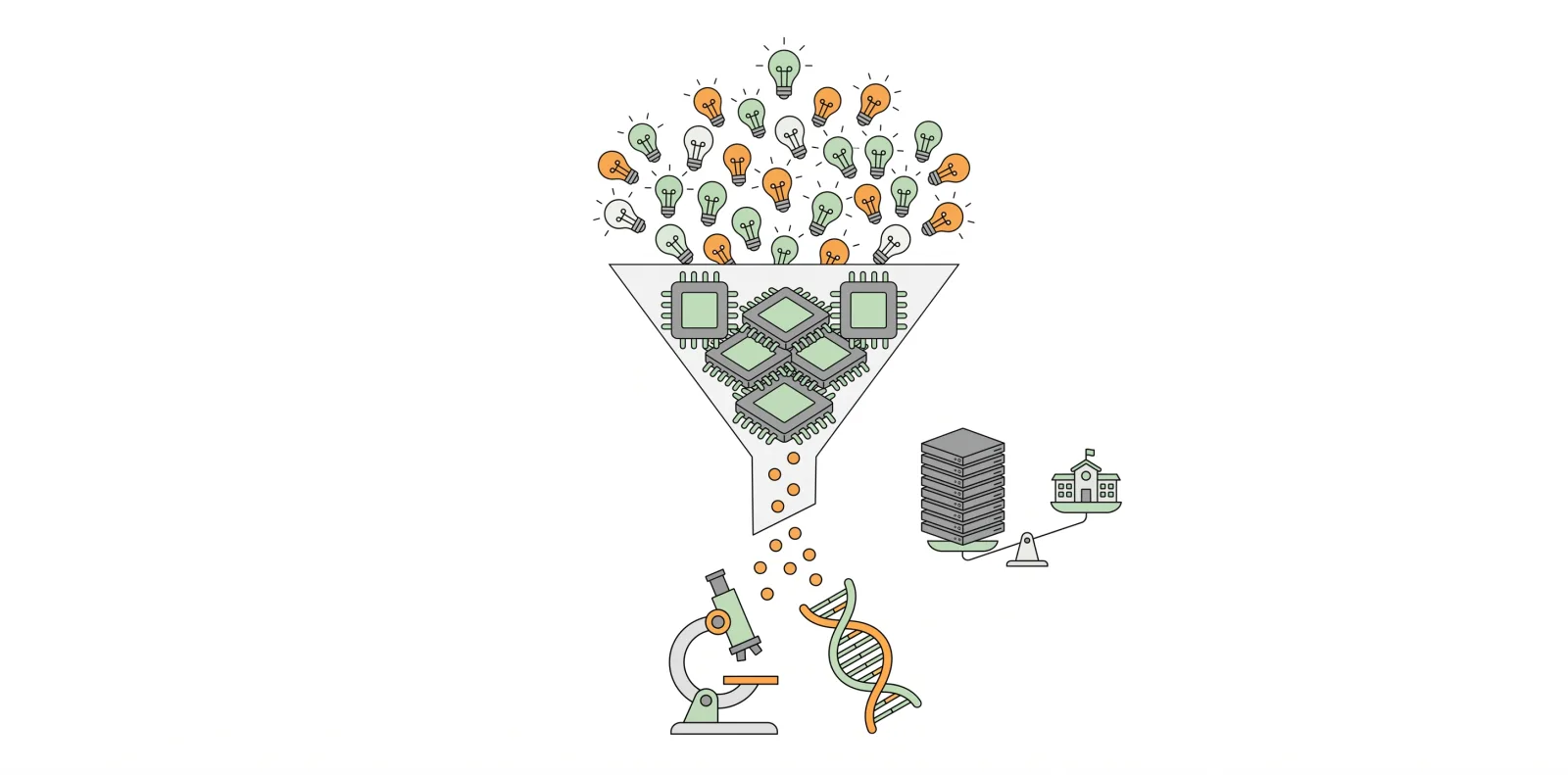
Three strategies are showing real promise, and none of them involves simply waiting for more chips.
Do more with less. Efficiency gains can be dramatic. Boltz-2, an open-source model from MIT and Recursion researchers that predicts how tightly a drug-like molecule binds to a protein, is described by its authors as "at least 1000× more computationally efficient" than free-energy perturbation, a physics-based method that is the usual gold standard for this job. They also say it is the first AI model to approach FEP's accuracy (Passaro et al., bioRxiv, 2025, not peer reviewed). If that holds up under independent testing, it means some of the drug-discovery workload moves from a supercomputer to something a department can run. That is a "if", because the work is still a preprint.
Share the hardware. In the United States, the National Science Foundation announced a new NAIRR operations centre in September 2026, led by the San Diego Supercomputer Center at UC San Diego and the Texas Advanced Computing Center at the University of Texas at Austin (Nextgov, 2026). It is a coordination layer for access, training and support. Whether it gets enough hardware behind it is the open question, given the funding gap CNAS describes.
Match the model to the problem. Scaling is not a universal remedy. Many scientific tasks have small, precious, hard-won datasets, where a bigger model cannot conjure information that was never measured. The Nature Computational Science editorial argues that perfectly equal GPU access is unrealistic but that geography should not stop researchers from using the methods reshaping their fields (Nature Computational Science, 2026). That is a modest, achievable goal.
What It Means for Researchers and Founders#
If you run a lab, budget for compute the way you budget for sequencing or animal housing: early, explicitly, and with a plan B. If you are a founder, the Evo 2 pattern of partnering with a cloud or chip provider looks more realistic than owning clusters. If you are a student, learn efficiency tricks, because the people who can make a one-billion-parameter model behave are in demand everywhere.
And if you read a headline about a model "breakthrough", ask a boring question: could anyone outside the originating organisation afford to check it?
Frequently Asked Questions#
What is the AI compute bottleneck? It is the gap between how much computing power AI developers want and how much hardware, memory and electricity the world can currently supply. CNAS describes chip manufacturing as becoming a binding constraint on the AI compute build-out (CNAS, 2026).
How fast is AI training compute growing? Epoch AI estimates that frontier training compute grew by about 4 to 5 times per year from 2010 to May 2024 (Epoch AI, 2024).
Is there really a GPU shortage, or is it just expensive? Both. CNAS reports that TSMC's chief executive said advanced-chip demand ran about three times ahead of capacity in November 2025, and that H100 rental prices are higher than they were a few years ago (CNAS, 2026).
Why does this matter for biology and medicine? Large biology models such as Evo 2 needed over 2,000 H100 GPUs for several months (Arc Institute, 2025). Teams without that access are limited to smaller models, which can affect who is able to build and verify the next generation of tools.
Can universities still train useful models? Yes, at modest scale. One preprint found a one-billion-parameter model could be replicated on 4 GPUs in 18 days instead of 64 GPUs in 3 days (Khandelwal et al., arXiv, 2024, not peer reviewed).
Which countries have the most GPU capacity? According to a 2026 editorial in Nature Computational Science, the United States hosts most GPU cluster capacity, with China a distant second (Nature Computational Science, 2026).
Could more efficient algorithms make the problem go away? They can ease it for particular tasks. Boltz-2's authors report a method at least 1,000 times more computationally efficient than free-energy perturbation for binding-affinity prediction, though this is a preprint awaiting peer review (Passaro et al., bioRxiv, 2025, not peer reviewed).
What is the NAIRR? The National AI Research Resource is a US programme meant to give researchers access to computing and data. In September 2026 the NSF unveiled an operations centre run by the San Diego Supercomputer Center and the Texas Advanced Computing Center (Nextgov, 2026).
References#
- Center for a New American Security (2026). American AI Companies Can't Get Enough Chips. https://www.cnas.org/publications/reports/american-ai-companies-cant-get-enough-chips
- Epoch AI (2024). Training compute of frontier AI models grows by 4-5x per year. https://epoch.ai/blog/training-compute-of-frontier-ai-models-grows-by-4-to-5x-per-year
- Nature Computational Science (2026). Editorial: The inequalities of GPU access. Nat. Comput. Sci. 6, 543. https://www.nature.com/articles/s43588-026-01013-w
- Kudiabor, H. (2024). AI's computing gap: academics lack access to powerful chips needed for research. Nature 636, 16–17 (news). https://www.nature.com/articles/d41586-024-03792-6
- Hayes, T. et al. (2025). Simulating 500 million years of evolution with a language model. Science https://www.science.org/doi/10.1126/science.ads0018
- Arc Institute (2025). AI can now model and design the genetic code for all domains of life with Evo 2. https://arcinstitute.org/news/evo2
- Khandelwal, A., Yun, T., Nayak, N. V., Merullo, J., Bach, S. H., Sun, C., Pavlick, E. (2024). $100K or 100 Days: Trade-offs when Pre-Training with Academic Resources. arXiv:2410.23261 (not peer reviewed). https://arxiv.org/abs/2410.23261v1
- Passaro, S. et al. (2025). Boltz-2: Towards Accurate and Efficient Binding Affinity Prediction. bioRxiv preprint (not peer reviewed). https://pmc.ncbi.nlm.nih.gov/articles/PMC12262699
- Nextgov (2026). NSF launches a new AI research operations center. (Reputable journalism; used because no primary NSF release was retrieved.) https://www.nextgov.com/artificial-intelligence/2026/09/nsf-launches-new-ai-research-operations-center/415786/