Nobody Gave the Model a Codon Table. It Noticed Anyway.#
Every biology student learns the genetic code from a wall chart: 64 three-letter codons, 20 amino acids, three stop signals. It is the lookup table that turns a nucleotide sequence into a protein. It took molecular biologists most of the 1960s to finish it.
Now consider Evo 2, a 40-billion-parameter model trained on 9.3 trillion tokens of raw genome sequence and published in Nature in March 2026. It was never shown that chart. It was never told where genes start, where exons end, or which triplet means "stop". It saw nucleotides, one at a time, and was asked to predict the next one, over and over, across 113,379 prokaryotic and 15,032 eukaryotic genomes (Brixi et al., Nature, 2026).
And yet: mutate a start codon, and the model's confidence in the surrounding sequence collapses. Introduce a frameshift or a premature stop, and the likelihood drop is far larger than for a synonymous change that leaves the protein untouched. Scan along a gene and the model's sensitivity rises and falls in a clean three-base rhythm, with the third position of each codon, the wobble base where most synonymous substitutions hide, showing the smallest effect of the three (Brixi et al., Nature, 2026).
That is the genetic code, reconstructed from statistics. Which raises the question this post is about: how far can a model get on raw DNA alone, and where does the trick stop working?
Background: Two Alphabets, One Molecule#
A quick orientation, because this field runs on jargon.
A language model is a neural network trained to predict missing or upcoming pieces of a sequence. Hide a word, make the model guess it, repeat a few trillion times, and the model ends up encoding a great deal about how the sequence works. Swap words for biological letters and the same recipe applies.
A protein language model, or pLM, reads sequences in the 20-letter amino acid alphabet. Meta's ESM-2 is the best-known example. Because amino acids are what actually fold, these models sit close to protein structure and function, and they power much of today's antibody and enzyme design work.
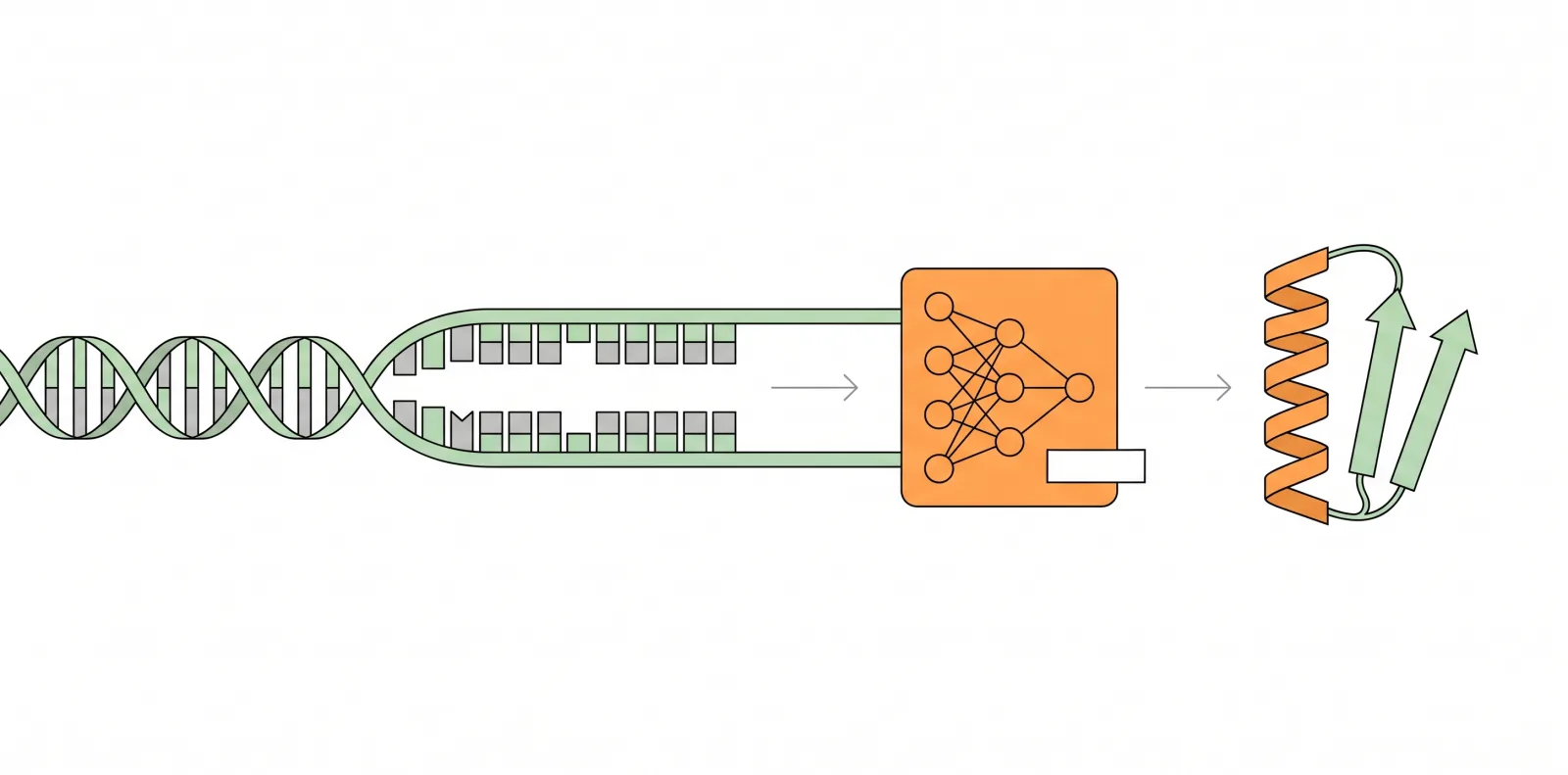
A genomic language model, or gLM, reads the four-letter nucleotide alphabet instead: A, C, G, T. Examples include the Nucleotide Transformer, DNABERT-2, and the Evo family. These models see the gene as it is written in the genome, not as it is expressed in protein.
The word codon matters here. A codon is one three-nucleotide unit, and the code is degenerate: 64 codons map onto only 20 amino acids plus stops, so most amino acids have several spellings. Leucine has six. A synonymous mutation changes the spelling without changing the amino acid. A nonsynonymous one changes the protein.
Degeneracy is why "codon-free" is interesting. A nucleotide model carries strictly more information than an amino acid model, because the DNA sequence specifies both which protein you get and which of the many possible spellings the organism chose. Organisms are not indifferent to spelling. Different species, and different genes within a species, favour different synonymous codons, a phenomenon called codon usage bias, and that bias tracks things like expression level, translation speed and transcript stability.
So the honest version of the headline question is not whether a model can discover the genetic code. It is whether reading DNA gives a model something useful that reading amino acids does not, and whether what it gains is worth what it loses.
What the Models Actually Learn, Measured#
The single most informative study here is a 2024 paper in Bioinformatics with a blunt title: "Are genomic language models all you need?" The authors took the Nucleotide Transformer v2 (500M parameters) and DNABERT-2 (117M), fed them the true coding sequences of proteins, and compared them against ESM-2 and ESM-1b (both 650M) given the matching amino acid sequences. Five protein tasks: stability, fluorescence, melting point, beta-lactamase activity, and secondary structure prediction (Boshar et al., Bioinformatics, 2024).
The nucleotide model matched or beat the protein models on three of the five: stability, fluorescence and melting point. On melting point it won clearly. On beta-lactamase activity and secondary structure it lost (Boshar et al., Bioinformatics, 2024).
That split is the whole story in miniature, and the authors did the work to explain it. Melting point correlates with the organism a protein comes from, since thermophiles run hot. The nucleotide model identified the source species with 0.95 accuracy against 0.81 for ESM-2, and when codon usage information was stripped out its accuracy fell to 0.64, below the protein model's 0.72. Then came the awkward control: a version of the nucleotide model with its codons randomly permuted, which destroys the protein entirely while preserving overall codon composition, still reached an R² of 0.80 on melting point (Boshar et al., Bioinformatics, 2024).
So the model did not need the protein to predict a property of the protein. It read the species off the codon statistics and inferred the rest.
The flip side appears in a neat embedding analysis on the beta-lactamase task, which involves single-point mutants. The authors asked a simple question of each model's internal representation: if you take a mutant sequence and find its ten nearest neighbours, do those neighbours share the same mutant amino acid, or merely the same mutated position? ESM-2 grouped by amino acid 58.4% of the time. The Nucleotide Transformer managed 8.8%, barely above the 4.6% random baseline, while clustering tightly by position instead (Boshar et al., Bioinformatics, 2024).
The nucleotide model, in other words, knows where you cut. It has only a hazy sense of what you put back. That is a precise description of a model that has learned the shape of the code without fully internalising its content.
Scale Changes the Picture, Up to a Point#
The Nucleotide Transformer is a mid-sized model trained on comparatively little data. What happens at the frontier?
Evo, published in Science in 2024, was the first serious answer: 7 billion parameters, single-nucleotide tokenisation, a 131 kb context window, and roughly 300 billion nucleotides from more than 80,000 bacterial and archaeal genomes plus phage and plasmid sequences, with eukaryotic viruses excluded from training. On nine prokaryotic deep mutational scanning datasets, Evo beat every other nucleotide model tested and reached competitive performance with dedicated protein language models, all without a single coding sequence annotation (Nguyen et al., Science, 2024).
It also failed instructively. On human protein mutational scans, Evo could not predict effects at all, which the authors attribute to its prokaryote-only training data (Nguyen et al., Science, 2024).
Evo 2 closed that gap by widening the diet: 8.8 trillion nucleotides spanning all domains of life, a context window of up to a million bases, and 7B and 40B parameter versions. Beyond the codon-rhythm results already mentioned, two findings stand out.
First, the model is sensitive to alternative genetic codes. A handful of lineages have reassigned codons: in some Mycoplasma, TGA codes for tryptophan rather than stop; in ciliates, TGA is the only stop codon. Evo 2 distinguishes the standard code from both variants, though identifying the ciliate code required 4 to 8 kb of surrounding context, which is a reasonable proxy for "it needed to work out what kind of organism it was reading" (Brixi et al., Nature, 2026).
Second, when the Arc Institute team applied sparse autoencoders, a technique that decomposes a model's internal activity into individually interpretable features, they found units that fire on coding regions, on introns, on the first base of an exon after an intron, and on the last exon base before one. They also found features corresponding to alpha helices and beta sheets, the two basic elements of protein secondary structure, plus features for prophage regions, transfer RNAs and transcription factor motifs (Brixi et al., Nature, 2026).
A model fed nothing but nucleotides grew a detector for protein secondary structure. That is the most compelling single piece of evidence that these models learn genuine protein biology rather than species fingerprints alone.
Downstream, the practical payoff is in variant interpretation. A supervised classifier trained on Evo 2 embeddings reached an AUROC of 0.95 on BRCA1 single-nucleotide variants, distinguishing likely pathogenic from benign (Brixi et al., Nature, 2026).
The Middle Path: Codon-Aware and Hybrid Models#
Between "pure amino acids" and "pure nucleotides" sits a third design, and it is quietly the most practical.
CaLM takes the codon as its token: a 64-word vocabulary rather than four letters or twenty. At only 86 million parameters, trained on roughly 8.8 million cDNA sequences after homology filtering, it reached a Pearson R² of 0.75 on melting point prediction, better than every comparison method, and outperformed some amino acid models with more than fifty times its parameter count on several tasks. Randomise the synonymous codon usage and R² falls from 0.75 to 0.39, which pins the gain squarely on codon-level signal (Outeiral and Deane, bioRxiv, 2022 (not peer reviewed)).
gLM2 goes further and mixes the alphabets. Trained on the Open MetaGenomic corpus of about 3.1 trillion base pairs and 3.3 billion coding sequences, it tokenises coding regions by amino acid and intergenic regions by nucleotide, with special tokens marking which DNA strand each gene sits on. At 650M parameters it outperforms ESM-2 on most protein tasks in the Diverse Genomic Embedding Benchmark. More interestingly, given a single sequence containing both the ModA and ModC subunits of a bacterial transporter, gLM2 recovers the contacts between the two proteins at a quality comparable to a classical alignment-based coevolution method, while ESM-2 at the same size shows no such signal (Cornman et al., ICLR, 2025).
That result points at what genomic context buys you. Genes that work together tend to sit together. A related genomic language model trained on contextual gene embeddings predicted masked genes in E. coli K-12 with 71.9% pseudo-accuracy against 28% for a bidirectional LSTM baseline, correlated its attention patterns with known operons, and improved enzyme class prediction from 46.98% using protein embeddings alone to 51.6% once genomic context was folded in (Hwang et al., Nature Communications, 2024).
An amino acid model cannot see any of that, because it throws the neighbourhood away before it starts reading.
| Model | Reads | Size | Training scale | What it demonstrates |
|---|---|---|---|---|
| ESM-2 | Amino acids | 650M | UniRef protein database | Strong baseline; best at knowing which amino acid a mutation yields (Boshar et al., 2024) |
| Nucleotide Transformer v2 | Nucleotides (6-mers) | 500M | ~300B tokens, multi-species genomes | Wins on stability, fluorescence, melting point; loses on secondary structure (Boshar et al., 2024) |
| CaLM | Codons | 86M | ~8.8M cDNA sequences | Codon tokens beat models 50x larger on several tasks (preprint, not peer reviewed) (Outeiral and Deane, 2022) |
| Evo | Nucleotides (single base) | 7B | ~300B nucleotides, >80k prokaryotic genomes | Matches protein models on prokaryotic fitness; fails on human proteins (Nguyen et al., 2024) |
| gLM2 | Mixed: amino acids plus nucleotides | 650M | 3.1T bp, 3.3B coding sequences | Recovers protein-protein interfaces ESM-2 misses (Cornman et al., 2025) |
| Evo 2 | Nucleotides (single base) | 7B / 40B | 8.8T nucleotides, all domains of life | Codon periodicity, alternative codes, secondary-structure features, BRCA1 AUROC 0.95 (Brixi et al., 2026) |
Where the Codon-Free Story Breaks Down#
Three caveats deserve equal billing with the headline results.
The first is the shortcut problem. Codon usage bias is a species label hiding in plain sight. When a nucleotide model wins on a task that correlates with organism of origin, the win may say more about the benchmark than the model. The permuted-codon result, where destroying the protein barely dented melting point prediction, is the clearest demonstration we have, and the authors of that study were explicit that genomic models "largely exploit species-specific codon bias" on such tasks (Boshar et al., Bioinformatics, 2024).
The second is that tokenisation is not the fix. If codon structure is what nucleotide models are missing, aligning the tokens to codons ought to help. The same team built a 50M-parameter model with 3-mer tokens and found it improved on exactly the two codon-sensitive tasks, beta-lactamase and secondary structure, without closing the gap to protein models, and without helping elsewhere. Training it to 600 billion tokens instead of 300 billion changed little. Their conclusion was that tokenisation may not be the most fruitful route (Boshar et al., Bioinformatics, 2024).
The third is that the benchmarks themselves are young and contested. The broader DNA language model field has had a bruising year of evaluation papers. Careful benchmarking in regulatory genomics has repeatedly found that pre-trained nucleotide models do not automatically beat well-tuned supervised baselines, and that performance depends heavily on pre-training data choices (Tang et al., Genome Biology, 2025). None of that invalidates the Evo 2 interpretability work, but it should temper any claim that nucleotide models have simply won.
The sanest reading of the evidence is also the least dramatic. Amino acid models are the better tool when you care about the folded protein. Nucleotide models are the better tool when you care about expression, species context, regulatory sequence, gene neighbourhoods or variants in non-coding DNA. And on the five-task comparison, the best result came from neither: concatenating the nucleotide and protein embeddings matched or beat both parent models on all five tasks and set a new state of the art on stability (Boshar et al., Bioinformatics, 2024).
What This Means If You Build Things#
For a biotech team choosing a backbone, the practical guidance falls out fairly cleanly.
If your task is structure, binding or protein engineering, start with an amino acid model. That is where the representation is sharpest, and the nearest-neighbour analysis explains why.
If your task touches expression, codon optimisation, heterologous production or anything where the host organism matters, a codon-level or nucleotide model is likely to earn its keep, and CaLM's results suggest you may not need a large one.
If your task involves variant interpretation across coding and non-coding sequence, the large genomic models now have the strongest case, with Evo 2's BRCA1 numbers as the reference point (Brixi et al., Nature, 2026).
And if you have the budget, concatenate. The ensemble result is boring and it is also the best number in the literature.
Worth sitting with for a moment: nobody handed Evo 2 the central dogma. It inferred the three-base rhythm, the asymmetry between wobble and non-wobble positions, the heavy cost of a frameshift and the existence of lineages that rewrote their own stop codons, from the statistics of nucleotides alone. Attempts to show more directly that language models can recover the DNA-to-protein mapping have been shakier. One widely circulated preprint reported 81% accuracy on a DNA-protein matching task, but that was the best of 100 fine-tuning runs, most of which sat near chance (Liang, arXiv, 2025 (not peer reviewed)). The frontier models make the case better, and they make it sideways.
None of which means they hold a codon table. They hold a very good statistical account of sequences that happen to obey one. Usually that is close enough to be useful. The failure modes, when they come, will be the cases where it is not, and the melting point result is a preview of what those look like.
Frequently Asked Questions#
Do genomic language models really not know the genetic code? Not as an explicit rule, no. They are never given a translation table or told where genes begin. What they acquire is a statistical shadow of the code: Evo 2 shows a three-base periodicity along coding sequence, treats wobble positions as less constrained, and penalises frameshifts and premature stop codons heavily (Brixi et al., Nature, 2026).
Which is better overall, a protein language model or a genomic one? Neither, and the question is slightly wrong. On a five-task protein benchmark the Nucleotide Transformer won three and lost two against ESM-2, and combining both models' embeddings beat each of them on all five (Boshar et al., Bioinformatics, 2024).
Why does codon usage bias matter so much? Because synonymous codon choice is not random and varies by species, it acts as a label for organism of origin. A nucleotide model identified source species with 0.95 accuracy against 0.81 for a protein model, which is how it wins on species-correlated properties like melting point (Boshar et al., Bioinformatics, 2024).
Is there direct evidence these models represent protein structure? The strongest evidence comes from sparse autoencoder analysis of Evo 2, which isolated internal features firing on alpha helices and beta sheets, alongside features for exons, introns and exon-intron boundaries (Brixi et al., Nature, 2026).
What is a codon-aware model, and why would I use one? It tokenises sequence in three-nucleotide units rather than single bases or amino acids. CaLM, at 86 million parameters, outperformed some amino acid models over fifty times larger on several tasks, and its advantage disappeared when synonymous codon usage was randomised (Outeiral and Deane, bioRxiv, 2022 (not peer reviewed)).
Can these models see things protein models structurally cannot? Yes, chiefly genomic context. gLM2, which mixes amino acid and nucleotide tokens, recovered contacts between two subunits of a bacterial transporter from a single sequence, while ESM-2 of the same size showed no inter-protein signal (Cornman et al., ICLR, 2025).
Are the benchmarks trustworthy? Treat them cautiously. Independent evaluations in regulatory genomics have found pre-trained DNA models frequently failing to beat well-tuned supervised baselines, with results sensitive to pre-training data choices (Tang et al., Genome Biology, 2025).
Does any of this change clinical genetics today? Cautiously and at the margins. A classifier on Evo 2 embeddings reached an AUROC of 0.95 on BRCA1 single-nucleotide variants, which is promising for variant prioritisation, but that is a research benchmark on one well-studied gene rather than a validated diagnostic (Brixi et al., Nature, 2026).
References#
- Brixi, G., et al. "Genome modelling and design across all domains of life with Evo 2." Nature (2026). https://www.nature.com/articles/s41586-026-10176-5 (full manuscript: https://arcinstitute.org/manuscripts/Evo2.pdf)
- Nguyen, E., et al. "Sequence modeling and design from molecular to genome scale with Evo." Science (2024). https://arcinstitute.org/publications/science.ado9336.pdf
- Boshar, S., et al. "Are genomic language models all you need? Exploring genomic language models on protein downstream tasks." Bioinformatics 40(9): btae529 (2024). https://academic.oup.com/bioinformatics/article/40/9/btae529/7745814
- Hwang, Y., et al. "Genomic language model predicts protein co-regulation and function." Nature Communications (2024). https://www.nature.com/articles/s41467-024-46947-9
- Cornman, A., et al. "The OMG dataset: An Open MetaGenomic corpus for mixed-modality genomic language modeling." ICLR (2025). https://proceedings.iclr.cc/paper_files/paper/2025/hash/dbb40375daa3c39f1c098b12608aed12-Abstract-Conference.html
- Tang, Z., et al. "Evaluating the representational power of pre-trained DNA language models for regulatory genomics." Genome Biology (2025). https://link.springer.com/article/10.1186/s13059-025-03674-8
- Outeiral, C., and Deane, C. M. "Codon language embeddings provide strong signals for use in protein engineering." bioRxiv (2022). (not peer reviewed) https://www.biorxiv.org/content/10.1101/2022.12.15.519894.full.pdf
- Liang, W. "Find Central Dogma Again: Leveraging Multilingual Transfer in Large Language Models." arXiv:2502.06253 (2025). (not peer reviewed) https://arxiv.org/abs/2502.06253
- Arc Institute. "Evo: DNA foundation models." Tool and model documentation. https://arcinstitute.org/tools/evo