The two days nobody has#
A patient arrives in intensive care with a bloodstream infection. The laboratory grows the bug, then tests it against a panel of antibiotics to see which ones still work. That second step, antimicrobial susceptibility testing, usually takes another day or two after the culture comes up. Meanwhile somebody has to prescribe something, so they prescribe broadly and hope.
The cost of that guess is measurable. One 2026 review of artificial intelligence in this field cites evidence that each hour of delay in appropriate therapy raises mortality in septic shock by roughly 7.6% (Sardar et al., Briefings in Bioinformatics, 2026). Multiply that across the world and the arithmetic becomes grim. The Global Research on Antimicrobial Resistance study estimated 4.71 million deaths associated with bacterial resistance in 2021, including 1.14 million directly attributable to it, and forecast 1.91 million attributable deaths a year by 2050 (GBD 2021 Antimicrobial Resistance Collaborators, The Lancet, 2024). According to PubMed, that paper covered 22 pathogens across 204 countries.
So the appeal of AI diagnostics here is not hype. If a machine learning model could read a pathogen's genome and tell you within hours which drugs will fail, it would change how infections are treated. The honest question is whether the models are good enough yet. This year produced an unusually clear answer, and it is not the one the press releases suggest.
Background: how a genome becomes a prescription#
Antimicrobial susceptibility testing (AST) is the laboratory gold standard. You expose the isolated organism to a drug at known concentrations and observe whether it grows. The output is a category: susceptible, intermediate, or resistant. The concentration at which growth stops is the minimum inhibitory concentration, or MIC.
Breakpoints are the thresholds that turn an MIC into one of those categories. Two major bodies set them, the Clinical and Laboratory Standards Institute in the United States and the European Committee on Antimicrobial Susceptibility Testing in Europe, and they do not always agree. There is also the epidemiological cut-off value (ECOFF), which separates organisms with no acquired resistance from those that have picked some up. The distinction matters more than it sounds, because a model trained against one standard can look worse, or better, when judged against another.
Whole genome sequencing (WGS) reads the organism's complete DNA. The hope is genotype-to-phenotype prediction: infer the laboratory result from the sequence alone. The simplest version just looks for known resistance genes. That works when resistance comes from one gene doing one thing, and fails when it emerges from several mutations interacting, from how strongly a gene is switched on, or from mechanisms nobody has catalogued.
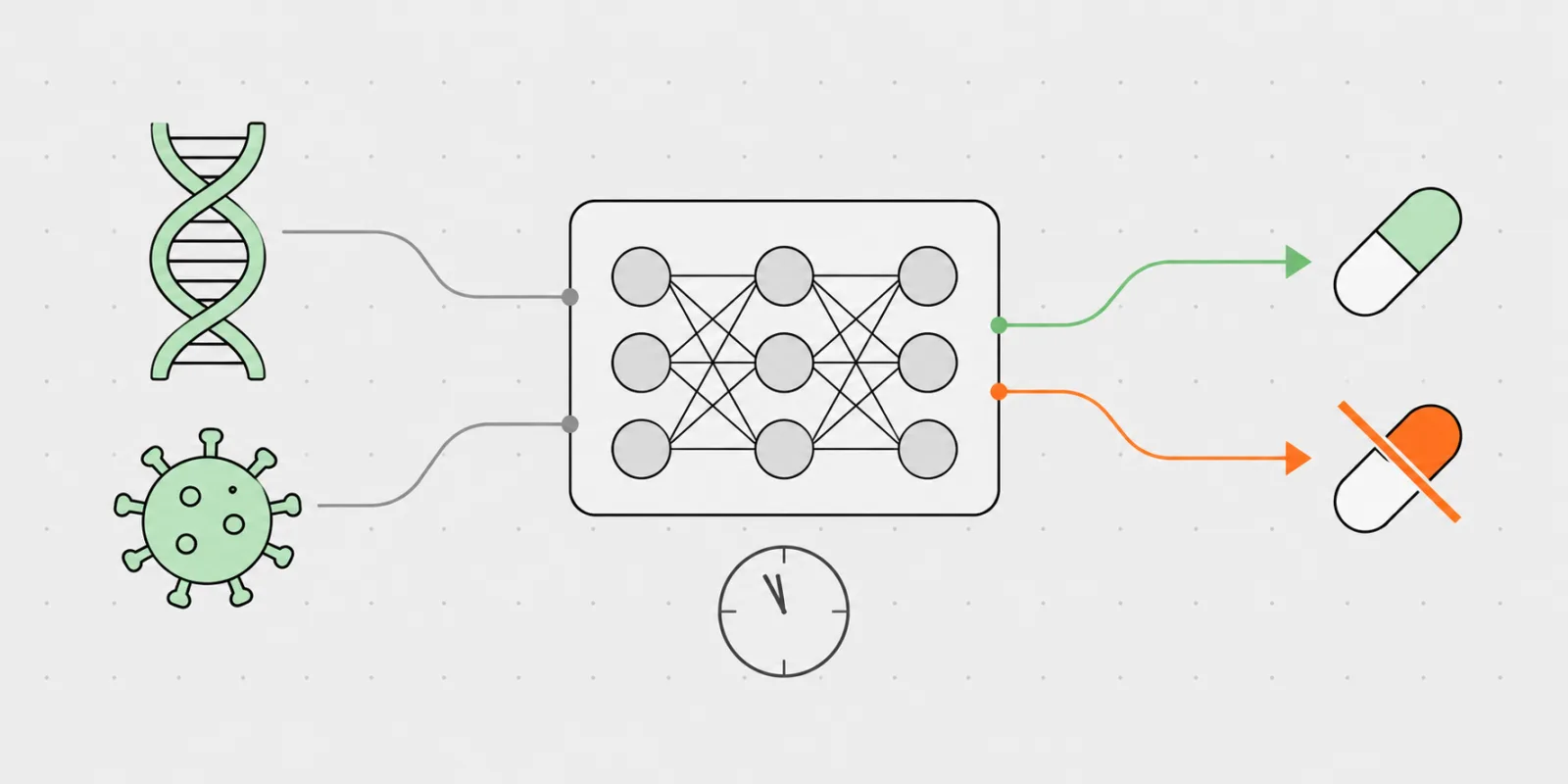
This is where machine learning antimicrobial resistance models come in. Instead of a hand-written rule list, you train an algorithm on thousands of genomes paired with their real laboratory results and let it find the patterns, including ones no human curated. Common choices are random forests and gradient-boosted trees, which build many decision trees and pool their votes, and deep neural networks for larger or messier inputs.
Two other techniques appear below. MALDI-TOF mass spectrometry identifies microbes by the pattern of molecular masses in a sample, and is already standard in hospital laboratories because it is fast and cheap. Metagenomic next-generation sequencing (mNGS) sequences everything in a clinical sample at once, host DNA included, and tries to spot the pathogen in the mixture. That makes it powerful for infections where you do not know what you are looking for, and noisy for the same reason.
What the best bacterial models actually achieve#
The headline result of 2026 came from a team at Peking Union Medical College Hospital working on Klebsiella pneumoniae, one of the eight priority pathogens WHO tracks in its global surveillance programme, and the organism with the highest global resistance rate to third-generation cephalosporins at over 55% (WHO, via PAHO, 2025). They trained models on whole genome sequences from 5,239 strains across three independent cohorts spanning Europe, the Americas and Asia, and covering isolates collected between 2004 and 2022.
The results are genuinely impressive. For the basic resistant-versus-susceptible call, the model reached area under the curve above 0.9 for all 11 antibiotics tested, with mean categorical agreement of 0.96 against the laboratory result. According to PubMed, it held up across regions, sequence types, sample sources and that whole eighteen-year span, and the authors also built harder versions that separated resistant from intermediate from susceptible, and high-level from low-level resistance, both with mean AUC above 0.9 (Jia et al., International Journal of Antimicrobial Agents, 2026).
The error breakdown is the part clinicians care about. Very major errors, meaning the model called an organism susceptible when it was actually resistant, ran at 0.013. Major errors, the reverse mistake, were 0.015, and minor errors 0.024 (Jia et al., International Journal of Antimicrobial Agents, 2026). A very major error is the dangerous one, because it sends a patient home on a drug that will not work.
Other pathogen-drug pairs reach similar territory. The Briefings in Bioinformatics review collates a deep autoencoder reaching 96.3% sensitivity for Mycobacterium tuberculosis in external testing across 16 countries, random forests above 90% accuracy for Escherichia coli and beta-lactams in cross-validation, and MALDI-TOF-based models achieving positive and negative predictive values of 0.89 for carbapenem-resistant K. pneumoniae (Sardar et al., Briefings in Bioinformatics, 2026).
The numbers that do not survive the clinic#
That same review assembled the performance figures from across the field and found the pattern you would expect if most of the good numbers came from favourable conditions. A meta-analysis of 25 machine learning studies produced a pooled AUC of 0.82 with heterogeneity above 97%, meaning the studies disagreed with each other far more than chance would explain. A 2025 systematic review of gradient-boosted trees found a mean AUROC of about 0.80, varying widely by pathogen and drug (Sardar et al., Briefings in Bioinformatics, 2026).
The chart below sets the best reported results beside the externally and prospectively validated ones, and beside the pooled estimate.
A caveat about that chart: these are different metrics measured on different organisms by different groups, so the bars are not strictly comparable. The point is the shape of the distribution, not a league table. Headline results cluster near the top, and the figures from prospective or pooled settings sit noticeably lower.
The review also flags a problem with how success gets measured. Under heavy class imbalance, which is normal in resistance data, accuracy flatters a model. It gives an example where accuracy of 0.90 and an F1 score of 0.95 coexisted with a Matthews correlation coefficient of minus 0.03, which describes a classifier performing worse than a coin toss on the thing that mattered (Sardar et al., Briefings in Bioinformatics, 2026).
And then the sentence that should govern everybody's expectations. Reviewing the whole field, the authors concluded that no existing AI system for antimicrobial resistance has completed prospective clinical validation. They also note that only 0.68%, or 6 of 882, healthcare AI papers met explainability quality criteria in one assessment.
Europe's susceptibility testing committee says not yet#
If that sounds like a lone sceptical voice, it is not. EUCAST last assessed genome-based susceptibility prediction in 2017 and judged it not robust enough to guide clinical decisions. A new ad hoc subcommittee reconvened in 2024 to look again, reviewed the literature organism by organism, added sections on metagenomics and on machine learning, and went out to public consultation in November 2025.
Their 2026 verdict acknowledges real progress, particularly for M. tuberculosis and for cases where the clinical breakpoint happens to line up with the epidemiological cut-off. Then it lists what still blocks adoption: the need for integrated phenotypic and genotypic surveillance to cover complex resistance mechanisms and newer drugs, unified interpretation frameworks, harmonised bioinformatics tools, datasets that genuinely reflect the target population across the full susceptibility range, and robust external quality assessment schemes for clinical validation. Cost and turnaround time also have to improve (Samuelsen et al., Clinical Microbiology and Infection, 2026).
That is not a rejection. It is a specification. The committee is telling developers exactly which evidence would change the answer, which is more useful than either cheerleading or dismissal. Notably, it treats AI and machine learning as promising avenues for improving predictive accuracy rather than as the problem.
The viral side is earlier, and messier#
Antiviral diagnostics follow a similar arc a few steps behind, partly because viruses do not grow on agar plates the way bacteria do, so there is often no simple phenotypic gold standard to train against.
The most mature area is HIV, where resistance has been inferred from genotype for years. A Ugandan team recently applied interpretable machine learning to 41,247 publicly available HIV-1 integrase sequences, training six classifiers to separate treatment-naive from treatment-experienced sequences using mutation profiles alone. Gradient boosting performed best with an AUROC of 0.92, and the models surfaced candidate accessory mutations outside established resistance pathways, including co-occurring pairs such as G118R with R269K (Ssekagiri et al., BMC Genomics, 2026). The authors are careful about what this means: these are potential contributors acting through interactions between mutations, and confirming them needs independent clinical datasets plus experimental and longitudinal work.
Zooming out, a systematic review screened 476 studies of machine learning in HIV care and analysed 98 in detail, sorting them into six clinical uses including resistance prediction and treatment outcome. Random forests were the most used algorithm at about 17% of applications, while support vector machines dominated genotype-to-phenotype resistance work (Boudra et al., Journal of Medical Internet Research, 2026). The review's gap analysis is telling: treatment recommendation, adherence and therapeutic optimisation remain thinly covered, which are precisely the places a clinician would want help.
For infections where the pathogen is unknown, AI is being pointed at viral metagenomics. A 2026 review describes machine learning and deep learning improving sequence classification and the detection of low-abundance viral signals against heavy background noise, then lists the bottlenecks plainly: high host nucleic acid background, low viral titres, contamination control, limited reference databases, no standardised analytical pipelines, and limited interpretability and generalisability of some predictive models (Shen et al., Journal of Applied Microbiology, 2026).
There is a quieter and more immediately practical use too. Because mNGS is expensive, one group built models to predict whether it is worth ordering at all. In 284 patients with fever of unknown origin, where 64.1% of tests came back positive, a LightGBM model predicted positivity with AUC 0.84 in training and 0.93 in validation, with albumin, procalcitonin, blood culture result, disease type and sample type the most influential features (Gao et al., Frontiers in Cellular and Infection Microbiology, 2025). Helping a clinician decide which test to send is a smaller claim than replacing the test, and correspondingly easier to trust.
What would make these tools trustworthy#
Put the strands together and a reasonable position emerges. The modelling is no longer the weak link. Validation, standardisation and governance are.
A recent review of Helicobacter pylori care illustrates both halves. On the encouraging side, it reports a reinforcement learning system trained and validated on records from 38,049 patients that recommended eradication regimens with a 94.1% success rate against 88.1% for non-AI regimens, replicated in an external cohort of 7,186 patients, and an endoscopic AI reaching 85.7% sensitivity where senior endoscopists managed 68.0% (Zhang et al., Frontiers in Cellular and Infection Microbiology, 2026). On the sobering side, the same authors describe their framework as a conceptual blueprint rather than a validated clinical pathway, note a critical lack of prospective randomised evidence for AI in this specific disease, and warn that equipment-driven domain shift degrades performance in community settings.
Four things would move the field, and all of them are unglamorous:
- Prospective validation in the setting where the tool will be used, reporting very major error rates rather than accuracy alone.
- External quality assessment schemes for genome-based antimicrobial resistance testing, of the kind laboratories already run for conventional molecular diagnostics.
- Harmonised breakpoints and interpretation frameworks, so a model's output means the same thing in Stockholm and in Chennai.
- Honest reporting of failures, since the Briefings review notes that null results and failed candidates rarely reach publication, which inflates how well the field appears to be doing.
For now, the sensible use of AI diagnostics in infection is as a fast first opinion that narrows the question while conventional antimicrobial resistance testing confirms it. That is already worth having. Rapid genotypic prediction can support antimicrobial stewardship by flagging likely resistance early, it can triage which samples deserve expensive sequencing, and in settings where conventional testing is slow or absent it may be the only signal available. What it cannot yet do, on the published evidence, is replace the plate.
None of this is a reason for researchers or biotech founders to slow down. It is a reason to build the boring evidence base, because that is the only thing standing between a very good model and a clinician who is allowed to act on it.
Frequently asked questions#
What are AI diagnostics in infectious disease? They are tools that use machine learning to infer something clinically useful from laboratory data, most often predicting which drugs a pathogen will resist from its genome sequence or its mass spectrometry profile, rather than waiting for the organism to be grown against each drug.
How accurate is machine learning for antimicrobial resistance prediction? It depends heavily on the pathogen, the drug and how the model was tested. The strongest recent study reported AUC above 0.9 for all 11 antibiotics in Klebsiella pneumoniae (Jia et al., 2026), while a meta-analysis of 25 studies found a pooled AUC of 0.82 with very high disagreement between studies (Sardar et al., 2026).
Can a hospital replace susceptibility testing with sequencing and AI today? No. A 2026 EUCAST subcommittee review concluded that genome-based susceptibility prediction is not yet suitable as a clinical decision-making tool, and set out the validation, standardisation and quality assessment work still required (Samuelsen et al., 2026).
Why is a "very major error" the number to watch? Because it means the model called an organism susceptible when it was actually resistant, so a patient could be treated with a drug that will not work. In the Klebsiella study that rate was 0.013, lower than its major and minor error rates.
Does any of this work for viruses? Partly. HIV resistance prediction from genotype is well established and machine learning is now finding candidate accessory mutations in large sequence sets (Ssekagiri et al., 2026). AI-assisted viral metagenomics is earlier, and a 2026 review lists host background, low viral titres and missing standard pipelines as unresolved bottlenecks (Shen et al., 2026).
Why do published accuracy figures vary so much? Different breakpoint standards, noisy labels, batch effects, sampling bias and class imbalance all shift the numbers. One review shows a model with 0.90 accuracy and 0.95 F1 whose Matthews correlation coefficient was minus 0.03, which means it was not really working at all.
Is AI already useful in infection care, even if it cannot replace testing? Yes, in narrower roles. One model predicted whether metagenomic sequencing would return a positive result in fever of unknown origin, reaching AUC 0.93 in validation, which helps clinicians decide when to order an expensive test (Gao et al., 2025).
How big is the problem these tools are trying to solve? WHO's 2025 surveillance report found that 1 in 6 laboratory-confirmed bacterial infections in 2023 was resistant to treatment, with resistance rising for more than 40% of monitored antibiotics between 2018 and 2023 (WHO, via PAHO, 2025).
References#
- Jia X, Zhang J, Chen J, Wang J, Chu X, Yu W, Chen S, Zhang Q, Li Z, Gao H, Li M, Yang Q (2026). Machine learning-based prediction of multi-level antimicrobial resistance in Klebsiella pneumoniae using whole-genome sequencing data. International Journal of Antimicrobial Agents 67(7), 107807. https://doi.org/10.1016/j.ijantimicag.2026.107807
- Sardar S, Dash S, Roychowdhury P, Solanki J, Sikdar P, Thangappan J, Dutta S (2026). Artificial intelligence for antimicrobial resistance: advancing reproducibility, interpretability, and clinical deployment. Briefings in Bioinformatics 27(3), bbag269. https://doi.org/10.1093/bib/bbag269
- Samuelsen Ø, López-Causapé C, Aarestrup FM, et al., on behalf of the EUCAST Subcommittee (2026). The role of whole genome sequencing in antimicrobial susceptibility prediction of bacteria: 2025 update from the European Committee on Antimicrobial Susceptibility Testing Subcommittee. Clinical Microbiology and Infection 32(7S), S1-S34. https://doi.org/10.1016/j.cmi.2026.05.012
- GBD 2021 Antimicrobial Resistance Collaborators (2024). Global burden of bacterial antimicrobial resistance 1990-2021: a systematic analysis with forecasts to 2050. The Lancet 404(10459), 1199-1226. https://doi.org/10.1016/S0140-6736(24)01867-1
- Ssekagiri A, Ssemwanga D, Kateete DP, Jjingo D (2026). Machine learning identifies potential accessory resistance-associated mutations in HIV-1 integrase. BMC Genomics 27(1). https://doi.org/10.1186/s12864-026-13243-3
- Boudra T, Idrissou A, Barakat O, Davani S, Valnet Rabier MB, Lagoutte-Renosi J (2026). Machine learning in HIV care and antiretroviral therapy: systematic review. Journal of Medical Internet Research 28, e79219. https://doi.org/10.2196/79219
- Shen Q, Shi W, Liu C, et al. (2026). AI-empowered viral metagenomics for clinical diagnosis: advances, bottlenecks, and translational pathways. Journal of Applied Microbiology 137(10). https://doi.org/10.1093/jambio/lxag239
- Gao Z, Jiang Y, Chen M, Wang W, Liu Q, Ma J (2025). Enhancing fever of unknown origin diagnosis: machine learning approaches to predict metagenomic next-generation sequencing positivity. Frontiers in Cellular and Infection Microbiology 15, 1550933. https://doi.org/10.3389/fcimb.2025.1550933
- Zhang M, Lv N, Cao Y, Lou L, Cai T, Zhu J, Xu Y, Zhao X, Ma Z, Liu X (2026). Artificial intelligence-driven precision management of Helicobacter pylori: an integrated framework from endoscopy and multi-omics to vaccine design and digital care. Frontiers in Cellular and Infection Microbiology 16, 1999727. https://doi.org/10.3389/fcimb.2026.1999727
- World Health Organization (2025). Global Antibiotic Resistance Surveillance Report 2025, released 13 October 2025. Figures cited here as reported by the Pan American Health Organization. https://www.paho.org/en/news/13-10-2025-who-warns-widespread-resistance-common-antibiotics-worldwide