A slime mould walks into a language model#
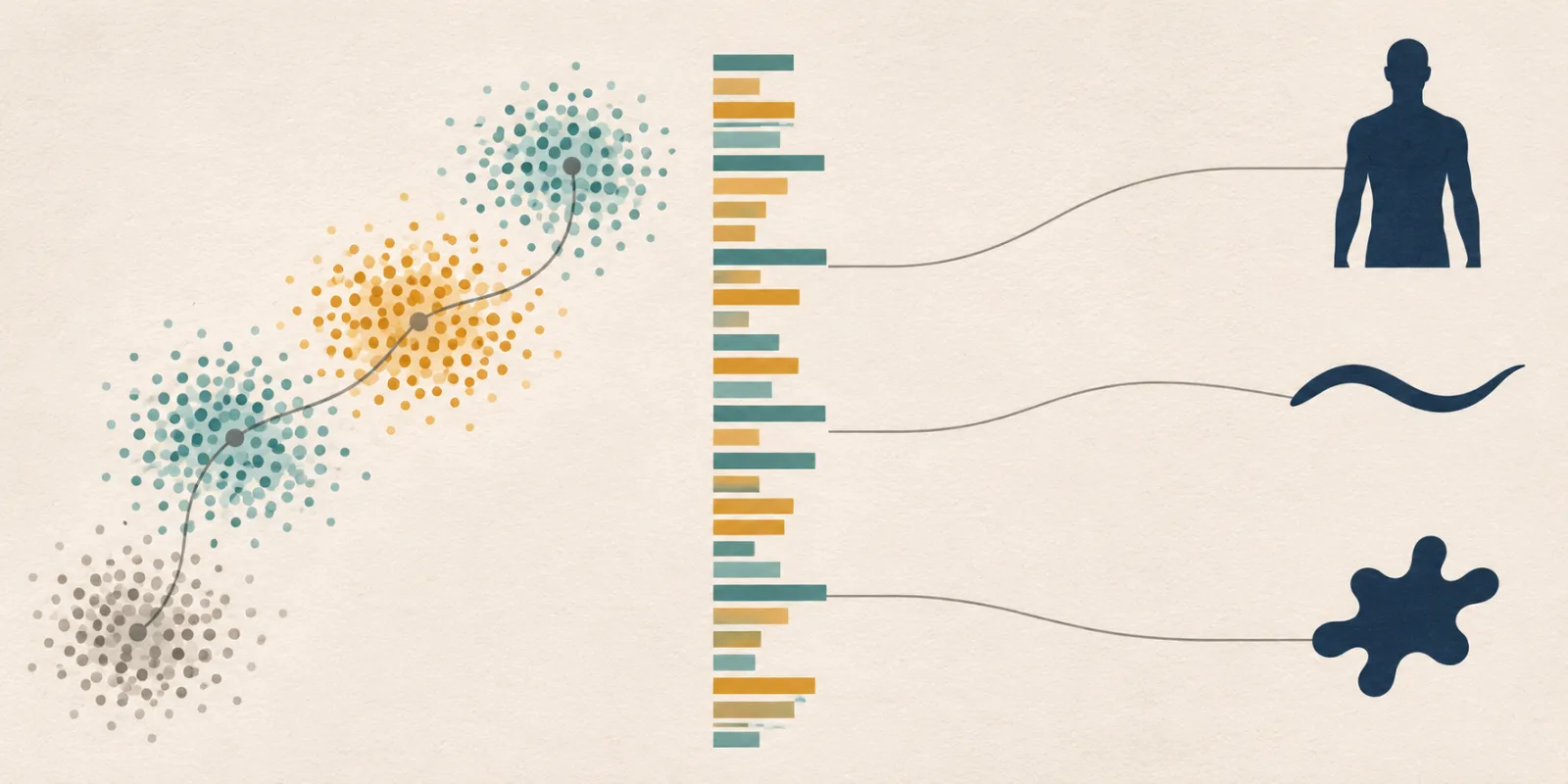
Last week a group from Ljubljana and Baylor College of Medicine published a result that ought to be impossible. They took AI models trained almost entirely on human and other vertebrate cells, pointed them at a slime mould and a nematode worm, and asked them to make sense of what they saw. No retraining, no fine-tuning, nothing.
The models worked. They recovered the correct developmental ordering of cells and kept organism-specific cell identities distinct, in organisms separated from us by 600 million and 1.2 billion years of evolution (Trnovec et al., bioRxiv, 2026, (not peer-reviewed)).
That is a genuinely striking claim, and it lands in the middle of the biggest bet in AI in biotech today. Arc Institute is running a competition with a $100,000 grand prize to see whether anyone can predict how cells respond to genetic perturbations in cell types a model has never seen perturbed, with final submissions closing on 5 November and winners announced later this month (Arc Institute, 2026). Arc calls this the AlphaFold moment it is aiming at for cellular modelling.
So here is the awkward part. While one body of work keeps finding that these models generalise further than anyone expected, another keeps finding that they struggle to beat methods that have been in every bioinformatician's toolkit since the 1990s. Both literatures are serious. Both are mostly right. Working out how they fit together is the most useful thing a researcher or biotech founder can do with an afternoon right now.
Background: what a single-cell foundation model actually is#
Let us build this up from the data.
Single-cell RNA sequencing measures how much of each gene is switched on inside individual cells, one cell at a time. The output is a huge table: tens of thousands of cells down one axis, around twenty thousand genes along the other, with a count in each box. A modern atlas holds tens of millions of cells.
An embedding is a compressed numerical summary of a cell. Instead of twenty thousand numbers, you represent each cell with perhaps a few hundred. Do this well and cells of the same type land near each other, and the geometry of the compressed space carries real biology.
Principal component analysis (PCA) is the oldest way to do this. It is a straightforward linear method that finds the directions of greatest variation in the data. scVI is a more modern neural approach trained on the single dataset in front of you. These two are the baselines that everything else has to beat.
Single-cell foundation models take the approach that worked for text and apply it to cells. Train a transformer on tens of millions of cells, let it learn general structure, then reuse those learned representations for whatever task comes along. Geneformer, scGPT and UCE (Universal Cell Embeddings) are the best known.
Zero-shot means using the pretrained model exactly as it comes, with no further training. This is the setting that matters most in discovery work, where you often have no labels to fine-tune on.
One more term, because the whole commercial case rests on it. Perturb-seq switches off a specific gene in each cell using CRISPR interference, then reads out what happened to every other gene. A virtual cell would predict that readout computationally. If it worked reliably, you could screen in silico instead of in the lab, which is why serious money is chasing it.
What the new preprint found, and what it does not say#
The Trnovec study evaluated zero-shot embeddings from Geneformer, scGPT and UCE against PCA and scVI, using developmental atlases of Dictyostelium discoideum, a social amoeba, and Caenorhabditis elegans, the laboratory nematode.
UCE came out best, performing most consistently and often exceeding baselines trained natively on those same species. The explanation the authors offer is mechanical rather than mystical, and it is the most useful part of the paper.
Geneformer and scGPT treat genes the way a language model treats words: each gene is an entry in a fixed vocabulary learned during training. Confront them with an organism whose genes are not in that vocabulary and you must first map each gene to its closest human equivalent, an ortholog. Many genes have no clean equivalent, so they are simply dropped. UCE sidesteps this by representing each gene through its protein sequence, which exists for every gene in every organism.
The consequence is stark. UCE could use 97% of measured genes. After ortholog mapping, Geneformer and scGPT could each use under a fifth.
Two caveats belong here, and the authors are careful about both. This is a preprint that has not been through peer review, so treat it as a serious finding awaiting independent scrutiny rather than settled fact. And when UCE was restricted to the same ortholog-mappable genes as the others, its advantage narrowed considerably: it still came out ahead on five of six annotation tasks, but some of those margins were slim.
Read carefully, the paper is less a claim that foundation models have cracked biology and more a claim about representation design. How you encode a gene determines how much of the data you can read at all.
The benchmark record is a good deal less flattering#
Now the other literature, which is peer reviewed and consistently more sober.
The most-cited result came from a team at Microsoft Research and the University of Oxford who evaluated Geneformer and scGPT in exactly the zero-shot setting that matters for discovery. Their conclusion was blunt: these models may face reliability challenges and could be outperformed by simpler methods (Kedzierska et al., Genome Biology, 2025). Not catastrophically worse. Just not better, which is a problem when the entire premise is that pretraining on millions of cells buys you something.
A Ghent University group went further and asked which design choices actually drive performance, building a framework called bento-sc to isolate one ingredient of the pretraining recipe at a time. Their verdict was that single-cell language models do not yet offer the generational leap in prediction performance that the foundation model framing promises, and that unpretrained baselines often remain competitive (De Waele et al., NAR Genomics and Bioinformatics, 2026).
That study is worth reading for its constructive half, which gets less attention than the headline. It identified specific practices that do help: process the counts minimally rather than normalising aggressively, use reconstruction losses matched to how count data is actually distributed, mask aggressively during training, and combine several pretraining objectives rather than relying on masked language modelling alone. It also found that raising the gene budget from 1,024 to 2,048 tokens made little difference overall, but did consistently help the tasks that need a detailed view of the whole cell.
There is a quieter worry underneath all of this. Because these models pretrain on large public repositories, and because benchmarks are drawn from the same repositories, some reported performance may reflect prior exposure to the test data rather than genuine generalisation. One audit framework reported pretraining-overlap evidence for 80.4% and 77.0% of cells in two of the most-cited benchmarks, against none at all in two datasets postdating the training cutoffs (Ali, arXiv, 2026, (not peer-reviewed)). That work awaits peer review, but the methodological point stands regardless of its specific numbers: benchmark contamination is measurable, and nobody was measuring it.
Perturbation prediction is where the money is, and the news is hardest#
Cell type annotation is a useful test, but it is not what anyone is funding. The commercial prize is predicting what a cell will do when you intervene.
The most thorough assessment to date benchmarked 13 representative methods and baselines across 25 datasets, spanning several perturbation types and species and including two primary immune-cell drug-response resources. The team evaluated three tasks, generalising to unseen single-gene perturbations, predicting combinatorial interactions, and transferring across cell types, using 24 metrics (Li et al., Science Advances, 2026).
Several findings deserve attention.
Models share what the authors call a conservative bias. Fine-tuned foundation models compress variance and underestimate synergistic effects when perturbations are combined. In plain terms, they hedge towards predicting that not much happens, which is usually true and therefore scores well, while missing precisely the surprising interactions that would justify running the model in the first place.
Scores depend heavily on effect size and on which metric you choose. Expression-level agreement looked best for small perturbations that barely differ from untreated controls, while metrics based on changes and differential expression gave clearer signals as effects grew larger. The authors make the point that different metrics probe genuinely different biological signals rather than being redundant summaries of one thing, which is a warning to anyone reading a single headline number off a leaderboard.
Most pointedly, no method generalised consistently across cell types. That is the third task, and it is exactly the capability the virtual cell concept depends on.
Arc Institute, to its credit, has built its 2026 competition around precisely this weakness. Participants receive the unperturbed state of six cell lines and a list of genes to knock down, and must predict the result without ever seeing a perturbation measured in those cells. Final rankings use an aggregate of six metrics rather than one, a direct response to the lesson from 2025 that a narrow scoring function invites optimisation against the metric instead of the biology.
The first competition drew more than 5,000 registrants from 114 countries, with over 300 teams making a final submission. Arc's own framing is refreshingly unhyped: they would be pleasantly surprised if anyone reached the AlphaFold level this year, and the point of measuring in public is to find out how far away it is.
So what should a working scientist conclude?#
Put the two literatures side by side and a coherent picture emerges, which is more interesting than either one alone.
Pretrained cell models clearly capture something real and surprisingly general. A model trained on vertebrates should not be able to order the development of a social amoeba, and apparently it can. That is not nothing, and it suggests the structure these models learn is closer to fundamental cell biology than to memorised human idiosyncrasy.
At the same time, capturing something real is not the same as being the best tool for a given job. On many standard tasks a linear method from the last century remains competitive, and on the task that matters most commercially, nothing yet generalises across cell types.
The reconciliation is that scale has been the wrong lever. The Ghent work found specific architectural and training choices mattering more than raw capacity, and the Ljubljana preprint found that how you represent a gene determined whether a model could read four-fifths of the data or almost none of it. Neither result is about parameter count.
For anyone choosing where to put effort, a few practical conclusions follow. Benchmark against PCA and scVI, every time, because the burden of proof sits with the expensive model. Check whether your evaluation data predates the model's training cutoff. Report more than one metric, since the perturbation benchmark showed they measure different things. And if you are working outside human and mouse, representation choice may matter more than model choice.
None of this argues against the virtual cell. It argues that the field is earlier than the funding implies, which is a normal condition for a young field and nothing to be defensive about. The useful posture is the one Arc has taken: define the hard task, measure in public, and let the leaderboard be unflattering if that is what the biology says.
Frequently asked questions#
What is a single-cell foundation model? It is a large neural network, usually a transformer, pretrained on tens of millions of single-cell gene expression profiles so that its learned representations can be reused across many downstream tasks. Geneformer, scGPT and UCE are the best-known examples.
Why does anyone compare these models to PCA? Because principal component analysis is a cheap, decades-old linear method that produces useful cell embeddings, so it sets the bar any expensive model must clear. A peer-reviewed zero-shot evaluation found that Geneformer and scGPT could be outperformed by simpler methods in some settings (Kedzierska et al., Genome Biology, 2025).
Did the new preprint prove that foundation models work? It reported that they produce informative embeddings in organisms up to 1.2 billion years from humans, which is a meaningful result, but it is a preprint awaiting peer review (Trnovec et al., bioRxiv, 2026, not peer-reviewed). Its advantage also narrowed when models were restricted to the same gene sets.
What is the gene vocabulary problem? Models that treat each gene as an entry in a fixed vocabulary cannot handle genes absent from that vocabulary, so working in a new species requires mapping genes to human equivalents and discarding the rest. The preprint reports that this left Geneformer and scGPT able to use under one-fifth of measured genes, against 97% for a model that encodes genes by protein sequence.
Can AI predict how a cell responds to switching off a gene? Partly, and not yet across cell types. A benchmark of 13 methods across 25 datasets found a shared conservative bias, underestimation of combinatorial effects, and no method generalising consistently to new cell types (Li et al., Science Advances, 2026).
What is the Virtual Cell Challenge? It is an open competition run by Arc Institute in which models must predict CRISPR interference knockdown responses in six cell lines they have never seen perturbed, scored on an aggregate of six metrics, with a $100,000 grand prize (Arc Institute, 2026).
Does making these models bigger fix the problem? The evidence so far says not much. A systematic study isolating pretraining choices found design decisions such as input processing, loss function and masking rate mattered more than capacity, with a doubled gene budget producing only minimal overall change (De Waele et al., NAR Genomics and Bioinformatics, 2026).
Should biotech companies still invest in virtual cell models? That is a judgement call rather than a scientific finding, and this article is not investment advice. What the evidence supports is that this corner of AI in biotech is earlier than the headlines suggest, that benchmark design is currently a bottleneck alongside modelling, and that claims should be checked against simple baselines before being believed.
References#
- Kedzierska KZ, Crawford L, Amini AP, Lu AX (2025). Zero-shot evaluation reveals limitations of single-cell foundation models. Genome Biology 26, 101. https://doi.org/10.1186/s13059-025-03574-x
- De Waele G, Menschaert G, Waegeman W (2026). A systematic assessment of single-cell language model configurations. NAR Genomics and Bioinformatics 8(3), lqag095. https://doi.org/10.1093/nargab/lqag095
- Li L, You Y, Fu Y, Liao W, Fan X, Lu S, Cao Y, Li B, Ren W, Kong J, Zheng S, Chen J, Liu X, Tian L (2026). A systematic comparison of single-cell perturbation response prediction models. Science Advances. https://doi.org/10.1126/sciadv.aed3414
- Arc Institute (2026). The 2026 Virtual Cell Challenge: predicting perturbation responses in cell contexts a model has never seen. Published 20 August 2026. https://arcinstitute.org/news/virtual-cell-challenge-2026
- Trnovec L, Katoh-Kurasawa M, Arey RN, Shaulsky G, Zupan B (2026). Single-cell foundation models transfer across deep evolutionary distances. bioRxiv 2026.10.28.762457, posted 31 October 2026. (not peer-reviewed) https://doi.org/10.64898/2026.10.28.762457
- Ali S (2026). Auditing pretraining contamination in single-cell foundation model benchmarks. arXiv 2607.20572. (not peer-reviewed) https://arxiv.org/abs/2607.20572