A sentence goes in, a working enzyme comes out#
For about four years, the standard way to design a new protein has involved a peculiar kind of translation. You know what you want the protein to do. The software, however, wants to hear about geometry: which amino acids sit where, how far apart, at what angle, with which metal ion nearby. So you spend your time converting biological intent into spatial constraints, and that conversion is where most of the expertise lives.
On 21 October 2026, a large team based mainly at Westlake University, Zhejiang University and the Hong Kong University of Science and Technology (Guangzhou) published something that skips the translation. Their model, Pinal, takes a description of what you want the protein to do, written in ordinary language, and returns candidate sequences (Dai et al., 2026).
Then they did the part that matters. They picked four very different targets, synthesised the designs, and tested them in the laboratory. All four classes worked, including two enzymes that showed genuine catalytic activity (Dai et al., 2026).
That is a real result, and it deserves a careful reading rather than a breathless one. Because the same paper, read closely, also shows how much human judgement still sits between a prompt and a protein.
Background: what a protein language model is, and why text is the hard part#
A protein is a chain of amino acids. There are 20 common ones, so a protein can be written out as a string of letters, which is exactly how biologists have stored them for decades. That representation is what makes machine learning on proteins possible at all.
A protein language model borrows the method behind text-generating AI and points it at those letter strings. Show a model hundreds of millions of natural protein sequences, hide some of the letters, and train it to guess what belongs in the gaps. In doing so it picks up statistical regularities that correspond to real biophysics, because sequences that would not fold into a stable shape mostly do not survive in nature to be in the training set. Meta's ESM-2 demonstrated how far this goes: scaled to 15 billion parameters, the model's internal representations contained enough structural information to predict atomic-level protein structure directly from sequence, which the authors used to predict structures for more than 617 million metagenomic sequences (Lin et al., 2023).
Two other terms will help. Protein structure prediction means working out the 3D shape a sequence folds into, the problem AlphaFold largely cracked in 2021 (Jumper et al., 2021). De novo protein design is the reverse: you want a shape or a function, and you need a sequence that delivers it.
Here is the gap Pinal aims at. Sequence and structure are both languages a model can learn from abundant data. Function is not. Function lives in English, in the annotations curators attach to database entries: "hydrolase", "binds zinc", "fluoresces green". Those labels are inconsistent, incomplete and written for humans. Linking them reliably to sequences is the genuinely new trick, and the authors' answer was volume. Pinal is a 16-billion-parameter model trained on 1.7 billion synthetically annotated protein and text pairs (Dai et al., 2026). To build that corpus they fed existing function tags to a language model, had it write plain-language descriptions, and trained on both the tags and the descriptions, pairing sequences from three databases with AlphaFold-predicted structures (Timmer, 2026).
How Pinal gets from a sentence to a sequence#
The model works in two stages, which mirrors how conventional design pipelines are built but changes what goes in at the front.
The first stage is a module called T2struct. It reads the prompt and produces a structural blueprint, though not a 3D shape as such. It emits a linear series of tokens describing how each amino acid position relates spatially to its neighbours, with a probability attached to each possibility (Timmer, 2026).
The second stage, SAProt-T, takes both the original text and that probabilistic blueprint and decides on the actual amino acids. Keeping the probabilities rather than committing to one blueprint matters here. The developers' reasoning is that a slightly less likely structure may be the one that accommodates a far better functional sequence, and a system that locks in its first structural guess never gets to find out (Timmer, 2026).
That design philosophy, the one that has driven most recent progress in protein engineering, works the other way round. RFdiffusion generates protein backbones from molecular specifications you supply, and it is genuinely powerful: the team characterised hundreds of designed assemblies and binders, and confirmed one binder to influenza haemagglutinin by cryo-electron microscopy, finding it nearly identical to the design model (Watson et al., 2023). A separate tool, ProteinMPNN, then fills in the sequence for a given backbone (Dauparas et al., 2022). The pipeline works. It just requires you to already know the geometry of what you are asking for.
What actually came out of the laboratory#
The four targets were deliberately unalike: a fluorescent protein, a polyethylene terephthalate hydrolase, an alcohol dehydrogenase and a metabolic H-protein (Dai et al., 2026).
The H-protein result is the one I keep returning to. An H-protein is a small carrier in the glycine cleavage system, the bit of single-carbon metabolism that shuttles a chemical group around on a lipoyl arm (Cronan, 2016). Unglamorous, but it is a component of engineered carbon-fixation pathways. Dropped into a multi-enzyme CO2 fixation pathway with no iterative experimental optimisation at all, the Pinal-designed H-protein increased product titre 1.7-fold compared with the native Escherichia coli version of the same protein (Dai et al., 2026).
Beating evolution's own component on the first attempt, in a pathway the protein never evolved to serve, is not what sceptics expect from a text prompt.
The PET hydrolase target is interesting for a different reason: enzyme engineering has already produced a strong published baseline there. FAST-PETase, engineered with a structure-based machine learning algorithm, carries five mutations relative to wild-type PETase and degraded untreated post-consumer plastic from 51 different thermoformed products almost completely within a week (Lu et al., 2022). Pinal's designed hydrolase showed catalytic activity (Dai et al., 2026), which is a meaningful result for a protein designed from a sentence, and a different achievement from an optimised industrial enzyme. Keeping those two things separate is how you read this literature honestly.
The funnel is the real story#
Here is where enthusiasm needs a cold compress.
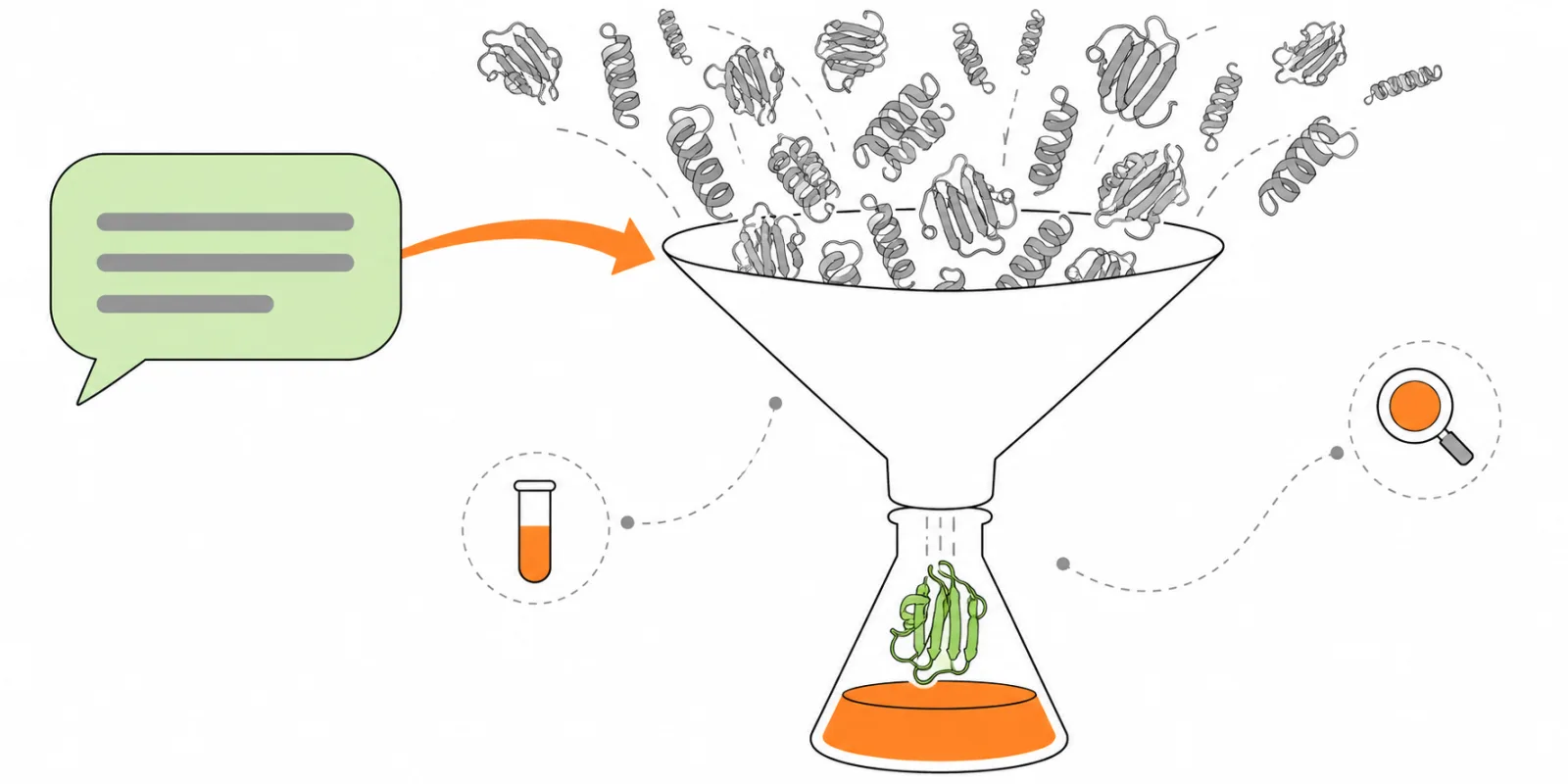
For the fluorescent protein, Pinal was asked to generate 50,000 candidates. The researchers then filtered hard: they threw out anything resembling a known fluorescent protein, and selected for two features found in green fluorescent protein, the barrel-like fold and a key modifiable amino acid. That left 29 candidates worth making in E. coli. One of them fluoresced (Timmer, 2026).
One in 29 sounds dreadful until you think about what the filter removed. The candidates most likely to fluoresce would have looked a lot like known fluorescent proteins, and those were deliberately discarded to prove the model was not simply reciting. Designs that did not form a GFP-like barrel were never tested at all, so a whole space of possible alternative fluorescent proteins went unexamined (Timmer, 2026). The reported success rate is a property of the screening strategy as much as of the model.
It also tells you who can use this. Writing the prompt is easy. Knowing that you should select for a barrel fold and a chromophore-forming residue, and then having a laboratory that can express and assay 29 constructs, is not. The authors' own framing is careful on this point: they present natural language as a high-level interface for generating candidates, with less reliance on manually specified constraints, not as a replacement for experiment (Dai et al., 2026).
Where this sits among the other approaches#
| Approach | What you supply | What you get back | What it still needs |
|---|---|---|---|
| Constraint-based design, such as RFdiffusion plus ProteinMPNN | Geometric specifications: motifs, binding sites, symmetry | Backbones, then sequences for them (Watson et al., 2023) | You must already know the geometry your function requires |
| Family-conditioned language models, such as ProGen | A protein family plus control tags | Sequences within that family, as low as 31.4% identical to natural ones yet comparably efficient (Madani et al., 2023) | A family with enough homologues to learn from |
| Machine-learning-guided engineering, such as FAST-PETase | An existing enzyme to improve | A small set of mutations with large practical gains (Lu et al., 2022) | A natural starting protein |
| Natural-language design, Pinal | A sentence describing the function you want | Candidate sequences across unrelated functional classes (Dai et al., 2026) | Expert filtering and a wet laboratory to sort them |
Read down that table and the trend is clear: each step removes one prerequisite. Pinal removes the need to pre-specify structure, which is the prerequisite that kept de novo protein design inside specialist protein engineering groups. What it has not removed, and what nothing yet removes, is the experiment at the end.
There is also a dependency worth naming. Pinal's training paired sequences with AlphaFold-predicted structures, and AlphaFold is not uniformly accurate (Timmer, 2026). For well-studied protein families with plenty of experimental structures, those predictions were likely sound. For genuinely obscure corners of protein space, the training signal was weaker, which is precisely where a researcher might most want help.
The screening problem that no prompt can solve#
Lowering the expertise barrier cuts in more than one direction, and the field has been unusually candid about it.
Nucleic acid synthesis is the practical choke point. A designed sequence is just text until somebody orders the DNA, and synthesis providers screen those orders against databases of sequences of concern. In October 2025, a group spanning Microsoft, synthesis companies, biosecurity organisations and academia tested whether open-source AI protein design software could produce variants of concerning proteins that slip past those screening tools. It could. They found a vulnerability in which AI-redesigned sequences were not reliably detected, then developed and deployed patches that substantially improved detection of the synthetic variants most likely to retain function (Wittmann et al., 2025).
The sequence of events there is the encouraging part. A risk was identified by the people positioned to fix it, published openly, and patched in the systems that matter. That is roughly what responsible disclosure looks like when it is working.
A harder question is whether safeguards built into the models themselves hold up. In late October 2026, the UK AI Security Institute reported on filtering training data as a safeguard for openly released protein models. Training ESM-2 models from scratch with certain sequences excluded did selectively suppress the targeted capability while leaving performance on other proteins largely intact. The catch was durability: the suppressed capability could be restored by further training, and the institute's conclusion was that data filtering raises the cost of recovery rather than removing a capability, so it needs to sit alongside other measures such as access controls (UK AI Security Institute, 2026; preprint, not peer-reviewed).
None of this is a reason to stop building text-to-protein models. It is a reason to keep the screening layer funded and current, because that layer, not the model's own refusals, is where the durable control sits.
What to watch next#
Three things would tell us whether natural-language protein design becomes a working tool rather than a striking demonstration.
Success rates per prompt, reported consistently. The field needs the equivalent of a batting average: given one functional description and a fixed testing budget, how often does something work? Until that number is routinely published, comparing methods is guesswork.
Independent replication outside the originating laboratories. Pinal's four validated classes are a strong start, and a second group reproducing even one of them, particularly the H-protein titre result, would settle a lot.
Prompts for functions with thin annotation. Fluorescence, hydrolases and dehydrogenases are all well represented in the databases that trained the model. The interesting test is a function described in terms the training data never saw much of.
For now, the honest summary is this. You can describe a protein in a sentence and get candidates that sometimes fold and sometimes work, and one of them beat a natural enzyme in a real pathway. The biologists have not been written out of the process. They have been handed a much larger pile of things to test, and the skill has shifted from specifying the design to choosing which of 50,000 guesses deserves a week of bench time.
Frequently asked questions#
What is a protein language model? It is an AI model trained on protein sequences written as strings of amino acid letters, in the same way text models are trained on words. From that training it learns patterns that reflect real biophysics, which is why scaling one to 15 billion parameters was enough to predict atomic-level protein structure from sequence alone (Lin et al., 2023).
What makes Pinal different from AlphaFold? They solve opposite problems. AlphaFold predicts the shape a given sequence will fold into (Jumper et al., 2021). Pinal starts from a description of a desired function and generates candidate sequences that might perform it (Dai et al., 2026).
Did the designed proteins really work in the laboratory? Yes, across all four functional classes tested, including catalytic activity for both designed enzymes. One designed H-protein raised product titre 1.7-fold over the native E. coli protein in a CO2 fixation pathway, with no iterative experimental optimisation (Dai et al., 2026).
How many designs fail? Most of them. In the fluorescent protein task, 50,000 generated candidates were filtered to 29 worth testing, and one fluoresced. That figure partly reflects a deliberately strict filter that discarded anything resembling known fluorescent proteins (Timmer, 2026).
Does this mean anyone can design a protein now? Anyone can generate sequences. Turning them into a working protein still requires knowing which computational filters to apply and having a laboratory to express and assay the survivors. The authors describe natural language as an interface for generating candidates, not a replacement for experimental validation (Dai et al., 2026).
How does this compare with existing de novo protein design tools? Tools such as RFdiffusion are powerful but need the desired geometry specified up front (Watson et al., 2023). Family-conditioned models such as ProGen generate within a known protein family (Madani et al., 2023). Pinal's contribution is removing the requirement to state structural constraints at all.
What are the biosecurity implications? They are being actively addressed at the DNA synthesis step. A 2025 study found that AI-redesigned sequences could evade the screening tools used by synthesis providers, and the authors developed and deployed patches that improved detection (Wittmann et al., 2025). Separately, the UK AI Security Institute found that filtering training data suppresses targeted capabilities in protein models but is not durable on its own (UK AI Security Institute, 2026).
Is the research peer-reviewed? The Pinal study was published in Nature on 21 October 2026 (Dai et al., 2026). The AI Security Institute's filtering work is reported on its own site with an accompanying arXiv preprint that has not been peer-reviewed.
References#
- Cronan, J. E. (2016). Assembly of lipoic acid on its cognate enzymes: an extraordinary and essential biosynthetic pathway. Microbiology and Molecular Biology Reviews, 80(2), 429 to 450. https://doi.org/10.1128/MMBR.00073-15
- Dai, F., You, S., Zhu, Y., Gao, Y., Fu, L., Zhou, X., Su, J., Wang, C., Fan, Y., Tan, Q., et al. (2026). Programmable design of functional proteins from natural language. Nature, published 21 October 2026. https://doi.org/10.1038/s41586-026-11205-z
- Dauparas, J., et al. (2022). Robust deep learning-based protein sequence design using ProteinMPNN. Science, 378, 49 to 56. https://doi.org/10.1126/science.add2187
- Jumper, J., Evans, R., Pritzel, A., et al. (2021). Highly accurate protein structure prediction with AlphaFold. Nature, 596, 583 to 589. https://doi.org/10.1038/s41586-021-03819-2
- Lin, Z., Akin, H., Rao, R., et al. (2023). Evolutionary-scale prediction of atomic-level protein structure with a language model. Science, 379(6637), 1123 to 1130. https://doi.org/10.1126/science.ade2574
- Lu, H., Diaz, D. J., Czarnecki, N. J., et al. (2022). Machine learning-aided engineering of hydrolases for PET depolymerization. Nature, 604, 662 to 667. https://doi.org/10.1038/s41586-022-04599-z
- Madani, A., Krause, B., Greene, E. R., et al. (2023). Large language models generate functional protein sequences across diverse families. Nature Biotechnology, 41(8), 1099 to 1106. https://doi.org/10.1038/s41587-022-01618-2
- Timmer, J. (2026, 27 October). Vibe genes? Natural(ish) language comes to protein, genome design software. Ars Technica. Reputable science journalism, cited for details of the Pinal design funnel and architecture not available in the paper's open abstract. https://arstechnica.com/science/2026/10/vibe-genes-naturalish-language-comes-to-protein-genome-design-software/
- UK AI Security Institute (2026, 26 October). Pretraining data filtering in open-weight biological models. Official organisation report. https://www.aisi.gov.uk/blog/pretraining-data-filtering-in-open-weight-biological-models
- UK AI Security Institute (2026). Accompanying paper, arXiv 2610.26651. (not peer-reviewed) https://arxiv.org/abs/2610.26651
- Watson, J. L., Juergens, D., Bennett, N. R., et al. (2023). De novo design of protein structure and function with RFdiffusion. Nature, 620(7976), 1089 to 1100. https://doi.org/10.1038/s41586-023-06415-8
- Wittmann, B. J., Alexanian, T., Bartling, C., et al. (2025). Strengthening nucleic acid biosecurity screening against generative protein design tools. Science, 390(6768), 82 to 87. https://doi.org/10.1126/science.adu8578