
The consent form that assumes you are only one person#
Sign a standard research consent form and you are making a promise on behalf of exactly one individual: yourself. That assumption is so deeply built into medical ethics that it rarely gets examined.
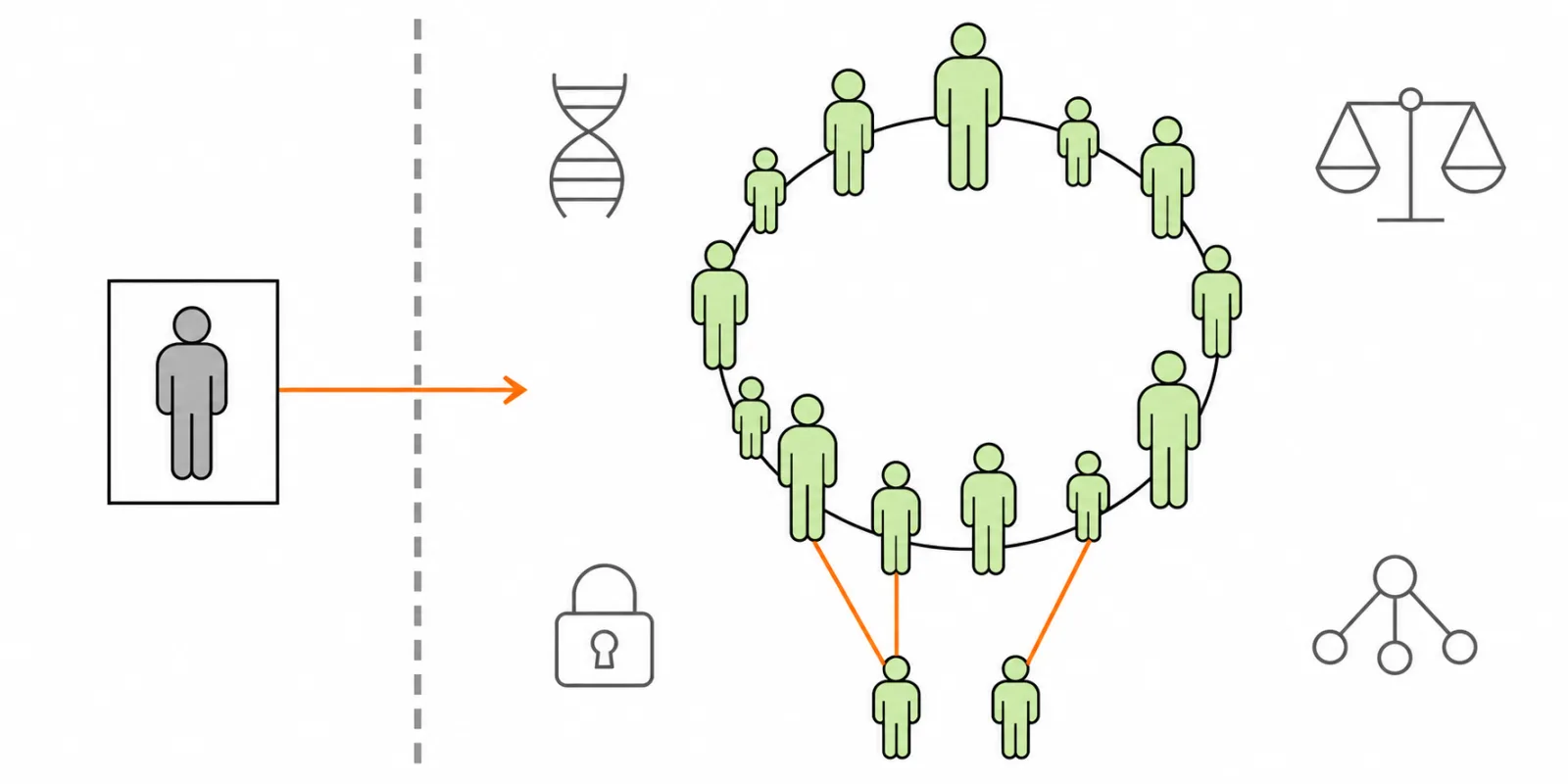
Now consider what you are actually consenting to when the research is genomic. Your genome is substantially shared with your siblings, your parents, your children and your wider kin, none of whom signed anything. Consent to its indefinite storage, re-analysis by algorithms not yet written, and secondary use by researchers not yet funded, and the individual signature starts to look like a thin instrument for a thick problem.
A paper published on 28 October 2026 in Developing World Bioethics takes that mismatch seriously and does something unusual with it. Rather than patching the existing framework, a team of eleven authors led by Clement Adebamowo at the University of Maryland School of Medicine, with co-authors at the University of Ibadan and elsewhere, asks what the governance of AI-driven health research would look like if it were built from Yoruba moral philosophy instead (Adebamowo et al., 2026).
The result is not a manifesto. It is a set of six principles mapped onto six pieces of institutional machinery, which is a much rarer thing in bioethics than it sounds.
Background: what is being governed, and why Africa sits at the centre#
The paper's subject is data science health research, which it defines as covering genomic biobanking, algorithmic clinical prediction, large-scale secondary use of health data, and AI-assisted diagnostics (Adebamowo et al., 2026). Four activities, one common feature: each separates the moment a person gives a sample or a record from the moment something is done with it, often by years and continents.
Some terms worth fixing before going further.
Principlism is the dominant framework in Western bioethics, built on four principles: respect for autonomy, beneficence, non-maleficence and justice. It is what most research ethics committees are trained in.
A biobank is an organised collection of biological samples and associated data, held for future research that is usually not fully specified when samples are collected.
Secondary use means using data or samples for a purpose beyond the one they were originally gathered for.
Data sovereignty is the principle that data generated by or about a community falls under that community's authority, rather than belonging to whoever happens to host the servers.
Africa is not an incidental setting for this argument. Two major programmes anchor it. The Human Heredity and Health in Africa (H3Africa) consortium began in 2012 to build an environment for genomic research in Africa, with a model explicitly designed so that research is led by African scientists (Sengupta, Choudhury & Ramsay, 2025). That design was a deliberate response to history. Concerns about inequality and exploitation in genomics collaborations drove H3Africa's policy framework towards a firm focus on African leadership (de Vries et al., 2015). The consortium then built its ethics and governance framework by engaging African research ethics committees directly rather than importing one (Tindana et al., 2019). The newer Data Science for Health Discovery and Innovation in Africa (DS-I Africa) programme extends this into AI and data science (Adebamowo et al., 2026).
So the institutional appetite for African-led governance already exists. What the new paper argues is missing is the moral content to put inside it.
Three frameworks, three gaps#
The authors are careful not to set up a straw man. They name three existing approaches and credit each with capturing part of the ethical terrain, before arguing that gaps remain (Adebamowo et al., 2026).
The first is Western principlism, which handles individual rights well and collective interests poorly. The second is Ubuntu-based bioethics, drawing on the southern African relational philosophy often glossed as "a person is a person through other persons." The third is the CARE Principles for Indigenous Data Governance, which set out Collective benefit, Authority to control, Responsibility and Ethics as a counterweight to purely technical data-sharing standards.
The CARE Principles in particular have become a reference point for indigenous data sovereignty worldwide. The authors' complaint is not that these are wrong. It is that they operate at a level of generality that leaves implementation unspecified. Harmonised research instruments routinely require "community engagement" without saying what form it should take, who speaks for a community, or what happens when engagement produces a refusal. The paper positions its framework precisely in that gap, designed to operate within existing harmonised procedures rather than alongside them, supplying locally grounded moral content where those instruments leave the form open (Adebamowo et al., 2026).
For a field where AI ethics statements tend to float free of any institution that could act on them, that is a modest and rather shrewd piece of positioning. It asks ethics committees to change what they ask for, not which forms they use.
Six principles, in plain terms#
The framework rests on six Yoruba moral principles which the authors describe as extending rather than replacing principlism (Adebamowo et al., 2026). Stripped of the technical vocabulary, they run roughly as follows.
Ifọgbọntáayésé, procedural communal deliberation, holds that decisions affecting a group should emerge from a structured collective process rather than an aggregation of individual choices. Applied to consent, the question shifts from whether each person agreed to whether the group deliberated properly.
Moderate-communitarian relational personhood treats a person as constituted partly through relationships, without dissolving the individual into the collective. The "moderate" qualifier matters: this is not a licence for communities to override individuals.
Ìwà and Omolúàbí supply virtue-based character ethics. Omolúàbí names a person of good character. The focus moves from whether a procedure was followed to whether the researcher is the sort of person who can be trusted with the data.
Àjọbí, intergenerational kinship obligations, is the principle most directly relevant to genomics. It takes seriously that obligations run across lineage and across generations, which is precisely the structure of genomic information.
Awo, sacred-epistemic confidentiality, holds that some knowledge is appropriately restricted, with legitimate gradations of who may know what. It maps onto data classification more naturally than a binary of identified versus de-identified.
Ìlàjà, restorative-adjudicative justice, is concerned with repairing relationships after harm rather than only assigning liability.
From philosophy to institutions#
Where the paper distinguishes itself is in refusing to stop at principles. Each one is attached to a named mechanism (Adebamowo et al., 2026), and the result is specific enough to argue with.
| Yoruba principle | What it means | Proposed mechanism | Problem it targets |
|---|---|---|---|
| Ifọgbọntáayésé | Procedural communal deliberation | Community Data Stewardship Councils | Unspecified "community engagement" in harmonised instruments |
| Àjọbí | Intergenerational kinship obligations | Tiered consent with lineage-level governance | Individual consent to data that is inherently familial |
| Ìwà / Omolúàbí | Virtue-based character ethics | Omolúàbí-informed researcher assessment | Compliance checks that assess forms, not researchers |
| Relational personhood | Persons constituted through relationships | Ẹbọ-based benefit-sharing | Benefits accruing to institutions rather than communities |
| Awo | Sacred-epistemic confidentiality | Awo-governed data classification | Binary identified/de-identified distinctions |
| Ìlàjà | Restorative-adjudicative justice | Ìlàjà restorative harm remediation | Harm processes that assign blame but repair little |
Two of these deserve a second look. Tiered consent with lineage-level governance is the most direct answer to the problem this article opened with: it treats the family line, not only the individual, as a locus of authority over genomic data. Awo-governed data classification proposes graded access tiers grounded in an existing moral vocabulary about restricted knowledge, which is arguably a better fit for modern data governance than the blunt binary most frameworks still use.
Whether any of this survives contact with a research ethics committee is an open question. The paper is a work of normative philosophy, not an evaluation. No councils have been convened, no consent model trialled, and the authors present no empirical data on whether these mechanisms improve outcomes. That is worth stating plainly, because the gap between an elegant framework and a working institution is where most governance proposals quietly die.
Why algorithmic fairness is not an abstract worry here#
One of the five challenges the framework addresses is algorithmic fairness, and the evidence that algorithmic bias is a live problem rather than a theoretical one is unusually solid.
The landmark demonstration came from a widely used commercial algorithm affecting millions of patients in the United States, which allocated extra care by predicting health costs rather than illness. Because less money is spent on Black patients, the algorithm systematically underestimated their needs. At a given risk score, Black patients were considerably sicker. Correcting the disparity would have raised the share of Black patients receiving additional help from 17.7% to 46.5% (Obermeyer et al., 2019). Nothing in that algorithm mentioned race. The bias came from the choice of what to predict.
Now layer on the data problem. Models learn from the populations they are trained on, and those populations are skewed. A systematic review of the GWAS Catalog and literature found that 82% of genome-wide association studies in neurodegenerative disease focused on Europeans (Jonson et al., 2024). In cancer genomics, of more than 700 risk loci identified, roughly 80% were first discovered in European-ancestry populations, with African and Latin American populations together accounting for under 1% (Park, Cheng & Haiman, 2017). Across the first decade of polygenic scoring studies, 67% included exclusively European-ancestry participants (Duncan et al., 2019).
Put the two findings side by side and the governance question sharpens. A model trained largely on European-ancestry data, optimising a proxy chosen by whoever commissioned it, deployed in Lagos or Kampala, is not a neutral instrument. Deciding whose interests it should serve is an AI governance question, and exactly the kind that "obtain individual informed consent" was never designed to answer.
Pluralism, not replacement#
It would be easy to read this paper as a rejection of Western bioethics. The authors explicitly decline that framing. They present Yoruba moral philosophy as "one voice in a principled pluralism," and describe the framework as a substantive addition to the current governance landscape rather than a replacement for existing approaches (Adebamowo et al., 2026).
There are obvious objections, and the honest thing is to name them. A framework grounded in one ethnic group's moral tradition raises the question of what happens in the many African research settings that are not Yoruba, a difficulty the authors implicitly acknowledge by casting the work as pluralist rather than universal. Lineage-level governance creates a genuine tension with individual autonomy: if a kin group can shape decisions about shared genomic data, an individual's right to refuse needs careful protection, which is presumably why the authors specify moderate communitarianism. Character-based researcher assessment is harder to standardise and audit than a checklist, and could become a vector for its own biases.
None of these sink the project. They are the sort of problems that only become visible once a framework is specific enough to be tested, which is more than can be said for most calls for "meaningful community engagement."
The wider significance is not really about Yoruba philosophy at all. It is about who holds the pen. For two decades the default has been that data flows from the Global South while ethical frameworks flow in the opposite direction. H3Africa changed the first half of that equation by insisting on African scientific leadership (de Vries et al., 2015). This paper is an attempt at the second half. Whether or not Community Data Stewardship Councils ever convene, the more durable contribution may be the demonstration that a non-Western moral tradition can generate operational governance machinery, not just a critique of somebody else's.
The next time a consent form asks you to sign on behalf of exactly one person, it is worth remembering that this was a choice, made by particular people, in a particular philosophical tradition. Choices can be made differently.
Frequently asked questions#
What is data science health research? The paper uses it to cover genomic biobanking, algorithmic clinical prediction, large-scale secondary use of health data, and AI-assisted diagnostics (Adebamowo et al., 2026). The common thread is a gap in time and place between collecting data and using it.
What is wrong with standard informed consent for genomic research? It assumes an individual can consent on their own behalf, but genomic data is shared across a family line, and future uses are often unknown at the moment of collection. The paper proposes tiered consent with lineage-level governance as an alternative (Adebamowo et al., 2026).
What are the six Yoruba principles? Procedural communal deliberation (Ifọgbọntáayésé), moderate-communitarian relational personhood, virtue-based character ethics (Ìwà/Omolúàbí), intergenerational kinship obligations (Àjọbí), sacred-epistemic confidentiality (Awo), and restorative-adjudicative justice (Ìlàjà) (Adebamowo et al., 2026).
Does this replace Western bioethics or the CARE Principles? No. The authors describe the framework as one voice in a principled pluralism, designed to operate within existing harmonised procedures and to supply moral content where those instruments require community engagement but leave its form unspecified (Adebamowo et al., 2026).
Is there evidence that AI in healthcare is actually biased? Yes. A widely used commercial algorithm affecting millions of patients was shown to underestimate the needs of Black patients because it predicted costs rather than illness; correcting it would have raised the share of Black patients receiving extra help from 17.7% to 46.5% (Obermeyer et al., 2019).
How skewed is the genomic data that models learn from? Substantially. One systematic review found 82% of neurodegenerative disease GWAS focused on Europeans (Jonson et al., 2024), and 67% of polygenic score studies in the field's first decade used exclusively European-ancestry participants (Duncan et al., 2019).
What is H3Africa and why does it matter here? It is a consortium begun in 2012 to build genomic research capacity in Africa under African scientific leadership (Sengupta, Choudhury & Ramsay, 2025), which developed its ethics framework by engaging African research ethics committees rather than importing one (Tindana et al., 2019).
Has this framework been tested in practice? Not yet. The paper is a work of normative philosophy proposing institutional mechanisms, and it reports no empirical evaluation of whether those mechanisms improve research governance in practice.
References#
- Adebamowo, C., Akintola, S., Jegede, A., Imam-Tamim, M. K., Uthman, I., Callier, S., Adebamowo, S. N., Akintola, A., Ikhane, P., Ogundiran, T., & Adeyemo, O. (2026). Yoruba moral philosophy and the ethical governance of data science health research in Africa. Developing World Bioethics, published online 28 October 2026. https://doi.org/10.1111/dewb.70066
- de Vries, J., Tindana, P., Littler, K., Ramsay, M., Rotimi, C., Abayomi, A., Mulder, N., & Mayosi, B. M. (2015). The H3Africa policy framework: negotiating fairness in genomics. Trends in Genetics, 31(3), 117 to 119. https://doi.org/10.1016/j.tig.2014.11.004
- Duncan, L., Shen, H., Gelaye, B., Meijsen, J., Ressler, K., Feldman, M., Peterson, R., & Domingue, B. (2019). Analysis of polygenic risk score usage and performance in diverse human populations. Nature Communications, 10, 3328. https://doi.org/10.1038/s41467-019-11112-0
- Jonson, C., Levine, K. S., Lake, J., Hertslet, L., Jones, L., Patel, D., Kim, J., Bandres-Ciga, S., Terry, N., Mata, I. F., Blauwendraat, C., Singleton, A. B., Nalls, M. A., Yokoyama, J. S., & Leonard, H. L. (2024). Assessing the lack of diversity in genetics research across neurodegenerative diseases: a systematic review of the GWAS Catalog and literature. Alzheimer's & Dementia, 20(8). https://doi.org/10.1002/alz.13873
- Obermeyer, Z., Powers, B., Vogeli, C., & Mullainathan, S. (2019). Dissecting racial bias in an algorithm used to manage the health of populations. Science, 366(6464), 447 to 453. https://doi.org/10.1126/science.aax2342
- Park, S. L., Cheng, I., & Haiman, C. A. (2017). Genome-wide association studies of cancer in diverse populations. Cancer Epidemiology, Biomarkers & Prevention, 27(4), 405 to 417. https://doi.org/10.1158/1055-9965.EPI-17-0169
- Sengupta, D., Choudhury, A., & Ramsay, M. (2025). H3Africa: a model for implementing biobank-based genomic research in resource-constrained settings. Human Molecular Genetics. https://doi.org/10.1093/hmg/ddaf113
- Tindana, P., Yakubu, A., Staunton, C., Matimba, A., Littler, K., Madden, E., Munung, N. S., & de Vries, J., as members of the H3Africa Consortium (2019). Engaging research ethics committees to develop an ethics and governance framework for best practices in genomic research and biobanking in Africa: the H3Africa model. BMC Medical Ethics, 20, 69. https://doi.org/10.1186/s12910-019-0398-2