An antibody that plans for the virus you have not met#
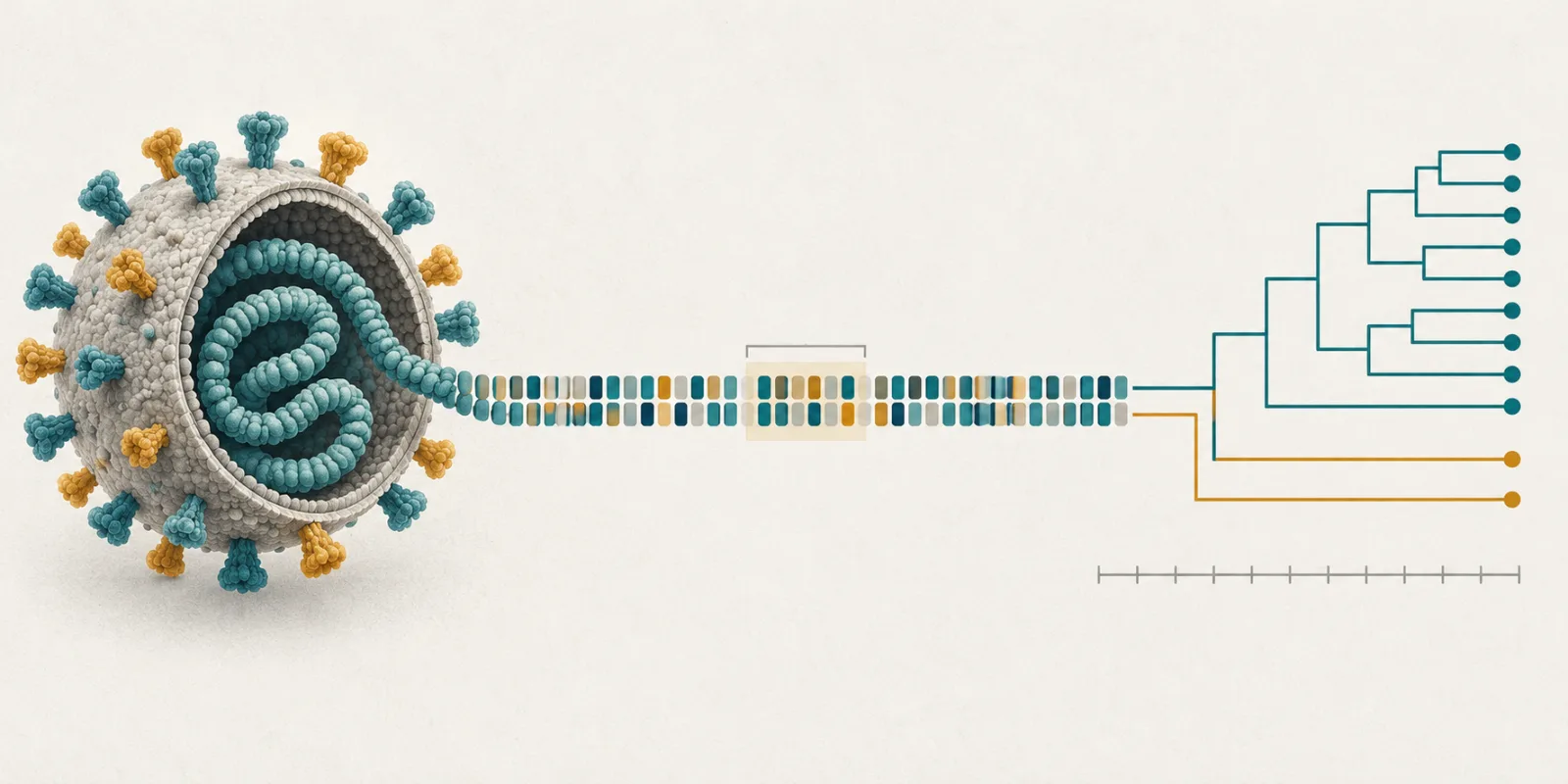
Antibody drugs have a built-in weakness: the target changes. A treatment tuned to one version of a virus can lose its grip when the virus mutates, which is why new variants have repeatedly knocked out antibody therapies. A preprint posted on 16 November by a Stanford University and Arc Institute team asks whether artificial intelligence can design antibodies with the foresight to cope (bioRxiv, not peer-reviewed).
The method, called Germinal Multi, designs a single antibody that is optimised against several variants of a target at the same time. The authors then went one step further. They used an evolutionary forecasting model to help choose a prospective escape variant of SARS-CoV-2, the virus behind COVID-19, and redesigned a known antibody so that it worked against that variant again (bioRxiv, not peer-reviewed).
That is a useful idea for pandemic preparedness, because the usual workflow is reactive: a variant spreads, then the antibodies are tested, then the field scrambles. It deserves a careful reading rather than a victory lap. This post explains what was done, what the numbers say, and where the evidence stops.
Background: antibodies, variants and why breadth is hard#
An antibody is a Y-shaped protein that latches onto a specific part of a pathogen. The tip of the Y, the paratope, is the part that makes contact, and the site it binds on the target is the epitope. When an antibody blocks a virus from entering a cell, it is said to neutralise it. A broadly neutralising antibody (bnAb) is one that still works across many related variants.
Viruses mutate, and mutations that change the epitope can let a variant slip away from an antibody. That is called escape. The preprint's authors put the problem plainly: the therapeutic efficacy of antibodies is often limited by the evolution of their targets, and designing antibodies whose binding surfaces tolerate antigenic variation is challenging (bioRxiv, not peer-reviewed).
Two more concepts help. Pseudovirus assays use a harmless, replication-incompetent virus particle that carries the SARS-CoV-2 spike protein, so researchers can measure neutralisation in the lab without handling live virus. The preprint says its particles were replication-incompetent, used for single-cycle entry assays and handled at biosafety level 2 (bioRxiv, not peer-reviewed). And IC50 is the antibody concentration that cuts infection by half, so a lower number means a more potent antibody.
How Germinal Multi works#
Germinal Multi extends an earlier single-target design pipeline. It treats the task as a multi-objective optimisation problem: during design, the model scores how confidently the antibody is predicted to bind each target, and combines the signals so one antibody can satisfy several targets (bioRxiv, not peer-reviewed). When choosing the amino acid sequence of the antibody's contact loops, it samples sequences that are consistent with all targets, rather than conditioning on just one (bioRxiv, not peer-reviewed).
At the final filtering stage, every filter is applied to each target, so only designs with confident predictions and similar predicted binding modes across all targets survive (bioRxiv, not peer-reviewed). Think of it as writing a single key and checking it against every lock in the set before cutting it.
The authors argue this complements traditional discovery, which fishes in a donor's antibody repertoire for antibodies that happen to have the right breadth. Computational design lets researchers state the desired breadth directly in the objective (bioRxiv, not peer-reviewed).
The cancer test run, and the SARS-CoV-2 results#
The team tested the idea on two kinds of target. The first was EGFR, a cancer protein whose resistance-associated mutations can undermine some antibody treatments. Sixty candidate sequences were evaluated, six met the initial hit threshold against wild-type EGFR, and four of those also exceeded the threshold against all six individual resistance variants tested (bioRxiv, not peer-reviewed). It is a small campaign, but it shows the logic working on a non-viral target.
The viral test used SARS-CoV-2 variants BA.2 and KP.3 as design targets. Of 57 designs, the lead candidate, R50, neutralised both, with IC50 values of 230 ng/mL against BA.2 and 120 ng/mL against KP.3 in pseudovirus assays (bioRxiv, not peer-reviewed). A second design, R42, also neutralised both, with geometric mean IC50 values of 0.48 and 3.2 micrograms per millilitre, while a third, R31, neutralised only BA.2 (bioRxiv, not peer-reviewed).
The more interesting claim is generalisation. The authors report that recognition extended to variants withheld from the design process, including BA.2.86, JN.1 and JN.1.11.1, as well as a later variant, PG.3.1 (bioRxiv, not peer-reviewed). Binding to PG.3.1 was measured with an apparent dissociation constant (KD) of 26 nM, against 60 nM for BA.2 and 20 nM for KP.3 (bioRxiv, not peer-reviewed). KD is a measure of binding strength, where smaller means tighter. Those values are in the range the authors describe as single-digit to tens of nanomolar, which is respectable for an initial design.
| Campaign | Designs tested | Headline result |
|---|---|---|
| EGFR resistance variants | 60 candidates evaluated | Six met the wild-type hit threshold; four bound wild-type and all six resistance variants (preprint) |
| Historical SARS-CoV-2 variants | 57 designs | Lead R50 neutralised BA.2 and KP.3, with binding extending to withheld variants (preprint) |
| Redesign of the bnAb BD55-1205 | 60 candidates | Lead X51 neutralised the parental XFG variant and a forecast-guided escape variant (preprint) |
Rescuing an antibody against a variant that does not exist in the wild#
The headline experiment is the third row of the table. The team took BD55-1205, a broadly neutralising antibody, and asked whether Germinal Multi could redesign it to work against a prospective escape variant. That variant, named XFG-Next, was engineered with guidance from an evolutionary forecasting model, which predicted which changes in the virus's spike protein were likely to matter (bioRxiv, not peer-reviewed). The forecast was combined with deep mutational scanning data, a lab technique that maps how each possible mutation changes a protein's behaviour, from an earlier variant background (bioRxiv, not peer-reviewed).
Germinal Multi then produced 60 candidates with 11 to 20 substitutions in the antibody's contact loops relative to the original, designed to bind both the XFG variant and XFG-Next (bioRxiv, not peer-reviewed). The lead, X51, neutralised XFG with an IC50 of 2.1 ng/mL and XFG-Next with 6.3 ng/mL, against 11 ng/mL for the original antibody on XFG, roughly fivefold better on the parental variant (bioRxiv, not peer-reviewed). Another design, X58, neutralised XFG at 36 ng/mL but showed no measurable neutralisation of XFG-Next (bioRxiv, not peer-reviewed).
That last detail matters. Not every candidate worked, and the success came from screening tens of designs, not from a single perfect prediction. The chart below puts the potency figures side by side on a logarithmic scale.
What the evidence does and does not show#
The positive reading is real. The work shows, in a controlled laboratory setting, that a design method can target several variants at once and that a forecast can pick a plausible target before it appears in circulation. The authors call the XFG-Next result a proof of concept for integrating evolutionary forecasting with antibody design for countermeasure development (bioRxiv, not peer-reviewed).
The cautions are equally concrete, and the authors state several themselves. They note that the likelihood of XFG-Next emerging or spreading remains uncertain (bioRxiv, not peer-reviewed). They applied Germinal Multi to evolutionary variants of the same protein, and say its applicability to more diverse target sets remains to be established (bioRxiv, not peer-reviewed). How the choice of design targets influences breadth against variants not included in optimisation is flagged as an important open question (bioRxiv, not peer-reviewed).
On suitability as a medicine, the preprint is candid. Screening against the unrelated antigen PD-L1 detected no binding under the tested conditions, but broader characterisation against unrelated antigens or cellular material, plus biophysical properties, would be needed before these designs could be judged for therapeutic development (bioRxiv, not peer-reviewed). Everything reported is in vitro, using pseudovirus and binding assays. There are no animal or human data in what I read, and the work is a preprint, so it has not been peer-reviewed.
Three further points of context. The paper discloses that senior author Brian Hie holds outside interests as a scientific co-founder of Arpelos Biosciences and Genyro, Inc., while the other authors declare no competing interests (bioRxiv, not peer-reviewed). Funding comes from a long list of sources including ARPA-H, the NIH and the Gates Foundation (bioRxiv, not peer-reviewed). And the authors say code and methods are publicly available, which allows others to test the claims (bioRxiv, not peer-reviewed).
Why this matters for pandemic preparedness, and the dual-use question#
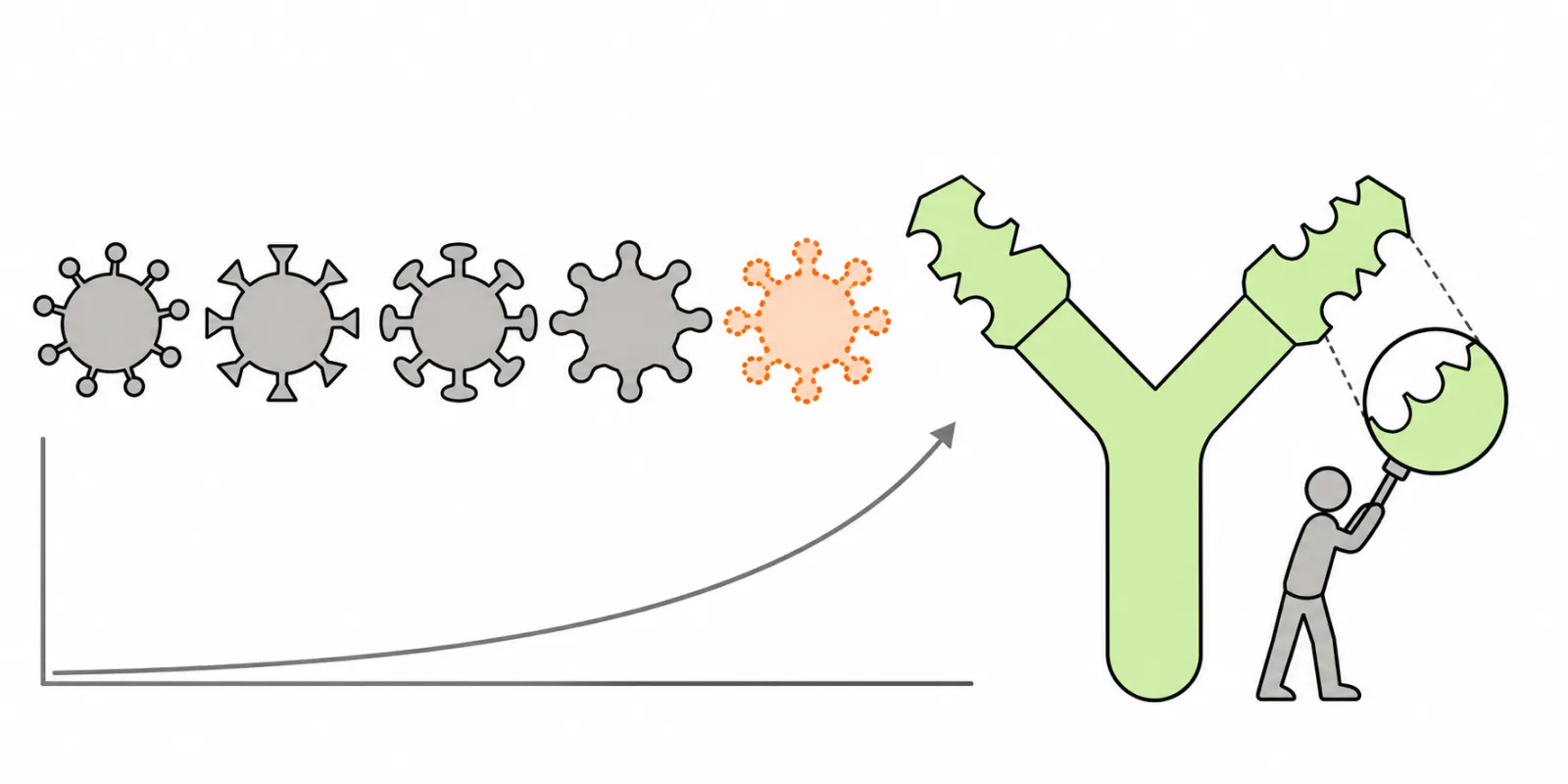
The preprint frames the forecast-guided campaign as a potential application to pandemic preparedness and biodefence, where predicted amino acid changes could help assess antibody robustness before such changes spread (bioRxiv, not peer-reviewed). If the approach holds up, it could shorten the lag between a variant's appearance and a matching countermeasure, and it could help prioritise which existing antibodies are worth keeping in stockpiles.
It also touches a sensitive area. Work that engineers a variant to evade an antibody, even as a laboratory stand-in, sits in the zone that biosecurity researchers call dual use, where knowledge that helps defence could in principle inform misuse. The preprint describes the escape variant as a defensive tool in a pseudovirus system, and I have deliberately left out sequence-level details here. The wider debate about how openness and gated access should work for such research is live, and I covered one side of it earlier this week in a post on trusted-access AI models for biology. For readers who want to follow the science, the useful questions are whether independent groups can reproduce the antibody results and whether the forecasting model's predictions hold up against real variant data.
Forecasting is the weakest link to watch. A forecast is a probability, not a prophecy, and the preprint is clear that the escape variant is a hypothetical one. If real-world evolution takes a different route, antibodies redesigned against the wrong prediction will help less. That is why the authors' own emphasis on testing across multiple designs and variants is the right instinct.
What to watch next#
Four things would change my confidence. First, peer review and independent replication, particularly of the withheld-variant results. Second, animal or other functional data showing protection, which pseudovirus assays cannot provide. Third, tests against more distant virus families, since the method has so far been applied to variants of one protein. Fourth, a prospective test: does a forecast made now line up with what actually circulates in a year?
For biotech founders and engineers, the practical takeaway is modest but real. Multi-target design is moving from concept to wet-lab data, and the cost of screening tens of designs, not thousands, is the part that makes it plausible as a workflow. For researchers, the open question is how far the design philosophy generalises beyond a single viral protein.
FAQs#
What is Germinal Multi? It is a computational framework for designing antibodies, and for redesigning existing ones, so that a single antibody is optimised against several antigenic variants at the same time. It was described in a bioRxiv preprint posted on 16 November 2026. (bioRxiv, not peer-reviewed)
Has this been peer-reviewed or tested in people? No. It is a preprint, so it has not been peer-reviewed, and the results I read come from lab assays using pseudovirus and binding measurements, not animals or patients. (bioRxiv, not peer-reviewed)
What is XFG-Next? It is a prospective escape variant that the team engineered, guided by an evolutionary forecasting model, to evade an existing antibody. The authors say the likelihood of it emerging or spreading remains uncertain. (bioRxiv, not peer-reviewed)
How well did the redesigned antibody perform? The lead design, X51, neutralised XFG at an IC50 of 2.1 ng/mL and XFG-Next at 6.3 ng/mL in pseudovirus assays, compared with 11 ng/mL for the original antibody on XFG. A lower IC50 means higher potency. (bioRxiv, not peer-reviewed)
Did every design work? No. For example, design X58 neutralised XFG but showed no measurable neutralisation of XFG-Next, and R31 neutralised BA.2 but not KP.3. Successful candidates emerged from screening tens of designs. (bioRxiv, not peer-reviewed)
Could this approach work for other pathogens or diseases? The team showed it on EGFR, a cancer target, as well as SARS-CoV-2, but the authors note that its applicability to more diverse target sets remains to be established. (bioRxiv, not peer-reviewed)
Are there conflicts of interest? The preprint discloses that senior author Brian L. Hie has outside interests as a scientific co-founder of Arpelos Biosciences and Genyro, Inc. The other authors declare none. (bioRxiv, not peer-reviewed)
References#
- Park S, Widatalla T, Driscoll CL, Mille-Fragoso LS, Specht I, Gao X, Hie BL. Antibody design across observed and forecasted antigenic evolution. bioRxiv, posted 16 November 2026, version 2. doi:10.64898/2026.11.10.765734 (not peer-reviewed). Abstract: https://www.biorxiv.org/content/10.64898/2026.11.10.765734v2. Full text: https://www.biorxiv.org/content/10.64898/2026.11.10.765734v2.full