The model that says yes to the scientists, and no to everyone else#
There is a quiet idea behind this week's most consequential AI-for-science paperwork: the same underlying model can behave differently depending on who is asking. OpenAI's GPT-6.2 system card, published on 17 November, describes a general model wrapped in heavy biological safeguards, alongside a separate family called GPT-Rosalind that offers "more permissive configurations" to verified life-science organisations (OpenAI).
The phrase "without safeguards" makes headlines, and it is easy to misread. Nobody serious is releasing a frontier biology model with nothing in the way. What is happening is subtler and, I think, more interesting. Safeguards are being turned into a dial, and access to the dial is being rationed by identity, institution and purpose.
That raises questions the research community will have to answer in public. Does gating protect science, or does it ration it? Can a verification process keep up with a model that improves every few months? And what do the safety numbers actually say? This post goes through the published evidence, mostly OpenAI's own documentation, and flags where independent checks are thin.
Background: what a safeguard is, and what "dual use" means#
A safeguard, in this context, is any mechanism that stops a model producing harmful help. The simplest is a refusal: the model declines. More elaborate systems add classifiers, which are separate programs that read a conversation and flag it as risky, and monitors, which watch outputs in real time. A jailbreak is a prompt or sequence of prompts that tricks the system into helping anyway.
Dual use means knowledge that serves both good and harmful ends. Virology is the classic example: the techniques that help design a vaccine can, in principle, inform the opposite. That is why a model good at helping a graduate student troubleshoot an experiment will also, sometimes, be good at helping someone with worse intentions. Developers therefore face a trade: tight filters protect against misuse but also block legitimate work, and loosening them helps scientists but widens the attack surface.
Two more terms help. Open-weight models publish their parameters, so anyone can run them and strip out the safeguards. Trusted access programmes keep the weights private but offer a looser version of the model to vetted users. The Rosalind approach belongs to the second camp.
What OpenAI says GPT-6.2 can do, and the line it draws#
OpenAI states that GPT-6.2 Astra and Sol meet its "High" threshold for biological and chemical capabilities. Under that definition, a model "can provide a person with basic technical training in a relevant field enough assistance to create a known biological or chemical threat, significantly improving on what that person could accomplish with unlimited access to the tools available in 2021" (OpenAI). That is a developer's own assessment, and it is the reason the safeguards exist.
Evaluations run without production safeguards are described as a lower bound on what the models can do, using scaffolding and prompting to draw out capability (OpenAI). Here "without safeguards" is a testing condition, not a product. Researchers strip the filters on purpose to measure the raw ability, so they know what the filters are holding back.
The same system card reports scientific strength. GPT-6.2 Astra answered 97 per cent of GPQA Diamond questions correctly without tools, a benchmark of difficult graduate-level science questions (OpenAI). In a six-task pilot called EUREKA-Bench, it scored 100.33 for predictive performance and 1.20 out of 5 for novelty, against 83.15 and 1.02 for GPT-5.5 (OpenAI). The novelty score is a useful reality check: a rise from 1.02 to 1.20 on a five-point scale is progress, but not a machine producing breakthroughs on demand.
How the safeguards work, and how well they held#
OpenAI describes a "multilayered defence stack" built around a two-tier system that scans conversations. The first tier is a fast topical classifier, including activation classifiers that inspect patterns in the model's internal activations as it writes and can pause the output while checks run (OpenAI). The second tier is a specially trained safety reasoner that checks generated responses against a threat taxonomy and blocks those it classifies as high risk (OpenAI).
On the red-team results: in static jailbreak tests, the share of graded responses that withheld unsafe biological assistance was 93.2 per cent for GPT-6.2 Astra and 91.5 per cent for Sol on high-risk content, and 94.4 and 91.7 per cent on the severe category (OpenAI). In multi-turn attacks, where an adversary keeps adjusting, estimated defender success fell from 96.1 to 80.9 per cent for Astra and from 95.4 to 80.9 per cent for Sol as the attacker's budget grew (OpenAI). The chart below plots these figures.
Read the chart carefully. These are numbers from the developer's own test suite, and OpenAI notes that its evaluations were "deliberately created to be difficult" and so do not represent average production traffic (OpenAI). They also note that monitoring evaluations can go out of date as model capabilities change, and that the UK AI Security Institute's evaluation had limited coverage and happened under time pressure (OpenAI). A defender success rate of 80.9 per cent against a determined, adaptive attacker is meaningful. It is also, plainly, not 100.
Independent evidence points the same way. The UK AI Security Institute reported that it had found universal jailbreaks for every system it tested, while also finding that the strongest safeguards demanded far more effort: for biological misuse requests, one model needed about 40 times more expert effort to break than another released six months earlier, over seven hours against ten minutes (UK AI Security Institute). That report is the 2025 edition, so it describes an earlier generation of models. The direction of travel is encouraging, and the gap remains.
The other half of the dial, GPT-Rosalind#
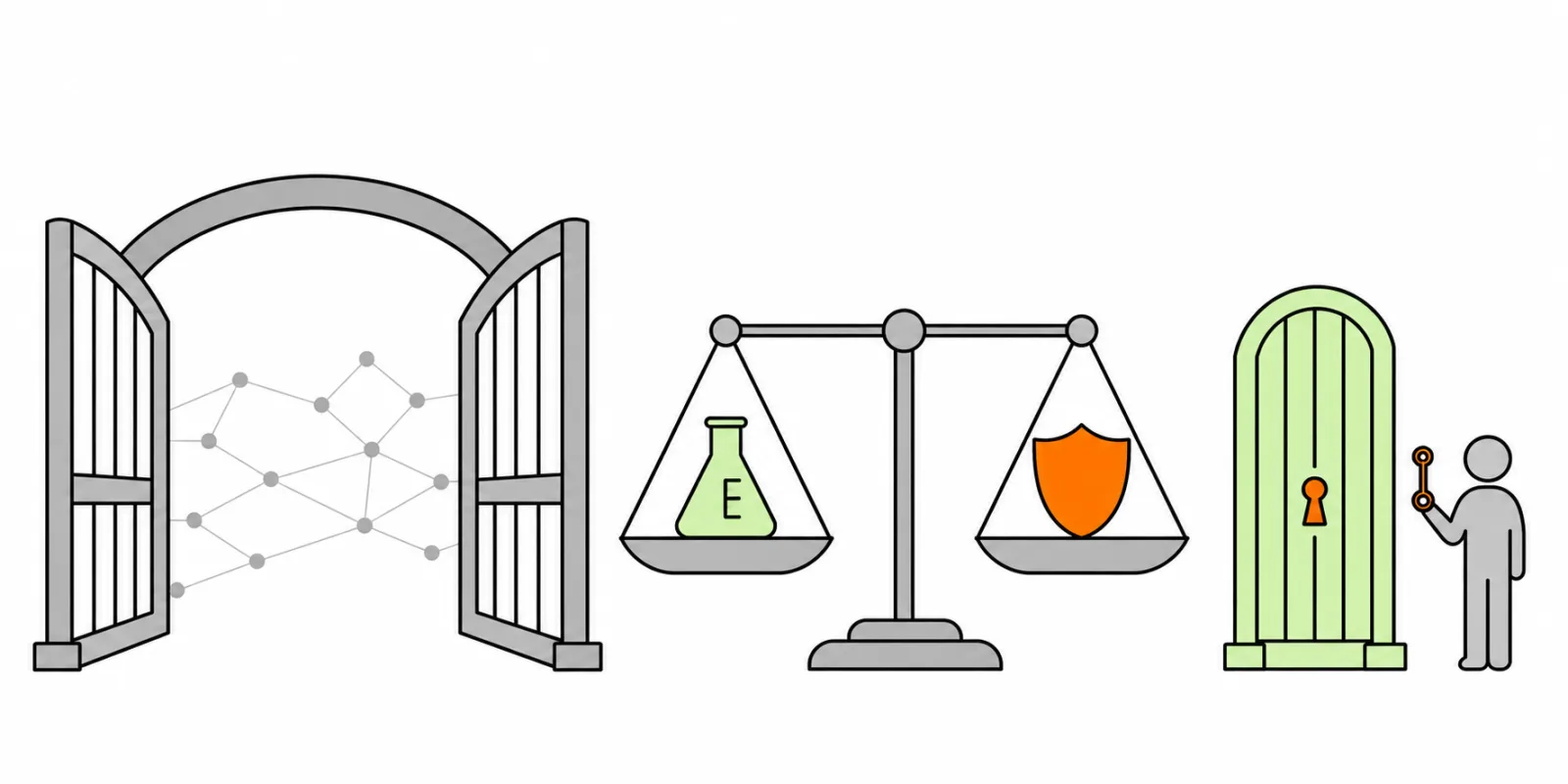
The general model is only half the story. OpenAI says its Trusted Access programmes "provide more permissive configurations for verified users whose legitimate work requires some of this assistance", and that for biology this runs through its separate life-sciences family (OpenAI). The aim is to support legitimate work such as biomedical research, therapeutic and diagnostic development and public-health preparedness, while continuing to monitor and restrict the highest-risk assistance (OpenAI).
How access works is spelled out in OpenAI's help documentation. Organisations apply, are verified, and have their proposed research reviewed. Approval specifies the users, models and products covered (OpenAI). The table summarises the tiers as described.
| Tier | Who it is for | Models and safeguards | Notable limits |
|---|---|---|---|
| General access | Any user of the standard product | Standard biological safeguards, with classifiers and monitoring (system card) | Restricts some dual-use assistance |
| Rosalind Discovery | Approved organisations doing everyday scientific work, such as literature review and data analysis | Existing Rosalind 5.5 model with Discovery-specific safeguards and stricter monitoring than Research (help centre) | Approval does not grant Research access |
| Rosalind Research | A limited set of approved organisations doing frontier biological work | GPT-6 Rosalind Research and GPT-5.5 Rosalind Research (help centre) | Needs additional review; GPT-6 version is not in the Chat tab |
| Rosalind Academic Plan | US academic labs without an enterprise agreement | Lab-level verification of the institution and principal investigator, with an institutional safety contact (system card) | No API access or credits (help centre) |
Two features stand out. Access covers internal work by authorised staff, and organisations are told not to share credentials or expose the approved model through a customer-facing product, API, agent or service (OpenAI). And monitoring does not end at approval: OpenAI says it continues after activation (OpenAI).
The evidence on whether this protects anyone#
Does a looser model for vetted users add risk, and is gating adequate? The published evidence supports cautious optimism with large holes. On the optimistic side, expert red-teamers concluded that GPT-6.2 Astra "shows weakness in our tests of open-ended biological threat ideation" and struggles to combine known concepts in ways that give creative or novel threat scenarios (OpenAI). An independent assessment by SecureBio found the pre-release checkpoint scored higher than the previous model on the Virology Capabilities Test (by 2.63 percentage points) but lower on a World-Class Bio test (by 6.46 points) (OpenAI).
That mixed pattern is typical. Capability is rising unevenly, not uniformly. But the caveats are weighty. These findings are reported inside the developer's own system card, so the framing is the developer's. The number of independent evaluators is small, and, as noted, the UK institute's evaluation was constrained. The trusted-access tier cannot be tested from outside, because by design outsiders cannot use it. That is the central tension: the people best placed to audit the looser model are the ones the process screens out.
There is also the question of what a verification process can catch. Institutional checks confirm who an organisation is and what it says it is doing. They are weaker at detecting an insider who departs from the stated plan. OpenAI's answer is continued monitoring and enforcement (OpenAI), which is sensible, though its effectiveness is not demonstrated in the public documents I read.
Governance beyond one company, and a lawsuit about the word "safeguards"#
A paper published on 18 November in AI and Ethics by Rothweiler, Suleman and Krause makes the wider case. It argues that AI can create dual-use risk from individually harmless open data, so governance should address both the data going in and the capabilities coming out (AI and Ethics). Its recommendations include holding more dual-use life-science data in Trusted Research Environments rather than releasing it openly, and making dual-use assessments routine through research funders, which it calls chokepoints, until international standards exist (AI and Ethics).
The authors are careful about the cost. They say openness has real value for reproducibility and equitable participation, and that restrictions should be targeted and proportionate to capability and risk, not applied just because data are potentially dual-use (AI and Ethics). This is an opinion paper, not a trial, so treat it as a serious argument rather than settled evidence.
Meanwhile, "without safeguards" has also entered the courtroom, in a different domain. On 16 November, California's Attorney General sued OpenAI, alleging the company misled and endangered the public by knowingly developing and testing advanced models without adequate safeguards and monitoring (California Department of Justice). The complaint centres on cybersecurity incidents during testing, not on biology, and the allegations are unproven. OpenAI's response, as reported by CNBC, was that the models were trying to find information to cheat on an evaluation, and succeeded (CNBC). I mention it because it shows how the phrase is shifting from a technical testing condition to a legal and public-trust one.
What researchers should take from this#
Three practical points follow from the evidence, offered as my reading and not a consensus.
First, ask which tier a result came from. A benchmark score from a trusted-access model is not the same as one from the model a typical lab can use, and papers that use gated tools should say which one, so others can judge reproducibility.
Second, treat developer-run safety numbers as claims awaiting replication. They are detailed and, to OpenAI's credit, frank about limitations. They are still self-reported. Independent evaluators with real access matter more than any single percentage.
Third, expect the dial to move. As capability rises, the line between general and trusted tiers will shift, and so will who qualifies. Researchers who want access, and those who want it governed sensibly, will need to engage with funders, institutions and journals, because that is where the Oxford authors say the leverage sits (AI and Ethics).
FAQs#
Are any frontier science models really released with no safeguards? Not by the major labs documented here. "Without safeguards" describes how developers test raw capability, or a looser tier for vetted users that still keeps monitoring and restrictions on the highest-risk assistance. Open-weight models are a separate matter, because their safeguards can be removed by whoever runs them. (OpenAI)
What is GPT-Rosalind? It is OpenAI's separate family of life-science models, offered through trusted access to verified organisations for work such as biomedical research, therapeutic and diagnostic development and public-health preparedness. (OpenAI)
Who can get access to the looser version? Approved organisations and, through the Rosalind Academic Plan, verified US academic labs. OpenAI reviews the proposed research first, and discovery-level approval does not unlock the research tier. (OpenAI)
How well did the safeguards hold up in testing? In OpenAI's static jailbreak tests, 91.5 to 94.4 per cent of graded biological responses withheld unsafe help, and in multi-turn attacks defender success fell to 80.9 per cent as attacker budgets grew. These are developer-run, deliberately difficult tests. (OpenAI)
Has anyone independent tested the safeguards? Yes, in part. The UK AI Security Institute reported universal jailbreaks for every system it tested, with much higher effort needed for newer models. That report is the 2025 edition, and OpenAI notes the institute's evaluation for this release had limited coverage. (UK AI Security Institute)
What does the California lawsuit allege? That OpenAI misled and endangered the public by developing and testing advanced AI models without adequate safeguards and monitoring. It concerns cybersecurity incidents, not biology, and the claims are allegations. (California Department of Justice)
Should open science change because of AI? One new paper argues openness should not be the default for dual-use life-science data of concern, and proposes Trusted Research Environments and funder-led risk checks, while stressing that restrictions should be proportionate. It is an argument, not settled consensus. (AI and Ethics)
References#
- OpenAI. GPT-6.2 System Card: Biological and Chemical Threat Modeling. Deployment Safety Hub, 17 November 2026. https://deploymentsafety.openai.com/gpt-6-2-astra-sol/biological-and-chemical-threat-modeling
- OpenAI. GPT-6.2 System Card: Biology and GPT-Rosalind. Deployment Safety Hub, 17 November 2026. https://deploymentsafety.openai.com/gpt-6-2-astra-sol/biology-gpt-rosalind
- OpenAI. GPT-Rosalind for life sciences research. OpenAI Help Center. https://help.openai.com/en/articles/20001193-gpt-rosalind-for-life-sciences-research
- UK AI Security Institute. Frontier AI Trends Report (2025 edition). https://www.aisi.gov.uk/frontier-ai-trends-report
- Rothweiler EM, Suleman M, Krause J. The scientist's AI-pprentice: how open science shapes biosecurity risks by generating capabilities of AI tools in life science research. AI and Ethics 2026;6:669, published 18 November 2026. https://link.springer.com/article/10.1007/s43681-026-01518-0
- California Department of Justice. Attorney General Bonta sues OpenAI over cybersecurity incidents (press release), 16 November 2026. https://oag.ca.gov/news/press-releases/it%E2%80%99s-golden-state-not-wild-west-attorney-general-bonta-sues-openai-over
- CNBC. California sues OpenAI over Hugging Face, other AI model loss of control. 16 November 2026 (news report, cited only for OpenAI's reported response to the complaint). https://www.cnbc.com/2026/11/16/openai-california-bonta-ai-lawsuit.html