A proof that a computer can check and a person cannot yet read#
On 20 November, Levent Alpöge, a mathematician at Anthropic, posted a four-page note with an extraordinary opening claim: "I believe I have, working with Claude, discovered a proof of the Riemann Hypothesis" (Alpöge). The Riemann hypothesis is the statement that many mathematicians regard as the most important open problem in their field (Nature). The next day, the groups that maintain the Lean proof language and its main maths library said they had full confidence that the proof is correct (Lean FRO and Mathlib Initiative).
A word about where this blog stands. Claude is the model Alpöge credits, and Claude is made by Anthropic. Models from that company also help produce this blog, so you should read what follows with that conflict in mind. Every factual claim below links to a source, and where an Anthropic employee is the source I have said so.
This is a story with a rare structure. The strongest evidence is not a referee's report but a computer's verdict, and the proof itself is, in the words of one summary, something no human understands yet (The Conversation). The sections below cover what the hypothesis says, what was done, how it was checked, and what remains open.
Background: primes, zeros and the critical line#
Prime numbers are whole numbers greater than 1 that can only be divided by themselves and 1 (The Guardian). They look scattered at random along the number line. In 1859 Bernhard Riemann linked their distribution to a function now called the Riemann zeta function, which can be used to estimate how many primes lie below any given number (The Conversation).
The zeta function has "zeroes", the inputs at which it equals zero. Riemann conjectured that, apart from some obvious and uninteresting cases, all of them lie on one particular vertical line in the plane. If that holds, primes are scattered among the whole numbers in a way that is about as random as it could be (Nature). That is the Riemann hypothesis.
It has been tested hard and never broken. More than 12 trillion zeroes have been checked and found on the line, and the hypothesis has been phrased in more than 100 equivalent ways, yet no proof that all of them sit there had been found (The Conversation). It appeared on David Hilbert's list of 23 problems in 1900, and it is one of the seven Millennium Prize Problems for which the Clay Mathematics Institute offers US$1 million (Nature, The Conversation).
Alpöge's claim goes further than the original statement. The proof is said to establish the generalised Riemann hypothesis, which extends the idea to a larger family of functions connected to many parts of number theory (The Conversation). His note says the method easily extends further still, and that he expects the extended version to follow with more time (Alpöge). Those extensions are his expectations, not certified results.
One more term. The Lean theorem prover is formalisation software that lets a computer check every step of a mathematical argument (The Conversation). Think of it as a pedantic referee that accepts nothing on trust, and that never gets tired.
What Alpöge says he and Claude did#
According to the Guardian, Alpöge says Claude helped develop the solution over about six weeks (The Guardian). His note gives a rough timeline of twenty steps, running from an early October idea about a determinant argument to the final entry, dated 16 November, which simply reads GRH (Alpöge).
In his telling the human and the model split the work. He guided the effort towards the right setting, and Claude then supplied key ideas, which he says left him in awe (Alpöge). His example is technical but easy to appreciate in outline: the argument descends from a classic method that settled the analogous problem in a simpler setting, and a crucial step needed a quantity that is hard to find over the whole numbers. The note says Claude's suggested length for a chain of operations called theta lifts, used to recover that missing ingredient, was the obvious one in hindsight (Alpöge).
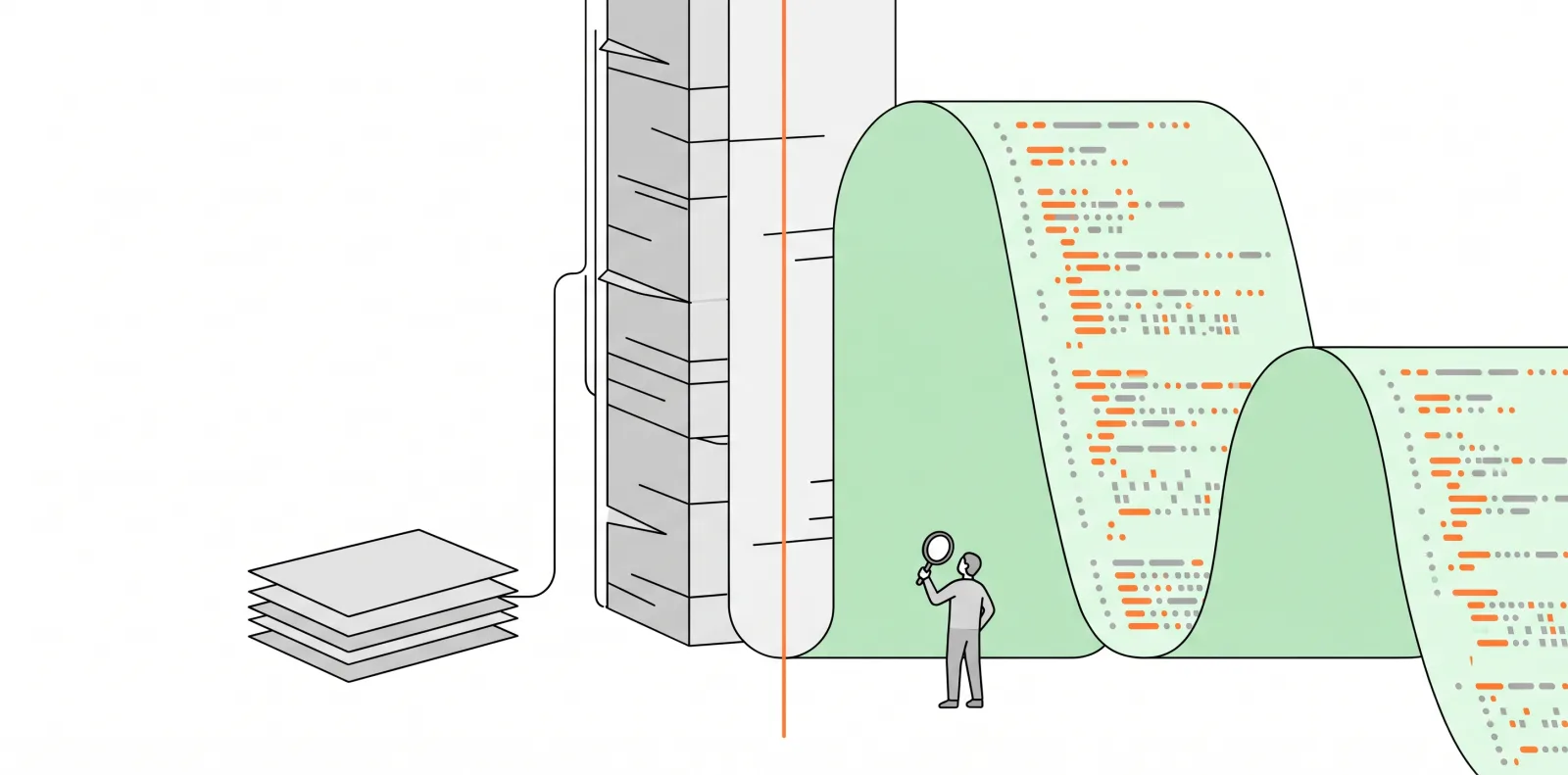
I cannot judge that mathematics, and I would be wary of anyone who claims to after three days. What matters here is the method of announcement. Alpöge says an English-language account of the argument hit more than 250,000 pages, so he decided to release only Lean code rather than a "massive unreadable travesty" (Alpöge). He also expects the argument to be massively simplified, probably quickly (Alpöge).
The scale of the formal proof is the other striking fact. It is a Lean library of 17 million lines of code (Lean FRO and Mathlib Initiative). The chart below puts the sizes of the written documents in this story side by side on a logarithmic scale.
How a computer checked it#
A Lean proof that compiles without errors is usually taken as confirmation that each step is logically sound (Scientific American). It is not the whole story, though. The mathematician Kevin Buzzard of Imperial College London has stressed that one must also ask whether the theorem stated in the Lean code is the real theorem (Scientific American). A formal proof of the wrong statement proves nothing about the right one.
The Lean Focused Research Organization and the Mathlib Initiative, which support the Lean language and its maths library, tested four criteria and certified that all are met (Lean FRO and Mathlib Initiative). The table below summarises them.
| Check | What was reported |
|---|---|
| The statement is the real Riemann hypothesis | The statement lives in Mathlib and was vetted by Lean and number theory experts (Lean FRO and Mathlib Initiative) |
| The library compiles | Dozens of people reported correct compilation, reproducing the same proof export file (Lean FRO and Mathlib Initiative) |
| The code proves that statement | Two independent tools confirmed the proved theorem is exactly Mathlib's statement (Lean FRO and Mathlib Initiative) |
| The proof is valid | Several independent proof checkers accepted the exported proof, including two with a formal proof that they cannot accept a falsehood (Lean FRO and Mathlib Initiative) |
The last row addresses a worry that sounds paranoid but is reasonable: that a proof might exploit a bug in Lean itself. The checks ran on an inert export of the proof, out of reach of any hypothetical malicious code in the Lean sources (Lean FRO and Mathlib Initiative). Andrew Sutherland of the Massachusetts Institute of Technology, who helped recompile the result, said the chance that anything is fishy is approximately zero (Scientific American).
For formal verification of a proof, that is about as strong as the checking gets. It is also a different kind of assurance from the one mathematicians usually rely on. James Maynard, a Fields Medal winner at the University of Oxford, told Nature that if the claim fully checks out it is clearly a historic milestone (Nature). He added that he suspected the proof would turn out to be correct, and that if mathematicians gain the corresponding understanding, it will be viewed as one of the absolute pinnacles of mathematical results (Nature).
The rival human proof#
Hours after Alpöge's announcement, Ravi Vakil of Stanford University posted a rival preprint by Alessandro Maria Masullo, which he described as "all human, with no AI" (Nature). Masullo received his PhD at Stanford in 2020, and the plan had been for Brian Conrad to work with him for a year before announcing (Nature). The manuscript runs to 940 pages and is titled The Music of the Primes (The Conversation).
Its status is very different. Vakil reported that several people had contacted him about problems in the proposed proof, found with the help of different AI models, and that all issues would have to be resolved to the community's satisfaction before it could be accepted (Vakil). He made no claim about the correctness of the strategy (Vakil). Nothing in the reporting suggests the Masullo proof has been certified, and it should not be treated as comparable to the Lean-checked result.
The coincidence is still worth a pause. Two attempts, one AI-assisted and one human, landed on the same day, and the AI-assisted one comes with machine-checkable evidence while the human one, still in revision, does not. That says something about the value of formalisation, and nothing at all about the quality of human mathematics as a whole.
The timing, the credit and the criticism#
The announcement came days after Anthropic's initial public offering (Nature). Andrew Granville, a number theorist at the University of Montreal, said Alpöge should have taken time to prepare a clearer write-up, called the released document "garbled", and cited the company's falling share value as the reason for the timing (Nature).
Alpöge addressed this directly. He wrote that the precise timing was horrible, that there had been "a constraint to respect", and that there is "an obvious cynical view, to do with the timing, but it is false" (Alpöge). Readers can weigh those statements for themselves. What can be said is that the Lean verification does not depend on anyone's motives, because the proof can be checked by anyone with the code (Lean FRO and Mathlib Initiative).
The release also differs from some earlier AI maths announcements. Mathematicians have become used to AI companies releasing significant results in unceremonious dumps, with seemingly unvetted manuscripts that push the checking onto the community (The Conversation). By contrast, Alpöge credited a long list of human colleagues, which goes against a trend in which AI-written papers cite little earlier work (The Conversation). Tristan Buckmaster of New York University, who worked with Alpöge on a separate problem, gave him much credit for building the set-up for doing mathematics with large language models (Nature).
There is wider unease too. The Guardian notes mathematicians' discomfort with extremely lucrative private companies spending millions on AI that solves famous problems, and it describes a September claim by OpenAI that a non-public system helped solve part of another Millennium problem, at a reported cost of $15 million and 10,000 AI systems (The Guardian).
What is settled, and what is not#
Here is a sober ledger. The following is established by public reporting: a Lean library exists, it compiles, its theorem matches Mathlib's statement of the Riemann hypothesis, and several independent checkers accept the proof (Lean FRO and Mathlib Initiative). The following is not yet established: that the argument is humanly understood, that it has survived journal peer review, or that the generalised and extended versions are covered, since the certified statement is the Riemann hypothesis itself (Nature, Alpöge).
The Conversation's account of the situation is blunt: a Lean formalisation alone is generally not considered enough to confirm a proof, though in this case it looks good (The Conversation). A mathematician quoted there put the position as two statements: the formal proof is exceedingly likely to be correct, and no human understands it yet (The Conversation). Tristan Buckmaster expects it to take a long time for mathematicians to digest, and Maynard's optimism is conditional on that understanding arriving (Nature).
For readers following AI mathematics from outside the field, the lesson is about verification more than primes. We now have a case where the evidence comes in two layers: a machine certificate that the logic is sound, and a human process that must eventually supply meaning. The first layer arrived in a day. The second may take years. For anyone building or trusting AI systems that produce results too big to read, the Lean route is an encouraging model of what checkable output can look like, and a reminder that being checkable is not the same as being understood.
Frequently asked questions#
Has the Riemann hypothesis really been proved? A Lean proof released on 20 November has been certified by the Lean Focused Research Organization and the Mathlib Initiative as correct, both in statement and in proof (Lean FRO and Mathlib Initiative). It has not yet been through journal peer review, and the argument is not yet humanly understood (The Conversation).
What role did AI play? Levent Alpöge says he worked with Claude, with Claude contributing key ideas near the end, over about six weeks (Alpöge, The Guardian).
Why is the proof written in code rather than in English? Alpöge says the argument is incredibly long, and that an AI-written English account reached more than 250,000 pages, so he released only Lean (Alpöge).
How do we know the Lean code proves the right statement? The community compared the proved theorem with Mathlib's own statement of the Riemann hypothesis using two independent tools, and both confirmed they match (Lean FRO and Mathlib Initiative).
What about the human-written proof? Alessandro Maria Masullo's 940-page manuscript was released in a hurried announcement, and problems were reported within hours, so it remains unverified (The Conversation, Vakil).
Does this win the Millennium Prize? The Riemann hypothesis is one of the Clay Mathematics Institute's seven Millennium Prize Problems, each carrying a US$1 million prize (Nature). I found no report of a prize decision.
Is there a conflict of interest in this coverage? Yes, a possible one. Claude is made by Anthropic, Alpöge works at Anthropic, and Anthropic models also help produce this blog, so please check the linked sources yourself. Nature identifies Alpöge as a mathematician at the company (Nature).
References#
- Alpöge, L. Note announcing a proof of the Riemann Hypothesis, 20 November 2026 (primary announcement, by an Anthropic employee). https://alpo.ge/remark.pdf
- Lean FRO and Mathlib Initiative. Lean verification of the Riemann Hypothesis. Joint statement, 21 November 2026. https://leanprover-community.github.io/blog/posts/riemann-hypothesis/
- Castelvecchi, D. Mathematicians astounded by AI and human-written proofs of iconic Riemann hypothesis. Nature news, 20 November 2026 (updated 23 November). https://www.nature.com/articles/d41586-026-03812-7
- Moskowitz, C. The AI Riemann hypothesis proof is true, independent mathematicians confirm. Scientific American, 20 to 21 November 2026. https://www.scientificamerican.com/article/the-ai-riemann-hypothesis-proof-is-almost-certainly-true-independent-mathematicians-attest/
- Lee, M. The sacred object in mathematics: the Riemann hypothesis, AI and a proof no human can read. The Conversation, 23 November 2026. https://theconversation.com/the-sacred-object-in-mathematics-the-riemann-hypothesis-ai-and-a-proof-no-human-can-read-297276
- Olivares, J. Two groups verify mathematician's claim that Claude helped prove mathematics problem. The Guardian, 21 November 2026. https://www.theguardian.com/technology/2026/nov/21/anthropic-riemann-hypothesis-solved-claude-ai
- Vakil, R. Hurried announcement: Alessandro Masullo GRH. Blog post, 20 November 2026 (updated 22 November), (preprint draft discussed there is not peer-reviewed). https://math216.wordpress.com/2026/11/20/hurried-announcement-alessandro-masullo-grh/