
The loop that AI labs now say they are inside#
Dario Amodei, the chief executive of Anthropic, wrote this autumn that "since roughly this summer, AI has been advancing drastically faster, driven primarily by AI's growing ability to build the next generation of AI" (Amodei). He called the dynamic recursive self-improvement and said it "is starting to happen across the industry" (Amodei). On 22 November, OpenAI's chief scientist described "full recursive self-improvement", with no human oversight, as "something we should obviously avoid" (Pachocki, OpenAI).
When competing labs agree on a risk, it is worth checking the evidence. So this post asks a narrower question than the headlines do. What has actually been measured about AI improving AI, how continual and how recursive is the process today, and what changes for the field if the loop tightens?
A disclosure first. Claude, made by Anthropic, appears among the models in one benchmark discussed below, Anthropic's chief executive is quoted, and Anthropic models also help produce this blog. Please check the linked sources yourself.
Background: what recursive and continual actually mean#
Recursive self-improvement, or RSI, has no single settled definition. A California government report describes it as the point at which automation of AI research becomes self-sustaining, accelerating capabilities without additional human input (California Government Operations Agency). In its strongest form, an AI system plans and builds its own successor with no human oversight (California Government Operations Agency).
Two words in that phrase carry the weight. "Recursive" means the improver is itself improved, so each round gets better at making the next. "Continual" is my shorthand for a loop that keeps running without being reset to a human-built starting point. A model that helps an engineer write faster code is using AI to build AI, but it is neither recursive nor continual. A model that rewrites itself, keeps the improvement, and uses its new skills to find a bigger improvement would be both.
Why does this matter beyond the research lab? Because most progress in AI is a product of human research effort, which grows slowly, whereas an automated loop could compress that timescale. That is the fear and, for some, the hope. The honest position is that nobody yet knows how much of the loop can be automated, so the useful work is measuring it.
How much AI already helps build AI#
OpenAI published the most detailed internal measurement on 18 November. Its estimate of AI success on tasks that would take a human two to four hours rose from 23% to 46% between March and October, and for four to eight hour tasks from 13% to 35% (OpenAI). The task mix matters: success was 79% for monitoring training runs, 35% for launching them, and 25% for writing code for inference and serving stacks (OpenAI).
Usage is heavy. More than two thirds of OpenAI's researchers averaged a daily peak of at least four agents working at once, and more than 10% averaged at least 16 (OpenAI). On ideas, the picture is nuanced. For GPT-6 Astra, researchers said people came up with the named ideas and models helped implement them, while for GPT-6.2 Astra some pretraining researchers described developing ideas in conversation with the coding agent Codex (OpenAI).
OpenAI is also frank about the limits. It reports that agents have poor taste in research ideas, code quality, data quality and writing, and that workflows need close human involvement to avoid wasted cycles (OpenAI). Its chief scientist adds that the steep acceleration in OpenAI's 2026 model quality comes mostly from long-term research and compute investment, and only in smaller part from automation (Pachocki, OpenAI). This is company self-reporting, not an independent audit, so treat the numbers as a credible but interested view.
A model that rewrites its own weights, once#
The most literal form of self-improvement is a model editing the numbers inside itself. A preprint titled "Language Models Can Rewrite Their Own Weights" (not peer-reviewed) tested this on the open Qwen3.5 family at 2, 4, 9 and 27 billion parameters (Fan et al., arXiv). The authors call it self-rewriting: no gradients, no training run, the model is its own optimiser (Fan et al., arXiv).
The result was real but small. In the first protocol, the 27-billion-parameter model's own edit made it 6.6 points more accurate on 490 unseen problems in a paired test fixed in advance (Fan et al., arXiv). Another protocol gave gains of 4.0 and 6.6 points in two of its sessions, reaching 61.3% and 63.8% accuracy against a base of 57.2% (Fan et al., arXiv). In a repair task, the model also found an extreme weight in a damaged copy of itself and clipped it, lifting held-out accuracy from 0.0% to 33.0%, though the undamaged base model scored 58.5% (Fan et al., arXiv).
Scale mattered, and not in a comforting direction. The 2B model made no edit, while the 4B and 9B models perturbed themselves and broke their own accuracy (Fan et al., arXiv). Crucially for our question, each session started from the original weights, so the improvement was not compounded and the loop was neither recursive nor continual (Fan et al., arXiv). The authors themselves conclude that any such path should keep people in the loop, with every self-made model evaluated for safety and confirmed by a person before use (Fan et al., arXiv). Treat this as a proof of concept, not a milestone.
Measuring the loop with Frontier RSI#
A new benchmark tries to measure the whole job. Frontier RSI, from the startup Abundant, asks whether an AI agent can do the research and engineering needed to improve AI, across 27 tasks in four areas: pretraining (5 tasks), post-training and harness (8), inference and serving (5) and GPU kernels (9) (Frontier RSI). Each model ran four independent trials per task, and the overall score is the mean across tasks (Frontier RSI).
The leaderboard shows that no model is close to saturating it. Gemini 4 Neon led at 35.2%, followed by Claude Fable 5.2 at 33.6%, Claude Opus 5.5 at 32.6% and GPT-6.2 Astra at 30.8% (Frontier RSI). Scores have also risen quickly with release date: GPT-6 Astra, released on 4 September, scored 21.7%, while GPT-6.2 Astra, released on 17 November, scored 30.8% (Frontier RSI).
Read the scoring rule before reading the percentages. A trial's reward is calibrated against the best valid model trial from an initial run of two trials per model, so a score of 100% means matching the best model output, not matching a human expert (Frontier RSI). That makes the benchmark a relative gauge of progress, not an absolute measure of how much of a lab's work AI can do. It is also a new, unreviewed benchmark from a young company, and I found no independent replication.
Why pretraining could be the step change#
OpenAI's chief scientist, Jakub Pachocki, argues that the usual framing of a single "full RSI" moment misses something. He points to one part of development, algorithmic research on pretraining, where AI participation could produce a step change (Pachocki, OpenAI).
Pretraining is the stage where a model learns to predict the next piece of text across a vast corpus, and its quality is measured by perplexity, which scores how well the model predicts held-out text, with lower being better (Pachocki, OpenAI). OpenAI says its models passed a log-perplexity of 0.8 as transformative abilities appeared in cybersecurity and mathematics, and that a model at roughly 0.76 began producing groundbreaking mathematical results (Pachocki, OpenAI). Pachocki expects further transformative capabilities in the 0.68 to 0.7 window and says a similar avalanche of pretraining advances could arrive as soon as 2027 (Pachocki, OpenAI).
This is a forecast, and a hedged one. He acknowledges that perplexity is hard to compare across labs, does not map directly to tasks, ignores gains from reasoning, and has an unknown floor (Pachocki, OpenAI). He also says progress on alignment and monitoring is unlikely to be fast enough to keep up with the full potential acceleration (Pachocki, OpenAI). The proposal that follows is a set of shared "common limits" that developers commit not to cross until their ability to monitor AI reaches a concrete milestone (Pachocki, OpenAI).
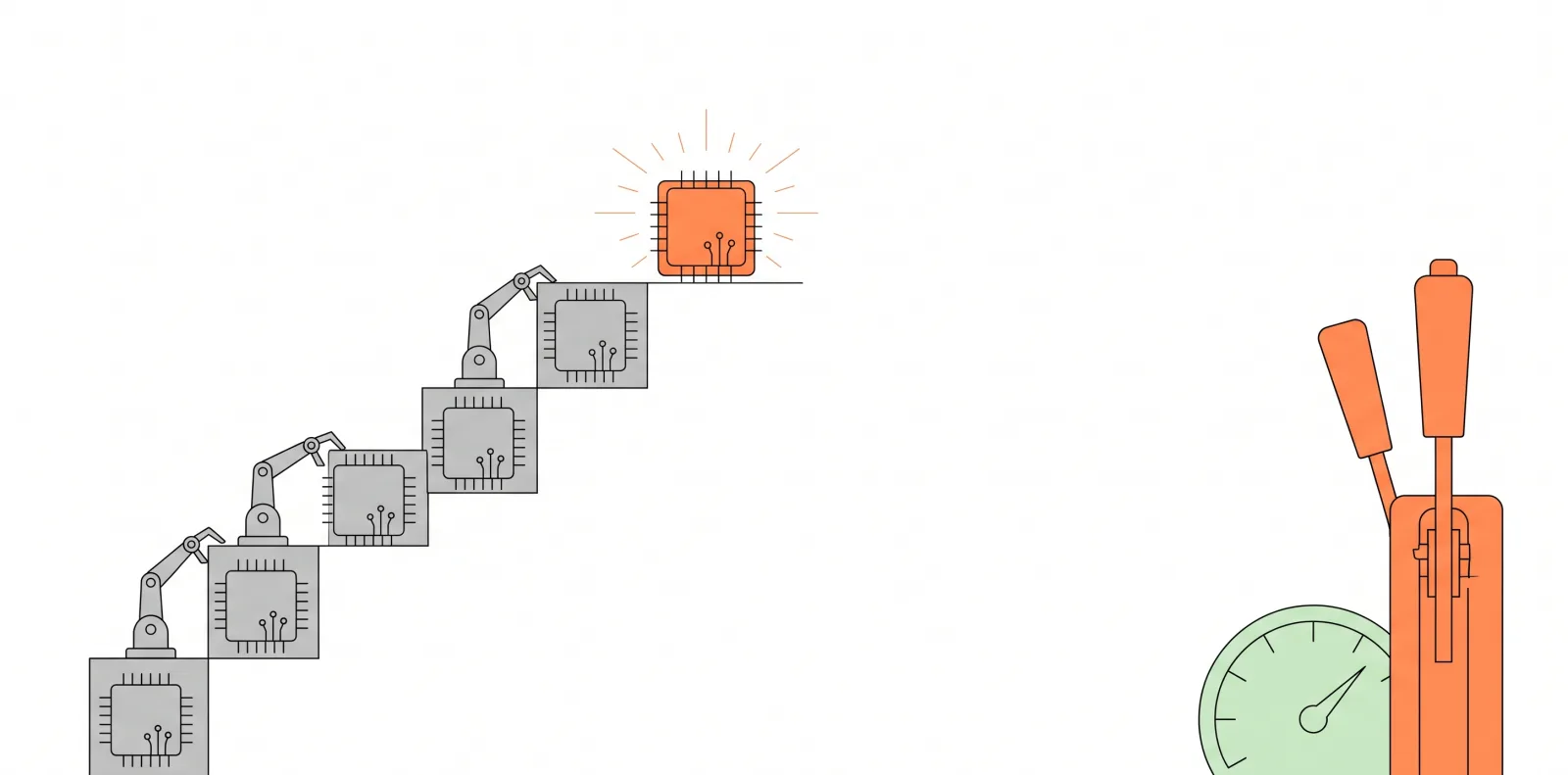
Who holds the brake#
Three proposals now sit on the table, and they differ in who has the power to stop things.
| Proposal | Who proposes it | The brake | Main enforcement question |
|---|---|---|---|
| Perplexity-based common limits | OpenAI's chief scientist (OpenAI) | Industry-wide limits on a shared metric until monitoring reaches a set milestone | Voluntary; labs use different datasets |
| A speed limit on RSI plus embedded evaluators | Anthropic's chief executive (Amodei) | Coordination among democratic-country labs, with third-party evaluators inside each company | Verifying compliance, and coordination with rivals |
| Standby state powers | California Government Operations Agency report (California) | Authority to cap the compute share devoted to automating AI research, and to order emergency shutdowns | Needs legislation; developers could contest in court |
Amodei argues that slowing RSI from "extremely fast" to "only somewhat fast" would give up relatively little strategic advantage while potentially greatly improving safety (Amodei). The California report, published on 16 November, recommends standby authority to cap automated AI research, licensed independent verification organisations, and a cut in the deadline for reporting most safety incidents from 15 days to 48 hours (California Government Operations Agency).
Critics have raised sensible objections. Robert Trager of the University of Oxford told Fortune that a limit on base-model perplexity would likely shift competition to post-training, which matters a great deal for capability, and that models might recognise the test and underperform deliberately (Fortune). That is secondary reporting of a single expert's view, but the concern is concrete: a limit on one metric can be routed around. A reasonable reading is that no single instrument is enough, and that measurement, evaluation access and legal authority would all be needed together.
What it means for the AI field if the loop tightens#
Several consequences follow, whichever way the evidence moves. For researchers, the scarce skill shifts from writing code to choosing which experiments are worth running, which is exactly where OpenAI reports agents are weakest (OpenAI). For safety teams, evaluations that were built for static models may not keep pace with models that change quickly, and Pachocki expects currently dominant forms of alignment auditing to degrade further (Pachocki, OpenAI).
For smaller labs and academics, a tighter loop could widen the gap, because the groups with the most compute and the best agents gain the largest speed-up. For policymakers, the live question is whether to act before or after clearer evidence, a debate the California report answers in favour of standby powers that can be switched on if risk becomes unacceptable (California Government Operations Agency).
What to watch next#
Four signals would tell us more. Independent replication of Frontier RSI would show whether the 35% ceiling is real. A self-rewriting study that compounds edits across sessions without resetting would be the first genuine test of continual recursion. Other labs publishing perplexity figures, as Fortune reports Microsoft has done for its own base model, would show whether a shared metric is workable (Fortune). And a legislative response in California would show whether standby powers become law.
Frequently asked questions#
What is recursive self-improvement? It is the point at which AI automation of AI research becomes self-sustaining, so that capabilities accelerate without additional human input (California Government Operations Agency).
Is AI already improving itself? AI is already contributing to AI research, but OpenAI says the work still needs close human involvement and that agents have poor research taste (OpenAI).
Has a model rewritten its own weights? A preprint (not peer-reviewed) reports that a 27-billion-parameter model edited its own weights for a small accuracy gain, but each session restarted from the original weights (Fan et al., arXiv).
How good are AI models at improving AI? On the Frontier RSI benchmark, the top overall score was 35.2%, though scores are calibrated against the best model run, not against human experts (Frontier RSI).
What does "continual" add to the idea? It means the loop keeps running without a reset, so gains compound, which none of the evidence reviewed here yet shows.
What are the proposed safeguards? They include shared perplexity-based limits, a speed limit on RSI with embedded third-party evaluators, and state powers to cap automated AI research and order shutdowns (OpenAI, Amodei).
Is there a conflict of interest in this coverage? Yes, a possible one. Claude is made by Anthropic, whose chief executive is cited here and whose models appear in the benchmark, and Anthropic models also help produce this blog, so please check the linked sources yourself.
References#
- Amodei, D. We Must Pace the Frontier. Essay, 2026 (by the chief executive of Anthropic). https://darioamodei.com/post/we-must-pace-the-frontier
- Pachocki, J. Perplexity and Intelligence. OpenAI, 22 November 2026 (company post). https://openai.com/index/perplexity-and-intelligence/
- OpenAI. Research acceleration: The jagged frontier. 18 November 2026 (company self-report). https://openai.com/index/research-acceleration-jagged-frontier/
- California Government Operations Agency. AI Safety in 2026 and Beyond. 16 November 2026. https://www.govops.ca.gov/wp-content/uploads/sites/11/2026/11/FINAL-AI-Safety-in-2026-and-Beyond-v2.pdf
- Fan, J. et al. Language Models Can Rewrite Their Own Weights. arXiv:2611.21885 (not peer-reviewed). https://arxiv.org/abs/2611.21885
- Abundant. FrontierRSI benchmark and leaderboard (company benchmark, unreviewed). https://frontier-rsi.org/
- Kahn, J. OpenAI chief scientist thinks 'perplexity' might be the key to coordinating an AI slowdown. Fortune, 24 November 2026 (science journalism, used only for expert reactions). https://fortune.com/2026/11/24/openai-chief-scientist-thinks-perplexity-might-be-the-key-to-coordinating-an-ai-slowdown/